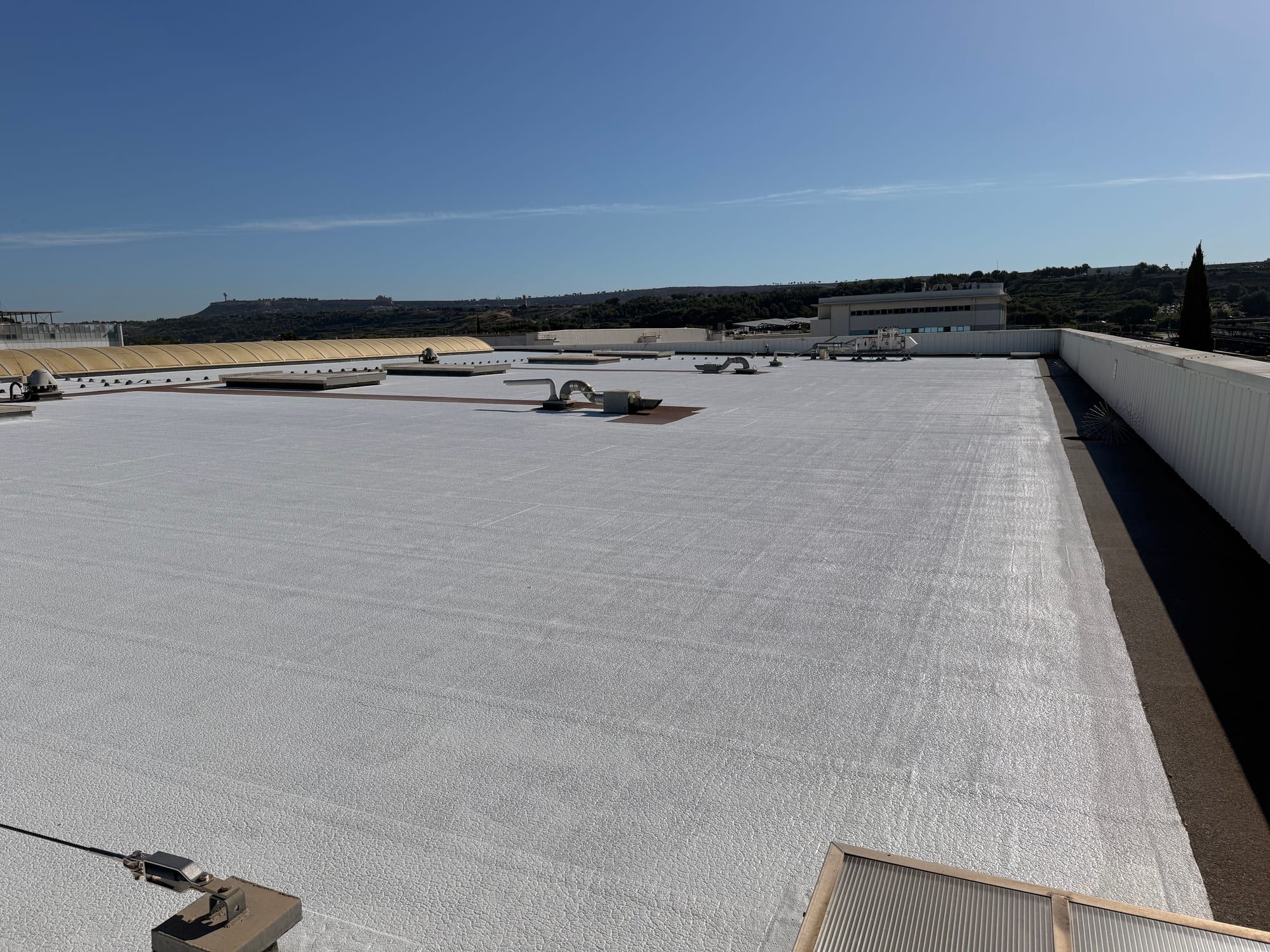
PrimaTherm® cool roof coating: the 4-layer system with 95 % solar reflectance
A reflective elastomeric coating applied on your existing roof. Every figure below comes from a test report attached to our proposals: 95 % reflectance, emissivity 0.89, SRI 120, Broof(t3) fire rating.
Three products, four layers, one certified system.
PH169 bonding primer
Anchors the system to the substrate, blocks bitumen bleeding and fixes powdery surfaces. Diluted 10 % with water.
PH107 reflective base, two coats
The certified reflective layer: 95 % reflectance, emissivity 0.89, SRI 120. Elastic (over 300 %) and waterproof. Ready to use, two crossed coats 24 hours apart.
PH107TCL anti-soiling topcoat
PVDF resins: UV protection, self-cleaning, whiteness and therefore reflectance retained over time.
| Property | PrimaTherm® | Standard / report |
|---|---|---|
| Solar reflectance | 95 % | ASTM E903-12 |
| Thermal emissivity | 0.89 | ASTM C1371-15 |
| Solar Reflectance Index (new) | 120 (119 after ageing) | ASTM E1980 |
| External fire performance | Broof(t3) | CSTB report RA23-0010 |
| Durability | SRI retained after 4,000 h QUV | conventional service life 20 years |
| Base / VOC | water-based · 27 to 33 g/L | manufacturer’s technical data sheet |
Measured on the roof, felt inside, visible on the bill.
On the roof: up to −30 °C
A dark roof reaches 50 to 70 °C in summer. Treated, it stays between 25 and 35 °C. At the reception of our 5,900 m² project in Marignane, the infrared measurement of 19 June 2026 read 57.8 °C untreated against 28.6 °C treated.
Indoors: up to −6 °C felt
Depending on insulation and ventilation, with an immediate effect under the poorly insulated roofs of workshops and warehouses.
On the bill: up to −40 % air conditioning
On an air-conditioned building, depending on the climate zone, insulation and use. We quantify the range in the study, from your real consumption.
On the waterproofing: fewer thermal shocks
The elastic coating follows the movements of the membrane and shields it from UV and from daily 60 °C cycles.
Where it applies, and where we say no.
Compatible substrates
Smooth: coated or galvanised steel deck, sheet metal, zinc, aluminium. Rough: bitumen membrane, renders, EPDM, asbestos-free fibre cement. Polycarbonate rooflights: PrimaTherm® LT lacquer.
Studied case by case
PVC membranes: only when laid more than 10 years ago, specific PH107PVC bonding coat, adhesion test first. Asbestos fibre cement: never. Tiles, slates, steep pitches: on request.
Application conditions
12 to 35 °C (15 °C minimum for the topcoat), relative humidity below 80 %, 3 °C above dew point, clean and dry substrate, no rain within 4 hours. Primer diluted 10 % with water; base and topcoat never diluted.
About the coating
What is a cool roof coating?
A reflective, water-based elastomeric coating applied on an existing roof to send solar radiation back to the sky instead of absorbing it. PrimaTherm® reflects 95 % of solar radiation (ASTM E903-12) and re-emits the absorbed heat with an emissivity of 0.89 (ASTM C1371-15), giving a Solar Reflectance Index of 120 (ASTM E1980).
How many layers are applied?
Four layers with three products: one coat of PH169 bonding primer, two crossed coats of PH107 reflective base, then one coat of PH107TCL anti-soiling topcoat. Thicknesses are checked with a wet-film gauge during application and recorded in the site file.
Which substrates are compatible?
Steel deck (coated or galvanised), bitumen membranes, EPDM and asbestos-free fibre cement. PVC membranes are treated only when laid more than ten years ago, with a specific PH107PVC bonding coat, after an adhesion test. Tiles, slates and steep roofs are studied case by case.
How long does the coating last?
The SRI is retained after 4,000 hours of accelerated QUV ageing (119 against 120 when new), and the conventional service life used by the French energy-savings scheme is 20 years. A low-pressure water rinse every 12 to 15 months keeps the surface white.
Coating or white membrane?
A white membrane means a full re-roofing: removal or overlay, joints, several times the cost. The coating is applied on the existing waterproofing when it is sound, in a few days, without lifting. When the waterproofing has reached the end of its life, we say so: a cool roof protects a membrane, it does not repair it.
Your free roof study, answered within 48 hours.
Satellite measurement, thermal potential, available incentives: an expert calls you back with facts, never with a catalogue price.