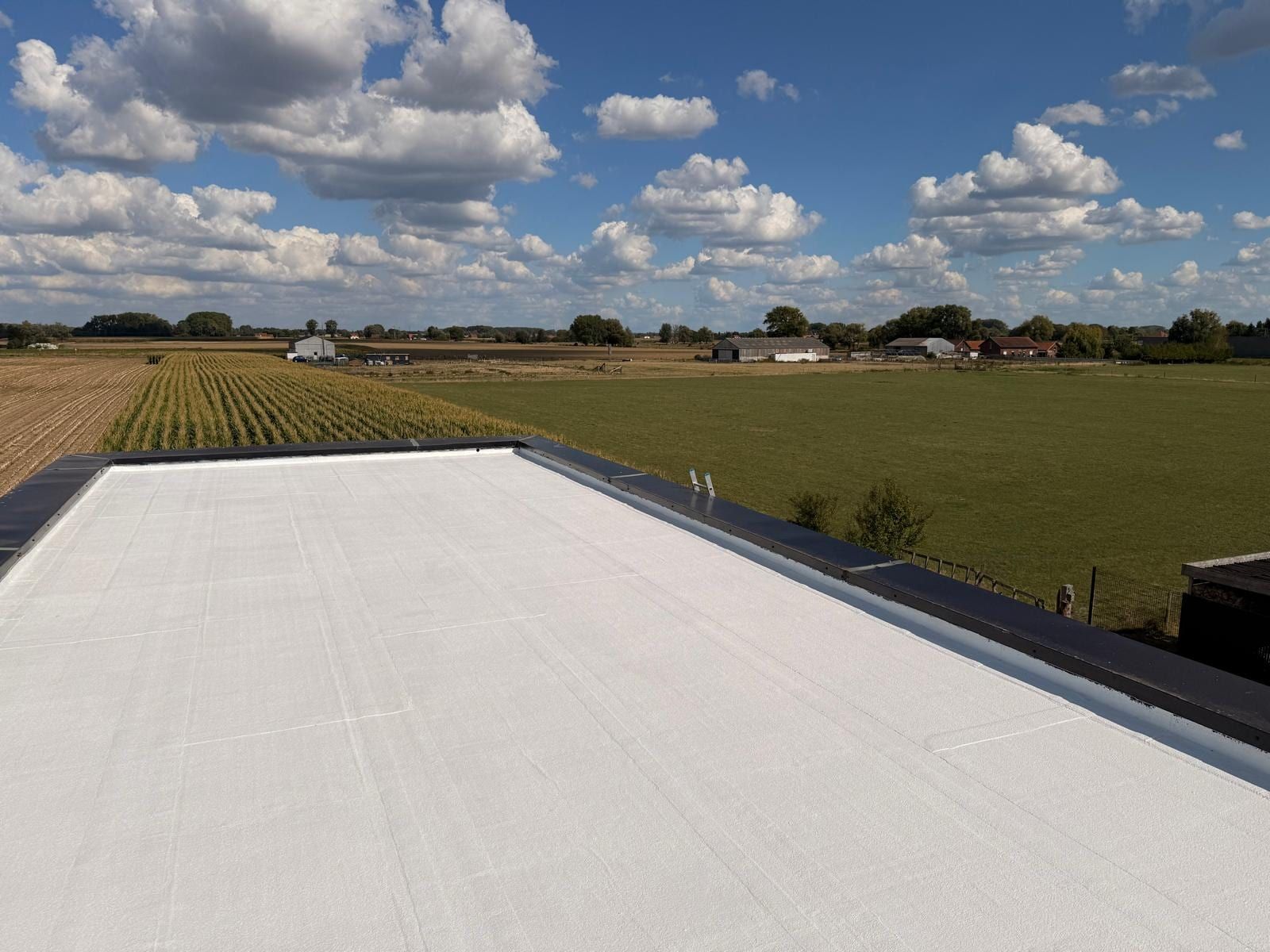
Cool roofs in Belgium: why now
Belgium lives under a temperate oceanic climate: moderate summers, only a few days a year above 30 °C, but more frequent and more intense heatwaves since 2018. On 25 July 2019, the reference station at Uccle recorded 39.7 °C, a national record. These episodes do not last for months as they do in the south of France, but they now return almost every summer, and they hit buildings designed to retain heat, not to shed it.
Yet it is not the heatwave that primarily justifies a cool roof in Belgium. It is the physics of a roof. A dark steel deck or a bitumen membrane does not react to the air temperature but to solar radiation: as soon as the May sun strikes it, it exceeds 60 °C on the surface, 50–70 °C at the height of summer, then releases that heat into the volumes below for hours. Cool roofing acts at the source by reflecting the radiation before it heats the building.
Brussels, Wallonia, Flanders on request
We work in the Brussels-Capital Region and across Wallonia, and serve Flanders on request, in particular the Brussels periphery of Zaventem and Vilvoorde. The building stock concerned is that of a dense, logistics-driven country. In Brussels, the warehouses of the port and the canal, the industrial zones of Anderlecht, Forest and Haren, the freight halls of Zaventem airport, the flat roofs of office buildings and apartment blocks, then the business parks of Walloon Brabant in Nivelles, Wavre and Louvain-la-Neuve. In Liège, the business parks of Herstal, the industrial sites of Seraing and the Meuse valley, the warehouses of Liège Airport at Bierset and the Trilogiport platform. In Charleroi, Gosselies airport, the business parks of Jumet, Fleurus and Courcelles, then La Louvière, Mons and Feluy in Hainaut. Namur, Tournai, Mouscron and Arlon complete the map. Everywhere, the business parks managed by the development intermunicipal bodies line up steel deck halls, and the municipalities run schools, swimming pools and administrative buildings that are hard to occupy from June onwards.
Local regulations
The European directive on the energy performance of buildings (EPBD, directive (EU) 2024/1275) requires the renovation of the 16 % worst-performing non-residential buildings by 2030 and of the 26 % worst-performing by 2033, according to thresholds set by each Member State; its transposition is expected by 29 May 2026. In Brussels-Capital, the PLAGE regulation (local action plan for energy management) has been mandatory since 1 July 2019 for companies and associations owning or occupying more than 100,000 m² of buildings, and 50,000 m² for most public authorities. Each region also applies its own PEB energy-performance regulation, with certificate and requirements. On the planning side, depending on the region (CoDT in Wallonia, CoBAT in Brussels) and the municipality, altering the appearance of a roof may require a planning permit, with exemptions in some cases: we check with the municipality before the works.
What a PrimaTherm® reflective roof changes
PrimaTherm® is a certified elastomeric coating, made in France by Primacoating (La Rochelle) and applied in four layers: PH169 primer, PH107 reflective base coat in two passes, PH107TCL topcoat. Its values come from test reports attached to every proposal:
| Characteristic | Value | Standard / report |
|---|---|---|
| Solar reflectance | 95 % | ASTM E903-12 |
| Thermal emissivity | 0.89 | ASTM C1371-15 |
| SRI (new condition) | 120 (119 after ageing) | ASTM E1980 |
| External fire rating | Broof(t3) | CSTB report RA23-0010 |
| Durability | SRI maintained after 4,000 h QUV | conventional service life of 20 years (French CEE sheet) |
On a Belgian roof in summer:
- up to −30 °C on the roof surface: from 50–70 °C to 25–35 °C. At the handover of our 5,900 m² project in Marignane, the infrared measurement of 19 June 2026 read 57.8 °C on the untreated zone against 28.6 °C on the treated zone; under the Belgian sun, the difference is smaller in absolute terms but follows the same physics;
- up to −6 °C felt inside depending on insulation, with an immediate effect under the poorly insulated roofs of warehouses and industrial halls;
- up to −40 % air-conditioning consumption depending on the climate zone: under a climate comparable to that of northern France, the observed range is 15 to 25 % depending on insulation and use, and the return on investment is generally between 3 and 5 years;
- a membrane protected from UV and thermal shock, whose daily amplitude wears out the waterproofing well before its theoretical end of life.
The Belgian winter counts for more than in the south of France, and we include it in the balance: the low sun from December to February, often veiled, strikes the façades and very little the roofs, so that the loss of solar gain during the heating season remains small compared with the summer gain. The subject is covered in our article on cool roofs in winter. Durability is ensured by the PH107TCL anti-soiling topcoat and by low-pressure cleaning every 12 to 15 months, useful under a sky that deposits pollen and dust. The system is detailed on the cool roof coating page.
Buildings concerned in Belgium
- Logistics and parcel delivery: warehouses of the port of Brussels, the Trilogiport, the airports of Zaventem, Bierset and Gosselies, platforms along the E19, E40 and E42. See cool roof for warehouses and logistics.
- Industry and workshops: sites of the Meuse valley, the Sambre valley and the Walloon business parks. See cool roof for industrial buildings.
- Food industry and cold chain: breweries, dairies, cutting plants, cold-storage warehouses and food distribution platforms. See cool roof for the food industry and cold chain.
- Retail and shopping centres: hypermarkets and retail parks on the outskirts of the main cities. See cool roof for retail and supermarkets and shopping centres.
- Offices and public buildings: flat roofs in Brussels, schools, swimming pools, hospitals and buildings of the municipalities, provinces and regions. See cool roof for offices and public buildings.
- Apartment buildings with flat roofs: numerous in Brussels, Liège and Charleroi. See cool roof for residential buildings.
As for substrates, steel deck, bitumen waterproofing membranes and flat roofs account for most cases. PVC is treated only if it is more than ten years old, with a specific adhesion base; fibre cement only if asbestos-free, on the basis of a diagnosis.
Our work in Belgium
Our head office is in Saint-Laurent-d’Agny, south of Lyon. Brussels is about 700 km away by road via the A6 and A1, Liège about 720 km and Charleroi about 680 km, i.e. a little over 500 km as the crow flies. At this distance, the project is planned: the technical visit and the works are grouped into a single trip, the team of applicators stays lodged on site until handover, and we group several sites into a single campaign, whether for a group present in Brussels and Liège, a retail chain, an intermunicipal body or several clients in the same business park. This is the pattern followed on our projects far from head office, in Provence as in the Paris region.
Without lifting
Drums and machines stay on the ground; only the hoses go up to the roof. No crane, no road closure, no footprint on your loading bays or car parks, and no lifting formalities to negotiate with the municipality or the business park manager.
The steps
- Free study within 48 h: satellite measurement, identification of the substrate, first review of the regional grants. Request the study.
- Technical visit: adhesion test on three zones, survey of singular points (skylights, parapets, drains), schedule taking into account the season and the grouping of sites.
- Preparation: low-pressure cleaning, repair of waterproofing details if necessary.
- Application in four layers: PH169 primer, PH107 reflective base coat in two cross passes, PH107TCL topcoat. Application window between 12 and 35 °C on a dry substrate: in Belgium, it runs in practice from May to September, and we set the schedule on rain-free windows.
- Check and handover: thickness check, infrared measurement before/after, site monitoring sheet and as-built file.
Polycarbonate skylights receive PrimaTherm® LT lacquer (one coat ≈ −25 % light and heat gain, two coats ≈ −50 %). How we work is described step by step.
The nearest reference
Our project for Airbus on the Paris-Le Bourget site, about 300 km from Brussels via the A1: roofs treated with the PrimaTherm® system in four layers, on an aerospace site in operation, under a prevention plan and without lifting, with a team lodged on site, drums and pumps on the ground, hoses up to the roof, and the same deliverables as on all our projects — thickness check, monitoring sheet, as-built file and warranties. The largest project remains Marignane: 5,900 m² of bitumen membrane on three buildings, −29 °C measured on the surface on 19 June 2026. Our other references are presented in our projects.
Incentives and regulations
French schemes not applicable. The French energy-savings certificates (CEE), the French tertiary-sector decree, MaPrimeRénov’ and the reduced 10 % VAT on French homes are French schemes: they do not apply in Belgium, and we do not include them in any Belgian proposal.
EPBD directive. Directive (EU) 2024/1275 requires the renovation of the 16 % worst-performing non-residential buildings by 2030 and of the 26 % worst-performing by 2033, according to thresholds set by each Member State; its transposition is expected by 29 May 2026. A reflective roof does not replace insulation, but it reduces cooling needs and takes its place in a renovation plan.
PLAGE and PEB. In Brussels-Capital, the PLAGE regulation has been mandatory since 1 July 2019 for companies and associations owning or occupying more than 100,000 m² of buildings, and 50,000 m² for most public authorities; each region applies its own PEB regulation, with certificate and requirements.
Regional grants. In Wallonia as in Brussels-Capital, energy grants are regional and change over time; we review them during the study, without promising or quantifying anything in advance. For apartment buildings, the reduced Belgian VAT rate targets the renovation of private homes more than ten years old, subject to conditions.
Planning. Depending on the region (CoDT in Wallonia, CoBAT in Brussels) and the municipality, altering the appearance of a roof may require a planning permit, with exemptions in some cases. We check with the municipality before the works and prepare the documents.
And the cost? It depends on the area, the substrate, the preparation, the access, the grouping of sites and the grants; the figure comes with the free study. The cool roof price page explains what makes up the quotation, and the simulator (in French) gives a first order of magnitude of your roof’s thermal potential. Our online shop (in French) delivers to mainland France; for Belgium, contact us before ordering.
Our pages in Belgium and northern France
Brussels and Walloon Brabant, Liège and the Meuse valley, Charleroi and Hainaut. To the south-east, the Grand Duchy of Luxembourg, often handled in the same campaign as Liège and Arlon. On the other side of the border, our pages Lille and Metz present comparable roofs and climate. Find all our service areas.
Frequently asked questions
How do you organise a project in Belgium from the Lyon area?
The free study is delivered within 48 h, remotely, from a satellite measurement. Brussels is about 700 km by road from our head office, Liège about 720 km and Charleroi about 680 km: the project is planned, the technical visit and the works are grouped together, and the team stays lodged on site until handover. The equipment fits in a van: drums and machines on the ground, only the hoses go up to the roof. Several sites of the same group, or of several clients, are grouped into a single campaign.
Is a cool roof worthwhile under the Belgian climate?
Yes, because a roof does not react to the air temperature but to solar radiation. A dark steel deck exceeds 60 °C as soon as the May or June sun strikes it, even at 24 °C outside, and that heat goes down into the building. The gain lies in the comfort of the teams throughout the summer, in the preservation of goods, in air-conditioning consumption where it exists and in the service life of the waterproofing, which undergoes wide thermal cycles every day. The heatwaves, more frequent since 2018, have made the subject concrete in Brussels as in Wallonia.
Which substrates do you treat in Belgium?
Coated or galvanised steel deck, the majority in the warehouses and industrial halls of the business parks; bitumen membrane on the flat roofs of office buildings, very common in Brussels; EPDM; asbestos-free fibre cement and PVC membrane laid more than ten years ago, with a specific adhesion base. The technical visit includes an adhesion test on three zones and a survey of singular points.
Which incentives and rules apply in Belgium?
The French energy-savings certificates, the French tertiary-sector decree, MaPrimeRénov’ and the reduced 10 % VAT on French homes are French schemes: they do not apply in Belgium. Energy grants are regional, in Wallonia as in Brussels-Capital; we review them during the study, without promising anything. On the obligations side, the European directive on the energy performance of buildings requires the renovation of the worst-performing non-residential buildings by 2030 and 2033, and Brussels applies the PLAGE regulation to the largest property portfolios. Depending on the region and the municipality, altering the appearance of a roof may require a planning permit, with exemptions in some cases.
I am a private individual or a property manager in Belgium: what should I do?
For an apartment building with a flat roof, we intervene after a free study; the reduced Belgian VAT rate for the renovation of private homes more than ten years old applies subject to conditions, which we check with you. For a house or a small area, our online shop (in French) delivers to mainland France; for delivery to Belgium, contact us before ordering.