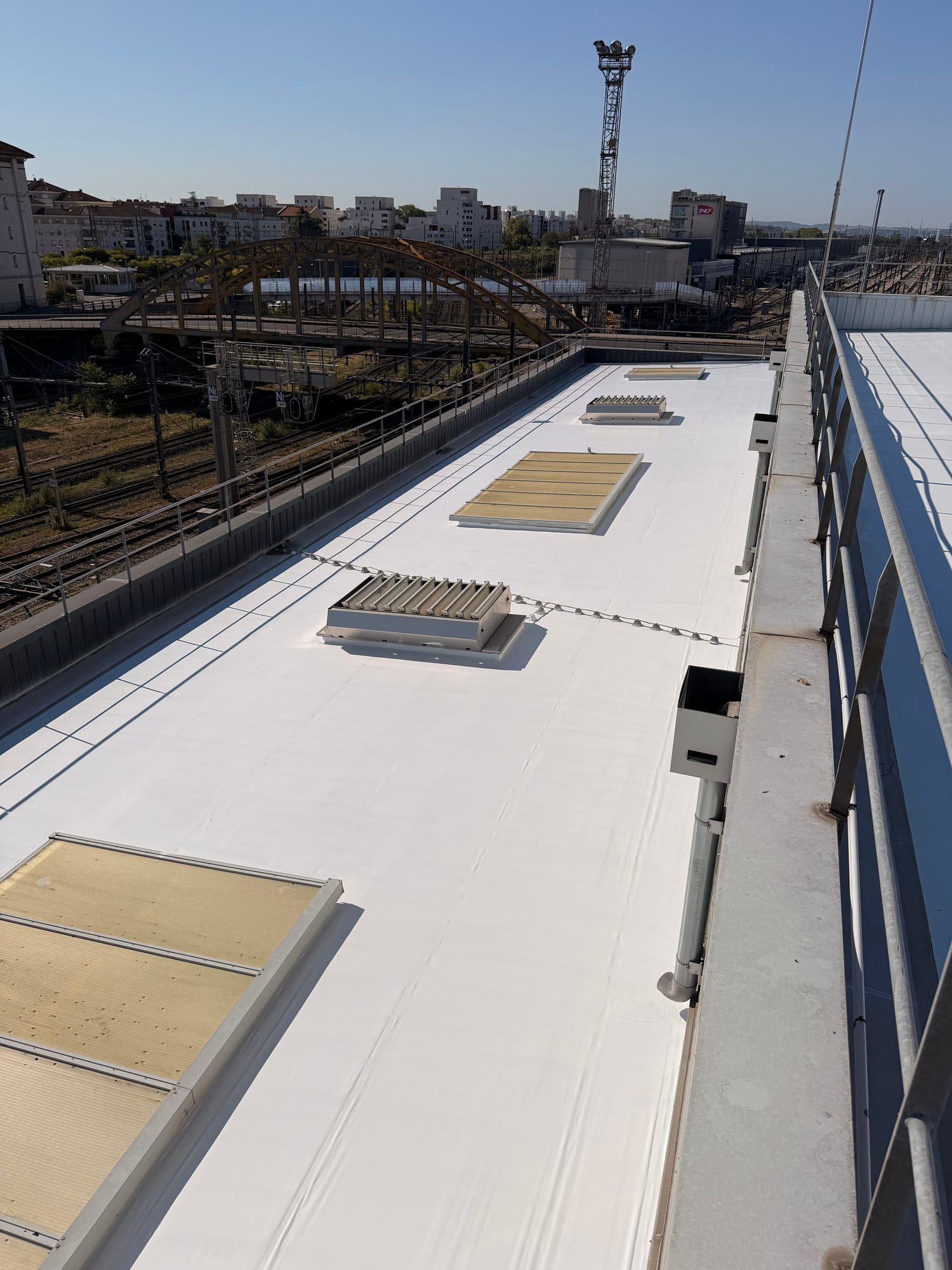
Cool roofs in French-speaking Switzerland: why now
French-speaking Switzerland is not divided into climate zones H1, H2 or H3 like France, but its lowlands live through the same summers as Lyon or Annecy: fifteen to twenty days a year above 30 °C in the Lake Geneva basin and central Valais, longer and more frequent heatwaves since 2015, and nights that no longer cool down the buildings near the lake. The Lake Geneva basin is sheltered by the Jura and the Pre-Alps: the air stagnates there between the lake and the hillsides. The Rhône plain of Valais, from Monthey to Sierre, is dry and very sunny. The Jura Arc, from Nyon to Neuchâtel and Delémont, is cooler at altitude but experiences the same episodes in the lowlands and the valleys.
On the roof, the picture is the same from Geneva to Sion: a dark steel deck or a bitumen membrane climbs to 50–70 °C on the surface under the midday sun, releases that heat into workshops, warehouses and sales areas for hours, and ages prematurely under the effect of UV and thermal shock. Cool roofing acts at the source by reflecting the radiation before it heats the building.
The buildings that heat up most in French-speaking Switzerland
The built fabric of French-speaking Switzerland is dense and industrial. In Geneva, the Meyrin-Satigny industrial zone (ZIMEYSA), Vernier, Plan-les-Ouates, the airport freight zone and the La Praille district, between Carouge and Lancy, concentrate precision industry, logistics and retail: see our page cool roof in Geneva. In the canton of Vaud, the western suburbs of Lausanne (Renens, Bussigny, Crissier, Ecublens, Chavannes) line up workshops, warehouses and retail parks, while Nyon, Morges, Vevey and Yverdon-les-Bains complete the A1 corridor and the Riviera: see our page cool roof in Lausanne. In Valais, the industrial zones of the Rhône plain, from Monthey to Martigny, Sion and Sierre, combine sunshine and stagnant heat. Fribourg and Bulle live off the food industry and manufacturing, Neuchâtel and Delémont off watchmaking and microtechnology, under steel deck workshop roofs and flat office roofs.
Local regulations
One clarification first: the French energy-savings certificates (CEE), the French tertiary-sector decree, MaPrimeRénov’ and the reduced French 10 % VAT are French schemes. They do not apply in Switzerland, and no Swiss proposal from Hélios mentions them. In planning terms, switching from a dark roof to a white roof changes the external appearance of the building. In Geneva, the law on constructions and various installations (LCI) makes any change, even partial, to the colour of a building subject to authorisation; the application is filed on the AC-Démat platform of the Office des autorisations de construire (OAC). In the canton of Vaud and the other French-speaking cantons, works that alter the external appearance are subject to an application to the municipality, by notification or by permit depending on the cantonal procedure. We prepare the technical documents in every case: drawings, technical data sheets and test reports for the system.
What a PrimaTherm® reflective roof changes
PrimaTherm® is a certified elastomeric coating, made in France by Primacoating (La Rochelle) and applied in four layers: PH169 primer, PH107 reflective base coat in two passes, PH107TCL topcoat. Its values come from test reports attached to every proposal:
| Characteristic | Value | Standard / report |
|---|---|---|
| Solar reflectance | 95 % | ASTM E903-12 |
| Thermal emissivity | 0.89 | ASTM C1371-15 |
| SRI (new condition) | 120 (119 after ageing) | ASTM E1980 |
| External fire rating | Broof(t3) | CSTB report RA23-0010 |
| Durability | SRI maintained after 4,000 h QUV | conventional service life of 20 years (French CEE sheet) |
On a roof in French-speaking Switzerland in summer:
- up to −30 °C on the roof surface: from 50–70 °C to 25–35 °C. At the handover of our 5,900 m² project in Marignane, the infrared measurement of 19 June 2026 read 57.8 °C on the untreated zone against 28.6 °C on the treated zone;
- up to −6 °C felt inside depending on insulation, with an immediate effect under the poorly insulated roofs of workshops, warehouses and halls;
- up to −40 % air-conditioning consumption depending on the climate zone: under a climate comparable to that of Lyon or Annecy, the observed range is 15 to 25 %, more on the most exposed buildings of the Rhône plain, and the return on investment is generally between 3 and 5 years;
- a membrane protected from UV and thermal shock, valuable on roofs that alternate between frost, snow and summer overheating.
Winter does not call the balance into question: the December sun is low and strikes the façades, snow covers the roof whatever its colour, and the loss of winter solar gain remains marginal compared with the summer savings, as explained in our article on cool roofs in winter. Durability is ensured by the PH107TCL anti-soiling topcoat and by low-pressure cleaning every 12 to 15 months. The system is detailed on the cool roof coating page, its test reports on the certifications page.
Buildings concerned in French-speaking Switzerland
- Industry and microtechnology: watchmaking, precision engineering, workshops of the ZIMEYSA, Plan-les-Ouates, western Lausanne, the Rhône plain and the Jura Arc. See cool roof for industrial buildings.
- Logistics and freight: warehouses of Vernier, La Praille, Geneva Airport and the A1 corridor between Nyon and Yverdon-les-Bains. See cool roof for warehouses and logistics.
- Retail and shopping centres: sales areas of Meyrin, Vernier, Crissier, Bulle or Sion, air-conditioned and open six days a week. See cool roof for retail and supermarkets and shopping centres.
- Food industry and cold chain: dairies, cheese dairies, chocolate factories and cold-storage warehouses of Fribourg, the Riviera and Valais. See cool roof for the food industry and cold chain.
- Hotels and restaurants: establishments on the shores of Lake Geneva and in the Valais resorts, open all season. See cool roof for hotels and restaurants.
- Public buildings, schools and hospitals: property of the municipalities and the cantons. See cool roof for public buildings and schools.
- Condominium buildings (PPE): flat roofs in Geneva, Lausanne or Sion. See cool roof for residential buildings, bearing in mind that the reduced French 10 % VAT does not apply there.
As for substrates, steel deck, bitumen waterproofing membranes and flat roofs account for most cases. Solar panels are increasingly present on roofs in French-speaking Switzerland: the coating is applied between the rows without dismantling, and a white surface lowers the temperature under the modules, see cool roof and solar panels. PVC is treated only if it is more than ten years old, with a specific adhesion base; fibre cement only if asbestos-free, after a diagnosis.
Our work in French-speaking Switzerland
Our head office is in Saint-Laurent-d’Agny, south of Lyon. Geneva is about 150 km away by road via the A42 and A40, Lausanne about 220 km continuing on the A1, Valais and Fribourg between 250 and 300 km via the A9 and A12; Neuchâtel and the Jura require a slightly longer journey. At these distances, the project is planned with a team on site for the duration of the works, often on a day basis for Geneva, lodged locally for the other cantons. The customs formalities for the equipment and the products are handled by Hélios, and several sites in the same canton, of the same brand or the same public authority can be grouped into a single campaign. Quotations are drawn up in euros or Swiss francs, as you prefer.
Without lifting
Drums and machines stay on the ground; only the hoses go up to the roof. No crane, no road closure, no footprint on your loading bays or car parks: the equipment fits in a van, which matters for a cross-border project.
The steps
- Free study within 48 h: satellite measurement, identification of the substrate, first review of the authorisations to request. Request the study.
- Technical visit: adhesion test on three zones, survey of singular points (skylights, parapets, drains), schedule taking into account the season and customs clearance.
- Preparation: low-pressure cleaning, repair of waterproofing details if necessary.
- Application in four layers: PH169 primer, PH107 reflective base coat in two cross passes, PH107TCL topcoat. Application window between 12 and 35 °C: in the lowlands of French-speaking Switzerland, from May to September, sometimes April and October depending on the weather.
- Check and handover: thickness check, infrared measurement before/after, site monitoring sheet and as-built file.
Polycarbonate skylights receive PrimaTherm® LT lacquer (one coat ≈ −25 % light and heat gain, two coats ≈ −50 %). How we work is described step by step.
The nearest reference
The Lyon Gerland TGV maintenance centre, 15 km from our head office and less than two hours’ drive from Geneva: high-speed train maintenance halls in continuous operation, PVC membrane roofs, a prevention plan, authorisations and permanent shared working with the site teams, without lifting near the tracks. This is the framework we apply to industrial, logistics and railway sites in French-speaking Switzerland.
Incentives and regulations
French schemes: not applicable. The French CEE incentive (sheet BAT-EN-112), the French tertiary-sector decree, MaPrimeRénov’ and the reduced 10 % VAT on French homes do not apply in Switzerland. If you have read about them elsewhere on our site, they concern our French projects.
Energy. The French-speaking cantons apply the MoPEC, the cantons’ model energy regulations, through their cantonal energy laws. The Buildings Programme of the Confederation and the cantons mainly subsidises envelope insulation and heating replacement: a reflective coating does not fall directly within its scope. We check canton by canton what applies to your building, during the study, without promising anything.
Authorisations. In Geneva, building authorisation under the LCI for any change of colour, filed on AC-Démat with the OAC. In the canton of Vaud, in Valais, Fribourg, Neuchâtel and the Jura, application to the municipality according to the cantonal procedure, by notification or by permit. The Geneva cantonal Climate Plan 2030 and the City of Lausanne’s climate plan make the fight against heat islands a priority, and a reflective roof responds to it directly.
Quotation. It is drawn up in euros or Swiss francs, as you prefer, with the applicable taxation specified item by item.
And the cost? It depends on the area, the substrate, the preparation, the access, the distance and the authorisations; the figure comes with the free study. The cool roof price page explains what makes up the quotation, and the simulator (in French) gives a first order of magnitude of your roof’s thermal potential. Private individuals will find PrimaTherm® coating in the online shop (in French), delivered in mainland France; for Switzerland, please contact us.
Our pages in French-speaking Switzerland and neighbouring France
Geneva and its canton, Lausanne and the canton of Vaud. On the other side of the border, our pages Annecy, Haute-Savoie, Ain for the Pays de Gex, Jura and Lyon present comparable roofs and climates. Find all our service areas.
Frequently asked questions
How do you organise a project in French-speaking Switzerland from France?
The free study is delivered within 48 h, remotely, from a satellite measurement. Geneva is about 150 km by road from our head office in Saint-Laurent-d’Agny via the A42 and A40, Lausanne about 220 km, Valais and Fribourg between 250 and 300 km: the project is planned with a team on site for the duration of the works, often on a day basis for Geneva. The customs formalities for the equipment and the products are handled by Hélios. Several sites in the same canton can be grouped into a single campaign.
Do the CEE, the tertiary-sector decree or MaPrimeRénov’ apply in Switzerland?
No. These are French schemes, irrelevant in Switzerland, and we never include them in a Swiss proposal. The French-speaking cantons apply the MoPEC through their cantonal energy laws, and the Buildings Programme of the Confederation and the cantons mainly subsidises insulation and heating replacement: a reflective coating does not fall directly within its scope. We check canton by canton what applies to your building, without promising anything.
What gain can be expected under the climate of French-speaking Switzerland?
Under the summer sun, a dark roof in the Lake Geneva basin or the Rhône plain reaches 50 to 70 °C; once treated, it stays between 25 and 35 °C, i.e. up to −30 °C on the surface and up to −6 °C felt inside depending on insulation. On an air-conditioned building, air-conditioning consumption generally drops by 15 to 25 %, up to −40 % on the most exposed buildings, with a return on investment generally between 3 and 5 years. Winter does not call the balance into question: the low sun strikes the façades, and snow covers the roof whatever its colour.
Is an authorisation needed to turn a roof white in Switzerland?
Most often, yes. In Geneva, the LCI makes any change, even partial, to the colour of a building subject to authorisation; the application is filed on the AC-Démat platform of the Office des autorisations de construire. In the canton of Vaud and the other French-speaking cantons, works that alter the external appearance of a building are subject to an application to the municipality, by notification or by permit depending on the cantonal procedure. We prepare the technical documents in both cases.
I am a private individual in French-speaking Switzerland: can I order the coating?
Our online shop (in French) delivers to mainland France; for delivery to Switzerland, please contact us before ordering and we will tell you the conditions. For a roof of several hundred m², a condominium building or a commercial building, our teams apply the system in four layers, with a quotation drawn up in euros or Swiss francs as you prefer.