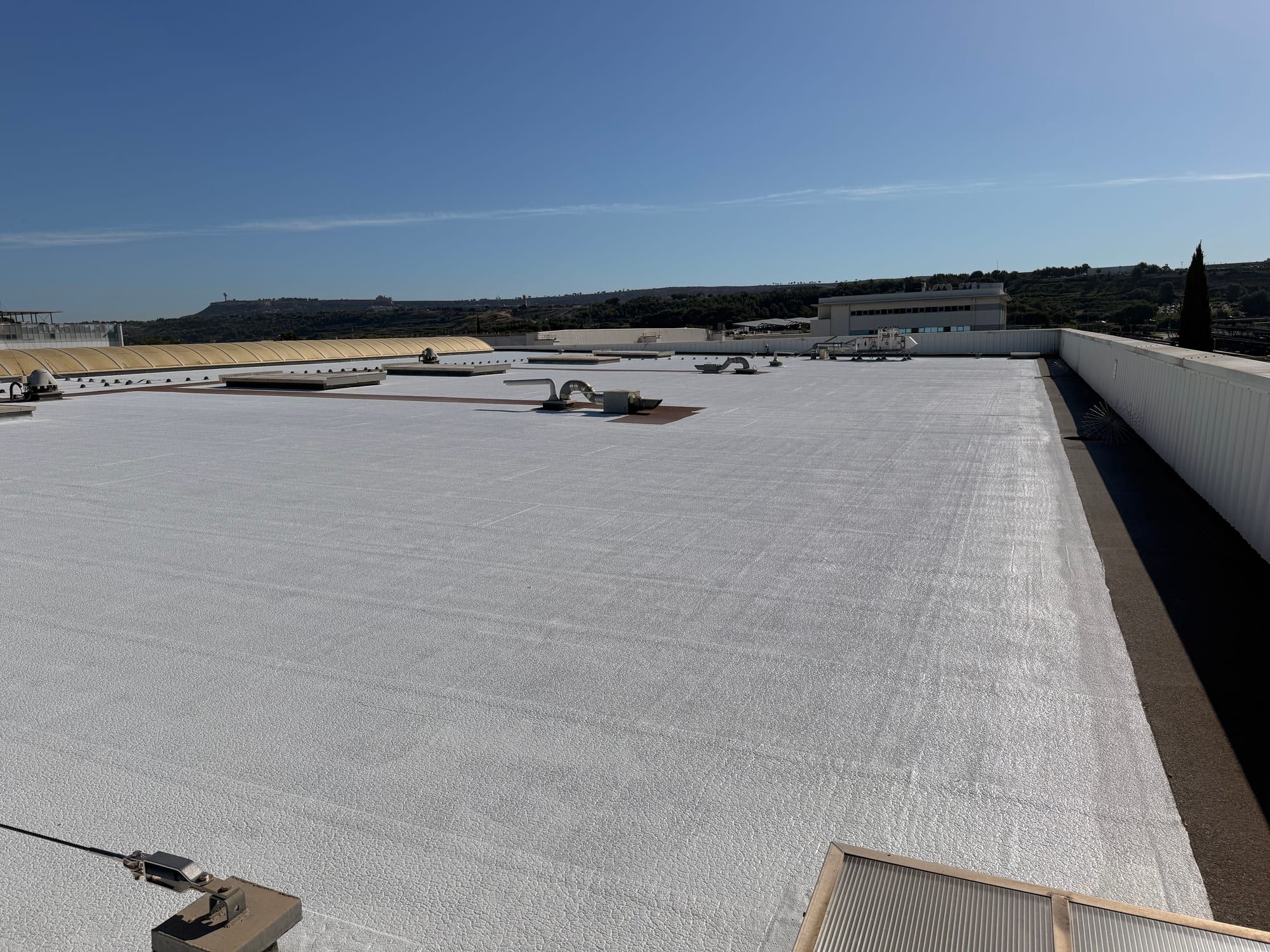
Cool roofs in overseas France: why now
The five French overseas departments and regions share the same fact: a high sun all year round, maximum temperatures of 28 to 33 °C on the coasts and high humidity. The rhythms differ. In Réunion, the southern summer, hot, humid and cyclonic, runs from November to April, and the southern winter, drier, from May to October. In the Antilles, in Martinique as in Guadeloupe, the carême, from December to May, alternates with the hivernage, from July to November. In French Guiana, the equatorial climate has no winter, and its dry season, from August to November, is the sunniest of the year. In Mayotte, the dry season runs from May to October. Everywhere, the roof heats up twelve months a year and the air conditioning never gets a break.
On the roof, the picture is harsher than in mainland France: a dark corrugated sheet or steel deck exceeds 60 °C by mid-morning, a bitumen membrane flat roof climbs to 50–70 °C, and that heat is released into the volumes below for hours, while UV, salt and rain-sun cycles age the waterproofing. These territories are non-interconnected zones: electricity is produced locally, more expensive and more carbon-intensive than in mainland France, with a consumption peak linked to air conditioning. Cool roofing acts at the source by reflecting the radiation before it heats the building.
The buildings that heat up, territory by territory
Most of what these territories consume arrives by sea: warehouses, parcel platforms and logistics bases are concentrated around the ports, Le Port in Réunion, Fort-de-France in Martinique, Jarry in Baie-Mahault in Guadeloupe, Dégrad-des-Cannes in Rémire-Montjoly in French Guiana, Longoni in Mayotte, and around the airports of Roland-Garros, Aimé-Césaire, Pôle Caraïbes, Félix-Éboué and Dzaoudzi-Pamandzi. Retail has built hypermarkets and retail parks there under metal roofs. The food industry, sugar mills, rum distilleries, banana packing stations, canneries, slaughterhouses and cold-storage warehouses, depends on refrigeration units that roof heat pushes into overdrive. Hotels work all year round. Local authorities, finally, run schools, sports halls, hospitals and administrative buildings that are hard to occupy in the afternoon. Each territory page details this fabric: Réunion, Martinique, Guadeloupe and French Guiana.
Regulations in the overseas departments and regions
The French planning code applies in the five territories as in mainland France: switching from a dark roof to a white roof alters the external appearance of the building and requires a prior declaration to the town hall (art. R. 421-17), with the opinion of the Architecte des Bâtiments de France in protected areas. The French tertiary-sector decree applies in Guadeloupe, French Guiana, Martinique, Réunion and Mayotte: −40 % final energy by 2030 for commercial buildings of 1,000 m² and more, declared on ADEME’s OPERAT platform. Finally, the overseas thermal regulations, the RTAA DOM, whose thermal section applies in French Guiana and Réunion, the RTG in Guadeloupe and the RTM in Martinique, impose very low roof solar factors on new housing; the cool roof applies the same logic to existing buildings.
What a PrimaTherm® reflective roof changes
PrimaTherm® is a certified elastomeric coating, applied in four layers: PH169 primer, PH107 reflective base coat in two passes, PH107TCL topcoat. Its values come from test reports attached to every proposal:
| Characteristic | Value | Standard / report |
|---|---|---|
| Solar reflectance | 95 % | ASTM E903-12 |
| Thermal emissivity | 0.89 | ASTM C1371-15 |
| SRI (new condition) | 120 (119 after ageing) | ASTM E1980 |
| External fire rating | Broof(t3) | CSTB report RA23-0010 |
| Durability | SRI maintained after 4,000 h QUV | conventional service life of 20 years (French CEE sheet) |
On an overseas roof, in the dry season as in the rainy season:
- up to −30 °C on the roof surface: from 50–70 °C to 25–35 °C, verified at handover by infrared measurement, treated zone against control zone;
- up to −6 °C felt inside depending on insulation, with an immediate effect under poorly insulated metal sheets and steel decks;
- up to −40 % air-conditioning consumption depending on the climate zone, insulation and use, with a return on investment generally between 3 and 5 years, which the free study calculates from your actual consumption;
- a membrane protected from UV and thermal shock, which counts doubly by the sea, where salt and spray accelerate ageing.
No heating season to offset: the reflective roof works twelve months a year. The PH107TCL anti-soiling topcoat and low-pressure cleaning every 12 to 15 months ensure durability. The system is detailed on the cool roof coating page.
Buildings concerned in overseas France
- Logistics and parcel delivery: warehouses and platforms of the ports and airports, distributors’ bases. See cool roof for warehouses and logistics.
- Food industry and cold chain: sugar mills, distilleries, packing stations, canneries, slaughterhouses and cold-storage warehouses. See cool roof for the food industry and cold chain.
- Industry and workshops: industrial and port zones, timber, materials, maintenance. See cool roof for industrial buildings.
- Retail and shopping centres: hypermarkets and retail parks under metal roofs. See cool roof for retail and supermarkets and shopping centres.
- Hotels and restaurants: establishments open all year round. See cool roof for hotels and restaurants.
- Public buildings, schools and hospitals: facilities of the municipalities, the local authorities, the Regions, the Departments and the hospital centres. See cool roof for public buildings, schools and hospitals.
- Apartment buildings and social housing with flat roofs: buildings in the main towns. See cool roof for residential buildings.
As for substrates, corrugated sheet and steel deck dominate, followed by bitumen waterproofing membranes and flat roofs. PVC is treated only if it is more than ten years old, with a specific adhesion base; fibre cement only if asbestos-free (buildings built after 1997).
Our work in overseas France
Our head office is in Saint-Laurent-d’Agny, south of Lyon, between 7,000 and 9,000 km from the overseas territories. Same protocol as in mainland France, different logistics. The team of applicators is flown in. The products, made in France by Primacoating (La Rochelle), and the equipment are shipped by sea container. Projects are grouped into campaigns: several sites and several clients during the same trip, a retail chain, a local authority, a hotel group, a port and its occupants. The schedule is set on the dry season of each territory, southern winter in Réunion and Mayotte, carême in the Antilles, dry season from August to November in French Guiana, and on rain-free hours: application window between 12 and 35 °C, dry substrate, relative humidity below 80 %. The precise calendar is set with you at the study stage. New Caledonia and French Polynesia are considered case by case, depending on logistics.
TODO-ENZO : délais d’acheminement des produits par conteneur et conditions de livraison de la boutique outre-mer à valider.
Without lifting
Drums and machines stay on the ground; only the hoses go up to the roof. No crane, no road closure, no footprint on your loading bays or car parks. In territories where heavy equipment is rare and expensive to mobilise, this is often what makes the project possible.
The steps
- Free study within 48 h: satellite measurement, identification of the substrate, regulatory and logistics framing. Request the study.
- Technical visit: adhesion test on three zones, survey of singular points (skylights, parapets, drains, sheet fixings), campaign schedule.
- Preparation: low-pressure cleaning, treatment of moss and micro-organisms, repair of waterproofing details if necessary.
- Application in four layers: PH169 primer, PH107 reflective base coat in two cross passes, PH107TCL topcoat, always on a dry substrate, never between two showers.
- Check and handover: thickness check, infrared measurement before/after, site monitoring sheet and as-built file.
Polycarbonate skylights receive PrimaTherm® LT lacquer (one coat ≈ −25 % light and heat gain, two coats ≈ −50 %). How we work is described step by step, and our Corsica page presents the same island-campaign logic, over a shorter distance.
The nearest climate reference
We do not yet have a completed project in overseas France, and we display no reference that has not been delivered and measured. Our nearest climate reference is our Marignane project: Airbus Marignane, 5,900 m² of bitumen membrane on three buildings, site in operation, −29 °C measured on the surface on 19 June 2026 (57.8 °C on the control zone, 28.6 °C on the treated zone).
Incentives and regulations
French tertiary-sector decree. The Éco Énergie Tertiaire scheme applies in Guadeloupe, French Guiana, Martinique, Réunion and Mayotte: commercial buildings of 1,000 m² and more must reduce their final energy consumption by 40 % by 2030, 50 % by 2040 and 60 % by 2050, and declare it every year on OPERAT. The reflective roof is one of the quickest actions to implement to contribute to it. See the French tertiary-sector decree and cool roofs.
CEE: no incentive to expect. We say so from the outset. The French CEE sheet BAT-EN-112 applies only in mainland France. The overseas sheet BAT-EN-109, “Reduction of solar gains through the roof (overseas France)”, targets the installation of a roof or roof elements with a solar factor of 0.03 or less and explicitly excludes the application of reflective coatings on an existing roof. No CEE incentive is therefore to be expected for an existing roof.
Green Fund and MaPrimeRénov’. Local authorities can call on the French Green Fund (Fonds Vert), subject to conditions: in overseas France, the 2026 guidance explicitly supports protecting buildings against solar radiation, roof included, within a project of at least two measures. MaPrimeRénov’ does not cover cool roofs.
Prior declaration. A prior declaration is filed with the town hall before the works (art. R. 421-17 of the French planning code); we prepare the file with you.
Taxation. Local taxation (VAT regime specific to each territory, octroi de mer dock dues on imported products) is specified in the quotation.
And the cost? It depends on the area, the substrate, the preparation, the access, the shipping and the grouping of the campaign; the figure comes with the free study. The cool roof price page explains what makes up the quotation, and the simulator (in French) gives a first order of magnitude. Private individuals will find PrimaTherm® coating in the online shop (in French): overseas delivery on quotation, contact us before ordering.
Our pages in overseas France and mainland France
Each territory has its own page: Réunion, in the Indian Ocean; Martinique and Guadeloupe, in the Antilles; French Guiana, on the South American mainland; Mayotte, in the Mozambique Channel. In mainland France, our page cool roof company in France presents all our areas, and you will find all our service areas.
Frequently asked questions
Do you really work in overseas France, and how?
Yes, through grouped campaigns. The free study is delivered within 48 h, remotely, from a satellite measurement. The team of applicators is then flown in, the products and the equipment are shipped by sea container, and several sites, possibly for several clients, are treated during the same trip. The calendar is set with you at the study stage, according to shipping and the dry season of the territory.
In which territories and in which season?
In Réunion, Martinique, Guadeloupe, French Guiana and Mayotte. The schedule follows the dry season of each territory: the southern winter, from May to October, in Réunion and Mayotte; the carême, from December to May, in the Antilles; the dry season, from August to November, in French Guiana. The application window is between 12 and 35 °C, on a dry substrate, with relative humidity below 80 %, during rain-free hours. New Caledonia and French Polynesia are considered case by case, depending on logistics.
What gain can be expected under a tropical climate?
The roof gains up to −30 °C on the surface, the volumes under the roof up to −6 °C felt, and the air-conditioning consumption of an air-conditioned building drops by up to 40 % depending on insulation and use. There is no winter to offset: the reflective roof works twelve months a year, and the return on investment is generally between 3 and 5 years. We quantify it in the free study, from your actual consumption.
Which incentives and rules apply in overseas France?
The French tertiary-sector decree applies in the five overseas departments and regions: commercial buildings of 1,000 m² and more must reduce their final energy consumption by 40 % by 2030 and declare it on OPERAT. On the other hand, there is no CEE incentive to expect: sheet BAT-EN-112 is only valid in mainland France and the overseas sheet BAT-EN-109 excludes reflective coatings on an existing roof. MaPrimeRénov’ does not cover cool roofs; local authorities can call on the French Green Fund (Fonds Vert), subject to conditions. Changing the colour of a roof requires a prior declaration to the town hall, and local taxation is specified in the quotation.
I am a private individual in overseas France: can I order the coating?
Yes. For a house or an area under 500 m², PrimaTherm® coating is available in our online shop (in French), with a quantity calculation per m² and an application guide in four layers. Overseas delivery on quotation: contact us before ordering. Remember the prior declaration to the town hall before changing the colour of your roof.