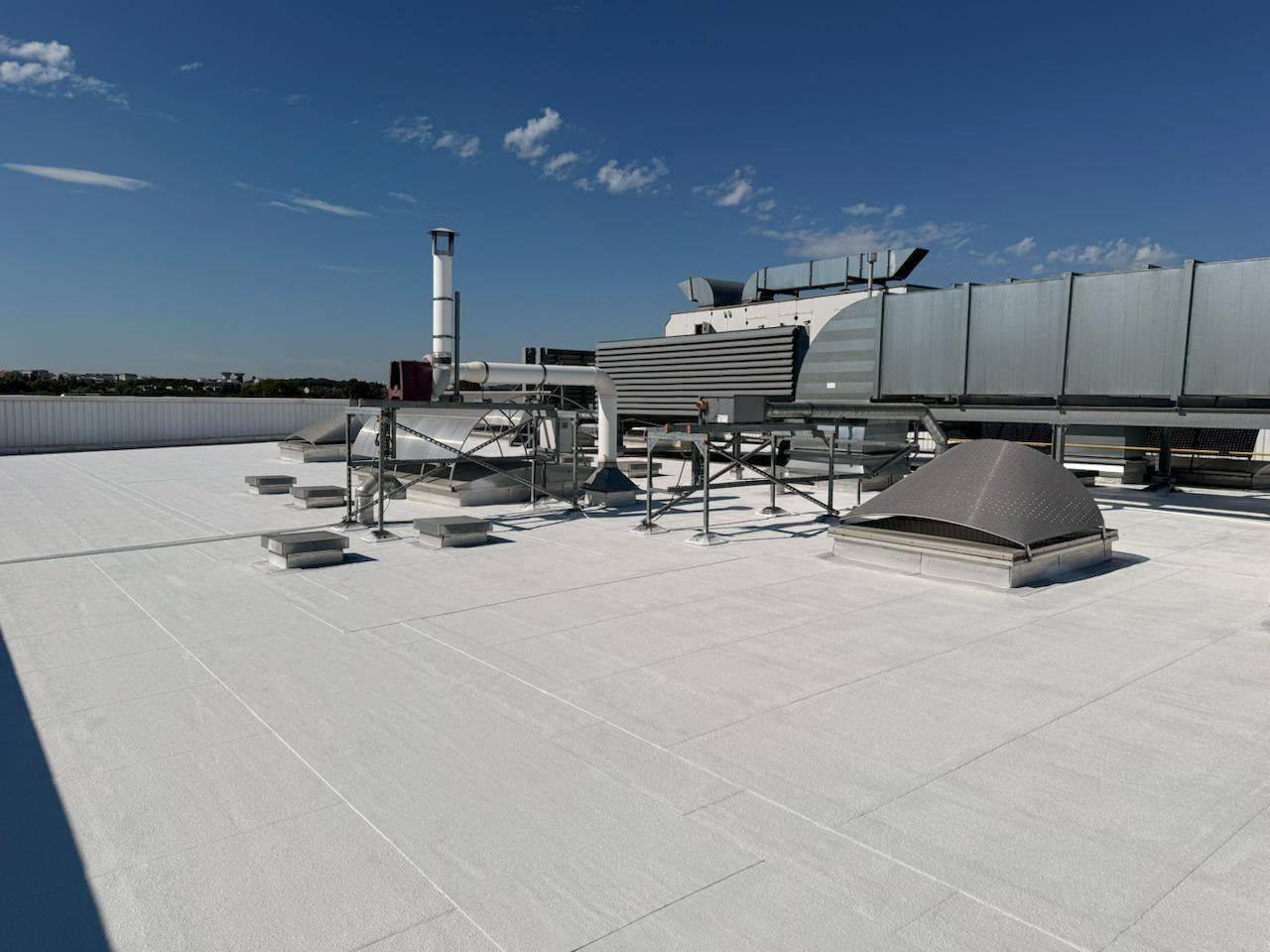
What is a cool roof, how does it work, and for which buildings?
A cool roof reflects the sun instead of absorbing it. Here is the physics in plain words, the figures we can defend, the limits we state clearly, and what French regulation says.
Two physical properties, one index.
Solar reflectance
The share of solar radiation sent back instead of absorbed. A dark membrane reflects 10 to 20 %, a standard white paint 70 to 80 % when new, the PrimaTherm® system 95 % (ASTM E903-12). What is not reflected turns into heat in the roof.
Thermal emissivity
The ability of the surface to release the heat it has absorbed as infrared radiation. PrimaTherm® has an emissivity of 0.89 (ASTM C1371-15): the little heat it takes in leaves quickly.
The Solar Reflectance Index
The SRI (ASTM E1980) combines both properties on a scale where a standard black surface scores 0 and a standard white one 100. PrimaTherm® scores 120 when new and 119 after 4,000 hours of accelerated ageing: the index that describes how a roof behaves under the sun, and the one used by the French incentive scheme.
What it changes on a building
In midsummer a dark roof reaches 50 to 70 °C. Treated, it stays at 25 to 35 °C: up to −30 °C on the surface, measured at the reception of our Marignane project (−29 °C). Indoors, up to −6 °C felt depending on insulation and ventilation; on an air-conditioned building, up to −40 % of cooling consumption depending on the climate zone.
The limits, stated clearly
A cool roof does not replace waterproofing at the end of its life nor missing insulation: it protects the first and complements the second. It is applied in dry weather, between 12 and 35 °C, above dew point. A PVC membrane is treated only after ten years in place, fibre cement only when asbestos-free. The diagnosis checks the substrate before any commitment, and we say when it is not the right answer.
And in winter?
The low winter sun mostly hits façades, hardly roofs. The winter loss is far below the summer gains; the yearly balance is positive everywhere in France, all the more so in the south.
Coating, membrane or gravel: what a cool roof is made of.
| Solution | Reflective coating (PrimaTherm®) | White membrane | Light gravel |
|---|---|---|---|
| Works needed | applied on the existing roof, no lifting | full re-roofing or overlay | ballast replacement |
| Performance | 95 % reflectance, SRI 120 certified | 70 to 85 % depending on product | modest, drops with soiling |
| Duration of works | days, site in operation | weeks | days |
| Best for | sound existing roofs: steel deck, bitumen, EPDM | roofs to be renewed anyway | ballasted terraces |
Qualitative comparison. The figures for your building are produced in the free study, from your roof and your real consumption.
Three texts that push in the same direction.
Éco Énergie Tertiaire
Tertiary buildings of 1,000 m² and more must reduce their final energy consumption by 40 % in 2030, 50 % in 2040 and 60 % in 2050, declared yearly on the OPERAT platform. A cool roof cuts the cooling share.
Heat at work
Since 1 July 2025, employers must assess the risk of intense heat episodes and take measures, including technical means to reduce solar radiation. A roof at 30 °C instead of 60 °C is one of them.
Energy-savings certificates
The standard sheet BAT-EN-112 rewards reflective roof coatings on air-conditioned commercial buildings, under conditions: 160, 170 or 270 kWh cumac per m² depending on the climate zone, for products with an SRI above 100 new and 90 aged.
Where a cool roof pays off first.
- Logistics warehouses in steel deck: large surfaces, low insulation, staff and goods under the roof.
- Factories and workshops: production heat plus solar heat, regulated sites in continuous operation.
- Retail and offices: air-conditioned volumes where the coating cuts the electricity bill and qualifies for incentives.
- Schools, sports halls, hospitals: summer comfort without generalised air conditioning.
- Food industry and cold storage: chillers relieved, product temperatures held.
- Aerospace and rail hangars: volumes impossible to cool, secured sites, prevention plans.
- Data centres: less heat load from the envelope and cooler air for rooftop condensers.
- Co-owned buildings and homes with flat roofs: comfort under the roof, waterproofing protected.
Cool roofs in five questions
What is a cool roof?
A roof designed to reflect most of the sun’s radiation and to re-emit the heat it absorbs, so that its surface stays far cooler than a conventional dark roof. It can be a reflective coating applied on an existing roof, a white membrane or, more rarely, light-coloured gravel.
What is the SRI?
The Solar Reflectance Index combines solar reflectance and thermal emissivity into a single number, from 0 for a standard black surface to 100 for a standard white one. Values above 100 are possible for very reflective, highly emissive surfaces: PrimaTherm® reaches 120 (ASTM E1980).
Does a cool roof work in a temperate climate?
Yes. Steel-deck warehouses and workshops under bitumen membranes overheat just as much in July in northern France as in the south. The gain in cooling energy is highest in the south; the gain in comfort and in waterproofing protection applies everywhere.
Does it replace insulation?
No. Insulation slows heat transfer in both directions; a cool roof stops most of the heat before it enters the roof. The two complement each other: a cool roof is often the first step, because it is fast, requires no structural work and protects the existing waterproofing.
Is there a regulatory push in France?
Yes. Tertiary buildings of 1,000 m² and more must cut their final energy consumption by 40 % by 2030 (Éco Énergie Tertiaire scheme), employers must protect workers from intense heat episodes since July 2025, and the energy-savings certificate scheme has a standard sheet for reflective roof coatings on air-conditioned commercial buildings.
Your free roof study, answered within 48 hours.
Satellite measurement, thermal potential, available incentives: an expert calls you back with facts, never with a catalogue price.