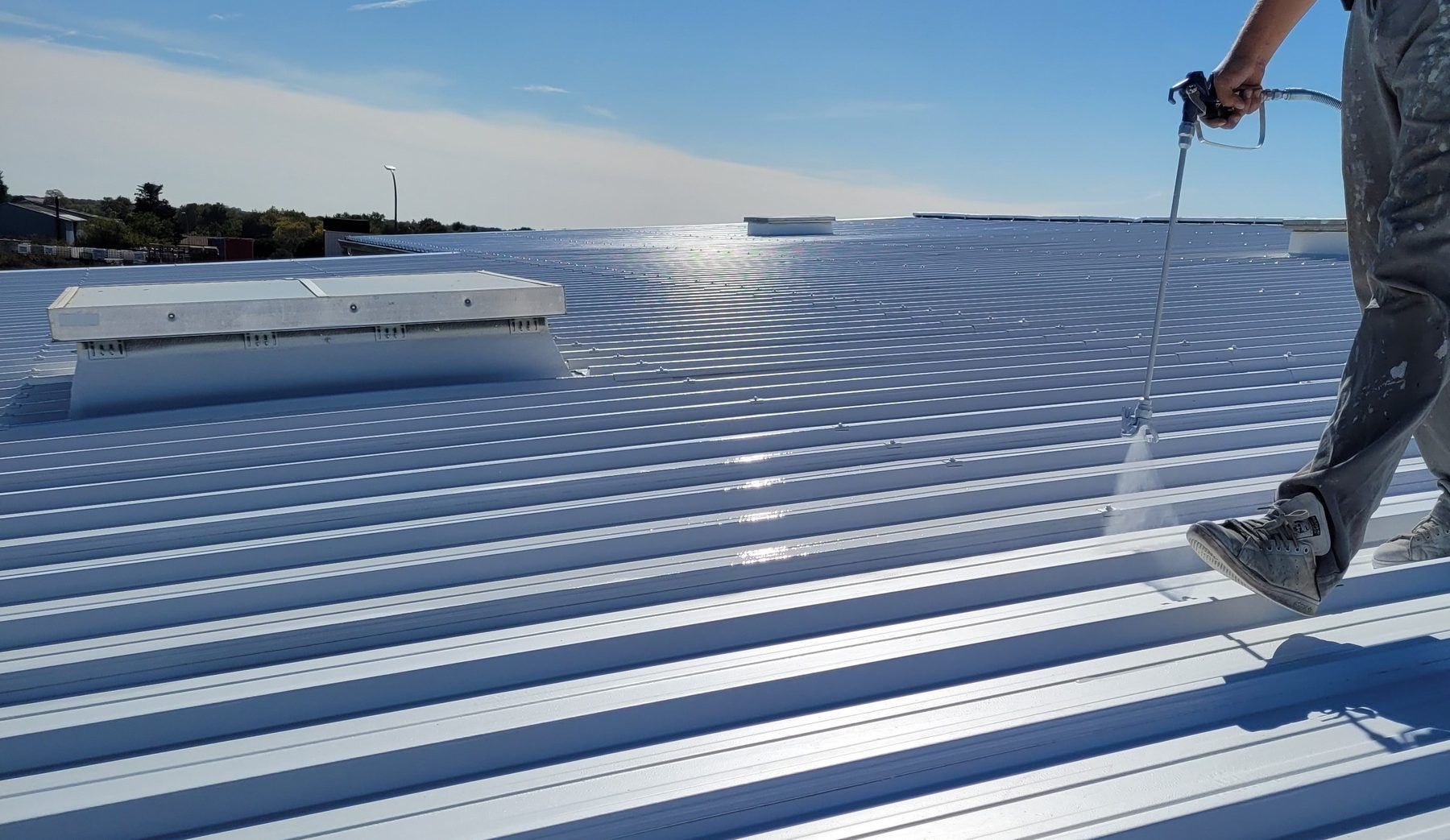
From the free study to reception: how we apply the PrimaTherm® cool roof coating
A reflective coating is only as good as its application. Here is our protocol, step by step, with the checks that go into the as-built file.
Five steps, one file.
Free roof study
You describe your building in two minutes: approximate roof area, building type, postcode. Within 48 hours you receive a satellite measurement, the substrate identification, the thermal potential and the pre-qualification of incentives.
Day 2Site visit and proposal
Adhesion tests on three zones if needed, survey of singular points (rooflights, parapets, drains, equipment), access and site constraints. Then an itemised quotation, the incentive file and a schedule.
Day 10Preparation
Anti-moss treatment if required, low-pressure cleaning, repair of waterproofing details where necessary, protection of air intakes and sensitive equipment. The substrate must be sound, dry and free of grease.
1 to 2 daysApplication without lifting
PH169 primer, PH107 reflective base in two crossed coats 24 hours apart, PH107TCL topcoat. Drums and pumps stay on the ground in a marked-off area; only hoses go up. No crane, no road closure, site in operation.
1 week / 3,000 m²Checks and reception
Wet-film thickness checks during application, before/after infrared measurements on the same day, as-built file with photos, quantities and data sheets, ten-year insurance certificate and maintenance plan.
Reception dayWhat goes on the roof, in which order.
Clean and dry
Anti-moss if needed, medium-pressure water (below 130 bar), 24 to 72 hours of drying.
PH169 primer
One coat diluted 10 % with water: 6 m²/L on rough substrates, 10 m²/L on smooth ones.
PH107 base, two coats
Two crossed coats 24 hours apart, 2 m²/L in total, never diluted. The certified reflective layer.
PH107TCL topcoat
One thin coat, 10 m²/L: whiteness and SRI retained over time.
Polycarbonate rooflights receive the PrimaTherm® LT semi-transparent lacquer: one coat reduces solar gains by about 25 % while keeping about 75 % of daylight; two coats, about 50 % and 50 %.
About the works
Does the site have to stop during the works?
No. The application is done entirely from the outside, in zones agreed with your operations team. Drums and machines stay on the ground, only hoses go up to the roof. Our aerospace and rail projects were carried out on sites in continuous operation, under prevention plans.
What weather do you need?
Dry weather, 12 to 35 °C (15 °C minimum for the topcoat), relative humidity below 80 %, 3 °C above dew point and no rain within four hours of each coat. In most of France the window runs from spring to autumn; we plan around the forecast.
How long does it take?
About one week for 3,000 m² in good conditions, preparation and drying times included. Large sites are phased building by building or cell by cell, so that each zone is prepared, coated, checked and handed over before the next.
How is the result verified?
With a wet-film gauge during application and an infrared thermometer at reception: treated zone against untreated zone, at the same time of day. The readings, photos and quantities applied are recorded in the as-built file handed to you.
What about maintenance?
A low-pressure water rinse every 12 to 15 months keeps the surface white and the reflectance high. The PH107TCL topcoat limits soiling; the SRI is retained after 4,000 hours of accelerated QUV ageing.
Your free roof study, answered within 48 hours.
Satellite measurement, thermal potential, available incentives: an expert calls you back with facts, never with a catalogue price.