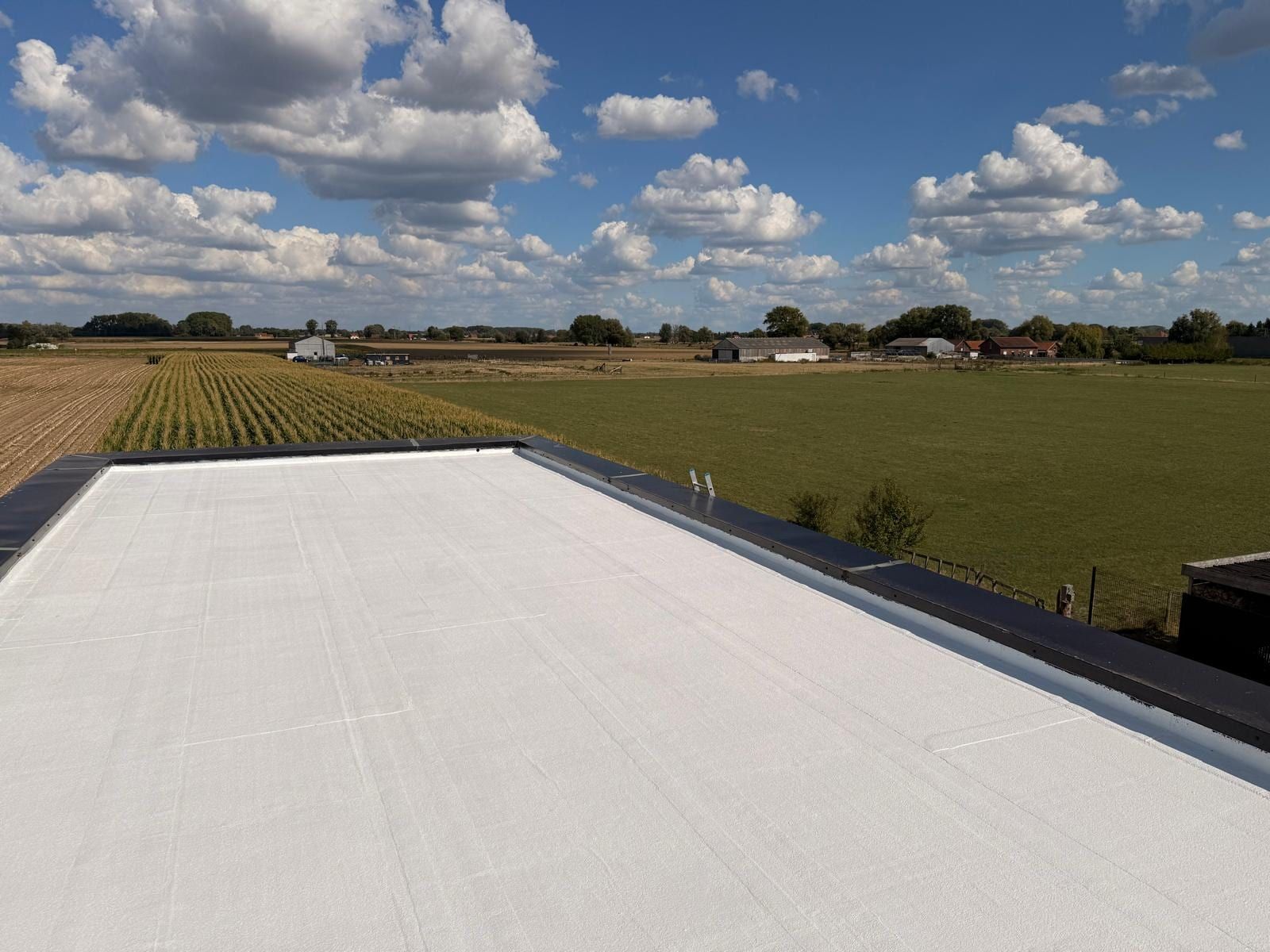
Key takeaways
- Reflective coating: 4-layer system applied on the existing roof, all substrates and all pitches, a few days without lifting, protects the waterproofing; does not provide it.
- White membrane: new, reflective waterproofing in a single product, flat or low-pitch roof, laid by a waterproofing contractor with welding, heavy works.
- The deciding criterion: the condition of the waterproofing. Sound, it is protected with a coating; at the end of its life, it is renewed in white.
- PrimaTherm®: reflectance 95 %, emissivity 0.89, SRI 120, Broof(t3), SRI maintained after 4,000 h of accelerated QUV ageing — conventional service life of 20 years (French CEE sheet).
- Combination: a PVC membrane over ten years old can receive the system with its specific bonding coat.
Two technologies, two functions
The reflective coating: a system applied on the existing roof
A cool roof coating is a liquid coating applied with a roller or an airless pump on the existing roof. The PrimaTherm® system applied by Hélios consists of three products in four layers, in an order set by the manufacturer’s protocol:
- PH169, fixing and blocking primer: anchors the system on the substrate and blocks bitumen bleed-through; 6 m²/L on bitumen, 10 m²/L on steel deck.
- and 3. PH107, reflective base coat, in two cross passes: this is the heart of the system, reflectance, emissivity, elasticity; 2 m²/L in total.
- PH107TCL, PVDF-resin topcoat: UV protection, anti-soiling, retention of whiteness; 10 m²/L.
The certified values of the system are a solar reflectance of 95 % (ASTM E903-12), an emissivity of 0.89 (ASTM C1371-15) and an SRI of 120 (ASTM E1980, 119 after ageing), with a Broof(t3) external fire rating (CSTB report RA23-0010). Its function is thermal and protective: the roof drops from 50–70 °C to 25–35 °C (up to −30 °C; −29 °C measured at the handover of a 5,900 m² project in 2026), and the underlying waterproofing no longer suffers the thermal cycles or the UV that age it. It does not provide waterproofing: the waterproofing must be sound before application. The system is described in detail on our page cool roof coating.
The white membrane: reflective waterproofing
Cool roof membranes are prefabricated synthetic sheets, most often PVC or TPO, white in colour, reinforced with a polyester scrim or a glass fleece. Mechanically fixed or bonded, hot-air welded to one another, they form the waterproofing of the flat roof. Their initial reflectance is good, with an SRI that depends on the manufacturer and the shade; it decreases with soiling and surface ageing, which explains why an old white membrane is often grey. Their primary function is waterproofing; reflection is an associated benefit.
The full comparison
| Criterion | Reflective coating (4-layer system) | White PVC or TPO membrane |
|---|---|---|
| Function | Thermal and physical protection of the existing waterproofing | New, reflective waterproofing |
| Solar performance | Reflectance 95 %, emissivity 0.89, SRI 120 certified | Good when new, varies by manufacturer, soils |
| Durability | SRI maintained after 4,000 h QUV; conventional service life of 20 years (French CEE sheet) | Service life of a waterproofing layer, depending on exposure and maintenance |
| Warranties | 10-year manufacturer’s system warranty, Hélios ten-year (décennale) insurance, one-year completion and two-year warranties | Manufacturer’s warranty and the waterproofing contractor’s ten-year insurance |
| Substrates | Steel deck, bitumen, asbestos-free fibre cement (after 1997), EPDM, PVC over 10 years old | Flat or low-pitch roof, compliant waterproofing substrate |
| Pitch | All pitches, barrel roofs, profiled roofs, rooflights | Low pitch only |
| Stripping | None | Stripping or overlay of the existing layer, waste management |
| Works | A few days, without lifting, without stopping activity | Weeks, waterproofing contractor, often lifting |
| Added weight | A few hundred g/m² | Low |
| Repair | Local touch-up with a roller | Patch welded by a professional |
| Maintenance | Low-pressure water cleaning every 12 to 15 months | Cleaning, checking welds and upstands |
| Regulation | Prior declaration for the change of colour | Prior declaration; French waterproofing DTU standards |
| Incentives | French CEE BAT-EN-112 under conditions, reduced 10 % VAT on homes over 2 years old | Depending on the applicable waterproofing and insulation sheets |
| Best use | Renovation of a sound roof | New build, or renewal of waterproofing at the end of its life |
We do not publish prices: the cost of a cool roof depends on the area, the substrate, the preparation, access and incentives. The difference in cost structure is however obvious: a membrane involves a complete waterproofing package; a coating, a cleaning and four layers.
The strengths of the reflective coating
It is applied on what exists. Steel deck, bitumen membrane, EPDM, asbestos-free fibre cement: the appropriate primer provides the bond, without stripping or waste. This is the decisive argument on a sound roof, and it is what made it possible to treat 5,900 m² at Airbus Marignane between April and June 2026 on a bitumen membrane, with the site in operation.
It goes everywhere. All pitches, barrel roofs, domes, profiled roofs, the surroundings of rooflights and equipment: the roller and the hose follow the details where a sheet has to be cut and welded. The rooflights themselves receive, if you wish, the semi-transparent PrimaTherm® LT lacquer (one coat, about −25 % of light and solar gains; two coats, about −50 %).
It is applied without lifting. 150 to 200 L drums and airless pumps stay on the ground; only the hoses, up to 80 m long, go up to the roof. No crane, no road occupation, no stopping activity.
It is easy to repair. An area damaged by an impact or by the installation of equipment is cleaned and recoated with a roller.
It carries the best certified values. 95 % reflectance and SRI 120, with a topcoat that retains whiteness; this is the difference between a standard white paint, which turns grey within a few seasons, and a certified system.
Its limits, to be complete: it requires a sound, dry and cohesive substrate, a weather window of 12 to 35 °C, relative humidity below 80 %, no rain in the hours following each layer, and maintenance every 12 to 15 months. It does not provide waterproofing and adds no thermal resistance.
The strengths of the white membrane
It is the waterproofing. When the waterproofing has to be renewed, choosing a white membrane solves two problems in one project: the weathertight envelope, and solar reflection.
It benefits from the technical approvals and French DTU standards for waterproofing, which insurers and inspection bodies know well, particularly in new construction.
It resists mechanically and chemically thanks to its reinforcement and composition, useful on some industrial roofs exposed to discharges.
It offers a homogeneous surface, without joins or variations in thickness.
Its limits: works lasting several weeks with a waterproofing contractor, often stripping or overlay, lifting most of the time, installation limited to flat or low-pitch roofs, technical repairs, a reflectance that soils and is not always documented by ageing tests. And on waterproofing that is still sound, replacing it to gain reflectance makes no economic sense.
The deciding criterion: the condition of the waterproofing
Sound waterproofing
The diagnosis checks adhesion, the absence of blisters and cracks, the upstands, the drains and the areas of standing water. If the waterproofing is functional, the reflective coating is the solution: it provides the thermal performance and extends the waterproofing, without touching it. Local repairs are possible before application, quoted separately. This is the case for the majority of the roofs we visit, in bitumen as in steel deck.
Waterproofing at the end of its life
If the diagnosis concludes that renewal is needed, the question is no longer “coating or membrane” but “which waterproofing, and which finish”. Two consistent options: a white membrane, or conventional waterproofing (bitumen or synthetic) followed by the PrimaTherm® system as a reflective finish. The second has the advantage of certified, maintained and renewable performance; the first that of a single package. We tell you honestly during the study, including when the answer is “renew first”.
Existing PVC membrane over ten years old
A frequent case in offices and industry: a PVC membrane in good condition, but grey and hot. After adhesion tests on three areas, it receives the PH107PVC bonding coat instead of the primer, one pass of PH107 then the PH107TCL topcoat. The rail maintenance depot in Lyon was treated this way. PVC membranes under ten years old, whose plasticisers are still migrating, are excluded; TPO membranes are subject to a prior test. See cool roof on waterproofing membranes.
Special situations
- Pitched roof or long-span steel deck: coating, the membrane is not suitable.
- Appearance constraints (protected area, opinion of the French heritage architect, the Architecte des Bâtiments de France): the coating exists in light shades, with lower reflectance than white; a membrane is almost always white or grey.
- Very cluttered roof (air-handling units, rooflights, cable trays): coating, which works around obstacles; the membrane requires upstands and welds at every singular point.
- New construction: white membrane, or conventional waterproofing with a PrimaTherm® finish specified in the tender documents; in both cases, the reflectance and emissivity values feed the French RE2020 calculation and the certification files.
- Photovoltaics planned: the coating is applied between and under the rows; a new white membrane does the same if the waterproofing is renewed.
Mistakes to avoid
- Coating leaking waterproofing. The coating does not repair; repairs come first.
- Renewing sound waterproofing for the colour. Heavy works for a gain the coating delivers in a few days.
- Confusing white paint with a certified system. A coat of standard paint has neither the reflectance, nor the anti-soiling topcoat, nor the measured durability of a four-layer system.
- Ignoring the age of a PVC membrane. Under ten years: no application.
- Forgetting the prior declaration. Changing the colour of a roof generally falls under article R. 421-17 of the French planning code.
- Neglecting maintenance. Coating or membrane, a soiled reflective surface loses its performance; cleaning every 12 to 15 months is the price of durability.
How we decide for your roof
The free roof study starts with a satellite measurement and an analysis of the substrate; the technical visit checks the condition of the waterproofing and carries out the adhesion tests. The conclusion is put in writing: coating on the existing roof, repairs then coating, or waterproofing renewal. The application process then describes each step, up to the thickness checks and the before and after infrared measurements. Reply within 48 h.
Sources: CSTB, ADEME, ASTM E903, C1371 and E1980 standards (ASTM International), Primacoating, manufacturer of the PrimaTherm® system.
Frequently asked questions
Does a cool roof coating provide waterproofing?
No. The PrimaTherm® system is a protective and thermal-performance coating applied on existing, sound waterproofing; it protects it from UV and thermal shocks and extends its life, but it does not replace failing waterproofing. Repairs are made before application. A membrane, on the other hand, is the waterproofing.
When should a white membrane be chosen over a coating?
When the waterproofing is at the end of its life or the building is new: the waterproofing is renewed or created, and a reflective one is chosen. On waterproofing that is still sound, replacing a membrane to gain reflectance is heavy work without justification; the coating is the right answer.
Can PrimaTherm® be applied on a PVC or TPO membrane?
On a PVC membrane laid more than ten years ago, yes, with the PH107PVC bonding coat instead of the primer, one pass of PH107 and the PH107TCL topcoat, after adhesion tests on three areas. This is how a rail maintenance depot in Lyon was treated. More recent membranes, whose plasticisers are still migrating, are excluded; TPO membranes are subject to a prior test.
What is the service life of a cool roof coating?
For the PrimaTherm® system, the SRI is maintained after 4,000 h of accelerated QUV ageing, and the French CEE sheet uses a conventional service life of 20 years, with low-pressure water cleaning every 12 to 15 months. This is not a 20-year guarantee: the manufacturer’s system warranty is 10 years.
Can the coating be applied on a pitched roof?
Yes, on all pitches, including long-span steel decks, barrel roofs and profiled roofs, which a membrane, reserved for flat or low-pitch roofs, does not allow. The works are done without lifting: drums and pumps on the ground, only the hoses go up.
How are the two solutions repaired?
A damaged area of coating is cleaned and recoated locally with a roller; a membrane is repaired with a welded patch, a technical operation reserved for a waterproofing contractor. If equipment is installed afterwards, the coating is touched up around the support; the membrane requires a waterproofing repair.