Quick facts — Cool roof on bitumen roofs: application, blocking primer and measured results
- Substrate
- SBS or APP bitumen membrane, bare, slate-surfaced or aluminium-faced, polyester- or glass-fleece-reinforced bitumen
- Primer
- PH169 bitumen bleed-blocking primer — 6 m²/L, long-pile roller 20–22 mm (8 m²/L with airless sprayer)
- Reflective base coat
- PH107 in two cross passes — 2 m²/L (0.5 L/m²)
- Topcoat
- PH107TCL anti-soiling — 10 m²/L
- Preparation
- Cleaning below 130 bar, removal of loose granules, spot repairs, 24 to 72 h drying, moisture below 5 %
- Points to watch
- Bitumen bleed-through, blisters and upstands, ponding water, end-of-life membrane (renew the waterproofing first)
- Reference
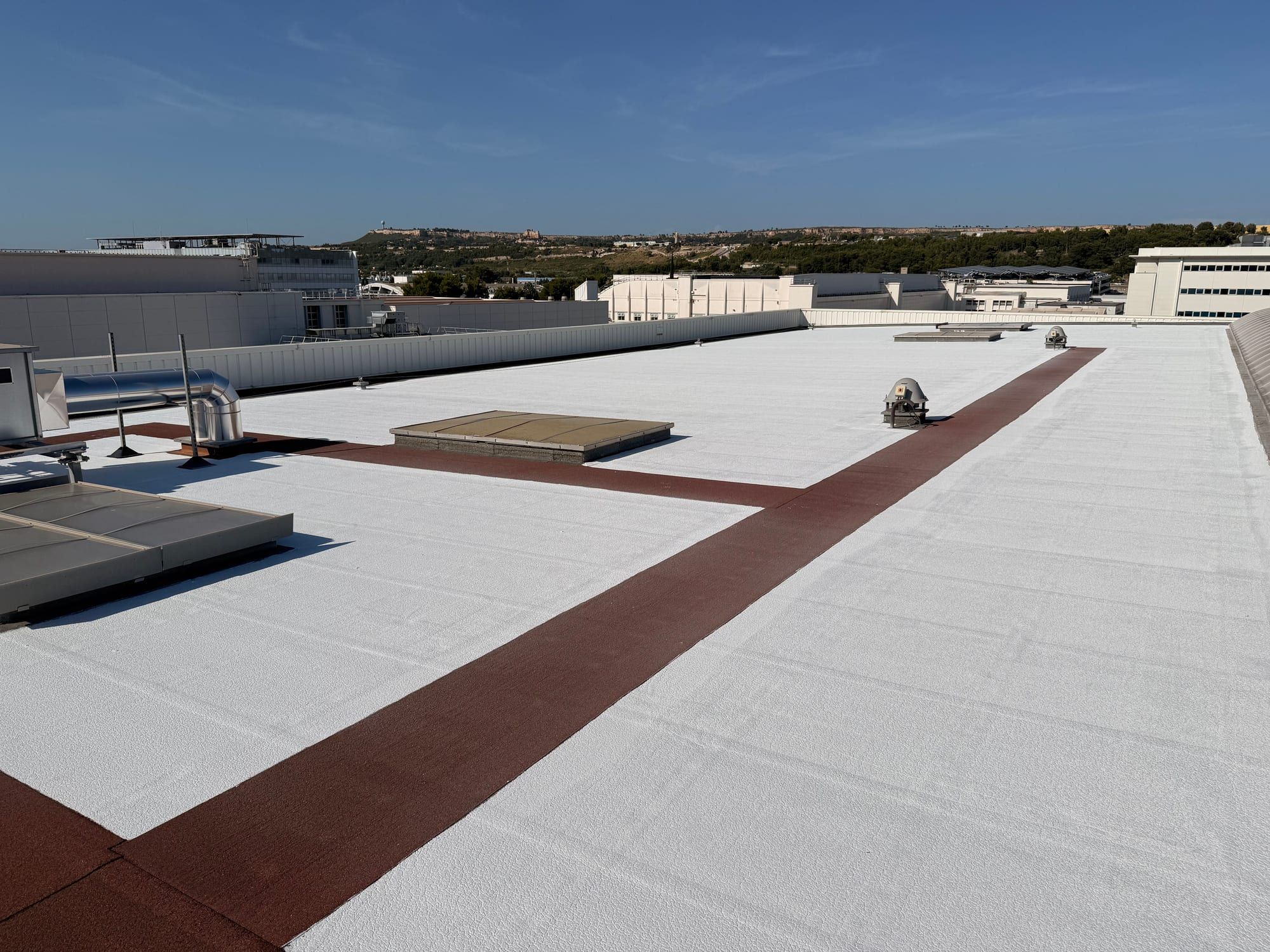
- 5,900 m² of bitumen membrane on three buildings, April–June 2026, −29 °C measured
- Indicative lead time
- About 1 week for 3,000 m² (Marignane: 3,100 m² from 12 to 19 June 2026)
Why a bitumen roof overheats
Bitumen membranes — SBS elastomeric bitumen, APP plastomeric bitumen, reinforced bitumen, roofing felt — cover the majority of flat roofs and roof terraces in France. Their black or anthracite-grey colour absorbs most of the solar radiation: the reflectance of new bitumen lies between 5 and 15 %, and its SRI between 0 and 10. On a 35 °C day, the surface reaches 60 to 70 °C.
Bitumen nonetheless has good emissivity (0.85 to 0.90): it radiates the heat it has stored quite well. The problem is that it stores an enormous amount of it. That heat travels down into the waterproofing build-up, into the insulation, then into the rooms below: top-floor offices, workshops, classrooms. The consequences show up on three fronts:
- comfort: ceilings that radiate heat, 30 °C and more in rooms directly under the roof;
- air conditioning: chillers running flat out from June to September;
- the waterproofing itself: bitumen that cycles every day between 20 and 70 °C expands, contracts, loses its oils, blisters and cracks. The signs often appear after 8 to 12 years.
In urban areas, these dark roofs also feed urban heat islands. A cool roof on bitumen acts on all three fronts at once, without removing the membrane.
What the PrimaTherm® cool roof changes on a bitumen membrane
The PrimaTherm® system reflects 95 % of solar radiation (ASTM E903-12), with an emissivity of 0.89 (ASTM C1371-15) and an SRI of 120 (ASTM E1980), maintained at 119 after 4,000 h of accelerated QUV ageing. On bitumen, the comparison is the most striking of all substrates.
| Indicator | Untreated bitumen | Bitumen + PrimaTherm® |
|---|---|---|
| Solar reflectance | 5 to 15 % | 95 % |
| Thermal emissivity | 0.85 to 0.90 | 0.89 |
| SRI | 0 to 10 | 120 |
| Surface temperature (35 °C outside) | 60 to 70 °C | 25 to 35 °C |
| Day/night thermal swing of the membrane | 40 to 50 °C | 5 to 15 °C |
| External fire classification | depends on the membrane | Broof(t3) — CSTB report RA23-0010 |
The proof: 5,900 m² of bitumen treated with the site in operation
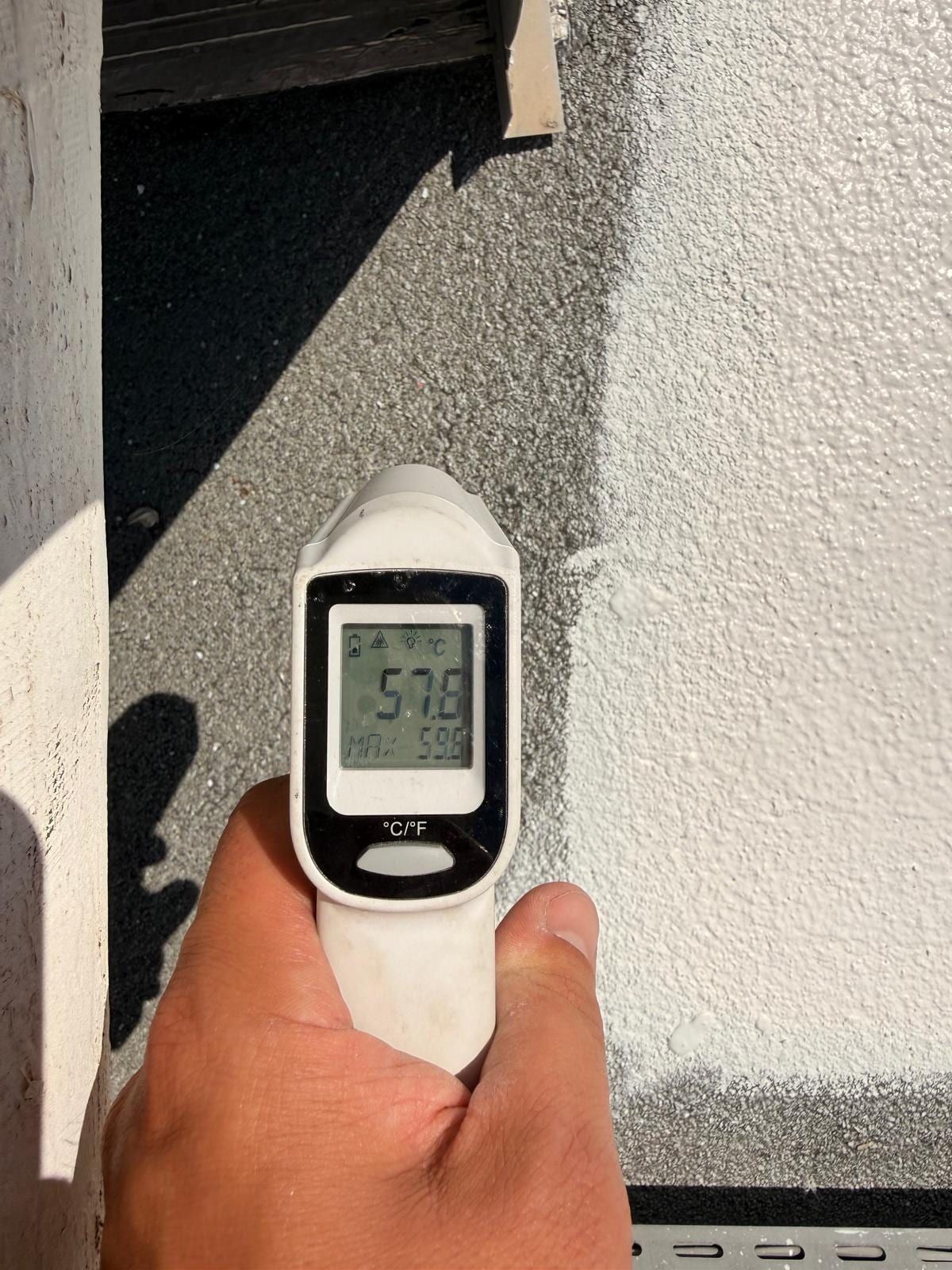
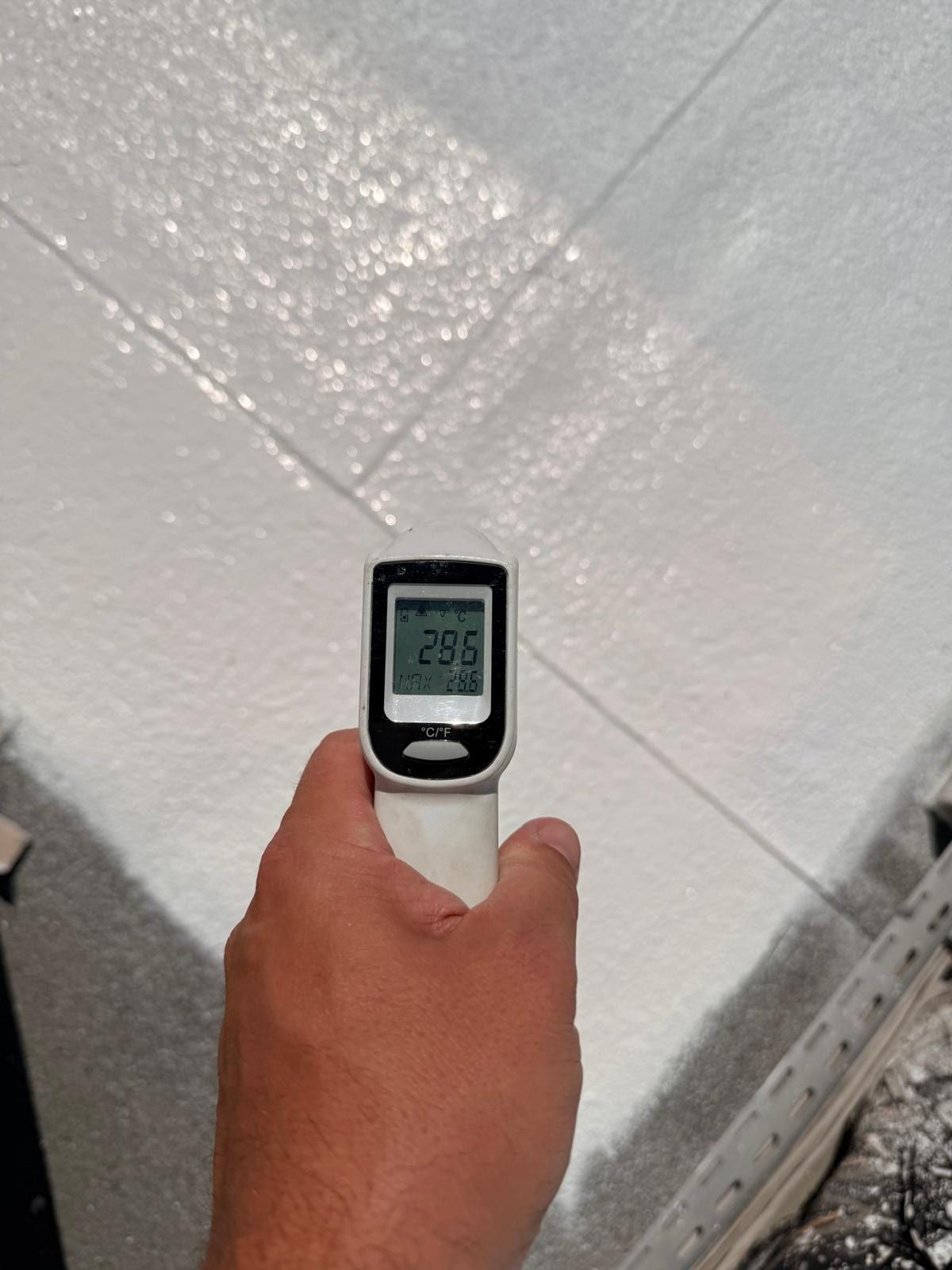
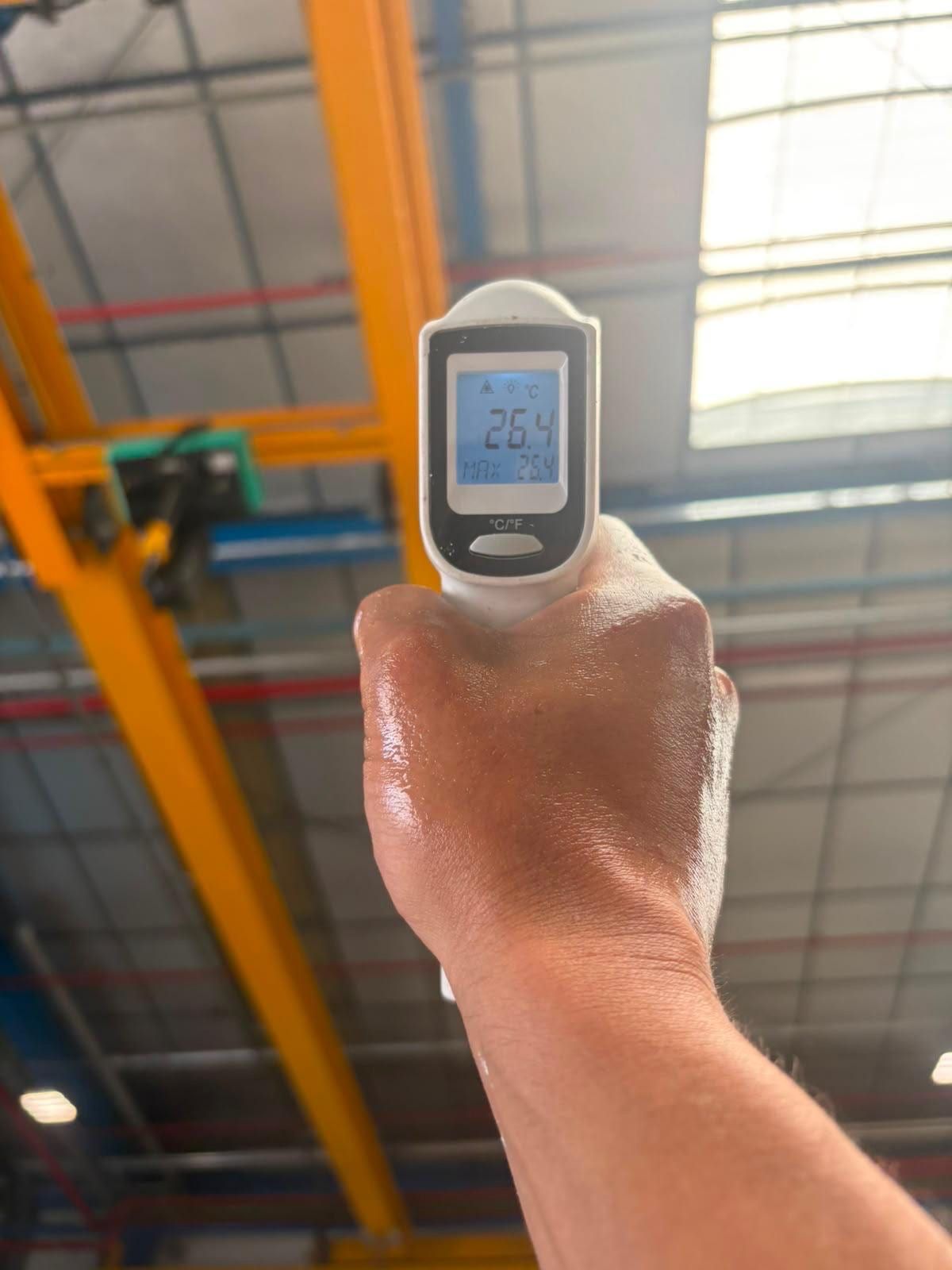
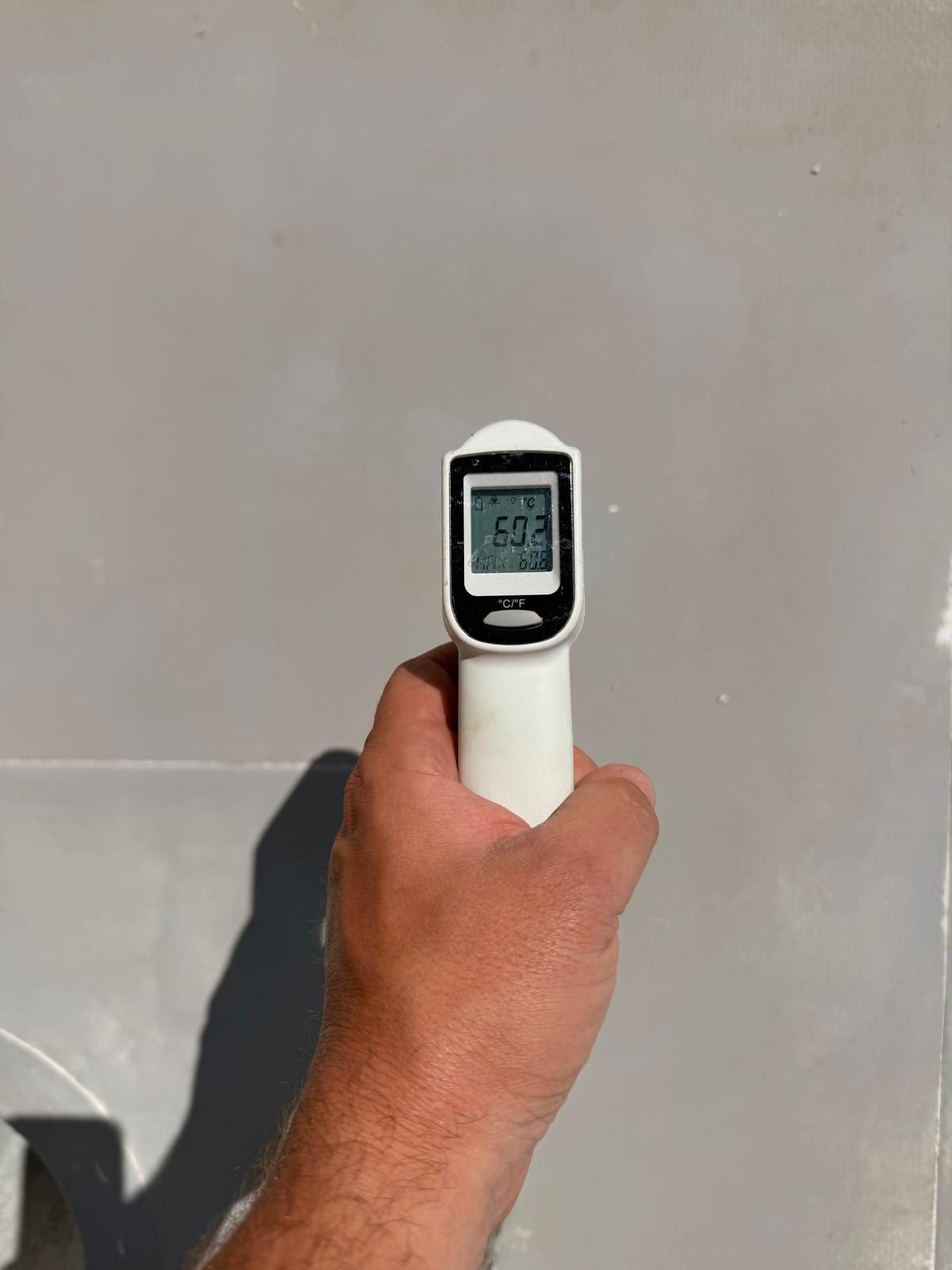
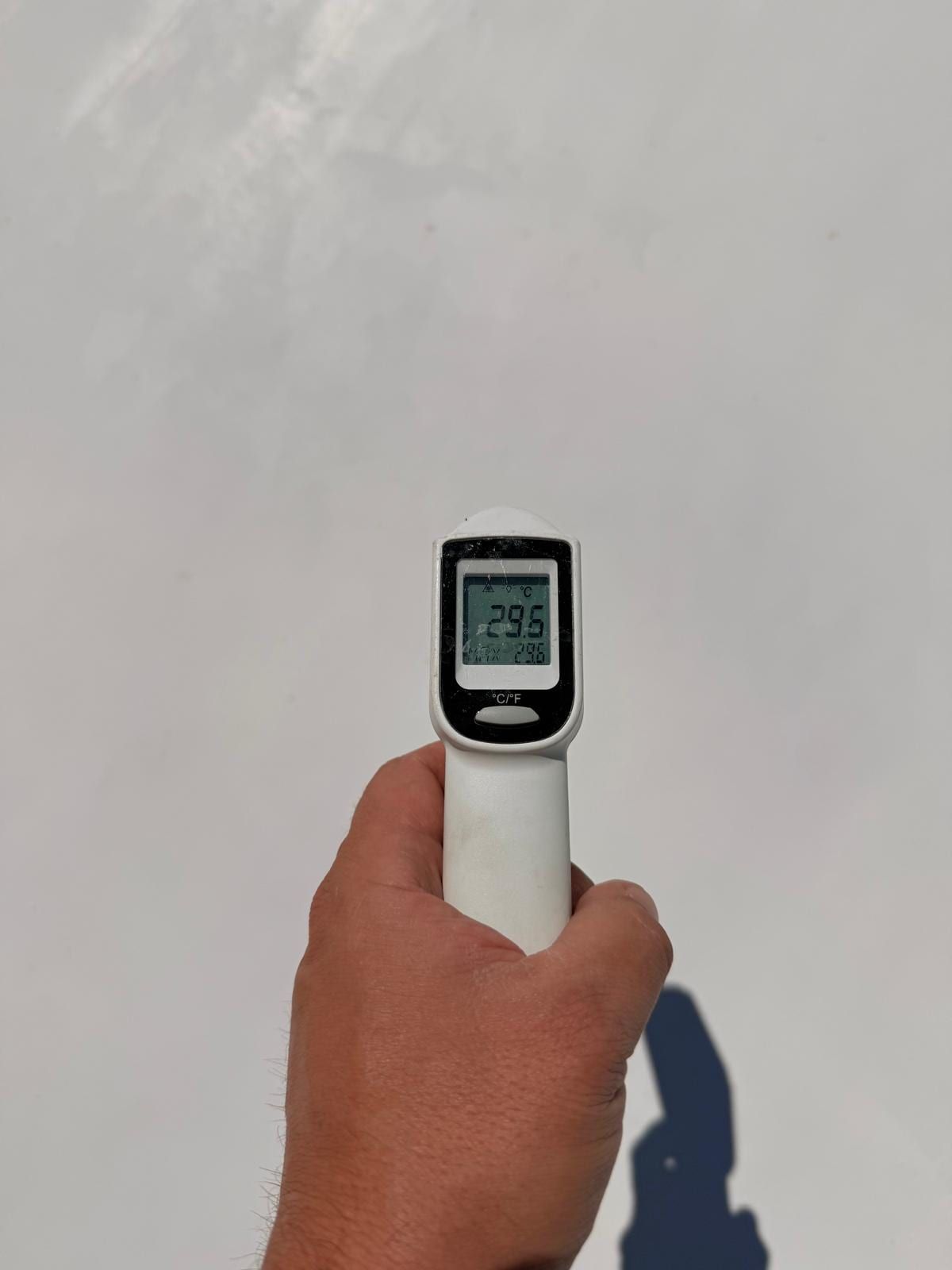
Between April and June 2026, we treated three buildings on an aerospace site: 5,900 m² of bitumen membrane, site in operation, without lifting equipment. At the handover of one of them, on 19 June 2026, the infrared measurement showed 57.8 °C on the control zone against 28.6 °C on the treated zone: −29 °C. The details are on the Airbus Marignane project page.
Indoors and on the bill
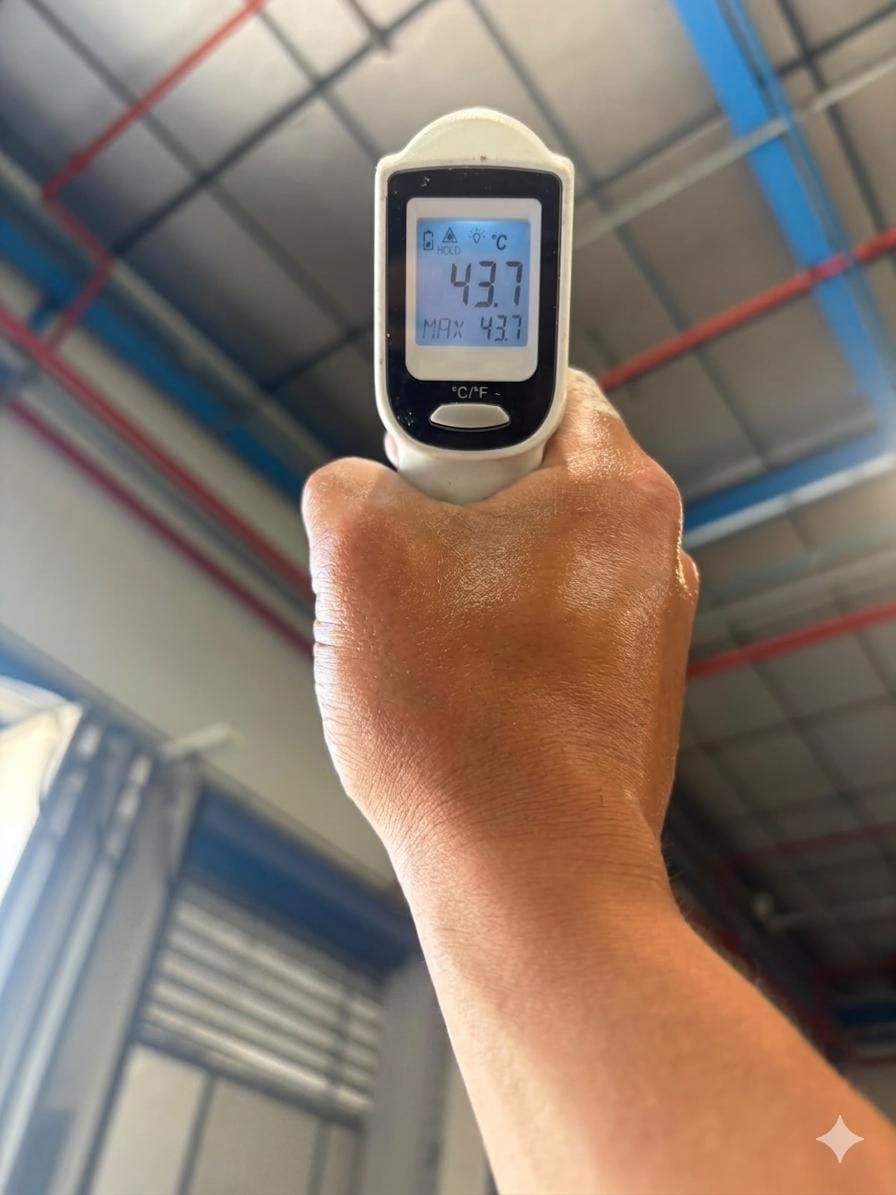
The indoor gain depends on the insulation of the roof build-up: up to 4 to 6 °C under a poorly insulated roof terrace, 1 to 3 °C under a roof insulated to current standards. On air conditioning, the reduction lies between 15 and 40 % depending on the French climate zone (15 to 25 % in H1, 20 to 30 % in H2, 25 to 40 % in H3). The return on investment of a cool roof is calculated from your actual consumption, never from a catalogue.
The blocking primer: the layer that makes the difference on bitumen
Bitumen is a living material. Under heat, its oils and light fractions migrate towards the surface. Applied directly, a white paint turns yellow-brown within a few months: this is bitumen bleed-through, and it ruins the reflectance. It is the first reason why a cool roof on bitumen cannot be reduced to “painting it white”.
The PH169 primer is a bonding and blocking primer formulated for this case. On bitumen, it is applied at 6 m²/L with a roller — against 10 m²/L on steel deck — because the rough, absorbent surface of a membrane uses more of it. The tool matters as much as the product: a long-pile roller of 20 to 22 mm carries enough product to fill the grain of the membrane and the relief of the slate granules. With an airless sprayer, 521 or 721 tip, the coverage rate rises to 8 m²/L. Drying: touch-dry in 2 h, recoatable after 16 h.
The application protocol on bitumen
1. Diagnosis
The technical survey examines the membrane point by point: blisters, cracks, detachment at the upstands, condition of the seams between sheets, rainwater outlets, ponding areas, presence of loose granules or an aluminium foil on the surface. An adhesion test is carried out on any doubtful membrane. If the waterproofing shows active leaks, we say so: renewal first, cool roof afterwards — the coating versus white membrane comparison helps you decide.
2. Preparation
- anti-moss and anti-lichen treatment if needed, without chlorinated products;
- medium-pressure cold-water cleaning, below 130 bar — enough to strip, not enough to damage the membrane;
- removal of loose slate granules and gravel;
- spot repairs: blisters opened and refilled, cracks and upstands repaired with membrane or compatible bitumen sealant;
- protection of rainwater outlets, rooflights and equipment;
- 24 to 72 h of drying depending on the weather, substrate moisture below 5 % checked with a moisture meter.
3. The 4 layers
| Layer | Product | Coverage on bitumen | Tool and drying |
|---|---|---|---|
| 1 | PH169 blocking primer | 6 m²/L | long-pile roller 20–22 mm; recoatable after 16 h |
| 2 and 3 | PH107 reflective base coat, two cross passes | 2 m²/L in total (0.5 L/m²) | roller or airless; rain-safe in 4 h, recoatable in 24 to 48 h |
| 4 | PH107TCL topcoat | 10 m²/L | one coat of 100 to 125 µm wet, never more |
The base coat is never applied in a single thick pass: two cross passes, the first thin, the second heavier, checked zone by zone. On large roofs, the no-lift method keeps drums and pumps on the ground; only the hoses go up. The site keeps running.
4. Inspection and handover
Film thickness checks, reconciliation of the quantities used against the coverage rates, infrared measurements of the treated zone against the control zone, as-built file with test reports and ten-year insurance certificate.
Slate-surfaced, aluminium-faced, bare membranes: the special cases
Membrane self-protected with slate granules. This is the most common case. Loose granules come off during cleaning; those that remain are sound and the primer fixes them. The relief increases consumption: hence the 6 m²/L of primer and the importance of the long-pile roller.
Aluminium-faced membrane. The aluminium foil reflects some visible light but emits heat very poorly (low emissivity): it gets hot. After degreasing and an adhesion test, the primer bonds and the system brings the emissivity that was missing.
Bare bitumen or old roofing felt. The surface is often powdery and crazed: careful cleaning, a generous coat of primer and, if needed, repair of the most tired areas before the base coat.
Bitumen with photovoltaic panels. The cool roof is preferably applied before the modules; on a roof already fitted with panels, we treat the accessible areas. See cool roof and solar panels. A 1,000 m² school in La Rochelle (bitumen membrane, combined with PV) illustrates this arrangement: a Hélios project.
What the cool roof does, and does not do, for your waterproofing
What it does: it divides the thermal swing of the membrane by two to three, blocks the UV that degrades the binder, forms an elastic film (elongation above 300 %) that is rainproof, over the existing waterproofing. A sound membrane ages markedly more slowly.
What it does not do: it does not repair a punctured membrane, does not replace an end-of-life waterproofing layer and does not perform the primary waterproofing function within the meaning of the French DTU standards. A leaking roof is repaired or renewed, then protected. The guide cool roof on waterproofing membranes details this boundary substrate by substrate: bitumen, EPDM and PVC.
The mistakes that ruin a cool roof on bitumen
Every year we take over bitumen roofs “painted white” that have yellowed or peeled within two summers. The causes are always the same, and all avoidable.
- No primer, or a universal primer. Bitumen bleeds through any coating that is not blocked. PH169 at 6 m²/L is not a place to save money.
- A substrate that is still damp. A membrane holds water in its grain and under its granules. Painting before 24 to 72 h of drying, with more than 5 % moisture, condemns the adhesion.
- One thick pass instead of two cross passes. The film dries poorly in depth, blisters and never reaches the thickness that carries the certified performance.
- Ignored upstands and seams. The singular points concentrate the movements of the membrane; they are prepared by hand, before anything else.
- Cleaning that is too aggressive. Above 130 bar, the jet tears off the granules and damages the membrane. Medium pressure, cold water, angled jet.
- No topcoat. Without the PH107TCL layer, the base coat gets dirty and the reflectance drops. Four layers, not three.
These rules are part of the manufacturer’s protocol, which we follow as a contractual document, and of our site log sheet.
Slope, outlets and ponding water
A bitumen roof is rarely perfectly flat. Ponding areas (puddles that persist more than 48 h after rain) are identified during the diagnosis: the system tolerates temporary standing water, but a permanent puddle signals a slope defect or a blocked outlet, to be corrected before application. Rainwater outlets are cleared, protected during the works, then checked at handover with a flow test.
Lead times, in practice
| Bitumen area | Preparation | Application of the 4 layers | Indicative total |
|---|---|---|---|
| 500 to 1,500 m² | 1 to 2 days | 2 to 3 days | about 1 week |
| 3,000 m² | 2 days | 3 to 4 days | 1 week (3,100 m² building: 12 to 19 June 2026) |
| 10,000 m² and more | by zones | by zones | 3 to 5 weeks, phased around operations |
These durations assume a suitable weather window, from April to October depending on the region.
For which buildings
Bitumen roofs dominate in the tertiary sector, public buildings, schools, hospitals, co-owned residential buildings and part of industry — the aerospace site in Marignane is the example. Flat roofs of detached houses are covered by the guide cool roof on flat roofs and, for small areas, by the online shop (in French). The cool roof applications hub guides you by building type and substrate.
Incentives and regulations
The French energy-savings certificates (CEE), sheet BAT-EN-112, apply under conditions: a tertiary-sector building for commercial use, with a volume heated and cooled by heat pump, for 160, 170 or 270 kWh cumac per m² depending on the French climate zone H1, H2 or H3. MaPrimeRénov’ does not cover cool roofs. For a home over 2 years old (co-owned building), supply and installation qualify for the reduced 10 % VAT in France. Changing the colour of a roof may require a prior declaration to the town hall (Article R. 421-17 of the French planning code). The details are on the page cool roof incentives in France 2026, and eligibility is checked during the free study.
Maintenance
Annual inspection, cleaning with clear water or low pressure (100 bar maximum) every 12 to 15 months, load-spreading boards during technical interventions. The SRI is maintained after 4,000 h of accelerated QUV ageing — conventional service life of 20 years (French CEE sheet). The full plan is in the guide maintaining a cool roof.
The thermometer, same time of day, before and after.
Frequently asked questions
Does a cool roof work on every type of bitumen membrane?
Yes, after a diagnosis: SBS elastomeric bitumen, APP plastomeric bitumen, polyester- or glass-fleece-reinforced bitumen, bare, slate-surfaced or aluminium-faced membrane. The PH169 primer blocks bitumen bleed-through on all of these substrates. What matters is the condition of the membrane: cohesive, well bonded and watertight.
Can a cool roof be applied to an old bitumen roof?
Yes, as long as the waterproofing still works. Blisters, cracks and detached upstands are repaired before application, and the cool roof then protects the membrane from UV and thermal shock. If the membrane has reached the end of its life, with active leaks, the waterproofing must be renewed first: a cool roof is not a waterproofing renewal.
Why a specific primer on bitumen?
Because bitumen migrates: under heat, its oils rise through a light-coloured coating and turn it yellow, which makes the reflectance collapse. The PH169 primer, applied at 6 m²/L with a long-pile roller, blocks this bleed-through and anchors the system. Without it, the certified performance does not hold.
How long does a cool roof project on bitumen take?
About one week for 3,000 m² in good weather conditions, preparation and drying times included. A building with 3,100 m² of bitumen membrane was treated from 12 to 19 June 2026, with the site in operation. Large roofs are phased zone by zone.
Does a cool roof really protect the bitumen?
Yes. A membrane that no longer exceeds 35 °C instead of 70 °C goes through expansion cycles half as wide, and the PH107TCL topcoat blocks the UV that degrades the binder. The coating, elastic and rainproof, forms an additional protection over the existing waterproofing without replacing it.
What maintenance does a treated bitumen roof need?
An annual inspection and a clean with clear water or low pressure, 100 bar maximum, every 12 to 15 months. The SRI of PrimaTherm® is maintained after 4,000 h of accelerated QUV ageing; the conventional service life used by the French CEE sheet is 20 years.