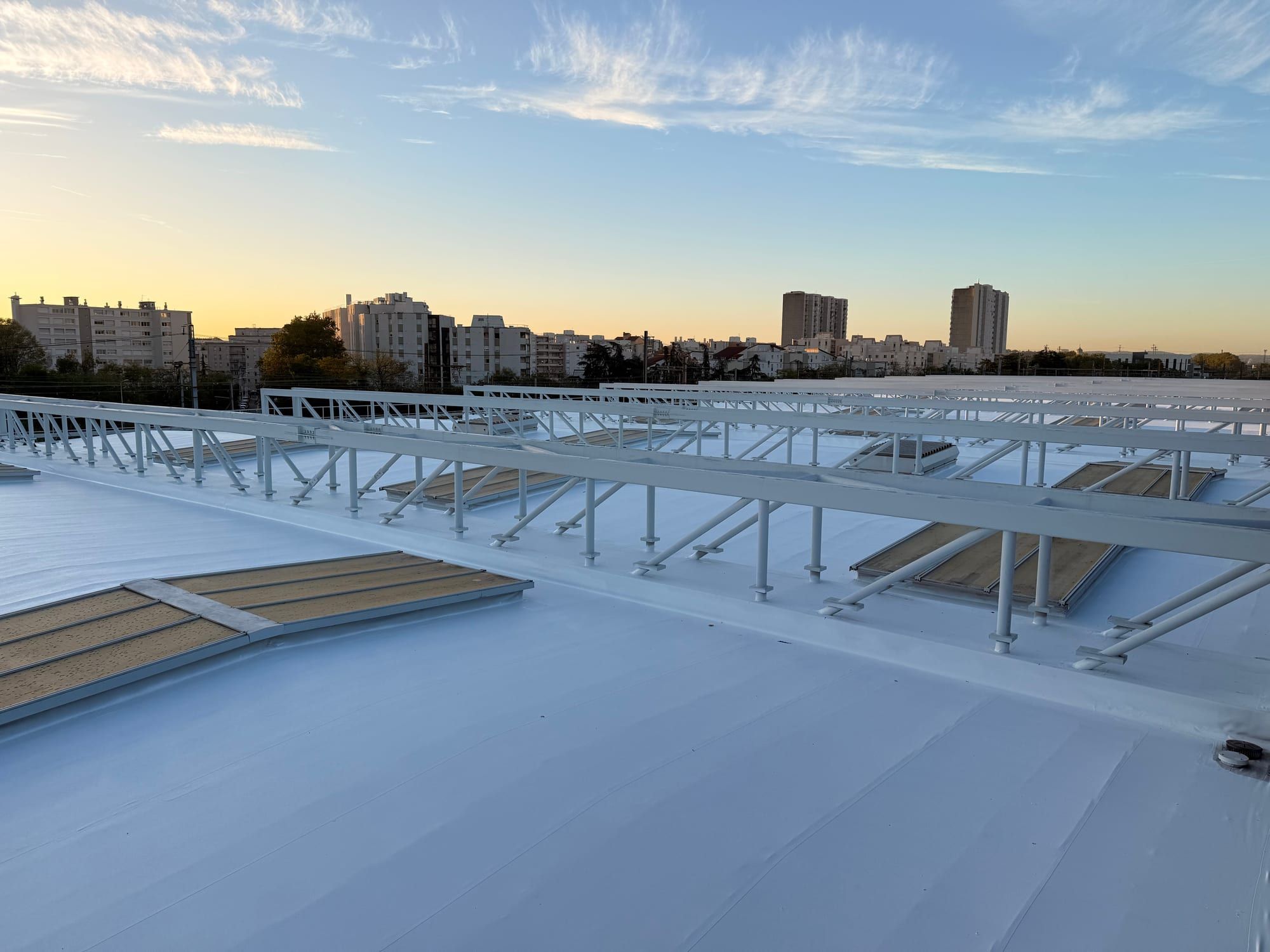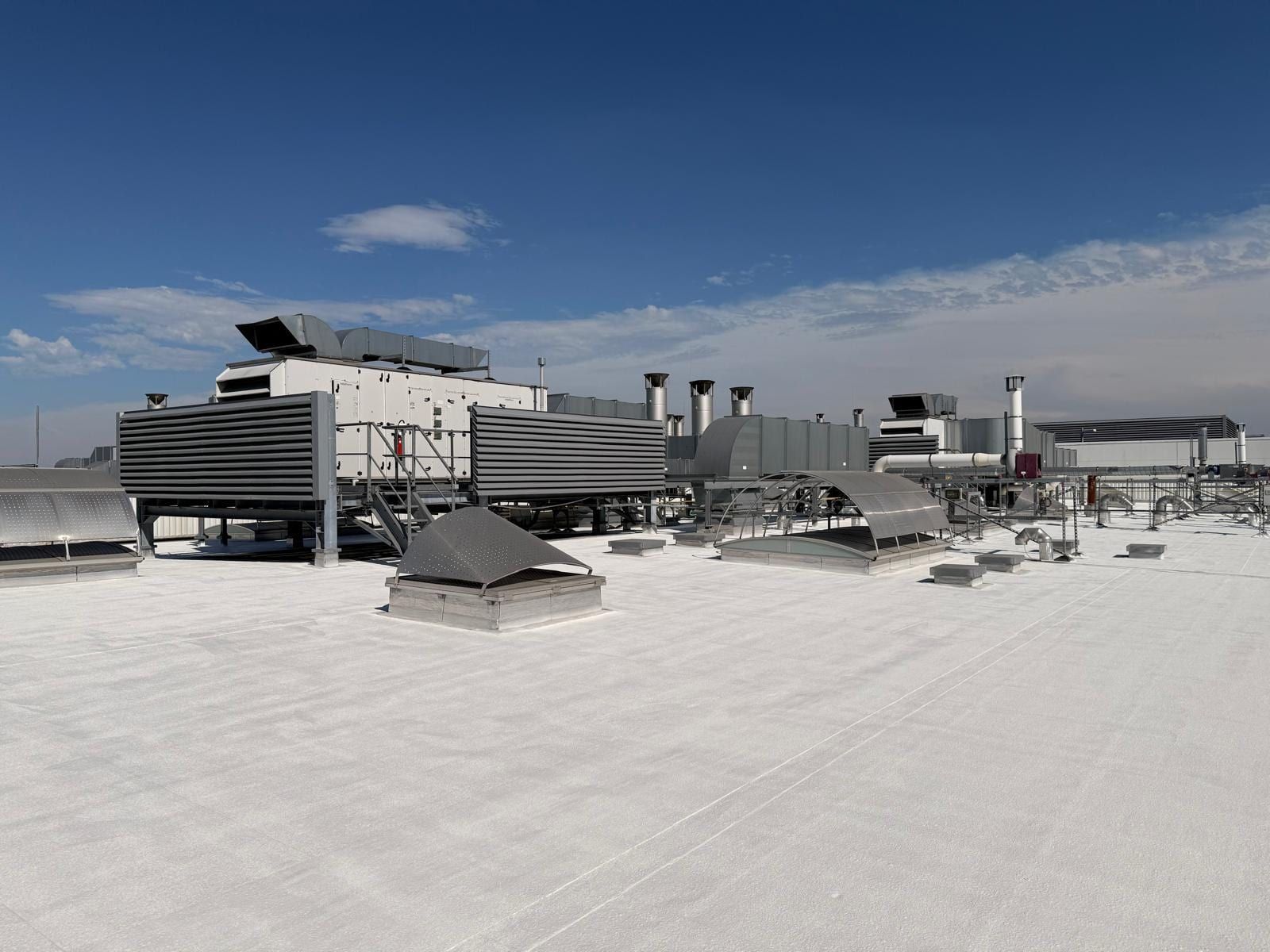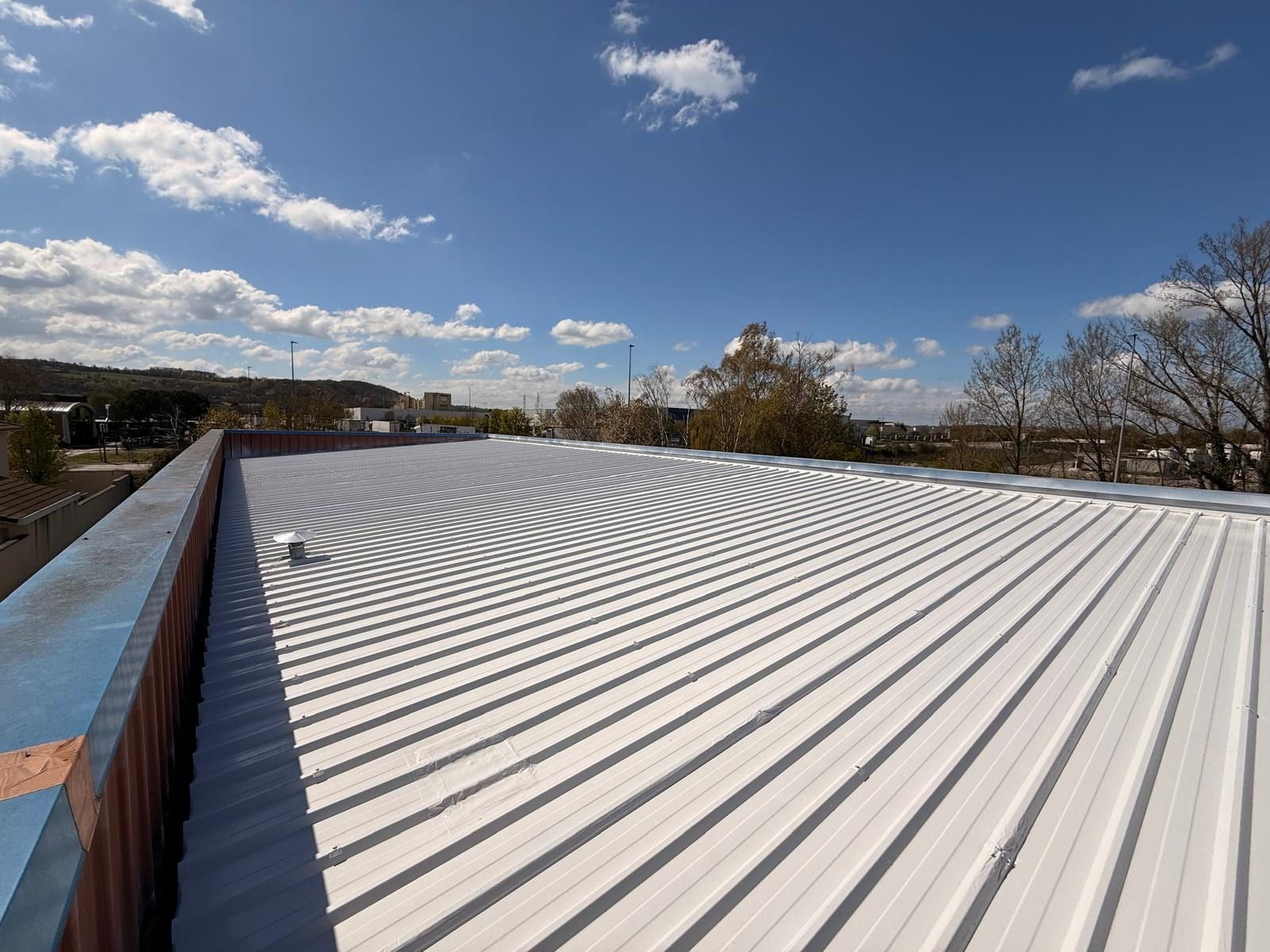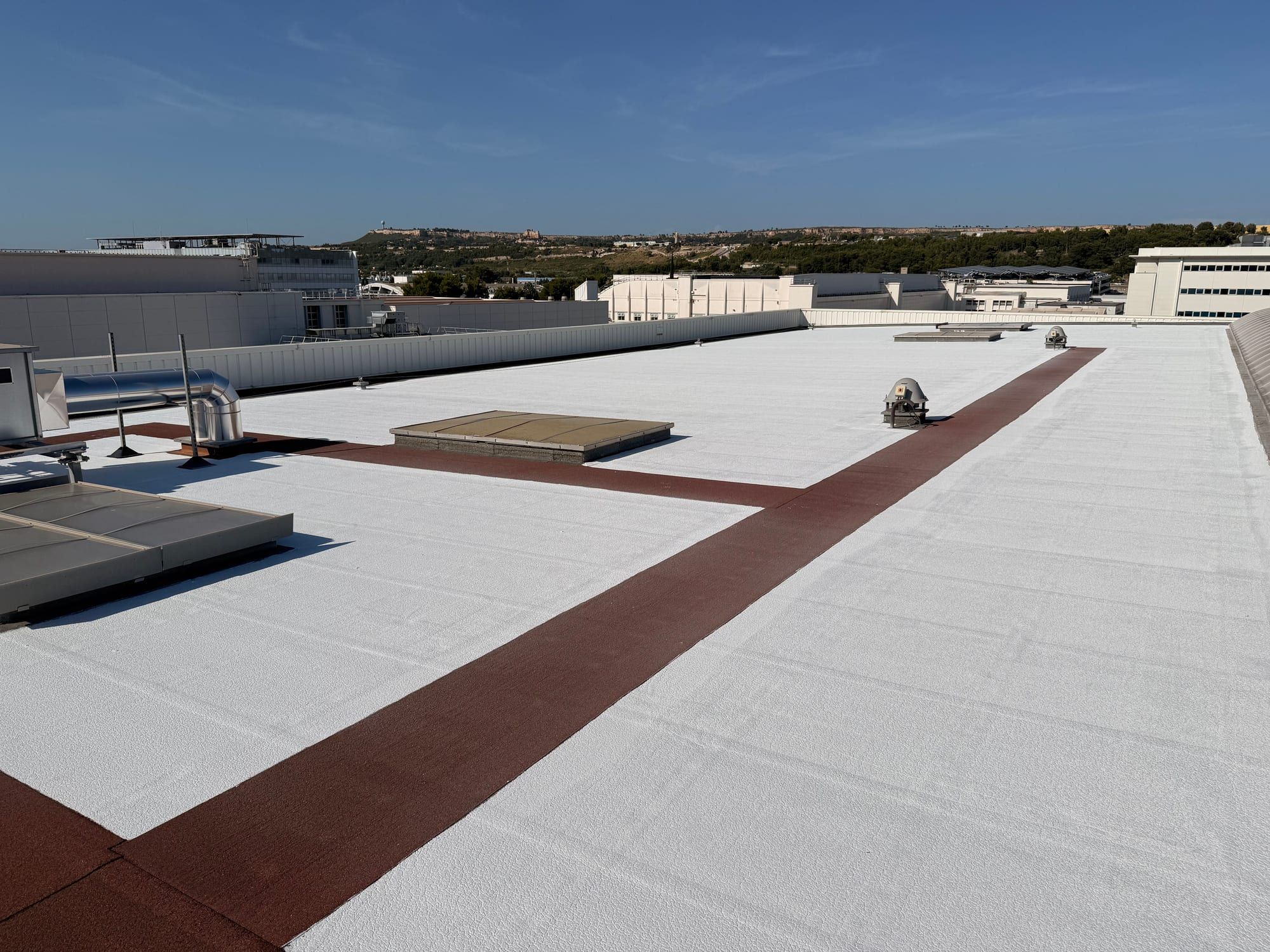
Measured result: −29 °C on the surface (57.8 → 28.6 °C, infrared measurement of 19 June 2026)
The context
On the Airbus Operations site in Marignane, several workshop and office buildings covered with a dark bitumen membrane were reaching roof temperatures close to 50 to 70 °C every summer, with the usual consequences: overheated volumes, air conditioning under strain, waterproofing exposed to violent thermal cycles. Working on behalf of the site’s multi-technical maintenance contractor, Hélios was selected to treat three buildings with the PrimaTherm® reflective system, between April and June 2026.
Total area: 5,900 m² of roofing on three buildings, plus around a hundred m² of skydomes treated with PrimaTherm® LT lacquer.
The constraints of an aerospace site
- Safety: prevention plan and site-specific health and safety plan (PPSPS) approved, access badges, work-at-height certificates for every applicator, marking of the work zones, Airbus protocols followed.
- Business continuity: no interruption of the workshops or the offices. Phasing building by building, secure storage at ground level.
- Rooftop equipment: air-handling units, skylights, cabling and walkways to be protected before cleaning and application.
- Zero lifting: 150 to 200 L drums and airless pumps at ground level, 80 m hoses up to the roof. No crane, no road closure on an airport site.
The method
- Technical visit on 2 April 2026: condition of the membrane, points of deterioration, access, equipment.
- Preparation: protection of sensitive equipment, high-pressure cleaning to remove dust, dirt and micro-organisms, drying.
- PrimaTherm® application in 4 layers: PH169 primer, PH107 reflective base coat in two passes (roller and airless), PH107TCL anti-soiling and anti-UV topcoat.
- Skydomes: semi-transparent PrimaTherm® LT solar lacquer on the polycarbonate rooflights.
- Verification: visual inspection, check of the quantities applied against the coverage rates, infrared temperature measurements.
- Cleaning and removal of waste, handover of the as-built file.
The largest of the three buildings, around 3,100 m², was treated from 12 to 19 June 2026: one week, with the site in operation.
The measured results
At handover, the surface temperature was read with an infrared thermometer on a treated zone and a control zone, at the same time of day: 57.8 °C on the untreated zone, 28.6 °C on the treated zone, i.e. −29 °C on 19 June 2026 on the project — and the same difference on another building on 27 May. These measurements, the before/during/after photo reports and the technical data sheets are recorded in the as-built files handed over to the client.
Expected benefits over time: a roof kept between 25 and 35 °C at the height of summer instead of 60 to 70 °C, a reduced air-conditioning load, waterproofing protected from thermal shock, improved indoor comfort in the workshops and offices under the roof.
Products and performance
| Layer | Product | Function |
|---|---|---|
| 1 | PH169 primer | sealing primer suited to waterproofing membranes |
| 2–3 | PH107 reflective base coat (2 passes) | core of the system: 95 % solar reflectance, emissivity 0.89, SRI 120 |
| 4 | PH107TCL topcoat | anti-soiling, anti-UV, lasting performance |
Values certified to ASTM E903-12, C1371-15 and E1980; Broof(t3) fire rating (CSTB report RA23-0010). See the PrimaTherm® certifications.
Recommended maintenance
Annual visual inspection, cleaning with clean water or at low pressure (100 bar maximum) every 12 to 15 months, load-spreading boards during technical interventions, touch-up by Hélios in the event of localised damage. Details in our guide to maintaining a cool roof.
Further reading
- Cool roof for industrial buildings — regulated sites, continuous activity, prevention plan.
- Cool roof on bitumen roofs — why the membrane heats up and how to prepare it.
- Cool roof in Marseille and Aix-en-Provence — our projects in French climate zone H3.