Why roof heat is an industrial issue
An industrial building combines three characteristics that make it the ideal candidate for a cool roof: a large roof area, poor insulation (single-skin steel deck, sawtooth roofs, membranes laid twenty years ago) and an activity that does not stop when the thermometer climbs. A dark roof absorbs most of the radiation it receives; at the height of summer, its surface reaches 50 to 70 °C and becomes the site’s first source of heat, well ahead of the machines.
Hardship, safety and social dialogue
From 28 °C in a workshop, working conditions deteriorate: reduced alertness, handling errors, more accidents, absenteeism. The French Labour Code requires the employer to assess the “extreme heat” risk in the single risk-assessment document (DUERP) and to take preventive measures; since 2025, a decree specifies the obligations during heatwave alerts. The subject therefore reaches the works council (CSE), the HSE manager and, in the end, the site director’s desk. A cool roof treats the cause: it removes the heat radiated by the ceiling, the most unpleasant component of the discomfort, without extra fans or workshop air conditioning.
Processes, machines and sensitive stock
Many processes dislike temperature swings: packaging lines, industrial paint shops, electronics, plastics, measurement rooms, electrical cabinets and variable-speed drives that trip above 40 °C ambient. Stocks of raw materials, composites or finished goods face the same constraint. A roof that no longer exceeds 35 °C on the surface stabilises the temperature of the volume and reduces heat-related unplanned stoppages.
The cost of cooling
Where the workshop is air-conditioned, partly or fully, the heat entering through the roof goes straight into the consumption of the chillers and air-handling units. Depending on the climate zone, a reflective roof cuts this consumption by 15 to 25 % in French climate zone H1, 20 to 30 % in H2 and 25 to 40 % in H3. Where there is no air conditioning, the gain is read in degrees and in hours of production preserved. In both cases, the payback study starts from your data, never from a catalogue.
A cool roof solution for industrial buildings: what PrimaTherm® changes
Hélios applies the PrimaTherm® system, made in France by Primacoating. It is not a white paint: it is a water-based elastomeric coating, applied in 4 layers (PH169 primer, PH107 reflective base coat in two passes, PH107TCL anti-soiling topcoat), each performance of which is measured in the laboratory.
| Characteristic | Value | Standard / report |
|---|---|---|
| Solar reflectance | 95 % | ASTM E903-12 |
| Thermal emissivity | 0.89 | ASTM C1371-15 |
| SRI (new) | 120 | ASTM E1980 (119 after ageing) |
| Durability | SRI maintained after 4,000 h QUV | conventional service life of 20 years (French CEE sheet) |
| External fire rating | Broof(t3) | EN 13501-5, CSTB report RA23-0010 |
In practice, on an industrial building:
- On the roof: up to −30 °C on the surface. A roof that went from 20 to 70 °C every summer day now cycles between 20 and 35 °C: fewer thermal shocks, waterproofing that ages more slowly, steel-deck fixings under less stress.
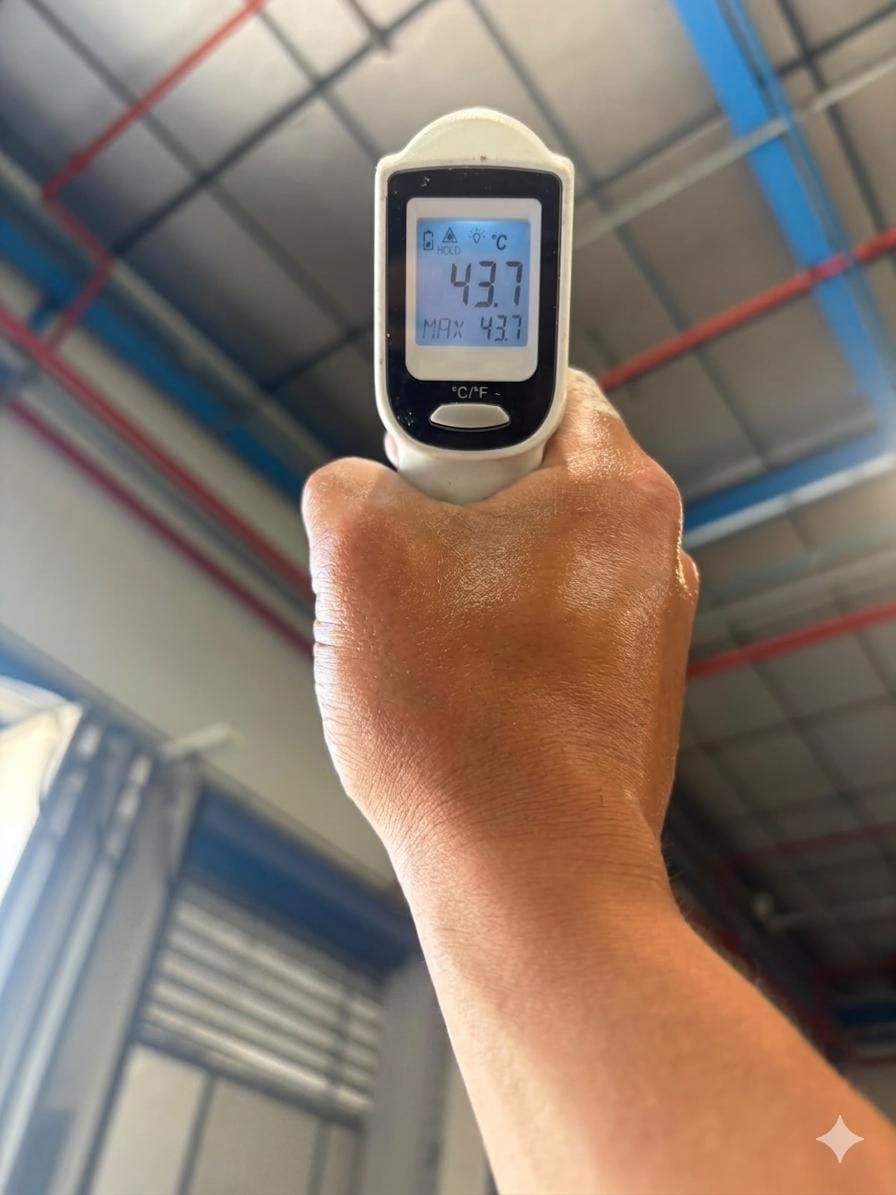
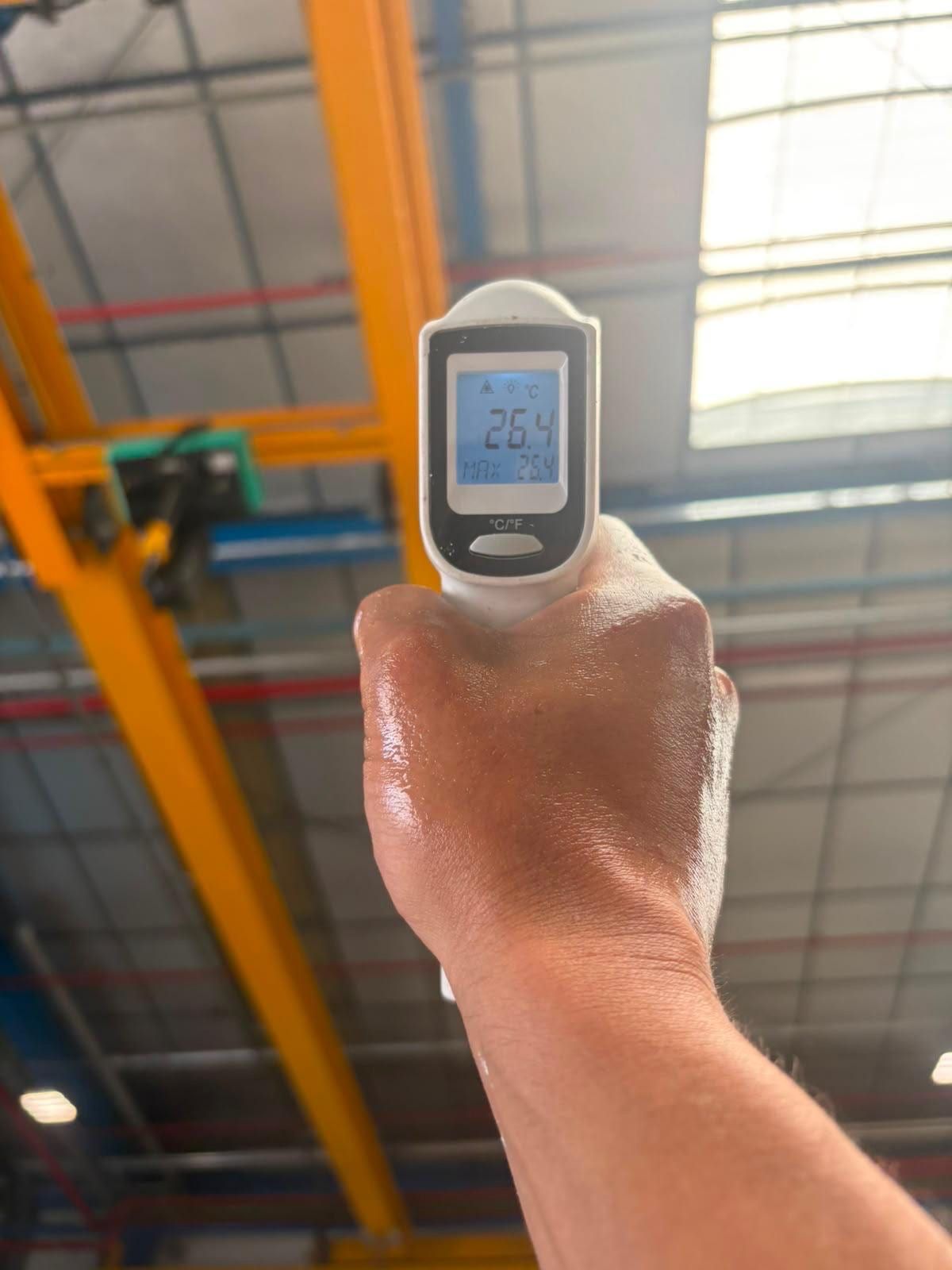
- In the workshop: up to −6 °C felt inside depending on insulation. Under a single-skin steel deck, it is the difference between a workstation that can be manned and one evacuated at 3 p.m.
- On the equipment: the air-handling units, chillers and compressors installed on the roof draw in cooler air and run more efficiently.
- On the bill: up to −40 % air-conditioning consumption, depending on the climate zone and the use.
The test reports are attached to every proposal; the PrimaTherm® certifications page details them.
The reference: 5,900 m² of aircraft hangars treated with the site in operation
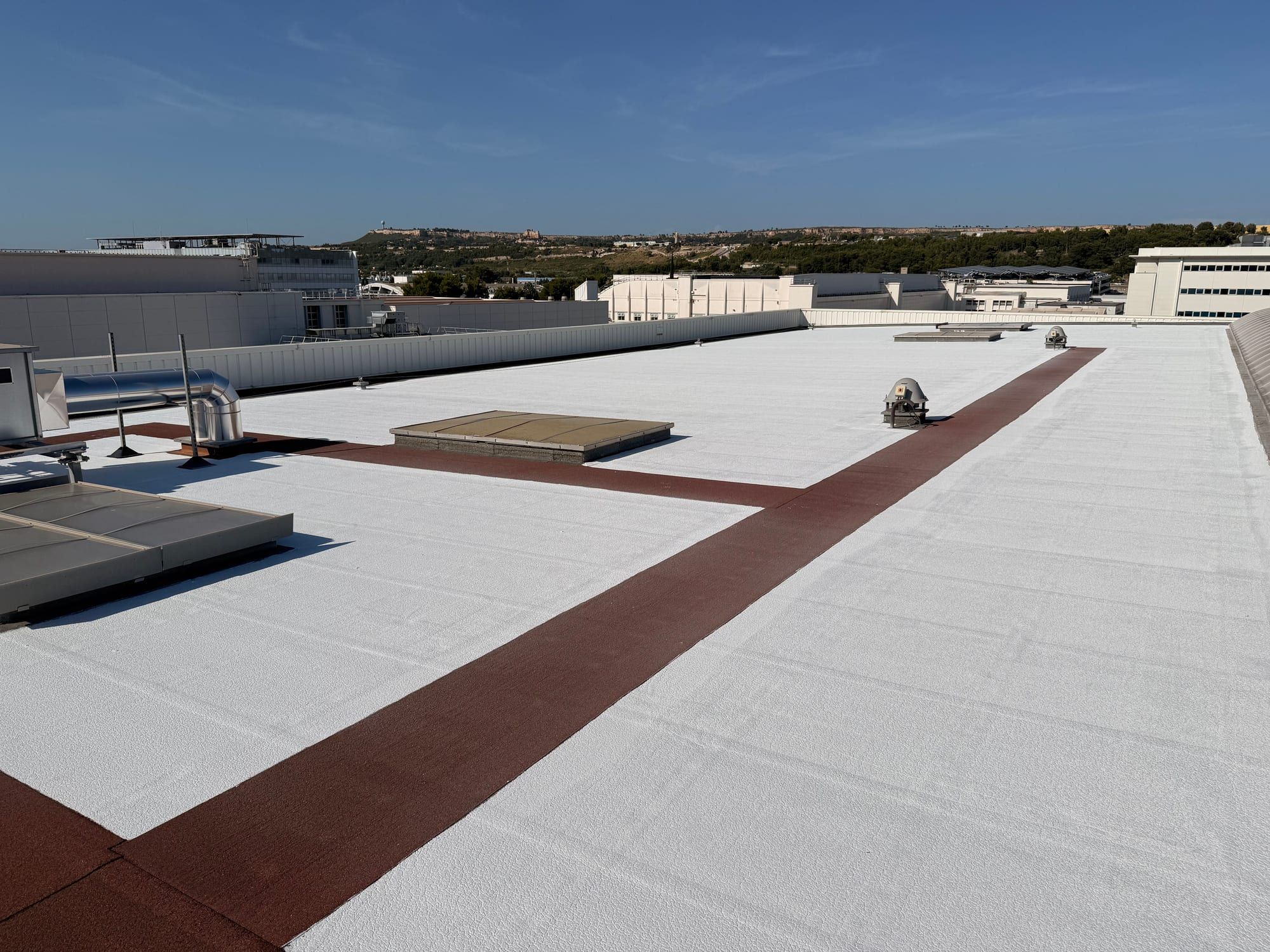
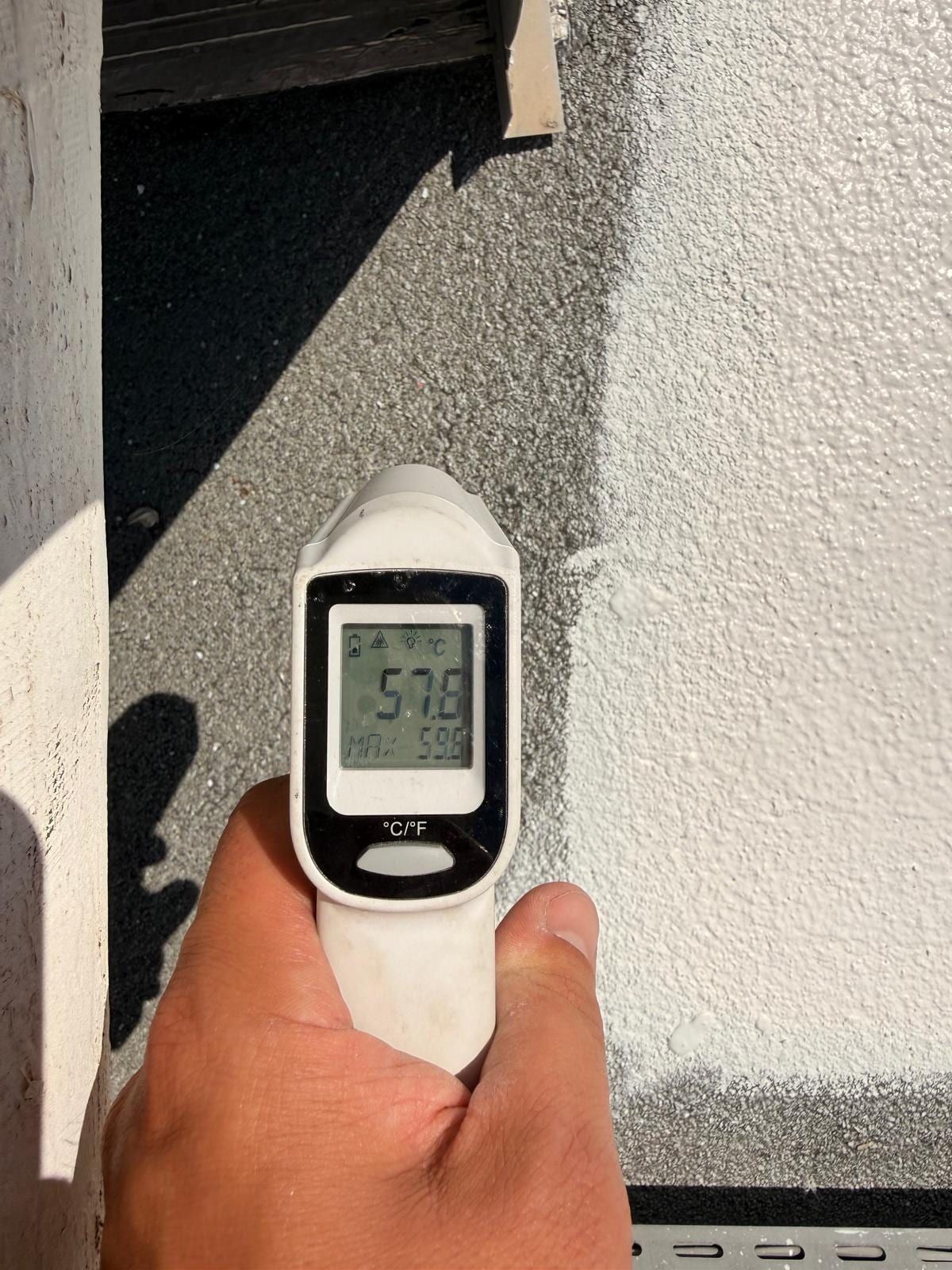
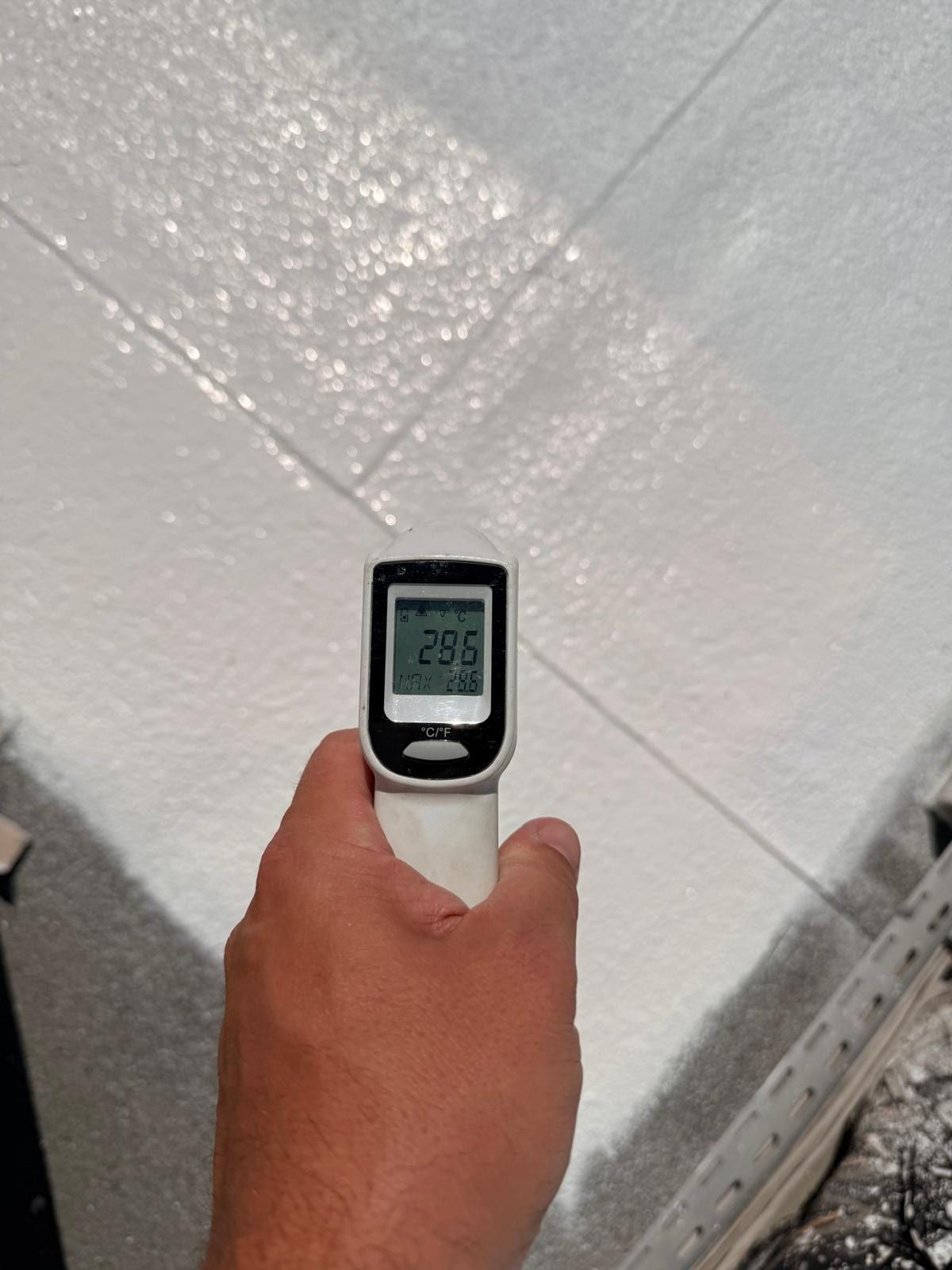
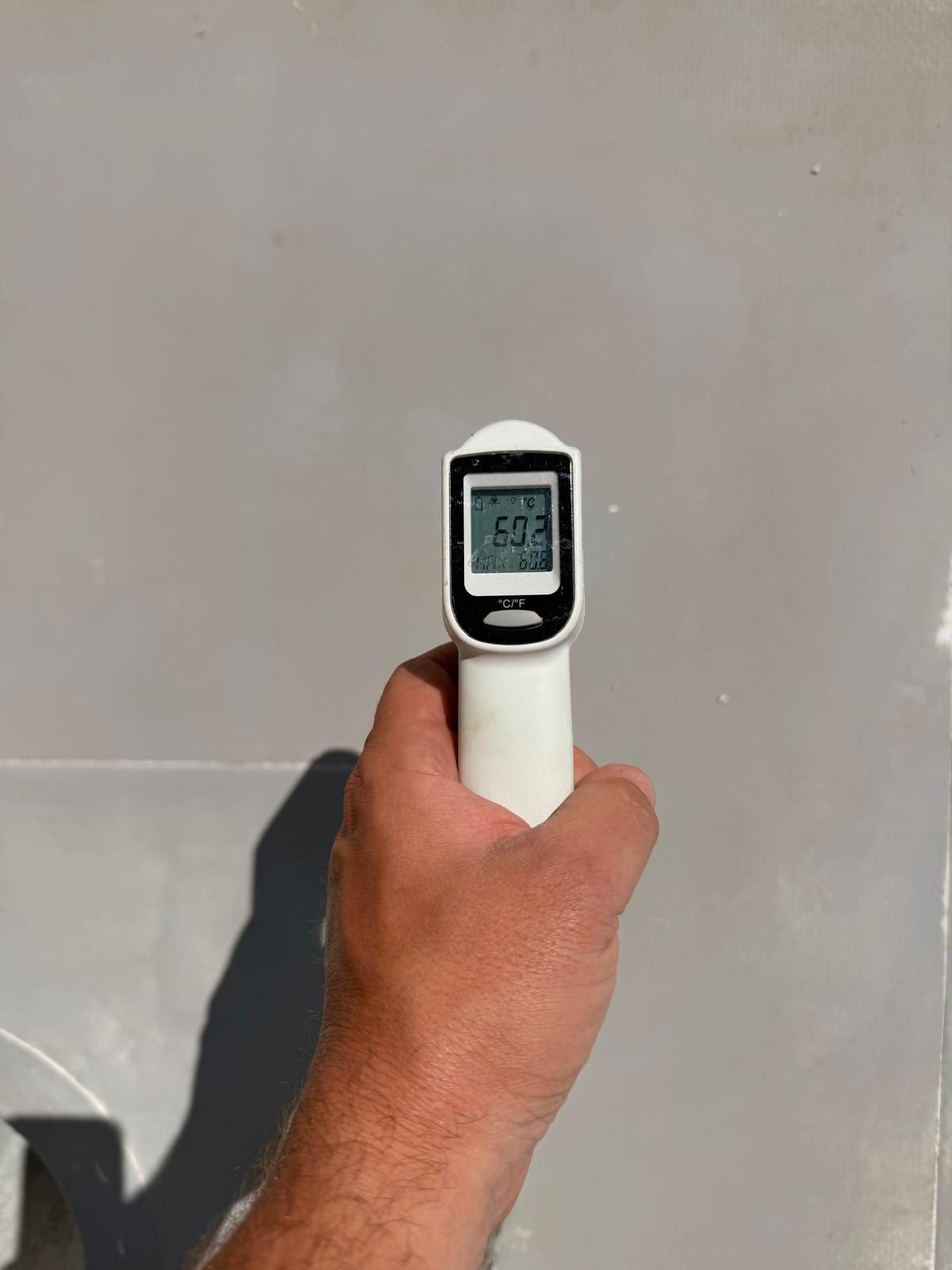
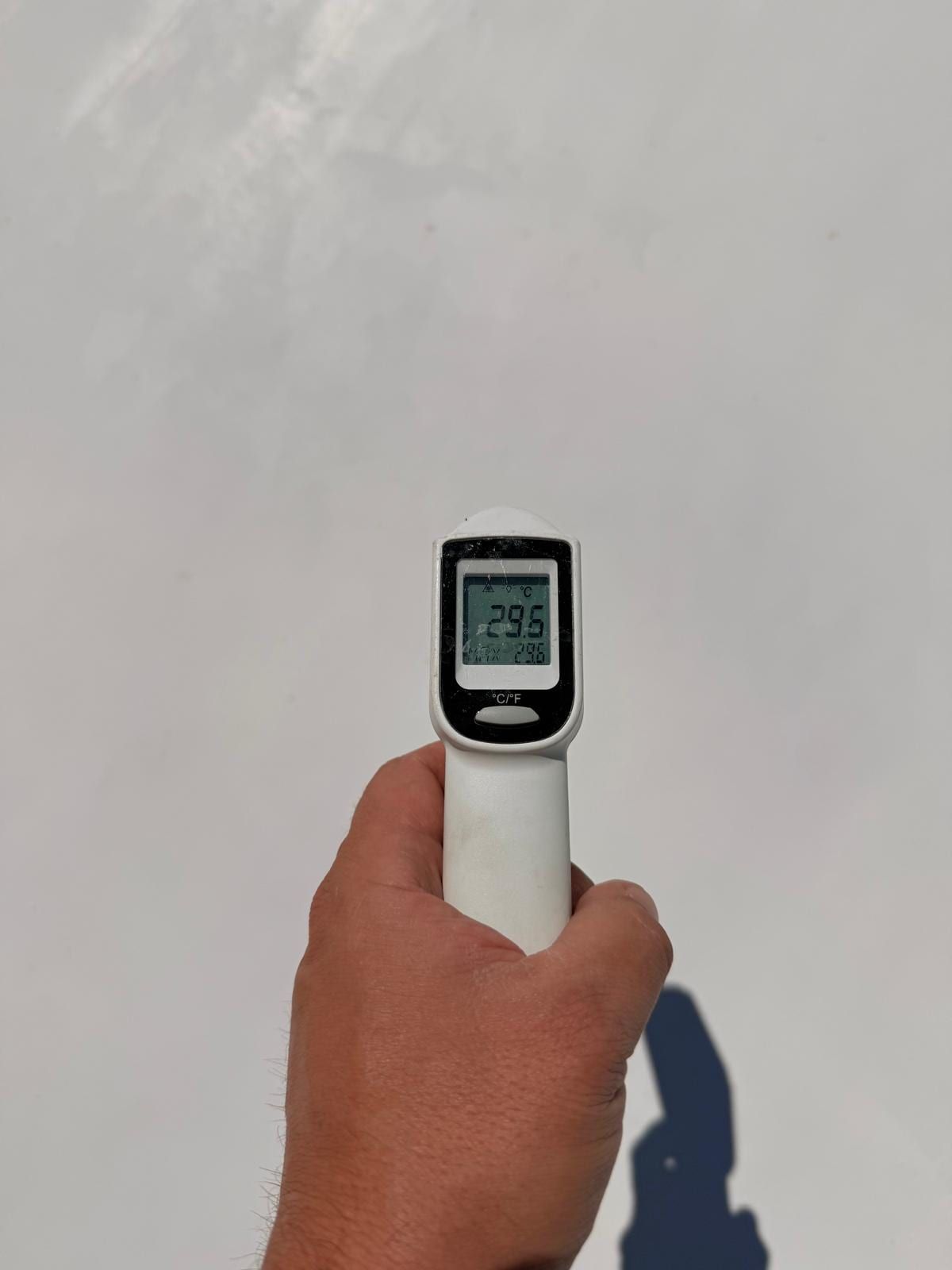
The aircraft-hangar cool roof is not a hypothesis at Hélios: it is our reference project. From April to June 2026, our teams treated 5,900 m² of bitumen-membrane roofs on three buildings of an aerospace site in full operation. At handover, on 19 June 2026, the infrared measurement on one of them read 57.8 °C on the untreated area against 28.6 °C on the treated area: −29 °C.
What counted for the client: certified values rather than promises, a no-lifting method compatible with a secure industrial site, building-by-building phasing without interrupting activity, and a complete as-built file (thickness checks, before/after measurements, site follow-up sheet). The details are on the Airbus Marignane project page. The same protocol was applied on a second aerospace site at Paris-Le Bourget and on railway maintenance workshops in Lyon; other industrial sites complete these references.
Industrial site constraints: what we take care of
Seveso sites, ICPE and prevention plans
A classified site imposes a framework: a prevention plan drawn up with the client, work permits, hot-work permits when hot work is carried out nearby, qualifications, specific PPE, ATEX zones to respect. The PrimaTherm® system is water-based, low in VOCs and free of flammable solvents: it creates no fire risk and its Broof(t3) external fire rating is documented. Our teams are used to the rules of aerospace and railway sites; we provide safety data sheets, method statement and risk analysis in advance.
Site in operation: no lifting, no production stop
This is the argument that tips most industrial projects. The 150 to 200 L drums and the airless pumps stay on the ground; only the hoses, up to 80 m long, go up to the roof. There is no crane, no heavy aerial platform, no road closure to book, and no logistics flow cut off. Fire-brigade access stays clear. Application is phased by roof zone, which makes it possible to isolate one building or one wing without touching the others. On a multi-building site, we treat the most exposed workshops first, then the stores, then the offices.
Cluttered roofs: AHUs, rooflights, smoke vents, guardrails
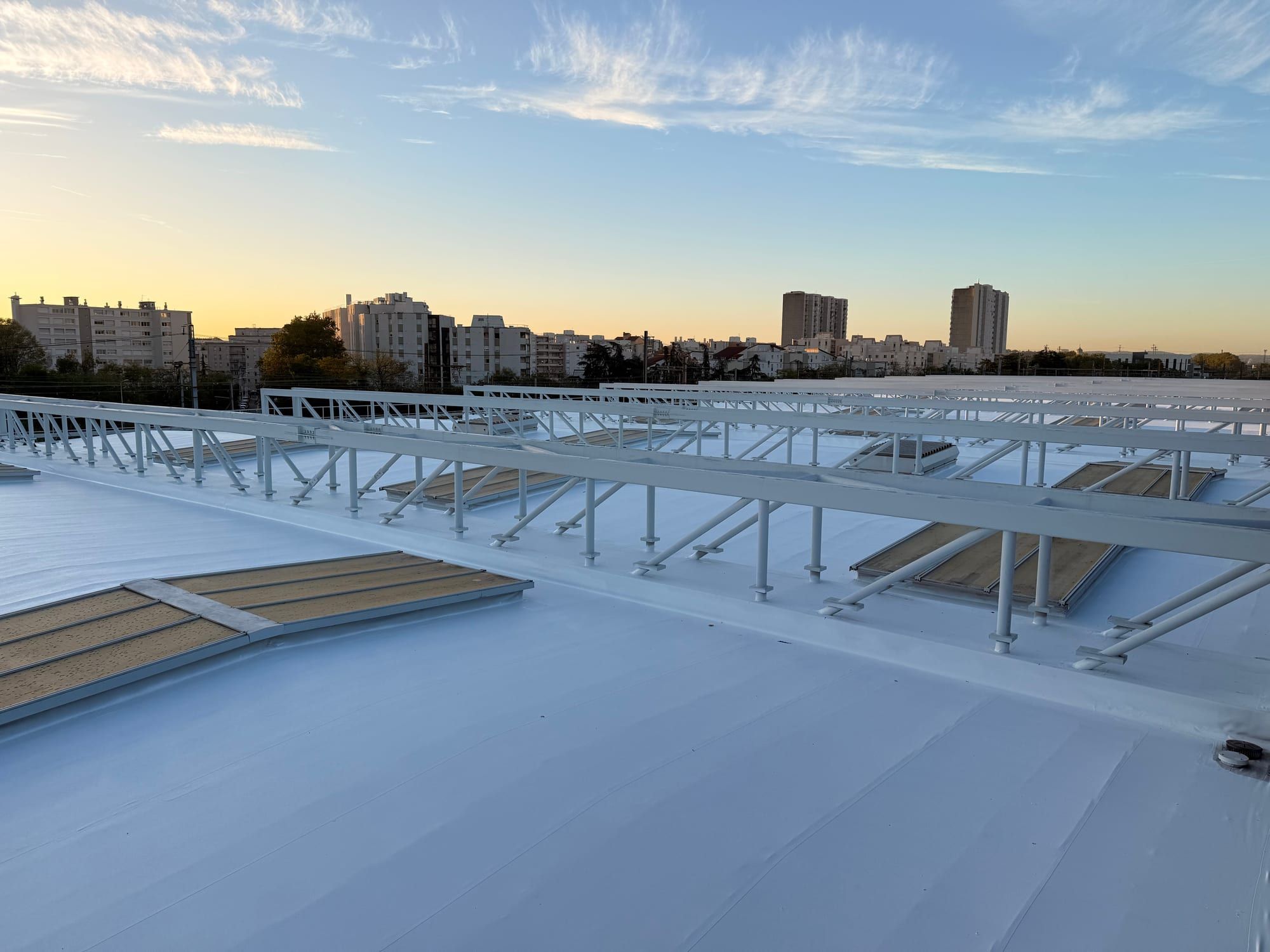
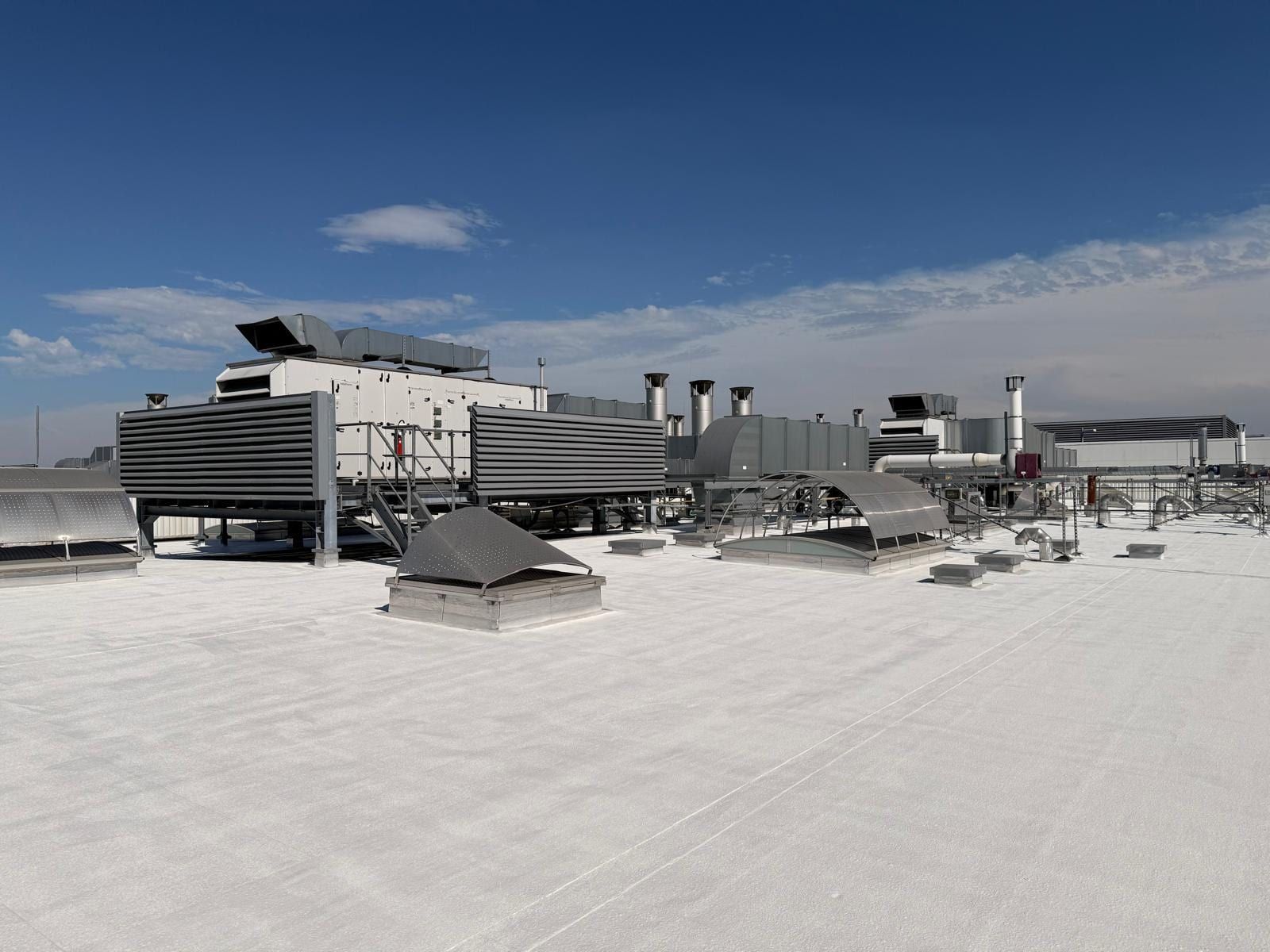
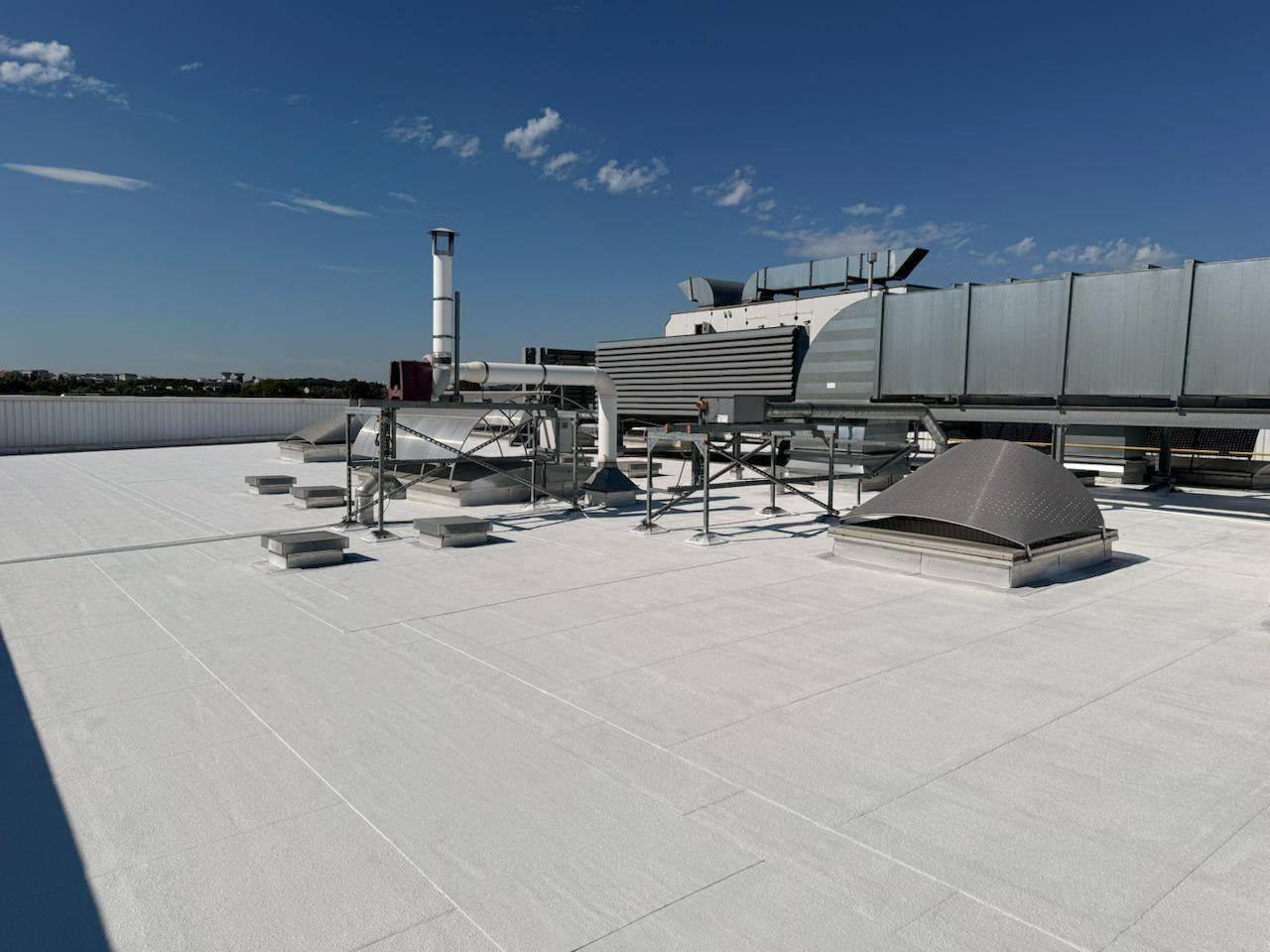
An industrial roof is rarely empty. Air-handling units, smoke vents, rooflights, cable trays, lifelines, guardrails, photovoltaic panels: every element is mapped during the technical visit and protected or worked around during application. Polycarbonate rooflights can, if you wish, receive the PrimaTherm® LT semi-transparent lacquer: one coat reduces heat gain and transmitted light by around 25 %, two coats by around 50 %. Roofs fitted with solar panels are treated between and beneath the rows: see cool roof and solar panels.
Roof types found in industry
- Steel deck, coated or galvanised, the most common roof type in industry: PH169 primer at 10 m²/L, preparation by medium-pressure cleaning, treatment of corrosion spots. See the cool roof on steel deck roofs guide.
- Bitumen membrane: primer essential to block bitumen bleed-through, at 6 m²/L. See cool roof on bitumen roofs.
- Fibre cement: asbestos-free only, so buildings built after 1997; any doubt is settled by a survey before work starts.
- EPDM: compatible after an adhesion test.
- PVC: only on membranes more than 10 years old, with the PH107PVC bonding base.
Incentives and regulation for industry
We prefer to be clear before the study. The French energy-savings certificates (CEE), sheet BAT-EN-112, reward the reflective refurbishment of roofs on commercial tertiary buildings heated and cooled by heat pump. A workshop, a factory or a warehouse is not eligible as such. MaPrimeRénov’ does not cover cool roofs. On the other hand, the tertiary part of an industrial site (offices, staff restaurant, showroom) may fall under other schemes, and manufacturers engaged in an energy-sobriety plan or an ISO 50001 certification count the action in their reporting. We check each case in the free roof study; the cool roof incentives 2026 page details the schemes.
On the regulatory side: the French tertiary-sector decree (Éco Énergie Tertiaire) applies to tertiary areas of more than 1,000 m² on an industrial site (offices, staff facilities) and a cool roof is an action that can be declared on the OPERAT platform. Changing the colour of a roof may require a prior declaration to the town hall depending on the local planning rules (article R. 421-17 of the French planning code); we check this point for every project. Finally, the full regulatory context gathers what the law expects of your roof.
How an industrial cool roof project runs with Hélios
- Free study within 48 h: satellite measurement, analysis of the roof type and the uses, identification of priority zones, first estimate of the thermal potential.
- Technical visit: survey of rooftop equipment, adhesion tests if needed, HSE constraints and prevention plan taken into account, itemised proposal.
- Preparation: cleaning at under 130 bar, anti-moss treatment, spot repairs to the waterproofing, 24 to 72 h drying.
- Application without lifting: primer, reflective base coat in two crossed passes, anti-soiling topcoat. Weather window between 12 and 35 °C, relative humidity below 80 %, no rain within 4 h of each coat.
- Checks and handover: thickness checks, before/after infrared measurements, site follow-up sheet, as-built file, ten-year insurance and maintenance plan.
The installation process is detailed step by step. The cost depends on the area, the roof type, the preparation, the access and the incentives: it exists only in the proposal handed over after the study.
The objections we hear in industry
- “A paint is a gimmick.” An off-the-shelf white paint reflects 70 to 80 % of the radiation and loses its whiteness within two seasons. PrimaTherm® is a 4-layer system with 95 % reflectance, an application protocol, thickness checks and an SRI maintained after 4,000 h of accelerated ageing. The industrial clients who chose it are not buying a gimmick.
- “Our roof is too cluttered.” That is the case for almost every industrial roof we treat, including Marignane. The technical visit maps every piece of equipment.
- “We cannot stop production.” You do not have to: the no-lifting method and zone-by-zone phasing are designed for that.
- “What about winter?” The low sun hits the façades, not the roofs; the winter loss is marginal. Our article cool roof in winter details the annual balance.
- “Our roofs get dirty fast.” The PH107TCL topcoat with PVDF resins limits soiling; a low-pressure wash every 12 to 15 months is enough, even in an industrial environment.
Industrial buildings concerned
- Aircraft hangars and assembly workshops: large volumes, sensitive processes, secure sites.
- Production plants and mechanical workshops: steel deck, sawtooth roofs, heat hardship.
- Food and pharmaceutical industries: temperature-controlled rooms, cold rooms under the roof, reduced refrigeration load.
- Plastics, chemicals, surface treatment: ICPE sites, exothermic processes.
- Railway and maintenance workshops: the TGV maintenance centre in Lyon is the example.
- Industrial warehouses and adjoining platforms: see the dedicated page on cool roof for logistics.
- Technical rooms and server rooms: see cool roof for data centres.
We work throughout France from Saint-Laurent-d’Agny, near Lyon: for the industrial basins of the Rhône valley, Isère, Ain and the Lyon area, the team travels out for the day (Lyon, Saint-Étienne, Grenoble); for large sites in the South, the Paris region or the North, the team is accommodated on site for the duration of the works (Marseille, Toulouse, Paris, Lille).
Why Hélios for your industrial building
- The system chosen by aerospace and rail: two aerospace sites, railway maintenance workshops and several other manufacturers.
- Certified values, never rounded: 95 %, 0.89, SRI 120, Broof(t3), with the test reports attached to the proposal.
- An applicator trained in the PrimaTherm® protocol, not an intermediary: our teams apply, check and document.
- No lifting, no production stop, under a prevention plan, on classified sites.
- Ten-year insurance and professional liability cover attached to every proposal, as-built file at handover.
The first step takes two minutes: area, building type, postcode. Within 48 h you receive a satellite measurement and a first assessment of your roof’s potential, or an immediate estimate with the cool roof simulator (in French).
Frequently asked questions
Is a cool roof coating suitable for every industrial building?
For the vast majority. Coated or galvanised steel deck, bitumen membrane and EPDM are treated with the standard PrimaTherm® system. Fibre cement is accepted only when asbestos-free (buildings built after 1997) and PVC membrane only when more than 10 years old, with the PH107PVC bonding base. The free study checks adhesion before any commitment.
Can a cool roof be applied on a Seveso or ICPE site in operation?
Yes. We work under a prevention plan, with a hot-work permit if required, a work-at-height permit and the site's rules. Our no-lifting method keeps drums and machines on the ground: only the hoses go up to the roof. No crane, no road closure, no production stop. Our largest project, 5,900 m² of roofs on an aerospace site, was treated with the site in operation.
What temperature gain can be expected in a workshop?
On the roof surface, up to −30 °C (from 50–70 °C to 25–35 °C); −29 °C was measured by infrared at the handover of a 5,900 m² project in 2026. Inside, the gain depends on insulation: 4 to 6 °C under a single-skin steel deck or a poorly insulated roof, 1 to 3 °C on a well-insulated roof. It is the heat radiated by the ceiling, the most unpleasant part, that disappears.
Is an industrial cool roof eligible for the French CEE bonus?
Not as such. Sheet BAT-EN-112 of the French energy-savings certificates (CEE) targets commercial tertiary buildings whose volume is heated and cooled by heat pump; a workshop or a factory does not qualify. We nevertheless check every case during the study, in particular for the offices and tertiary premises of the site, and MaPrimeRénov' does not cover cool roofs. The return on investment is calculated on your actual consumption, generally within 3 to 5 years.
How long does a reflective coating last on an industrial roof?
The SRI of PrimaTherm® is maintained after 4,000 h of accelerated QUV ageing, and the conventional service life used by the French CEE sheet is 20 years. The PH107TCL anti-soiling topcoat preserves the whiteness; a low-pressure wash every 12 to 15 months maintains the reflectance, even in a dusty industrial atmosphere.
And in winter, does a white roof make the factory lose heat?
Marginally. The winter sun is low and mainly hits the façades; the days are short and often overcast. Over the year, the loss of winter solar gain remains far below the summer savings, and an industrial roof rarely heats the building beneath it. The annual balance is positive everywhere in France.