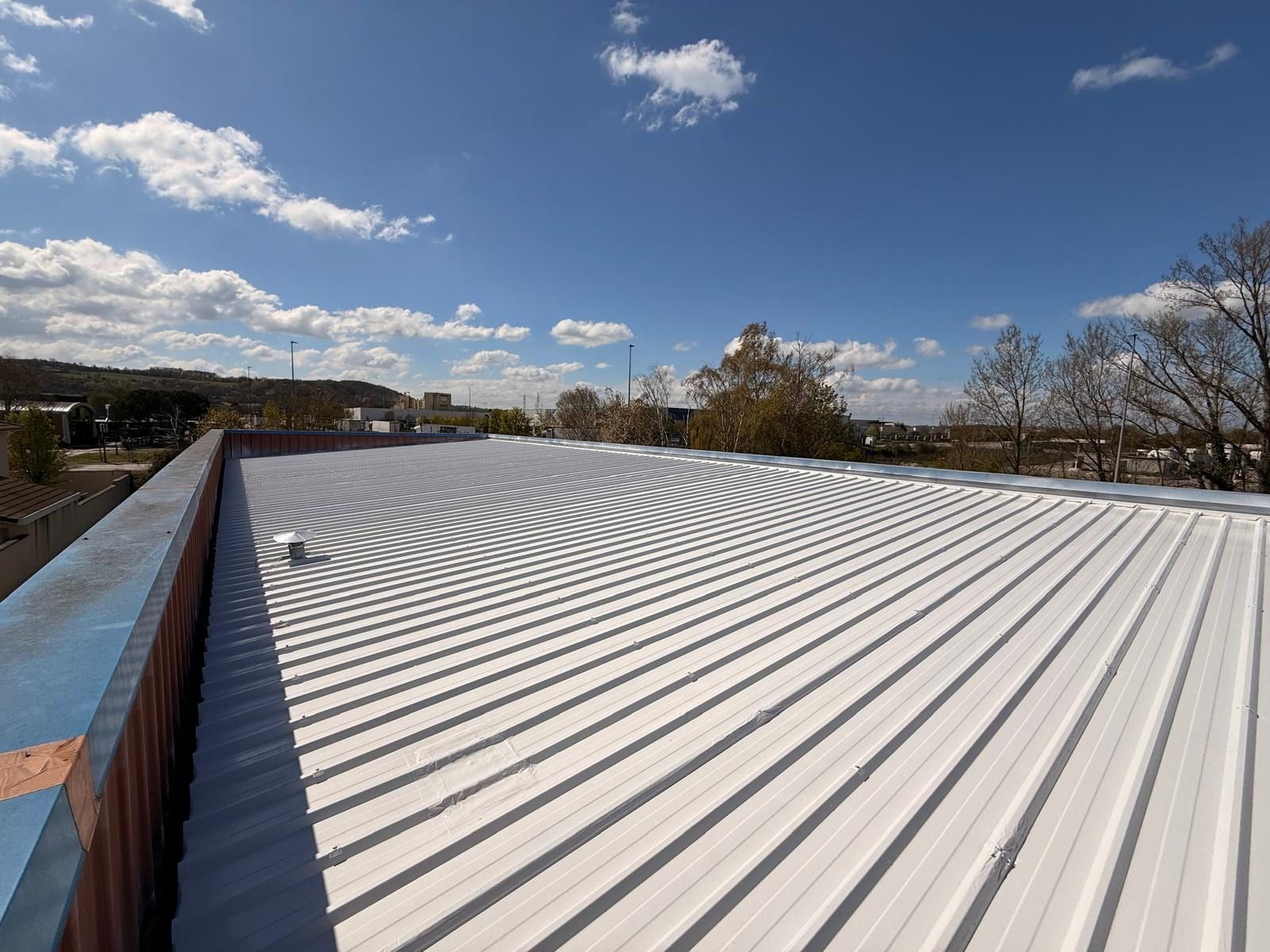
Key points
- What wears a reflective roof: ultraviolet light, thermal cycles, soiling, standing water and technical traffic.
- What PrimaTherm® sets against them: a 4-layer system (PH169 primer, PH107 reflective base coat in two passes, PH107TCL anti-soiling topcoat), an SRI maintained after 4,000 h of accelerated QUV ageing, a conventional service life of 20 years (French CEE sheet).
- What you have to do: low-pressure water cleaning every 12 to 15 months, an annual inspection, localised touch-ups with the same system, a maintenance logbook.
- What you gain: sustained thermal performance, waterproofing protected from thermal shock, an end of life by simple recoating.
What wears a roof coating
A roof is the most exposed element of a building. Five agents act permanently on a reflective coating:
- Ultraviolet light, which degrades organic binders and makes ordinary paints chalk or yellow.
- Thermal cycles: expansion during the day, contraction at night. The greater the amplitude, the more the film and its substrate work. This is where a reflective roof protects itself: by staying at 25–35 °C instead of 50–70 °C, it reduces the amplitude it undergoes.
- Soiling: dust, pollen, soot, sea spray, bird droppings, which reduce reflectance and retain moisture.
- Standing water in back-falls and around blocked outlets, which encourages algae and moss and stresses the overlaps.
- Technical traffic: repeated foot traffic, ladders, tools, equipment placed directly on the surface.
The durability of a cool roof therefore comes down to three things: the formulation of the product, the quality of the application and the maintenance.
What the tests demonstrate for PrimaTherm®
The PrimaTherm® system, developed by Primacoating and applied by Hélios, was subjected to 4,000 h of accelerated ageing in a QUV chamber (ISO 16474-3 standard): cycles of ultraviolet light, heat and condensation that simulate years of exposure. At the end of the test, the SRI measured according to ASTM E1980 is 119, against 120 when new. The performance is maintained. The starting values are a solar reflectance of 95 % (ASTM E903-12) and an emissivity of 0.89 (ASTM C1371-15). The conventional service life adopted by the French CEE sheet BAT-EN-112 is 20 years.
These results come from the structure of the system:
- the PH169 primer ensures adhesion to the substrate (steel deck, bitumen, asbestos-free fibre cement, EPDM); on PVC membranes over 10 years old, a PH107PVC adhesion base replaces it;
- the PH107 reflective base coat, applied in two passes, carries the reflectance and the elasticity;
- the PH107TCL anti-soiling topcoat protects the base coat from ultraviolet light and limits the adhesion of dirt, which makes cleaning easier.
The details of the reports and standards are on the PrimaTherm® certifications page, and the meaning of the SRI in our article on the solar reflectance index.
Application, the first condition of durability
A durable product badly applied does not last. Three points of the Hélios protocol determine how it holds up over time:
- Substrate preparation: cleaning, treatment of rust spots on steel decks, localised waterproofing repairs on membranes, adhesion test in case of doubt. A dry, clean and cohesive substrate is non-negotiable.
- Coverage rates and thicknesses: primer at 6 or 10 m²/L depending on the substrate, base coat at 2 m²/L in two passes, topcoat at 10 m²/L. Thicknesses are checked during application and recorded in the site monitoring sheet.
- The weather window: application between 12 and 35 °C, on a dry substrate, with no rain forecast, and with the recoating times between layers respected.
The installation process details these steps.
The maintenance that preserves performance
Cleaning
Low-pressure cleaning with clean water (100 bar maximum, flat-jet nozzle, from the high point towards the outlets) every 12 to 15 months restores the reflectance. No aggressive detergent, no wire brush, no rotary nozzle. A second pass in autumn is justified near trees, in a dusty industrial area or by the sea. The full method is in our guide cool roof maintenance: cleaning and upkeep.
The annual inspection
It covers the condition of the film (uniformity, cracks, blisters, delamination), the upstands and parapets, the rainwater outlets, the fixings and overlaps, the rooflights and the walkway areas. Each observation is photographed and recorded.
Walkways and load-spreading plates
On a roof that receives technical work, marked walkways and load-spreading plates protect the coating from point loads and abrasion. A simple instruction to contractors (soft soles, no metal tools placed on the film, reporting of damage) avoids most of the deterioration.
Touch-ups
Scratches, impacts and localised repairs are treated with the same system, on a clean and dry surface, in the same order of layers. Extensive delamination, through-cracks and leaks call for a diagnosis before any touch-up: waterproofing comes before appearance.
The maintenance logbook
The file handed over at completion (system applied, thickness checks, infrared measurements before/after, maintenance plan) continues as a logbook: cleaning dates, photographs, observations, touch-ups. It documents compliance with the recommendations and eases any exchange with the manufacturer, the applicator or the insurer. See cool roof guarantees: ten-year liability and manufacturer.
Durability and the environment
A water-based coating, with a low content of volatile organic compounds, applied without removal and recoatable at the end of its life, avoids a waterproofing renovation and the waste that goes with it. By reducing thermal shock, it extends the life of the underlying membrane; by reducing air-conditioning consumption, it reduces the associated emissions. Our guide on the environmental impact of cool roofing develops these points, and the what is a cool roof page places durability among the other selection criteria.
Sources
- French CEE sheet BAT-EN-112, reflective roof coating: https://www.ecologie.gouv.fr/
- ISO 16474-3, accelerated ageing with fluorescent UV lamps; ASTM E1980, SRI calculation: https://www.astm.org/
- Primacoating, manufacturer of the PrimaTherm® system: https://www.primacoating.com/
Frequently asked questions
What is the service life of a cool roof?
For the PrimaTherm® system, the SRI is maintained after 4,000 h of accelerated QUV ageing (119 against 120 when new) and the conventional service life adopted by the French CEE sheet is 20 years. In real conditions, durability depends on the substrate, the exposure and the maintenance: cleaning every 12 to 15 months and an annual inspection.
Is a cool roof maintained like a conventional roof?
More simply. Maintenance comes down to low-pressure water cleaning (100 bar maximum), an annual visual inspection and localised touch-ups with the same system. There are no moving parts and no consumables, and the coating makes visible the waterproofing defects that would go unnoticed on a dark roof.
What happens at the end of the coating's life?
A water-based system applied to a sound substrate is recoated: after cleaning and an adhesion check, a new reflective base coat and a new topcoat restore the initial performance without removal or membrane waste. This is one of the environmental strengths of the solution.
Does a cool roof really protect the underlying waterproofing?
Yes, by reducing thermal shock: a membrane that goes from 20 °C at night to 30 °C during the day instead of 60 °C undergoes far smaller expansions. Bitumen binders age more slowly, joints and overlaps work less. The reflective roof thus postpones the waterproofing renovation.
Can maintenance be entrusted to Hélios?
Yes. We offer inspection visits and maintenance contracts including cleaning, inspection, minor touch-ups and a photographic report. The content is adapted to the site and the cost is established after a visit.