Key points
- The urban heat island (UHI) is the temperature difference between a city and its rural outskirts: from a few degrees during the day to around ten degrees on the hottest nights in the large metropolitan areas, according to Météo-France and APUR.
- Dark roofs, which absorb most of the radiation and reflect only 5 to 20 % of the energy received, store heat during the day and release it at night. They represent a large share of the sun-exposed surfaces in business parks.
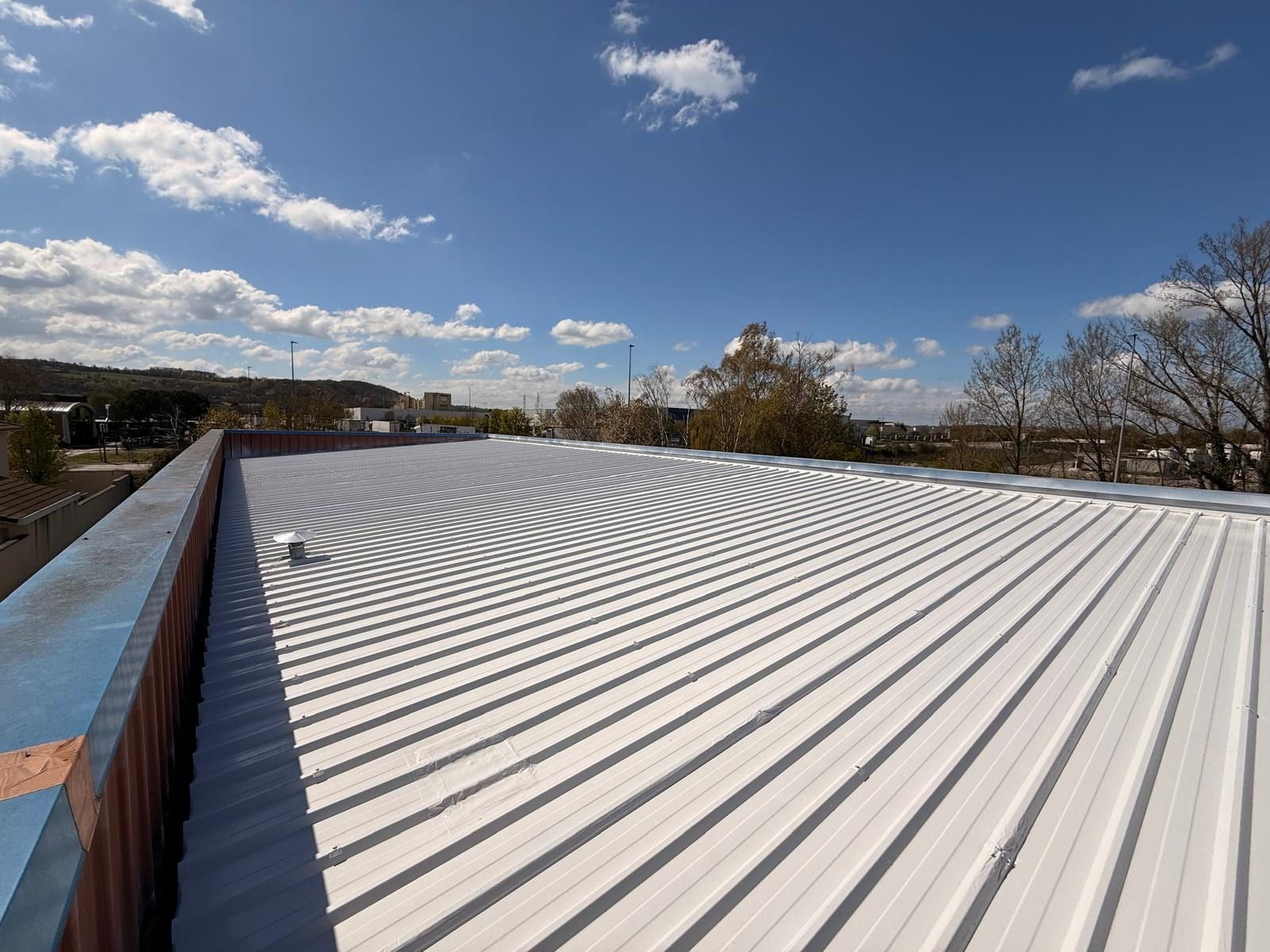
- A PrimaTherm® cool roof (solar reflectance 95 %, emissivity 0.89, SRI 120) sends the radiation back towards the sky: a surface brought from 50–70 °C down to 25–35 °C, less heat released at night, less air-conditioning heat rejected into the street.
- Los Angeles, New York and Paris have each, in their own way, built light-coloured roofs into their adaptation policies; in France, ADEME and Cerema list the cool roof among the levers for urban cooling.
- The district-scale effect appears when a significant share of the roofs is treated: large industrial, logistics, retail and public roofs are therefore the first to mobilise.
What is an urban heat island?
The urban heat island is the rise in temperature of an urbanised area compared with the rural areas around it. The phenomenon has been known since the 19th century, but it takes on new importance with the multiplication of heatwaves. It shows mainly at night: the countryside cools quickly after sunset, while the city slowly releases the heat accumulated in its materials. In Paris, the measurement campaigns of Météo-France and the work of the Paris urban planning agency (APUR) have recorded differences of around ten degrees between the centre and the outer suburbs on the hottest nights; in Lyon, Marseille or Toulouse, the orders of magnitude are comparable in the densest districts.
Three families of causes combine:
- Absorption of solar radiation by materials. Bitumen, dark tiles, grey or brown steel decks: these surfaces reflect only 5 to 20 % of the energy they receive. They rise to 50–70 °C in the height of summer, store heat deep down, then release it at night into the ambient air.
- Urban geometry. Narrow streets lined with tall façades trap radiation through multiple reflections and slow the wind, which limits the evacuation of heat.
- Anthropogenic heat and the lack of vegetation. Air conditioners rejecting on the façade the heat extracted from buildings, engines, industrial activities; conversely, few trees, few permeable soils, and therefore little evapotranspiration and little shade.
The health, energy and economic consequences
UHI is not a topic for urban planners only. Its effects are concrete:
- Public health. The French public health agency (Santé publique France) points out that heat-related risk depends as much on nights as on days: when the temperature does not drop below 20–24 °C at night, the body does not recover. The elderly, infants, the chronically ill and exposed workers are the first affected. Dense districts with little vegetation often combine a marked UHI and a vulnerable population.
- Energy. Each additional degree of outdoor air increases the load on air conditioners and degrades their efficiency. The heat rejected by chillers in turn warms the street: the city enters a loop where air conditioning worsens the cause it fights. Summer peaks in electricity consumption strain the grid at the moment it is most constrained.
- Comfort and productivity. Offices, workshops, shops and schools located in the hottest districts suffer prolonged discomfort, with the consequences described in our guide on heatwaves and building protection.
- Infrastructure. Roads that deform, rails that expand, networks that heat up: urban heat has a maintenance cost.
The projections of the French DRIAS portal and of Météo-France indicate a clear increase in the number of hot days and nights in all the large French conurbations by 2050. Without adaptation of the building stock, UHI will amplify every episode.
Why roofs are a decisive lever
Seen from the sky, a city is made of roofs. In a business park, a logistics platform or a shopping centre, the roof represents almost all of the sun-exposed surface; in the city centre, it remains the surface that receives the most direct radiation between 11 am and 5 pm. Acting on roofs has three advantages over the other levers:
- Scale. A single 10,000 m² logistics roof is equivalent to hundreds of individual house roofs.
- Speed. A reflective coating is applied in a few days to the existing roof, with no structure or network, whereas a tree takes ten years to provide shade and a green roof requires a reinforced load-bearing structure.
- The double benefit. The same action that cools the district reduces the building’s heat load and its air-conditioning consumption: the owner finds a direct interest in it, which makes deployment fundable without systematic subsidy.
Our what is a cool roof page details the principle; the one on the solar reflectance index (SRI) of a roof explains how to compare surfaces.
How a cool roof cools the city
The physical mechanism
Three quantities describe the behaviour of a roof under the sun: solar reflectance (the share of radiation sent back), thermal emissivity (the ability to re-emit absorbed heat as infrared) and the SRI, which combines the two. The PrimaTherm® system applied by Hélios has a reflectance of 95 % (ASTM E903-12), an emissivity of 0.89 (ASTM C1371-15) and an SRI of 120 (ASTM E1980), maintained after 4,000 h of accelerated QUV ageing.
At the scale of the building, the surface goes from 50–70 °C down to 25–35 °C, i.e. up to −30 °C. At the scale of the district, the effects are of three kinds:
- Less heat stored during the day, therefore less released at night. This is the direct contribution to reducing the night-time UHI, the most dangerous for health.
- Less hot air produced above the roofs. A roof at 30 °C warms the layer of air above it far less than a roof at 60 °C; the upper floors of neighbouring buildings and the inner courtyards benefit.
- Less air-conditioning heat rejected. A building whose roof is treated consumes up to 40 % less air conditioning; its chillers reject correspondingly less heat into the street.
What the simulations say
The Lawrence Berkeley National Laboratory, a pioneer on the subject in the United States, has shown by simulation that the generalisation of light-coloured roofs and pavements lowers the air temperature of cities by around 1 °C on average, more at the hottest hours and at surface level. In Paris, the EPICEA project led by Météo-France and CSTB after the 2003 heatwave simulated several adaptation scenarios; reflective roofs are among the measures that reduce the air temperature at pedestrian height, with an effect that grows with the share of the stock treated. In France, ADEME and Cerema list the cool roof among the urban cooling solutions, alongside vegetation, de-sealing of soils and water in the city.
This work converges on one point: the district effect is proportional to the surface treated. An isolated roof protects its building; a stock of roofs changes the local climate.
At the scale of a business park
Take a logistics or industrial zone on the outskirts: a few dozen buildings, steel deck or bitumen roofs of 2,000 to 20,000 m² each, few trees, many car parks. In summer, these roofs form a sheet of surfaces at 60 °C and more, which warms the air carried by the wind towards the residential districts downwind. Treating the roofs of the most extensive buildings amounts to removing, in a few weeks of works, the largest source of heat in the zone. For the estate manager, each building treated reduces its own air-conditioning load; for the local authority, the zone stops feeding the UHI of the neighbouring district. This is the logic followed by programmes that target large public, retail and logistics roofs first rather than the pitched roofs of houses.
Measuring the effect, before and after
A serious project is measured. At the scale of the building, infrared thermography compares the treated area and a control area on the same day, at the same time: this is how the 29 °C difference was recorded at the handover of our 5,900 m² project in Marignane. Temperature sensors placed under the roof and in the premises, read before and after application, complete the evidence; reading the air-conditioning meters over two comparable summers gives the energy translation. At the scale of the district, local authorities rely on networks of urban sensors, on mobile measurements (instrumented vehicles or bicycles) and on thermal satellite imagery, which clearly distinguishes light roofs from dark roofs. These tools make it possible to target the roofs whose treatment will have the most effect, and then to verify the result rather than assume it.
Pioneering cities: Los Angeles, New York, Paris
Los Angeles
As early as 2014, the city built cool-roof requirements into its building code for new homes and re-roofing, and is running light-coloured pavement trials in parallel. The Cool Roof Rating Council, the North American reference body, keeps the register of measured products there. The best-documented result is the drop in surface temperature in the treated districts; the effect on the ambient air builds up as the stock is transformed.
New York
The NYC CoolRoofs programme, launched in 2009, has had several million square feet of roofs painted white, primarily on public, non-profit and social housing buildings, training people far from employment in the application. It is the most accomplished example of a large-scale deployment led by a local authority, with a social justice logic: the districts most exposed to heat are treated first.
Paris
Paris has approached the subject through public buildings and public space: the Oasis schoolyards programme transforms asphalt schoolyards into cooler spaces (permeable ground, vegetation, shade, light-coloured surfaces), and the new local planning plan includes bioclimatic objectives, including the performance of roofs against heat. APUR’s studies map the UHI at street level and identify priority districts. Our local guide on reflective roofs in Paris and our Paris cool roof page (both in French) detail what this means for an owner or a manager.
In France, a spreading momentum
Lyon, Marseille, Montpellier, Toulouse, Bordeaux and Nice each have a climate plan that addresses urban cooling, with their own terms and calendars. We list the known schemes, without promising any, in the article cool roofs required or encouraged: which cities in France.
Cool roofs and other anti-UHI solutions: a comparison
No solution is sufficient on its own. The following table places the cool roof among the available levers.
| Lever | Mechanism | Time to effect | Constraints | Relevance on large roofs |
|---|---|---|---|---|
| Cool roof (reflective coating) | Reflection of radiation, low storage | Immediate | Sound substrate, maintenance every 12–15 months | Very high: steel deck, bitumen, membrane |
| Green roof | Evapotranspiration, shading of the substrate | Gradual (rooting) | Load-bearing structure, root-resistant waterproofing, irrigation, maintenance | Limited to structures designed for it |
| Tree planting | Shade, evapotranspiration | 5 to 15 years | Soil, water, underground networks | Not applicable on roofs |
| Light-coloured or permeable pavements and surfaces | Reflection, infiltration | Immediate to gradual | Roads, public budget | Not applicable on roofs |
| Water in the city (fountains, misting) | Evaporation | Immediate, very localised | Water consumption, maintenance | Not applicable on roofs |
The detailed comparison cool roof or green roof deals with the most frequently debated case. Remember the essential point: on the industrial, logistics, retail and office stock, whose roofs can support neither substrate nor trees, the cool roof is the fastest lever to deploy, and it can be combined with vegetation wherever the structure allows it.
What it changes for your building
The collective interest is only achieved if each owner finds their own in it. A roof treated with PrimaTherm® brings:
- up to −30 °C on the roof surface and up to −6 °C felt inside depending on insulation;
- up to −40 % air-conditioning consumption (15 to 25 % in French climate zone H1, 20 to 30 % in H2, 25 to 40 % in H3);
- waterproofing preserved from thermal shock;
- a contribution that can be declared in a CSR approach or in the trajectory of the French tertiary-sector decree;
- application without lifting equipment, site in operation, in a few days.
Hélios’s references bear witness to it: 5,900 m² of bitumen membrane on three buildings at Airbus Marignane with −29 °C measured on the surface on 19 June 2026, the TGV maintenance centre in Lyon and an aerospace site at Le Bourget. The sectors hub sets out the specific stakes for industry, logistics, retail, public buildings and residential blocks.
Territorial equity: starting with the most exposed districts
UHI maps often overlap with those of deprivation: dense districts, few trees, poorly insulated housing, little air conditioning. The most effective public programmes, in New York as in the Paris Oasis schoolyards, targeted these areas first. For a social landlord, a municipality or an estate manager, treating as a priority the roofs of the schools, sports halls, housing estates and facilities of these districts is both the fairest and the most effective move: they are often large flat roofs or steel decks, easy to treat without lifting equipment. The cool roof for public buildings page details the approach for a local authority.
Misconceptions about white roofs in the city
- “A white roof dazzles the neighbours.” The PrimaTherm® topcoat is matt: it diffuses light instead of reflecting it like a mirror. On a flat roof or a low-slope steel deck, the surface is in any case not visible from the street. The case of roofs overlooked by glazed buildings is studied during the assessment.
- “White gets dirty and loses its effect.” Soiling does reduce the reflectance of any light surface. That is why the system includes an anti-soiling topcoat and why we plan low-pressure water cleaning every 12 to 15 months. See cool roof maintenance.
- “In winter, you lose what you gain in summer.” The winter sun is low and strikes mainly the façades; sunshine is weak and insulated roofs transmit little. The annual balance remains positive everywhere in France. See cool roofs in winter.
- “Solar panels make the cool roof pointless.” On the contrary: photovoltaic modules occupy only a fraction of the roof, and a cooler roof slightly improves their efficiency. See cool roofs and solar panels.
- “An ordinary white paint does the same thing.” An ordinary building paint reflects far less radiation and yellows or gets dirty within a few seasons, with no test report. The difference lies in the measured values (reflectance, emissivity, SRI), the accelerated ageing and the 4-layer application protocol. See cool roof coating.
Outlook: towards a generalisation of light-coloured roofs?
Three trends are emerging for the decade:
- Integration into planning documents. After vegetation, roof albedo is entering bioclimatic local plans and climate plans. The debate is about where to set the cursor between incentive and obligation; the large metropolitan areas favour progressive obligation on new builds and major renovations, and incentives on the existing stock.
- Fine-grained heat mapping. Satellites, urban sensors and digital twins make it possible to target the roofs whose treatment will have the most effect, and to measure the results.
- New-generation coatings. Infrared-reflecting pigments for light non-white tints, anti-soiling topcoats that maintain reflectance over time, coupling with photovoltaics. See new technologies in cool roofing.
For a decision-maker, the conclusion is simple: a roof treated today protects the building from next summer, gets ahead of tightening requirements, and takes part in a collective effort whose benefits are already being measured in the cities that have committed to it.
Sources
- Météo-France, urban heat islands and heatwaves: https://meteofrance.com/
- APUR, studies on the Paris heat island: https://www.apur.org/
- Cerema, heat islands: acting in the territories: https://www.cerema.fr/fr/actualites/ilots-chaleur-agir-territoires-adapter-villes-au-changement
- ADEME, urban cooling and adaptation: https://www.ademe.fr/
- City of Paris, Oasis schoolyards programme: https://www.paris.fr/pages/les-cours-oasis-7389
- Santé publique France, high temperatures and heatwaves: https://www.santepubliquefrance.fr/determinants-de-sante/climat/fortes-chaleurs-canicule
- DRIAS portal, climate projections: https://www.drias-climat.fr/
- ASTM E1980 standard (SRI calculation): https://store.astm.org/e1980-11r19.html
Frequently asked questions
Does a single cool-roofed building have an effect on the urban heat island?
On its immediate surroundings, yes: the roof stops radiating into the ambient air and towards taller neighbouring buildings. On the temperature of a whole district, the effect becomes measurable when a significant share of the roofs is treated, which the simulations of Météo-France, APUR or the Lawrence Berkeley National Laboratory put at several tens of percent of the roof stock. Every large roof treated counts, and public or logistics buildings, which are very extensive, weigh heavily.
Does a white roof create glare or light pollution?
No. The coating reflects solar radiation towards the sky during the day; it emits nothing at night. On a flat roof or a low-slope steel deck, the surface is not visible from the street. The only cases to study are roofs overlooked by glazed offices: the PrimaTherm® topcoat is matt, which limits specular reflections.
Cool roof or green roof: which is the better solution against UHI?
Both act, through different mechanisms: vegetation cools by evapotranspiration as long as it is watered, the cool roof by reflection without consuming water. A green roof requires a load-bearing structure, suitable waterproofing and maintenance; a cool roof is applied in a few days to the existing roof. On a stock of industrial and logistics roofs, the cool roof is the only realistic option at scale; the two can be combined on roofs that allow it.
Do French cities encourage cool roofs?
Increasingly, through their climate plans, their planning documents and programmes on public buildings (schools, sports halls). The terms vary from one local authority to another and change quickly: we track them in a dedicated article and check, project by project, what applies in your municipality.
Does a cool roof increase heating needs in winter and therefore emissions?
Very little. The winter sun is low and strikes mainly the façades; sunshine is weak and insulated roofs transmit little. Over the year, the air-conditioning savings prevail by far, and the reduction in heat rejected by air conditioners in summer directly benefits the district.
How can a homeowner contribute?
A flat-roofed house or a small residential block can be treated with the same system as our industrial projects. For areas under 500 m², PrimaTherm® coating is available from the online shop (in French) with an application guide; changing the colour of a roof generally requires a prior declaration to the town hall.