Key takeaways
- The Solar Reflectance Index (SRI) combines in a single number the solar reflectance and the thermal emissivity of a surface, according to the ASTM E1980 standard.
- The scale is set on a reference black (0) and a reference white (100); a surface that performs better than this white exceeds 100.
- PrimaTherm® reaches an SRI of 120 when new (95 % reflectance, 0.89 emissivity) and 119 after 4,000 h of accelerated QUV ageing: the SRI is maintained.
- A high SRI means a roof close to the air temperature: 25–35 °C instead of 50–70 °C for a dark roof, i.e. up to −30 °C.
- The SRI is the common criterion of sustainable-building frameworks, incentive sheets and climate plans: it is the figure to demand on a product data sheet.
What is the Solar Reflectance Index?
The Solar Reflectance Index, or SRI, measures a surface’s ability to stay cool under the sun. It does not merely say whether the surface is light-coloured: it takes into account two physical properties measured in the laboratory.
- Solar reflectance (or albedo) is the share of incident solar radiation that the surface sends back, over the whole spectrum (ultraviolet, visible, near infrared). It is measured according to ASTM E903. A dark roof in bitumen or grey steel deck reflects only 5 to 20 % of the energy received; a standard white paint, 70 to 80 %; the PrimaTherm® system, 95 %.
- Thermal emissivity is the surface’s ability to re-emit, as far infrared, the heat it has absorbed. It is measured according to ASTM C1371. Bare metal emits poorly (0.1 to 0.3) and stays hot; a painted surface emits well. PrimaTherm® emits at 0.89.
The ASTM E1980 standard combines these two values in a calculation of the surface’s equilibrium temperature, under conventional conditions of sunshine, wind and air temperature, and positions the result on a scale where a reference black (reflectance 0.05, emissivity 0.90) is worth 0 and a reference white (reflectance 0.80, emissivity 0.90) is worth 100. The complete method, with the formulas and an example, is detailed on our page Solar Reflectance Index of a roof.
Why an SRI can exceed 100
Many readers are surprised by an SRI of 120. The reason is simple: the standard’s reference white reflects 80 % of the radiation. A surface that reflects 95 % with an equivalent emissivity stays cooler than this white, and therefore sits beyond 100 on the scale. The SRI is not a percentage; it is a position index relative to two references.
Why the SRI is the right criterion for comparing roofs
Two surfaces can have the same apparent colour and very different thermal behaviours: one reflects the near infrared, the other absorbs it; one re-emits heat well, the other stores it. Reflectance alone does not tell the whole story, nor does emissivity. The SRI integrates both and gives a single answer to the question that matters: at what temperature will this surface stabilise in full sun?
This is why the SRI has become the reference criterion:
- for sustainable-building frameworks (HQE, BREEAM, LEED) for reducing the heat island, see cool roof and HQE, BREEAM, LEED certifications;
- for the climate plans and planning documents of several metropolitan areas, which are starting to set albedo or SRI thresholds for roofs;
- for incentive sheets, including the French energy-savings certificates (CEE) sheet BAT-EN-112, which defines the reflective coating by its measured characteristics, and whose eligibility remains conditional (commercial tertiary building, volume heated and cooled by a heat pump);
- for the specifications of building owners who want to compare offers on an objective basis.
What a high SRI changes in practice
On the surface temperature
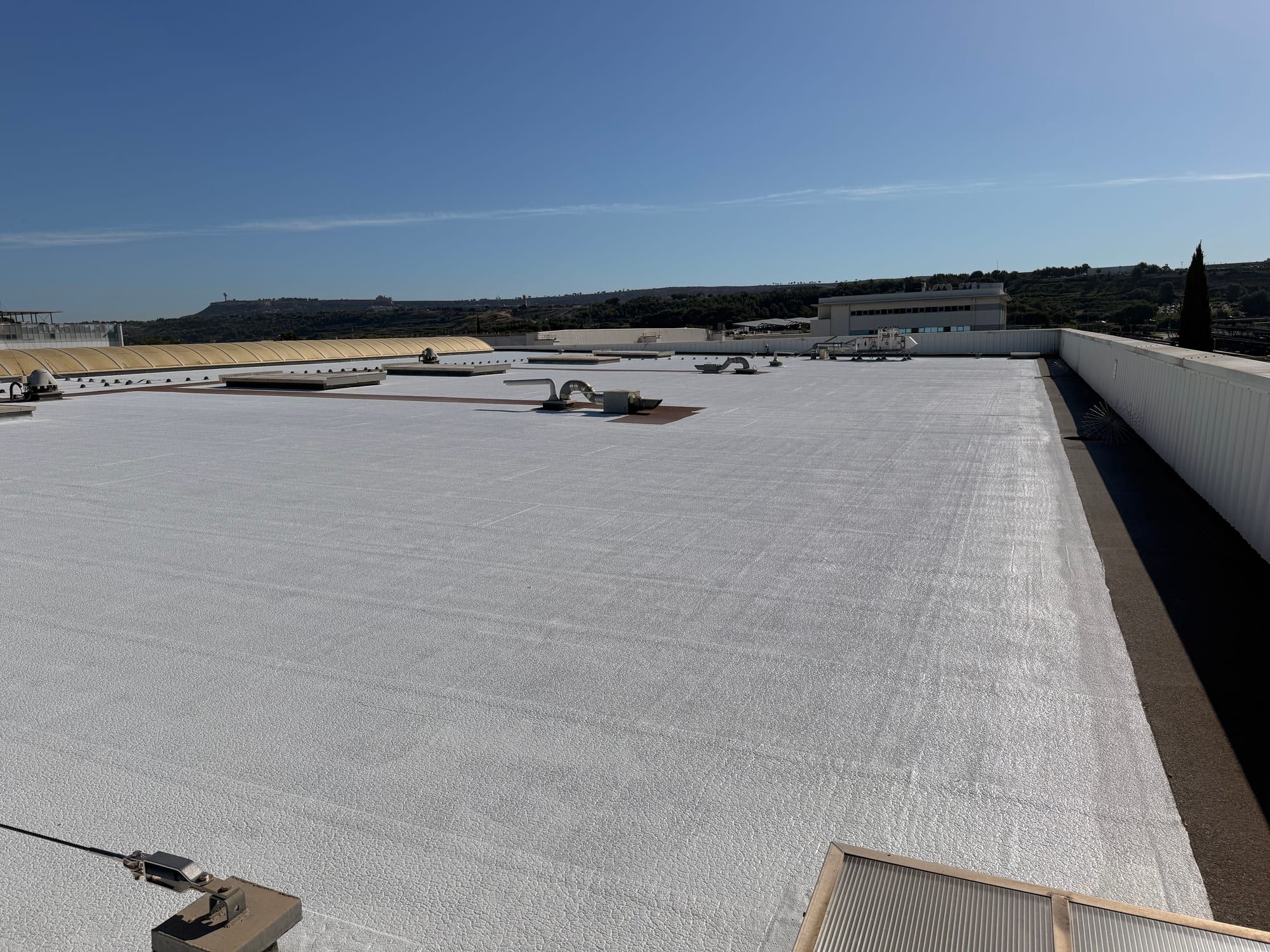
Under summer sunshine, a dark roof reaches 50 to 70 °C. A roof with an SRI of 120 stabilises between 25 and 35 °C, i.e. up to −30 °C. This is not an extrapolation: on our Marignane project, the infrared measurement of 19 June 2026 recorded 28.6 °C on the treated area against 57.8 °C on the control area, i.e. −29 °C, on 5,900 m² of bitumen membrane treated between April and June 2026. See the Airbus Marignane project.
On the building
Less heat on the surface means less flow through the insulation, a ceiling that no longer radiates, and air conditioning that returns to normal conditions: up to −6 °C felt inside depending on insulation, up to −40 % air-conditioning consumption (15 to 25 % in French climate zone H1, 20 to 30 % in H2, 25 to 40 % in H3). These ranges are refined, site by site, in the free roof study. They contribute directly to the objective of the French tertiary-sector decree (Éco Énergie Tertiaire), which requires −40 % final energy consumption by 2030 for tertiary buildings over 1,000 m².
On the city
A high-SRI roof stores little heat during the day and releases little at night: this is the cool roof’s contribution to reducing urban heat islands, detailed in our guide cool roofs and urban heat islands.
PrimaTherm®: an SRI of 120, maintained over time
The PrimaTherm® system, developed by Primacoating and applied by Hélios, reaches an SRI of 120 thanks to a water-based formulation whose values are measured by laboratories according to the reference standards:
| Quantity | Value | Standard |
|---|---|---|
| Solar reflectance | 95 % | ASTM E903-12 |
| Thermal emissivity | 0.89 | ASTM C1371-15 |
| SRI when new | 120 | ASTM E1980 |
| SRI after 4,000 h of accelerated QUV ageing | 119 | ISO 16474-3 then ASTM E1980 |
| External fire performance | Broof(t3) | CSTB report RA23-0010 |
The decisive point is not the initial value but its retention. The QUV test subjects specimens to cycles of ultraviolet light, heat and condensation that simulate years of exposure. After 4,000 h, the measured SRI is 119: the performance is maintained. The conventional service life used by the French CEE sheet is 20 years. The details of the reports are on the page PrimaTherm® certifications.
This result comes from the system itself: a PH169 bonding primer, a PH107 reflective base coat applied in two passes that carries the reflectance, and a PH107TCL anti-soiling topcoat that protects the base from UV and dirt. Four layers, three products, a controlled application protocol. See PrimaTherm® cool roof coating.
Reading a product data sheet: the traps to avoid
The SRI has become a sales argument, which calls for vigilance. Before comparing two offers, check:
- The presence of the three values. Reflectance without emissivity does not allow an SRI to be calculated. A “reflectivity” stated without a standard is not a measurement.
- The standards and the laboratory. ASTM E903 (or EN 410 for some European measurements) for reflectance, ASTM C1371 for emissivity, ASTM E1980 for the calculation. The report must be dated and identifiable.
- The condition of the surface tested. New, aged, cleaned? An SRI measured when new commits to nothing if it is not accompanied by an ageing test.
- The shade. The certified values of PrimaTherm® apply to white. A light non-white shade necessarily has a lower reflectance and must have its own test report. See white vs coloured cool roof.
- The application protocol. A product with an SRI of 120 applied in one layer that is too thin, or on a poorly prepared substrate, will not give 120 on the roof. Thickness checks and the site monitoring sheet are part of the performance.
The SRI over time: maintenance and measurement
Soiling (dust, pollen, industrial deposits, sea spray) reduces the reflectance of any light-coloured surface. The anti-soiling topcoat limits the adhesion of dirt; low-pressure water cleaning every 12 to 15 months restores the reflectance. A yearly inspection checks the condition of the film, the upstands and the drains. See cool roof maintenance and durability.
On site, performance is easily verified: infrared thermography of the treated roof and of a control area on the same day, temperature readings under the roof before and after application, air-conditioning meter readings over two comparable summers. These measurements are included in the file delivered at handover.
Sources
- ASTM E1980, method for calculating the Solar Reflectance Index: https://store.astm.org/e1980-11r19.html
- ASTM International, E903 and C1371 standards: https://www.astm.org/
- Primacoating, manufacturer of the PrimaTherm® system: https://www.primacoating.com/
- ADEME, OPERAT platform and tertiary decree: https://operat.ademe.fr/
- PrimaTherm® test reports (reflectance, emissivity, SRI, QUV, fire): presented on the certifications page and available on request.
Frequently asked questions
What is the SRI of the PrimaTherm® reflective coating?
120 when new, calculated according to ASTM E1980 from a solar reflectance of 95 % (ASTM E903-12) and a thermal emissivity of 0.89 (ASTM C1371-15). After 4,000 h of accelerated QUV ageing (ISO 16474-3), the measured SRI is 119: it is maintained.
How can an SRI exceed 100?
The SRI scale is set on two reference surfaces: a standard black at 0 and a standard white at 100. A surface that reflects more or re-emits better than this reference white stays cooler than it, and its SRI mechanically exceeds 100. This is not a calculation anomaly; it is the sign of performance above the reference white.
Does the SRI of a roof decrease over time?
Every surface soils and ages, which reduces its reflectance. The question is by how much. For PrimaTherm®, the 4,000 h accelerated QUV ageing test gives an SRI of 119 against 120 when new; the anti-soiling topcoat and low-pressure water cleaning every 12 to 15 months maintain the performance in real conditions.
What SRI is needed for a cool roof to be effective?
Sustainable-building frameworks and some incentive sheets set thresholds, often around 78 to 100 for low-pitch roofs. The higher the SRI, the closer the surface stays to the air temperature: between an SRI of 80 and an SRI of 120, the difference in surface temperature in midsummer is counted in tens of degrees.
Where can I find a product’s SRI and how can I check that it is reliable?
On the manufacturer’s test report, which must state the standards used (ASTM E903, ASTM C1371, ASTM E1980), the laboratory, the date and the conditions. A value announced without a report, or with reflectance alone without emissivity, does not allow an SRI to be calculated. Hélios provides the PrimaTherm® reports on request.