Key points
- Five environmental effects: less heat released into the city, less air conditioning and therefore less electricity and fewer emissions, longer-lasting waterproofing and therefore less waste, a water-based product with a low content of volatile organic compounds, and a coating that can be recoated at the end of its life.
- The defensible orders of magnitude: up to −30 °C on the roof surface, up to −40 % air-conditioning consumption depending on the climate zone. No tonnage of avoided emissions can be calculated before the study.
- A cool roof is not a habitat for biodiversity; it can be combined with a green roof where the structure allows it, and it is the only realistic solution on large industrial and logistics roofs.
- It is rewarded by the HQE, BREEAM and LEED schemes and by the French tertiary-sector decree.
1. Less heat released into the city
A dark roof absorbs most of the solar radiation, reflects only 5 to 20 % of the energy it receives, reaches 50–70 °C and releases that heat into the surrounding air both day and night. At the scale of a district, these surfaces feed the urban heat island, which can reach around ten degrees of difference between the city centre and the countryside on the hottest nights.
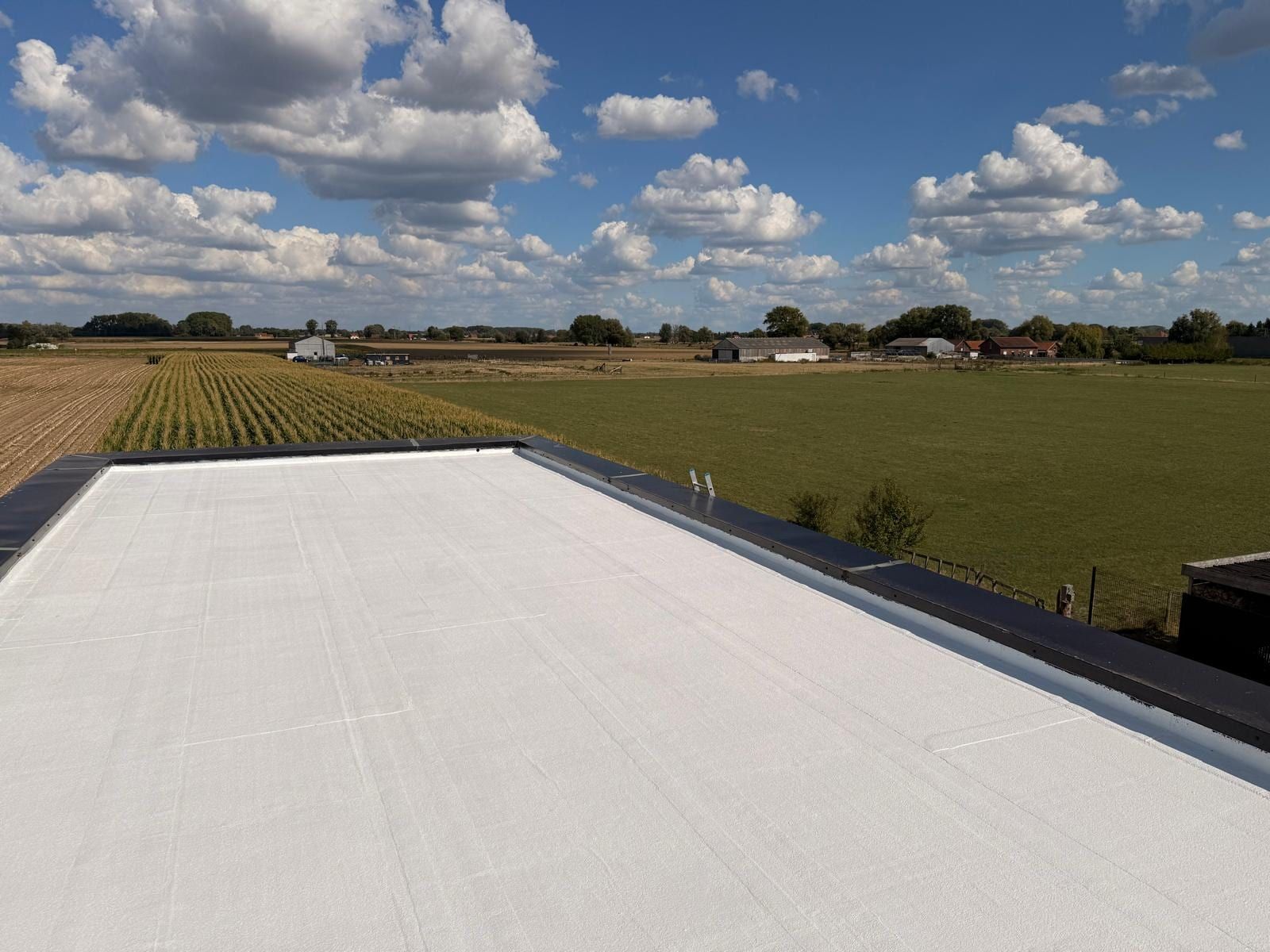
A PrimaTherm® cool roof (solar reflectance 95 %, emissivity 0.89, SRI 120) sends the radiation back towards the sky and stabilises at 25–35 °C. It stores little and re-emits quickly. The French agencies Cerema and ADEME list the cool roof among the levers for urban cooling; simulations carried out on Paris or by the Lawrence Berkeley National Laboratory show that the effect on air temperature grows with the share of the roof stock that is treated. The details are in our guide on cool roofs and urban heat islands.
At a wider scale, research has also documented that increasing the albedo of urban surfaces sends back into space a share of the radiation that would have been converted into heat: a direct cooling effect, distinct from the reduction in emissions, but whose magnitude depends on the surfaces involved and cannot be quantified for a single building.
2. Less air conditioning, therefore less electricity and fewer emissions
This is the most tangible effect for a facility manager. By reducing the heat load entering through the roof, a cool roof reduces air-conditioning consumption by up to −40 %: 15 to 25 % in French climate zone H1, 20 to 30 % in H2, 25 to 40 % in H3. Less electricity consumed during summer peaks means less strain on the grid at the moment it is most constrained, and fewer emissions associated with generation.
Two clarifications, for the sake of honesty. First, we do not publish a tonnage of avoided emissions: it depends on your actual consumption, the share of air conditioning, the emission factor of your electricity supply and your uses; it is calculated after the free roof study, from your data. Second, a building without air conditioning does not reduce its consumption; it gains in comfort, which has value for the occupants, and it often avoids installing an air-conditioning system that would have consumed energy. For tertiary buildings over 1,000 m², the reduction obtained is declared under the French tertiary-sector decree; see the French tertiary decree and cool roofs.
Finally, the question of winter: the winter sun is low and strikes mainly the façades, and an insulated roof transmits little; the loss of winter solar gains is small compared with the summer savings. See cool roofs in winter.
3. Longer-lasting waterproofing, therefore less waste
The ageing of a bitumen membrane or a steel deck is accelerated by thermal cycles: expansion during the day at 50–70 °C, contraction at night. By bringing the surface down to 25–35 °C, a cool roof divides the thermal amplitude that the waterproofing has to withstand. The binders age more slowly, the joints and overlaps work less, and cracks appear later.
In practical terms, this postpones a waterproofing renovation, that is to say the removal and disposal of thousands of m² of membrane, and the transport and installation of new materials. A cool roof is applied to the existing roof, provided it is sound, after localised repairs and without removal. See cool roof on bitumen roofs and cool roof on waterproofing membranes.
4. A water-based product, applied without lifting equipment
The PrimaTherm® system (PH169 primer, PH107 reflective base coat in two passes, PH107TCL anti-soiling topcoat) is water-based, with a low content of volatile organic compounds and no solvent. It is applied by roller or by airless spraying; once dry, it releases nothing into runoff water. The safety data sheet and the test reports are available; the external fire classification is Broof(t3) (CSTB report RA23-0010). See PrimaTherm® certifications.
The application method matters too: with no lifting equipment, the drums and machines stay on the ground and only the hoses go up onto the roof. No crane, no road closure, no lorry rotations to dispose of an old roof, and a site that stays in operation.
5. A coating that can be recoated at the end of its life
The SRI of PrimaTherm® is maintained after 4,000 h of accelerated QUV ageing (119 against 120 when new); the conventional service life adopted by the French CEE sheet is 20 years. At the end of this period, on a sound substrate, the coating is cleaned, checked and recoated with a new base coat and a new topcoat, without removal. Material consumption is then limited to the renewed layers. Intermediate maintenance comes down to low-pressure cleaning with clean water every 12 to 15 months, without aggressive detergent; see cool roof maintenance and durability.
Biodiversity: what a cool roof does not provide, and how to combine it
A cool roof is not a habitat. It offers neither substrate, nor vegetation, nor water retention. A green roof, on the other hand, brings biodiversity, rainwater management and evapotranspiration, at the cost of a reinforced load-bearing structure, root-resistant waterproofing, irrigation and maintenance. On roofs that allow it, the two can be combined: vegetation on the areas designed for it, reflective coating on the rest and on the technical areas. On industrial, logistics and retail roofs, which can support neither substrate nor trees, the cool roof is the only realistic action at scale. Our comparison cool roof or green roof details the criteria, and our comparison of ecological roofs (in French) widens the picture to the other options.
By cooling the air of the district, a cool roof also has an indirect positive effect on urban vegetation and wildlife, which suffer from heat stress just as residents do.
The cool roof in an environmental approach
- Building certifications: the HQE, BREEAM and LEED schemes reward the reduction of the heat island effect through high-SRI roofs; PrimaTherm® meets the usual thresholds. See cool roofs and HQE, BREEAM and LEED certifications.
- French tertiary-sector decree (Éco Énergie Tertiaire): an action that can be declared on the OPERAT platform as part of the consumption-reduction trajectory.
- CSR report and carbon footprint: the reduction in consumption measured on your meters feeds your indicators, with your own emission factors.
- Local climate plans: light-coloured roofs are among the recognised adaptation actions; see cool roofs required or encouraged: which French cities.
To go further on the place of the cool roof among low-impact roofing solutions, see our article ecological roofing and cool roofing.
Sources
- ADEME (French environment and energy agency), adaptation to climate change and urban cooling: https://www.ademe.fr/
- Cerema, heat islands: acting in the territories: https://www.cerema.fr/fr/actualites/ilots-chaleur-agir-territoires-adapter-villes-au-changement
- French Ministry of Ecological Transition, greenhouse gas emissions and carbon footprint: https://www.ecologie.gouv.fr/
- ADEME, OPERAT platform (French tertiary-sector decree): https://operat.ademe.fr/
- Primacoating, manufacturer of the PrimaTherm® system: https://www.primacoating.com/
Frequently asked questions
Does cool roofing reduce greenhouse gas emissions?
Yes, indirectly, by reducing air-conditioning consumption by up to 40 % depending on the climate zone, and therefore the electricity consumed and the associated emissions. We do not publish a tonnage of avoided emissions: it depends on your actual consumption, your electricity mix and your uses, and it is calculated after the study, not before.
Is a reflective coating a polluting product?
The PrimaTherm® system is water-based, with a low content of volatile organic compounds and no solvent. It is applied by roller or by spraying, with no release into runoff water once dry, and its safety data sheet is available. It requires neither removal nor disposal of the old roof.
Is a cool roof more environmentally friendly than a green roof?
The two have different merits. A green roof brings biodiversity and water retention but requires a load-bearing structure, a substrate, root-resistant waterproofing, water and maintenance. A cool roof is applied to the existing roof without any additional resource and acts immediately. On industrial and logistics roofs, it is the only feasible option; on roofs that allow it, the two can be combined.
What happens to the coating at the end of its life?
It is recoated: after cleaning and an adhesion check, a new base coat and a new topcoat restore the performance without removal or membrane waste. This is a clear advantage over replacing a waterproofing system.
Does a cool roof count towards an environmental building certification?
Yes: the HQE, BREEAM and LEED schemes reward the reduction of the heat island effect through high-SRI roofs, and the French tertiary-sector decree takes the reduction in consumption into account. PrimaTherm®'s SRI of 120 meets the usual thresholds of these schemes.