Key points
- EPDM is a synthetic rubber (ethylene-propylene-diene terpolymer) blackened with carbon black, with no plasticiser, highly elastic: it ages well but heats up like any black surface.
- Its surface carries release talc or mica and sometimes oils: a coating applied without cleaning or degreasing comes off. Manufacturers of primers for EPDM require an adhesion test before application.
- PrimaTherm® protocol on EPDM: cleaning, degreasing, adhesion test on a representative area, PH169 primer, PH107 reflective base coat in two passes, PH107TCL anti-soiling topcoat — four layers.
- Seams between sheets, upstands, corners and outlets are examined one by one; a ballasted membrane cannot be treated without removing the ballast.
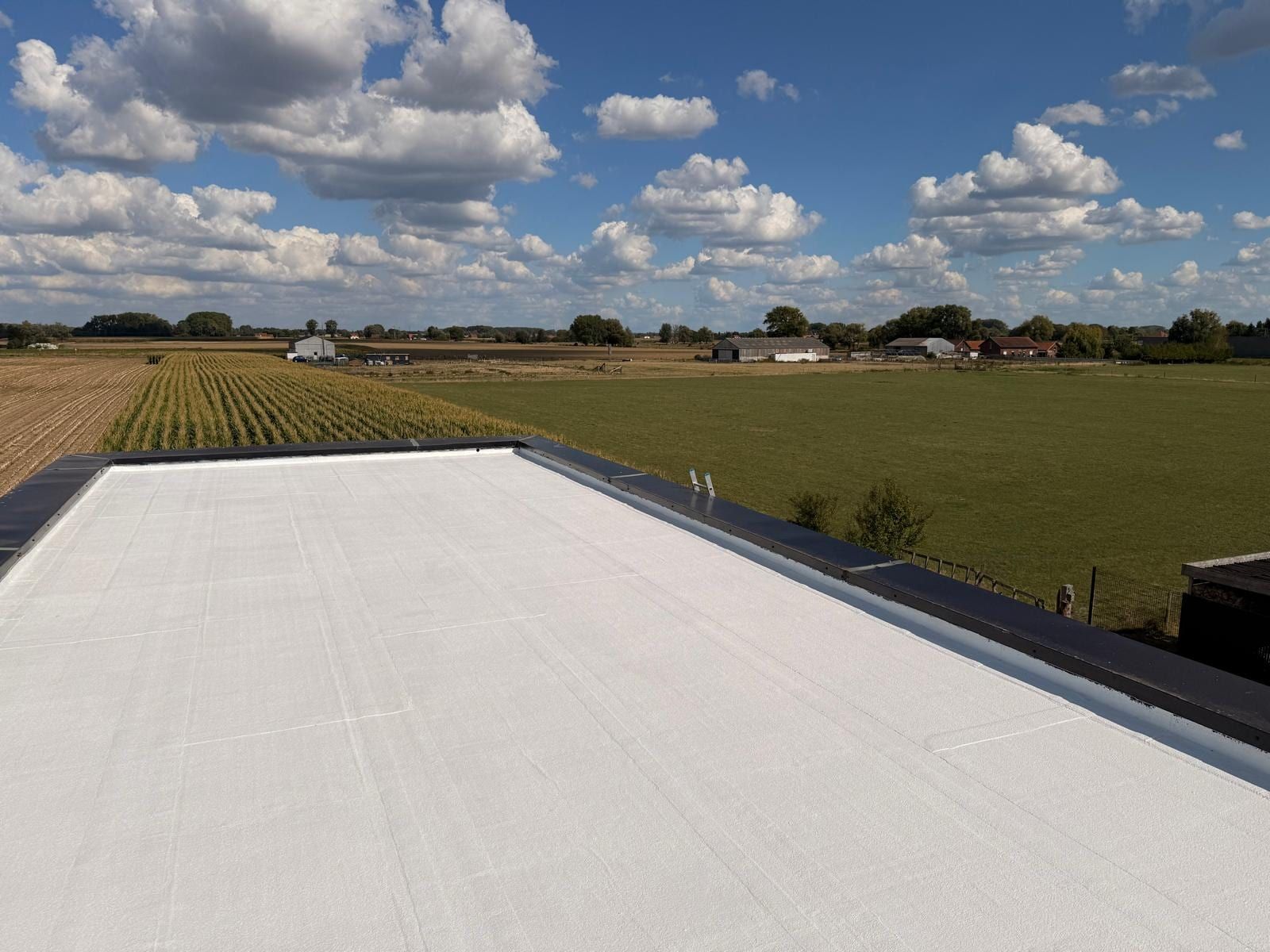
- Result: a surface that goes from 60–70 °C to 25–35 °C and a membrane protected from UV and thermal cycles; the cool roof does not replace an end-of-life waterproofing layer.
EPDM, a membrane that ages well and heats up a lot
EPDM (ethylene propylene diene monomer) is a synthetic rubber in sheets, installed since the 1980s on the flat roofs of offices, schools, shops and apartment buildings. The EPDM Roofing Association, which brings the manufacturers together, describes it as a terpolymer of ethylene, propylene and a diene; its black version owes its colour to carbon black, which absorbs ultraviolet rays and converts them into heat, while the white version uses titanium dioxide. The US Environmental Protection Agency (EPA) classifies it among single-ply membranes: a synthetic rubber “with seams that must be glued or taped together”.
Two properties explain its reputation. It contains neither plasticiser nor flame retardant — a manufacturer such as Elevate stresses that its characteristics remain stable over time, unlike PVC, whose plasticisers migrate for years — and it stretches by more than 300 % while resisting ozone, UV and extreme temperatures. In France, these sheets come under harmonised standard EN 13956 (plastic and rubber sheets for roof waterproofing, CE marking) and their installation under Avis Techniques, French technical approvals that the CSTB defines as the opinion of a group of experts “on the fitness for use of innovative construction processes”.
The downside is thermal. For a black single-ply membrane, the EPA reports a reflectance of 0.04 to 0.05 and an emissivity of 0.80 to 0.90: it absorbs almost everything and radiates towards the interior. The EPA measures conventional roofs 31 to 47 °C hotter than the air; in our diagnoses, black EPDM reaches 60 to 70 °C in summer. Our guide to cool roofs on waterproofing membranes places EPDM among the other membranes.
Why the surface of EPDM is tricky
New EPDM leaves the factory dusted with talc or mica, release agents that prevent the sheets from sticking to one another in the roll. These inorganic powders remain partly on the surface for years, joined by dust, pollen and, on some membranes, a slight exudation of oils. Manufacturers of primers for EPDM are unanimous: Karnak prescribes slow cleaning, as close to the surface as possible, “in order to remove mica and inorganic release agents”; the technical data sheet of the Sikalastic primer for EPDM states that “talc, dust, oil, ice, snow, or wet conditions inhibit good adhesion”, requires solvent cleaning, sometimes a scouring pad, and demands that you “always complete an adhesion test before application”.
The same data sheet sets conditions that hold for any liquid coating on a membrane: air and substrate at least 3 °C above the dew point, relative humidity below 80 %, membrane perfectly dry after rain or pressure washing. Our conditions for PrimaTherm® are similar: 12 to 35 °C, humidity below 80 %, no rain within 4 h of each layer, substrate dried for 24 to 72 h. The chemical compatibility between a water-based coating and EPDM is therefore not the problem; cleanliness and preparation are.
The adhesion test: method and reading
Two standardised methods qualify the adhesion of a coating:
- ASTM D3359, the tape test: the film is cross-hatched with a cutter, a standardised tape is applied, it is pulled off rapidly at 180° and the share of coating removed is rated from 0 to 5. The standard specifies that it only distinguishes low levels of adhesion and that it was developed for metal substrates; on a flexible substrate, it serves as an indicator, not as an absolute measurement.
- ASTM D4541, the pull-off test: a dolly glued to the film is pulled perpendicularly by a portable tester until failure; the stress and the plane of failure are read (glue, film, interface, substrate). The test is destructive.
On a roof, we proceed more simply: after cleaning and degreasing, a representative area receives the PH169 primer and then the system, under the real conditions of the site; after complete drying, adhesion is checked by cross-cut and pull-off, observing the plane of failure. If the film takes talc or a greasy film away with it, the cleaning is redone and the test repeated; if the interface holds, the roof can be treated. The test precedes any commitment, as the waterproofing membrane page states; on a TPO membrane or on PVC less than ten years old, the answer may be no.
The PrimaTherm® protocol on EPDM
- Diagnosis: age of the membrane, method of installation (bonded, mechanically fixed or ballasted), seams, upstands, blisters, ponding, equipment; the free roof study answers within 48 h, the technical visit confirms.
- Preparation: chlorine-free anti-moss treatment, medium-pressure cleaning below 130 bar, degreasing, rinsing, drying for 24 to 72 h with substrate moisture below 5 %, repair of the seams and upstands by the roofing contractor if necessary.
- Adhesion test on a representative area.
- Application of the four layers: PH169 primer, PH107 reflective base coat in two cross passes, PH107TCL anti-soiling topcoat, without lifting — drums and pumps on the ground, only the hoses go up to the roof. The installation process details each step.
- Inspection and handover: thickness checks, infrared measurements of the treated zone against the control zone, as-built file with the product test reports.
On bitumen, the PH169 primer blocks bleed-through; on EPDM, it is first and foremost a bonding bridge between a smooth, barely porous rubber and the reflective base coat. Its coverage rate is checked at the diagnosis, because EPDM absorbs nothing.
Singular points: seams, upstands, corners, outlets
An EPDM roof lives by its seams: sheets joined by adhesive tapes or seam adhesives, parapet upstands, corners, penetrations and rainwater outlets dealt with by preformed pieces or reinforcement strips. Each point is examined before application.
| Singular point | What we check | What we do |
|---|---|---|
| Seams between sheets | Lifting edges, wrinkles, capillary bridges | Repair by the roofing contractor if open; otherwise the system covers the seam without loading it |
| Parapet upstands | Hold at the top, fixing of the flashing strip | System taken up as far as the coping, with a cutting-in brush |
| Corners and preformed pieces | Adhesion, cracks | Spot repair, then application by brush |
| Outlets and overflows | Leaf guards, back-falls, ponding | Clearing; persistent puddles corrected before application |
| Mechanical fixings | Exposed plates and bars | Check, then covering by the system |
| Ballasted membrane | Gravel, paving slabs on pedestals | No cool roof without removing the ballast: the membrane is already in the shade |
The cool roof forms an elastic, rainproof film that follows the movements of the membrane; it is not a waterproofing layer within the meaning of the French DTU standards. An open seam or a detached upstand is repaired beforehand, never over the top. Our article on the service life of flat-roof waterproofing (in French) helps to read these signs.
Results on EPDM
The PrimaTherm® system reflects 95 % of solar radiation (ASTM E903-12), with an emissivity of 0.89 (ASTM C1371-15) and an SRI of 120 (ASTM E1980), maintained at 119 after 4,000 h of accelerated QUV ageing; it is classified Broof(t3) for external fire performance (CSTB report RA23-0010). On black EPDM, the surface goes from 60–70 °C to 25–35 °C, i.e. up to −30 °C on the roof surface, and the offices under the roof gain up to −6 °C felt inside depending on insulation.
Two references give the order of magnitude. On 1,500 m² of modular offices in La Rochelle, covered with black EPDM, the system was applied after an adhesion diagnosis: roof temperature halved, comfort restored for the occupants. On the 5,900 m² of bitumen membrane at Airbus Marignane, the infrared handover measurement of 19 June 2026 showed 28.6 °C on the treated zone against 57.8 °C on the control zone, i.e. −29 °C.
The gain on air conditioning, up to −40 % air-conditioning consumption depending on the climate zone, is quantified site by site from your consumption data. For buildings covered by the French tertiary-sector decree (Éco Énergie Tertiaire), the cool roof for offices page sets out what is at stake; for the slope, the upstands and the rooflights of a flat roof, see the guide to cool roofs on flat roofs.
What the cool roof does and does not do on EPDM
What it does: a membrane kept below 35 °C instead of 80, expansion cycles two to three times smaller, a barrier to the UV that the carbon black no longer has to absorb, a film that covers surface micro-cracks. Cleaning with low-pressure water every 12 to 15 months maintains the reflectance (see cool roof maintenance, in French).
What it does not do: repair an open seam, re-bond an upstand, or prolong a membrane that has reached the end of its life. When the EPDM has to be redone, the coating versus membrane comparison puts the two options side by side; our answer depends on the condition of your roof, not on what we sell.
Sources
- EPA, Reducing Urban Heat Islands compendium, Cool Roofs chapter (single-ply membranes, EPDM): https://www.epa.gov/sites/default/files/2014-06/documents/coolroofscompendium.pdf
- EPDM Roofing Association, Standard Attributes of EPDM: https://epdmroofs.org/what-is-epdm/why-epdm/standard-attributes/
- Elevate (Holcim), RubberGard EPDM: https://www.holcimelevate.com/uk-en/roofing/epdm/rubbergard-epdm
- Karnak, 507 SPC Primer/Wash for EPDM membranes: https://www.karnakcorp.com/product/507-spc-primerwash-for-epdm-membranes
- Sika, Sikalastic Primer EPDM technical data sheet: https://www.buildsite.com/pdf/sika/Sikalastic-Primer-EPDM-Product-Data-2258987.pdf
- ASTM D3359-23, adhesion by tape test: https://www.astm.org/d3359-23.html
- ASTM D4541-22, pull-off strength of coatings: https://www.astm.org/d4541-22.html
- CSTB, assessment (Avis Technique): https://www.cstb.fr/nos-offres/nos-activites/l-evaluation
- CSTB, CE marking of plastic and rubber sheets for roof waterproofing (EN 13956): https://www.cstb.fr/nos-offres/toutes-nos-offres/marquage-ce-feuilles-etancheite-toiture-plastiques-elastomeres
- French Ministry of Ecological Transition, construction products regulation, EN 13956: https://rpc-construction.ecologie.gouv.fr/feuilles-souples-detancheite-feuilles-detancheite-toiture-plastiques-elastomeres-definitions
- PrimaTherm® test reports (ASTM E903-12, C1371-15, E1980, ISO 16474-3, CSTB RA23-0010): certifications page.
Frequently asked questions
Can a cool roof be applied to an EPDM membrane?
Yes, on sound EPDM, after cleaning, degreasing and an adhesion test on a representative area. The PrimaTherm® system is then applied in four layers: PH169 primer, PH107 reflective base coat in two passes, PH107TCL anti-soiling topcoat. A membrane ballasted with gravel or laid under paving slabs on pedestals cannot be treated without removing the ballast.
Why does the talc have to be removed before a coating is applied?
EPDM sheets are dusted with talc or mica at the factory so that they do not stick to one another. These powders, together with dust and any exudation of oils, form a non-adherent layer: any film applied on top of it comes off. Manufacturers of primers for EPDM require cleaning that removes these release agents, then an adhesion test.
What does the adhesion test on EPDM consist of?
A representative area of the roof receives the primer and the system under the real conditions of the site. After complete drying, adhesion is checked by cross-cut and pull-off, observing where the failure occurs: within the film, a good sign; at the interface, with talc or a greasy film, the cleaning is redone. The standardised reference methods are the ASTM D3359 tape test and the ASTM D4541 pull-off test.
Does EPDM contain plasticisers like PVC?
No. EPDM is a vulcanised rubber with neither plasticiser nor flame retardant, which explains the stability of its characteristics over time. PVC contains plasticisers that migrate to the surface for years: that is why we only work on PVC beyond ten years, with a specific bonding base, whereas EPDM is treated after cleaning and testing.
What happens to the seams between sheets and to the upstands?
They are examined one by one before application. An open seam or a detached upstand is repaired by the roofing contractor, never covered over. The system is then taken up the upstands as far as the coping and applied by brush on the corners and the preformed pieces, so as to leave no black surface that heats up.
What result can be expected on an EPDM roof?
A surface that goes from 60–70 °C to 25–35 °C at the height of summer, i.e. up to −30 °C on the roof surface, and up to −6 °C felt inside depending on insulation in the top-floor rooms. On 1,500 m² of modular offices covered with EPDM in La Rochelle, the roof temperature was halved. The membrane, protected from UV and from thermal cycles, ages more slowly.