A measured subject that has become a production issue
Heat at work was long treated as a matter of comfort, settled with a fan and a bottle of water. Recent summers have changed the scale of the problem: in a workshop, a warehouse or an office under the roof, the temperature at the workstations now exceeds the alert benchmarks every summer, sometimes for weeks. International organisations, prevention institutes and researchers have measured what this costs in hours, errors and accidents. This feature summarises their findings, with the sources to back them, before drawing the consequences for a building.
The thresholds: comfort, alert, danger
There is not one threshold but a scale, which the sources describe in a convergent way.
| Benchmark | Value | Source |
|---|---|---|
| Maximum performance in the office | About 22 °C air temperature, from a review of 24 studies | Seppänen, Fisk and Lei, LBNL, 2006 |
| Productivity loss | 2 to 3 % per degree above 20 °C | WHO and WMO, 2025 |
| Alert benchmark, sedentary activity | 30 °C | INRS |
| Alert benchmark, physical work | 28 °C | INRS |
| Heat stress | Generally above 35 °C, in high humidity | ILO, 2019 |
The Lawrence Berkeley National Laboratory, which reviewed 24 studies on office work, places peak performance at around 71 °F, i.e. about 22 °C, with a decline on either side, while stressing the uncertainty about the size of the losses in real situations. Lan, Wargocki and Lian (Energy and Buildings, 2011) measured in the laboratory that a rise in air temperature degrades performance and that the best result is obtained in a slightly cool environment, and they recommend aiming for a thermal sensation between −0.5 and 0 on the PMV scale rather than the −0.5 to +0.5 range of the comfort standards.
INRS, the French occupational safety institute, points out that French regulations provide neither for a temperature from which action must be taken nor for one above which work would be prohibited, but that 30 °C for sedentary activity and 28 °C for physical work can serve as benchmarks; the actual risk depends on the humidity, the radiation, the clothing and the intensity of the effort. The International Labour Organization defines heat stress as heat in excess of what the body can tolerate without physiological impairment, which generally occurs above 35 °C in high humidity.
What the major international studies say
ILO, “Working on a warmer planet” (2019)
In a scenario of 1.5 °C of warming by the end of the century, the International Labour Organization projects the loss of 2.2 % of total working hours worldwide in 2030, the equivalent of 80 million full-time jobs and 2,400 billion US dollars. Agriculture would account for 60 % of the hours lost and construction for 19 %, but the report stresses that industry, transport and services are affected as soon as the work is carried out in premises that are not cooled.
ILO, “Ensuring safety and health at work in a changing climate” (2024)
Five years later, the ILO estimates that more than 2.4 billion workers, out of 3.4 billion, are exposed to excessive heat in the course of their work, a proportion that has risen from 65.5 % to 70.9 % since 2000. It attributes to excessive heat 22.87 million occupational injuries a year, 18,970 deaths and 2.09 million years of healthy life lost.
WHO and WMO, “Climate change and workplace heat stress” (2025)
The report and the guidance published on 22 August 2025 by the World Health Organization and the World Meteorological Organization take up these orders of magnitude and add the relationship that matters to a production manager: productivity falls by 2 to 3 % per degree above 20 °C. The authors stress the exposure of workers indoors as well as outdoors and call for heat action plans sector by sector.
The meta-analysis by Flouris et al. (2018)
Published in The Lancet Planetary Health, this systematic review pools 111 studies conducted in 30 countries, covering 447 million workers in more than 40 occupations: 35 % of exposed workers experience heat strain during their shift, 30 % of those working under heat strain report productivity losses, and 15 % of those who habitually work in the heat show kidney damage. The core body temperature of exposed workers rises by 0.7 °C on average.
Errors, alertness and accidents
Productivity is only one side of the problem; the other is safety. INRS is explicit: heat increases the risk of accidents because it leads to reduced alertness and longer reaction times; more errors and omissions are observed, it is harder to carry out a task that requires precision, and more dangerous to make a major physical effort in a very hot environment.
The econometric data confirm this. Park, Pankratz and Behrer (IZA, 2021) used the largest workers’ compensation system in the United States, that of California: high temperatures significantly increase injuries, by about 20,000 a year, and the effect persists indoors, in manufacturing and warehousing, including for injuries with no apparent link to temperature, such as falls from height. Heat does not injure only through heat stroke; it degrades attention, and it is attention that protects.
What the employer must do
The general safety obligation of article L. 4121-1 of the French Labour Code applies to heat as it does to any risk. Since 1 July 2025, decree no. 2025-482 of 27 May 2025 has added a chapter dedicated to episodes of intense heat, defined by reference to the Météo-France weather warnings: articles R. 4463-1 to R. 4463-8. The employer assesses the risk, indoors as well as outdoors, and records it in the single risk assessment document (document unique); it implements prevention measures: changes to processes, adapted working hours, technical means to reduce solar radiation, adjustments to workstations, fresh drinking water close to the workstations, information for employees, a reporting and emergency procedure.
Other articles target the building directly. INRS points out that article R. 4222-1 requires the air of enclosed premises to be renewed in a way that avoids excessive rises in temperature, that articles R. 4213-7 to R. 4213-9 require premises whose temperature is suited to the human body, and that young workers may not be assigned to work that exposes them to an extreme temperature (article D. 4153-36). The Code du travail numérique, the French government’s online labour-law service, specifies that the assessment forms part of the single risk assessment document or, from 50 employees upwards, of the annual prevention programme, and that the right to withdraw from work (droit de retrait) is assessed case by case. The detail is in our feature on employer obligations in hot weather (in French).
Translating the studies into decisions in a workshop or a warehouse
The prevention measures recommended by INRS fall into two families. Organisation: limit exposure times, increase the frequency of breaks, set up cooled rest areas, provide a source of fresh water and encourage people to drink often, change working hours during periods of intense heat. The building and the workstations: reduce temperature and humidity through ventilation or air conditioning where it is possible, reduce radiation by lagging hot surfaces, by using screens or reflective coatings, and take summer comfort into account in architectural choices.
In a single-storey building, the second family starts with the roof. A workshop or a warehouse with a steel deck or bitumen membrane roof receives most of the solar radiation through its roof, which reaches 50 to 70 °C in midsummer and radiates towards the workstations below; the heat then stratifies at height, on the mezzanines and the racking. Ventilating or stirring air that is already hot improves comfort without treating the cause. Our article on temperature in logistics warehouses (in French) details this physics and the measures to combine.
The role of the reflective roof
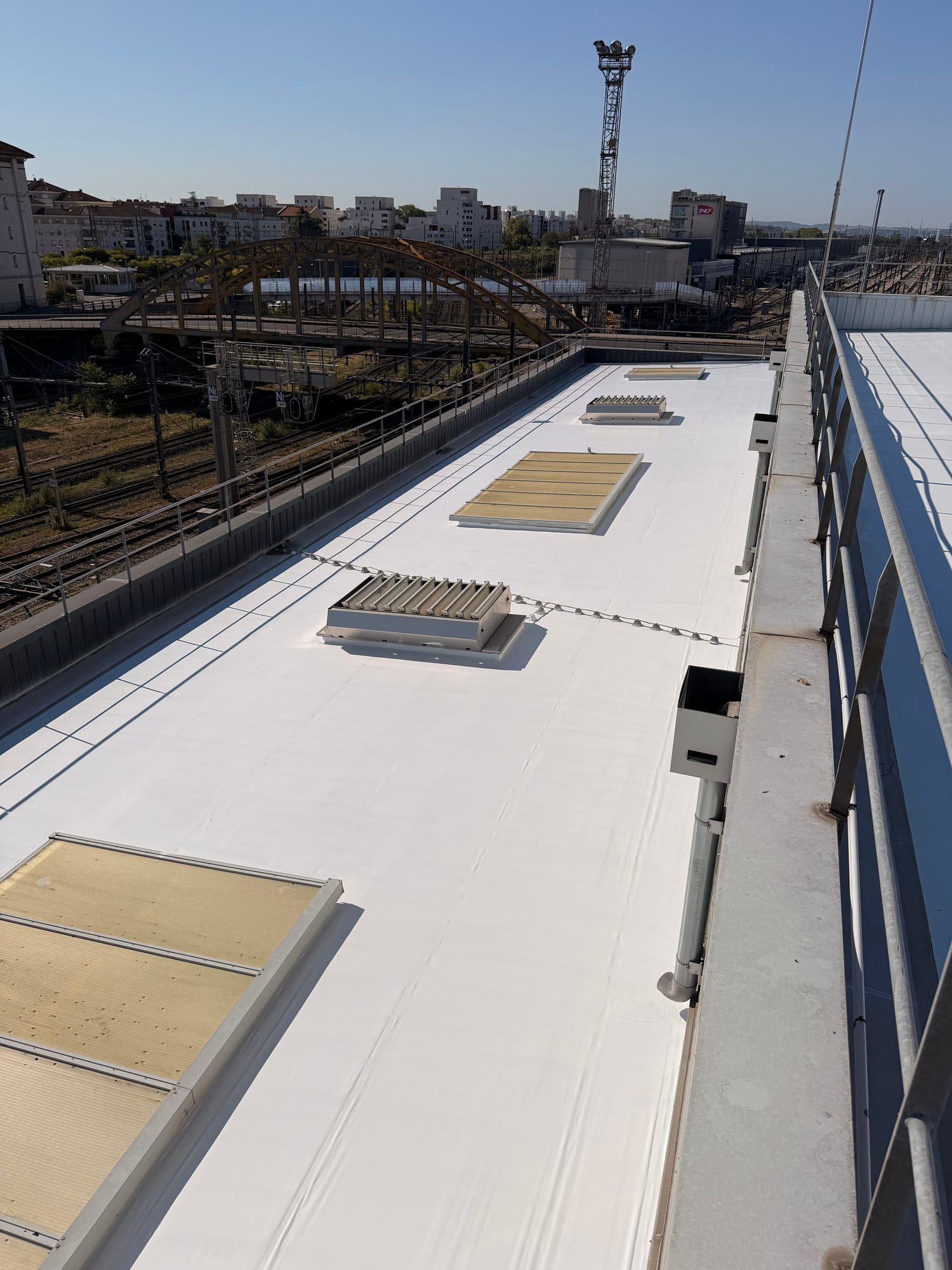
This is exactly the “technical means to reduce solar radiation” referred to in article R. 4463-3. The PrimaTherm® system that we apply in 4 layers reflects 95 % of solar radiation (ASTM E903-12), with an emissivity of 0.89 (ASTM C1371-15) and an SRI of 120 (ASTM E1980), maintained at 119 after 4,000 hours of accelerated ageing. The surface of a dark roof goes from 50–70 °C to 25–35 °C, i.e. up to −30 °C on the roof surface; at the handover of the Airbus Marignane project, the infrared measurement of 19 June 2026 gave 57.8 °C on the control area and 28.6 °C on the treated area, i.e. −29 °C. Under the roof, the gain felt reaches up to −6 °C depending on insulation and ventilation: set against the 2 to 3 % per degree used by the WHO and the WMO, it is the difference between an afternoon when the work rate holds and an afternoon when the breaks multiply.
The works are carried out without stopping activity, drums and pumps on the ground, hoses on the roof, and the handover is documented by before-and-after measurements, to be attached to the single risk assessment document as evidence of the action taken. Our pages on cool roofs for industrial buildings and cool roofs for warehouses and logistics describe the configurations encountered, our guide to cool roofs and health (in French) returns to the health effects, and the free roof study estimates the expected gain within 48 h.
Key takeaways
- Thresholds: peak office performance at around 22 °C (LBNL), −2 to −3 % productivity per degree above 20 °C (WHO and WMO), INRS benchmarks of 28 °C for physical work and 30 °C for sedentary activity, heat stress generally above 35 °C (ILO).
- Hours lost: 2.2 % of working hours worldwide in 2030, i.e. 80 million full-time jobs (ILO, 2019); 2.4 billion workers exposed and 22.87 million injuries a year attributable to heat (ILO, 2024).
- Errors and accidents: degraded alertness and reaction time (INRS); about 20,000 injuries a year in California attributable to heat, including indoors (Park et al., 2021).
- Obligations: articles R. 4463-1 to R. 4463-8 of the French Labour Code since 1 July 2025, including technical means to reduce solar radiation.
- Building: in single-storey premises, the roof is the main source; a certified reflective coating brings it down to 25–35 °C, up to −6 °C felt under the roof.
Sources
- ILO, “Working on a warmer planet”, 2019: https://www.ilo.org/publications/major-publications/working-warmer-planet-effect-heat-stress-productivity-and-decent-work ; press release: https://www.ilo.org/resource/news/increase-heat-stress-predicted-bring-productivity-loss-equivalent-80
- ILO, “Ensuring safety and health at work in a changing climate”, 2024: https://www.ilo.org/publications/ensuring-safety-and-health-work-changing-climate ; press release: https://www.ilo.org/resource/news/climate-change-creates-cocktail-serious-health-hazards-70-cent-worlds
- WHO and WMO, “Climate change and workplace heat stress: technical report and guidance”, 2025: https://www.who.int/publications/i/item/9789240099814 ; press release: https://www.who.int/news/item/22-08-2025-who-wmo-issue-new-report-and-guidance-to-protect-workers-from-increasing-heat-stress
- Flouris et al., “Workers’ health and productivity under occupational heat strain”, The Lancet Planetary Health, 2018: https://doi.org/10.1016/S2542-5196%2818%2930237-7
- Park, Pankratz, Behrer, “Temperature, Workplace Safety, and Labor Market Inequality”, IZA DP 14560, 2021: https://www.iza.org/publications/dp/14560
- LBNL, “Temperature and Office Work Performance” (Seppänen, Fisk and Lei, 2006): https://iaqscience.lbl.gov/temperature-and-office-work-performance
- Lan, Wargocki, Lian, “Quantitative measurement of productivity loss due to thermal discomfort”, Energy and Buildings, 2011: https://orbit.dtu.dk/en/publications/quantitative-measurement-of-productivity-loss-due-to-thermal-disc/
- INRS (France), working in the heat: https://www.inrs.fr/risques/chaleur/ce-qu-il-faut-retenir.html ; https://www.inrs.fr/risques/chaleur/accidents-effets-sante.html ; https://www.inrs.fr/risques/chaleur/reglementation.html ; https://www.inrs.fr/risques/chaleur/mesures-prevention.html
- Decree no. 2025-482 of 27 May 2025, Légifrance: https://www.legifrance.gouv.fr/jorf/id/JORFTEXT000051676074
- Code du travail numérique, “Fortes chaleurs, canicule : quelles mesures l’employeur doit-il mettre en place ?” (hot weather and heatwaves: what measures must the employer put in place?): https://code.travail.gouv.fr/information/fortes-chaleurs-canicule-quelles-mesures-lemployeur-doit-il-mettre-en-place
- Handover measurements of 19 June 2026, case study of the Marignane project, Hélios.
Frequently asked questions
Is there a legal maximum temperature at work in France?
No. The French Labour Code sets no ceiling temperature; it imposes a safety obligation and, since 1 July 2025, precise measures during episodes of intense heat defined by the Météo-France weather warnings. INRS gives two benchmarks, 28 °C for physical work and 30 °C for sedentary activity, beyond which heat can constitute a risk. They are indicators, not regulatory thresholds.
By how much does productivity fall with heat?
The report published in 2025 by the WHO and the WMO uses a fall of 2 to 3 % per degree above 20 °C. A 2018 meta-analysis covering 111 studies concludes that 30 % of people working under heat strain report productivity losses. The extent depends on the task, the humidity, the clothing and the acclimatisation; the order of magnitude itself is no longer debated.
Does heat really increase accidents at work?
Yes. INRS explains that heat leads to reduced alertness and to an increase in reaction time, errors and omissions. An econometric study of the Californian workers’ compensation system attributes about 20,000 workplace injuries a year to heat, including in factories and warehouses, and for types of injury with no apparent link to temperature, such as falls.
What must the employer do during a heat episode?
Assess the risk in the single risk assessment document (document unique), adapt processes and working hours, provide technical means to reduce solar radiation, make fresh drinking water available close to the workstations, inform employees and organise reporting and emergency response. These obligations are set out in articles R. 4463-1 to R. 4463-8 of the French Labour Code, introduced by the decree of 27 May 2025.
Are air-conditioned offices concerned?
Yes, in a different way. Studies on office work place maximum performance at around 22 °C and show that a slightly cool environment favours concentration. In summer, an air-conditioning system that reaches its limit under an overheated roof lets the temperature drift several degrees above that optimum, which shows in the quality of the work before it shows on the bill.
Is a reflective roof enough to solve the problem?
No, it treats the main source in single-storey buildings, workshops, warehouses and sports halls, where the heat enters through the roof. A dark roof goes from 50–70 °C to 25–35 °C on the surface, and the gain felt under the roof reaches up to −6 °C depending on insulation. Water, breaks, night ventilation and adapted working hours remain necessary.