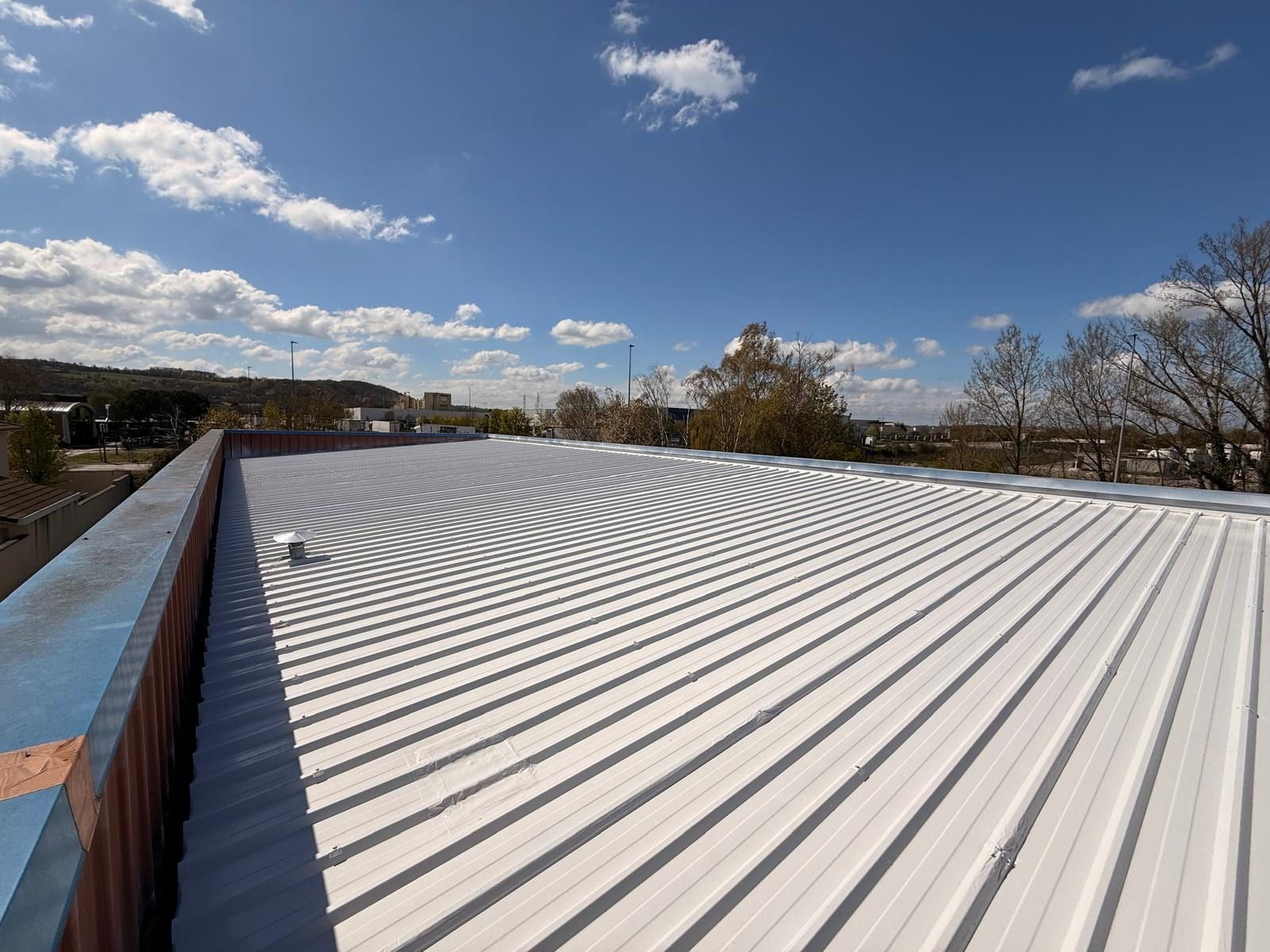
Why measure the roof surface, and not just the air
A building does not overheat because the outdoor air is at 32 °C; it overheats because its roof exceeds 60 °C. Surface temperature drives the heat flow towards the interior, the ageing of the waterproofing and the load on the air conditioning. It is also the only quantity that makes it possible to verify, in the field, that a reflective coating does what its test report says.
The Heat Island Group of the Lawrence Berkeley National Laboratory (LBNL) gives the order of magnitude: on a typical summer afternoon, a clean white roof that reflects 80 % of solar radiation stays about 31 °C cooler than a grey roof that reflects only 20 %; in one of its demonstrations, a black roof was measured 30 °C hotter than the neighbouring white roof. The US Environmental Protection Agency (EPA) adds that, in a home without air conditioning, a cool roof lowers the maximum indoor temperature by 1.2 to 3.3 °C and, in an air-conditioned home, reduces peak cooling demand by 11 to 27 %. These orders of magnitude can only be verified on your building by a measurement that is carried out correctly.
What an infrared thermometer really measures
An infrared thermometer or camera does not “see” temperature. The instrument captures the infrared radiation emitted by the surface and converts it into a temperature on the basis of an assumption: emissivity, that is, the ability of the surface to radiate the heat it contains. A matt surface emits almost like a black body; a bare or polished metal emits little and mostly reflects the radiation of its surroundings, sky included. The instrument manufacturer Fluke puts it plainly: shiny materials such as polished metal have a low emissivity and emit less infrared than matt surfaces, which leads the device to underestimate their temperature; wood, paint and plastic fall under the “high” setting.
Two standards frame the subject: ASTM E1933 describes the practice for measuring and compensating for emissivity with an infrared imaging radiometer; ASTM C1371 describes the measurement of the emittance of materials with a portable emissometer, the one used by laboratories. For the PrimaTherm® system, this value is certified: 0.89 (ASTM C1371-15). That is the setting to enter on a treated area. On an untreated galvanised steel deck, the raw reading is not reliable: you then measure on a matt adhesive tape or a reference plate of known emissivity, stuck to the substrate and left to reach its temperature.
The method, point by point
1. Set the emissivity
Enter the emissivity of the target material before any reading and note it on the report. PrimaTherm® treated area: 0.89. Untreated bitumen membrane: a high value, close to that of matt paints, gives a consistent reading; bare metal: tape or reference plate. An instrument with no emissivity setting cannot compare two surfaces of a different nature.
2. Control the distance and the angle
Every infrared thermometer has a distance-to-spot ratio (D:S) stated by its manufacturer. Fluke explains it like this: a 12:1 ratio means that you measure a spot 1 inch in diameter from 12 inches away, i.e. a 10 cm spot at 1.2 m. The further away you stand, the larger the spot becomes and the more likely it is to take in a parapet upstand, a rooflight or a patch of sky. The rule: a target larger than the measured spot, the instrument perpendicular to the surface, never at a grazing angle.
3. Choose the time and the sunshine
The surface of a roof changes temperature within a few minutes when a cloud passes. Measure in full sun, at the hottest time of the day, with the surface dry, and record the treated area and the control area within the same window of a few minutes. Let the instrument acclimatise: Fluke recommends about thirty minutes in the measurement environment before a critical reading. Never measure through a pane of glass or a rooflight: infrared does not pass through them the way visible light does.
4. Define a control area
The control area turns a figure into evidence. It must have the same substrate, same slope, same orientation and same exposure as the treated area: a strip deliberately left untreated on the same roof slope, or an identical neighbouring building. Not in the shade of a rooftop structure, nor under the exhaust of an air handling unit, nor damp. Record several points on each area, calculate the average and photograph the locations.
5. Record
| Item in the report | What it must specify |
|---|---|
| Conditions | Date, time, sky, wind, air temperature in the shade |
| Instrument | Model, D:S ratio, emissivity set |
| Areas | Substrate, location, condition (dry, clean), photographs |
| Values | Points recorded, average per area, treated/control difference |
| Signature | Applicator and building owner, any reservations |
The errors that distort a reading
- Emissivity left at its default value on bare metal: the temperature of the untreated steel deck is wrong, and so is the difference with the treated area.
- Too great a distance: the measured spot spills over the target and mixes several surfaces.
- Two different days: comparing a “before” in July with an “after” in September proves nothing; only a control area recorded on the same day, at the same time, isolates the effect of the coating.
- Control area in the shade, damp or dirty: the difference is artificially inflated.
- Surface still damp after application or cleaning: evaporation cools the surface and flatters the result.
- Dust, steam or smoke between the instrument and the target: Fluke points out that they scatter infrared energy; a dirty lens has the same effect.
- Confusing surface temperature with air temperature: the air above the roof is far cooler than the roof covering.
- Deducing an indoor gain from a roof measurement: comfort under the roof depends on the insulation and the ventilation; it is measured with indoor sensors, before and after.
Surface temperature, reflectance, SRI: three quantities, three methods
A temperature reading does not replace a test report, and vice versa. Solar reflectance is measured on site with an albedometer or a pyranometer in accordance with ASTM E1918, applicable to horizontal and low-slope surfaces when the angle of the sun to the normal is less than 45°, and in the laboratory with a spectrophotometer in accordance with ASTM E903. Emittance is measured in accordance with ASTM C1371. The SRI is not measured but calculated in accordance with ASTM E1980 from the two previous values. The Cool Roof Rating Council, the American body that rates roofing products, publishes initial values for each product, then aged values after three years of exposure.
The PrimaTherm® system has a reflectance of 95 % (ASTM E903-12), an emissivity of 0.89 (ASTM C1371-15) and an SRI of 120 (ASTM E1980), maintained at 119 after 4,000 h of accelerated QUV ageing, with a conventional service life of 20 years (French CEE sheet). Laboratory values say what the product is able to do; the infrared measurement says what it does on your roof. Our page on the solar reflectance index of a roof explains the calculation, and the PrimaTherm® certifications page lists the test reports.
Reading a handover report
At the handover of a project, we record the surface temperature with an infrared thermometer on a treated area and on a control area, at the same time, then we enter the result in the as-built file together with the thickness checks and the photographs. On the Airbus Marignane project, 3,100 m² of bitumen membrane treated in one week, the report of 19 June 2026 gives 57.8 °C on the untreated area and 28.6 °C on the treated area, i.e. −29 °C, under the same sun and a few minutes apart.
To read such a report, ask four questions. Is the difference calculated between two areas measured on the same day, at the same time? Is the emissivity setting stated, and is it consistent with each surface? Do the two areas have the same substrate and the same exposure? Are the points, the average and the photographs attached? If one answer is missing, ask for a new measurement before lifting the reservations. The complete method, from preparation to the final inspection, is described on the how we work page.
The handover report is a starting point. Low-pressure water cleaning every 12 to 15 months maintains the reflectance; repeating the measurement every summer, at the same points and in the same conditions, makes it possible to track performance and to document your action plan, in particular for the French tertiary-sector decree (Éco Énergie Tertiaire). See our guide to cool roof cleaning and maintenance (in French).
What a reflective roof changes for the measurement
A dark roof made of bitumen membrane or steel deck reaches 50 to 70 °C under the summer sun. Treated with the PrimaTherm® system in 4 layers (PH169 primer, PH107 reflective base coat in two passes, PH107TCL anti-soiling topcoat), it stabilises between 25 and 35 °C, i.e. up to −30 °C on the roof surface. The coating also makes the measurement simpler: its matt finish and its high emissivity make it an ideal target for infrared, where a bare galvanised steel deck required a reference tape.
What the measurement does not show directly is the effect inside the building: up to −6 °C felt inside depending on insulation, and up to −40 % air-conditioning consumption depending on the climate zone. These gains are verified with indoor sensors and sub-metering of the air conditioning, set up before the works. The free roof study defines, site by site, the before-and-after measurement protocol; the cool roof coating page details the system applied.
Key takeaways
- Surface temperature drives the heat flow towards the interior: that is what has to be measured, not the air.
- Emissivity set (0.89 on PrimaTherm®, reference tape on bare metal), distance compatible with the instrument’s D:S ratio, perpendicular aim.
- Same time, same sky, dry surface: the treated area and the control area are recorded a few minutes apart, never on different days.
- A handover report states the conditions, instrument, emissivity, points, average, difference and photographs; measured example: 57.8 → 28.6 °C, i.e. −29 °C.
- Reflectance and SRI remain laboratory quantities (ASTM E903, E1918, C1371, E1980): the infrared measurement complements them, it does not replace them.
Sources
- LBNL Heat Island Group, “Cool Roofs”: https://heatisland.lbl.gov/coolscience/cool-roofs
- US EPA, “Using Cool Roofs to Reduce Heat Islands”: https://www.epa.gov/heatislands/using-cool-roofs-reduce-heat-islands
- ASTM E1933-14(2022), measuring and compensating for emissivity using infrared imaging radiometers: https://store.astm.org/e1933-14r22.html
- ASTM C1371-15(2022), emittance of materials using portable emissometers: https://store.astm.org/c1371-15r22.html
- ASTM E1918-21, on-site measurement of the solar reflectance of horizontal and low-slope surfaces: https://store.astm.org/e1918-21.html
- ASTM E1980-11(2019), calculation of the SRI: https://store.astm.org/e1980-11r19.html
- Cool Roof Rating Council, Roof Rating Program: https://coolroofs.org/programs/roof-rating-program
- Fluke, “How to Get Great Results with an Infrared Thermometer”: https://www.fluke.com/en-us/learn/blog/temperature/how-to-get-great-results-with-an-infrared-thermometer
- Handover measurements of 19 June 2026, case study of the Marignane project, Hélios.
Frequently asked questions
What instrument do you need to measure the temperature of a roof?
A spot infrared thermometer or a thermal camera, provided that the emissivity can be set and that the distance-to-spot ratio is known. An everyday instrument is enough for a handover report; what matters is the protocol, not the price of the device. Solar reflectance, for its part, cannot be measured with a thermometer: it calls for an albedometer on site or a spectrophotometer in the laboratory.
Do you really need to set the emissivity?
Yes, it is the first setting. Many instruments leave the factory set to a value close to that of matt paints, which suits a treated roof, whose certified emissivity is 0.89 for PrimaTherm®. On bare or shiny metal, the same value gives a false reading: you then measure on a matt adhesive tape or a reference plate stuck to the substrate.
At what time should a roof be measured?
At the hottest time of the day, in full sun, with the surface dry, and above all at the same time for the treated area and the control area, a few minutes apart. A cloud, a gust of wind or a surface that is still damp is enough to shift a reading by several degrees. Note the time, the air temperature and the state of the sky on the report.
Does a surface measurement indicate the temperature inside the building?
No. Surface temperature drives the heat flow that passes through the roof, but the indoor gain depends on the insulation, the ventilation and the internal gains. We state up to −30 °C on the roof surface and up to −6 °C felt inside depending on insulation; the second value is verified with indoor sensors, never by deduction from a roof reading.
What should a handover report contain?
The date, the time, the weather and the air temperature; the instrument and the emissivity set; the location of the points on the treated area and on the control area; the values recorded, their average and the difference; time-stamped photographs. Without a control area measured at the same moment, an isolated figure proves nothing.
Is a thermal camera better than a spot thermometer?
It provides a complete image of the roof and reveals missed areas, equipment that heats up or a lack of uniformity, which a single point does not show. It obeys the same rules: emissivity set, distance, angle, same time for both areas. The two instruments complement each other in an as-built file.