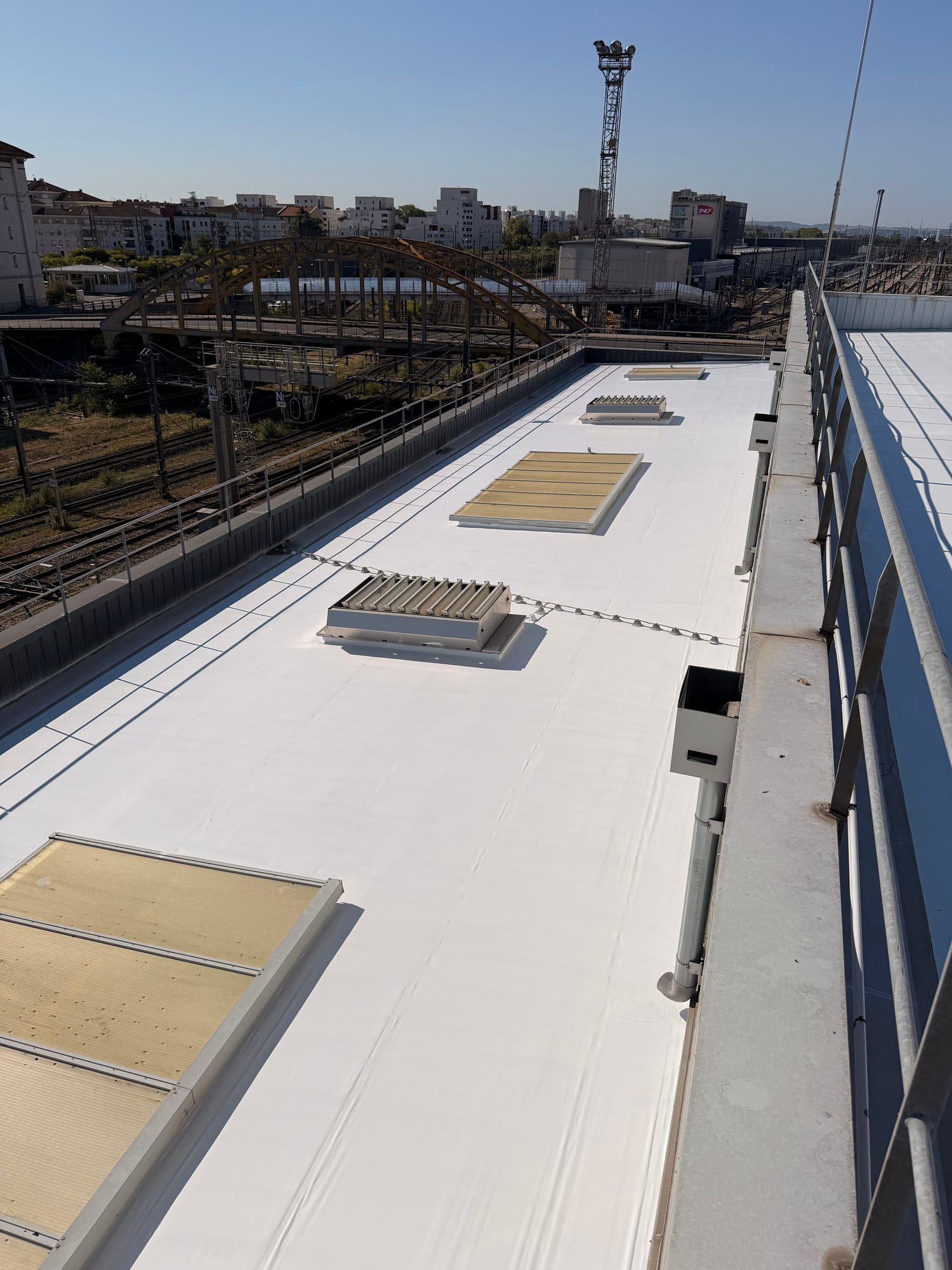
Key takeaways
- A reflective roof sends most of the solar radiation back; a dark roof reflects only 5 to 20 % of it.
- The PrimaTherm® system applied by Hélios reflects 95 % of the radiation (ASTM E903-12), has an emissivity of 0.89 (ASTM C1371-15) and an SRI of 120 (ASTM E1980), maintained after 4,000 h of accelerated QUV ageing.
- Results: surface brought down from 50–70 °C to 25–35 °C (up to −30 °C), up to −6 °C inside depending on insulation, up to −40 % air-conditioning consumption.
- Several families of reflective roofs exist (coating, white membrane, light-coloured gravel, green roof by comparison); the reflective coating is the only one applied to the existing roof in a few days, without lifting and without stopping activity.
- Maintenance: low-pressure water cleaning every 12 to 15 months, yearly inspection. Incentives: French CEE under strict conditions; MaPrimeRénov’ does not cover cool roofs.
What is a reflective roof?
A reflective roof, also called a cool roof or white roof, is a roof designed to send solar radiation back instead of absorbing it. Unlike conventional roofs in black bitumen or grey steel deck, which reflect only 5 to 20 % of the energy received and climb to 50–70 °C in midsummer, a reflective roof stays between 25 and 35 °C. The heat that is not absorbed does not have to be removed: the ceiling no longer radiates onto the occupants, the air conditioning runs less, the waterproofing no longer suffers the thermal cycles that crack it.
The principle is old: the white villages of the Mediterranean have applied it for centuries. Its modern version relies on coatings formulated for two properties measured in the laboratory, solar reflectance and thermal emissivity, and on a controlled application protocol. It is aimed at industrial, logistics, retail, office, public and agricultural buildings and, on a smaller scale, at flat-roofed houses and apartment buildings. The page what is a cool roof develops the definition and the history.
How a reflective roof works
Three quantities describe how a roof behaves in the sun:
- Solar reflectance (or albedo): the fraction of radiation sent back, measured according to ASTM E903. Dark roof: 5 to 20 %. Standard white paint: 70 to 80 %. PrimaTherm® system: 95 %.
- Thermal emissivity: the ability of the surface to re-emit absorbed heat as infrared, measured according to ASTM C1371. Bare metal emits poorly; PrimaTherm® emits at 0.89.
- The SRI (Solar Reflectance Index, ASTM E1980), which combines the two: 0 for a reference black, 100 for a reference white, 120 for PrimaTherm®. See the Solar Reflectance Index of a roof and our article on the Solar Reflectance Index explained.
A reflective roof therefore acts twice: it absorbs little, and it quickly releases the little it absorbs. It is this second point that makes the difference at night: the roof does not store the day’s heat and the building can cool down.
The benefits of a reflective roof, cautiously quantified
- Surface temperature: up to −30 °C (50–70 °C down to 25–35 °C). On the 5,900 m² of bitumen membrane at Airbus Marignane, treated from April to June 2026, the infrared measurement of 19 June 2026 recorded 28.6 °C on the treated roof against 57.8 °C on the control area: −29 °C.
- Indoor comfort: up to −6 °C felt depending on insulation, and above all the disappearance of ceiling radiation, the most unpleasant component of summer discomfort.
- Energy savings: up to −40 % air-conditioning consumption (15 to 25 % in French climate zone H1, 20 to 30 % in H2, 25 to 40 % in H3), for a payback generally between 3 and 5 years. See cool roof ROI and payback.
- Roof durability: fewer thermal shocks, fewer cracks, waterproofing that lasts longer and a renewal pushed back.
- Environment: less electricity consumed during peaks, less heat released into the city, a water-based product applied without stripping. See environmental impact of cool roofing.
- Urban heat island reduction: a light-coloured roof sends radiation back to the sky rather than into the street. See cool roofs and urban heat islands.
- Compliance: a direct contribution to the objectives of the French tertiary-sector decree (Éco Énergie Tertiaire) for buildings over 1,000 m², and recognition in the HQE, BREEAM and LEED frameworks.
The different types of reflective roofs
Not all reflective roofs are equal. The main families:
| Solution | Principle | Strengths | Limits |
|---|---|---|---|
| Reflective coating (elastomeric system) | System applied on the existing roof | Measured performance (95 %, SRI 120 for PrimaTherm®), application in a few days without lifting, without stopping activity, on steel deck, bitumen, membranes | Sound substrate required; cleaning every 12 to 15 months |
| White membrane (PVC, TPO, bitumen with light-coloured granules) | Waterproofing renewal with a light-coloured membrane | Relevant when the waterproofing is at the end of its life | Heavy works, stripping, waste; variable reflectance that soils |
| Light-coloured gravel or slabs on a flat roof | Light-coloured ballast | Simple | Modest reflectance, rapid soiling, load |
| Light-coloured pre-painted tiles or decking | New roof covering in a light colour | Suited to new builds | Complete replacement of the roof covering |
| Green roof (by comparison) | Cooling by evapotranspiration | Biodiversity, rainwater management | Load-bearing structure, root-resistant waterproofing, watering, maintenance, delayed effect |
Our comparison cool roof coating vs membrane details the first choice, and cool roof vs green roof the second.
The PrimaTherm® reflective roof: 4 layers, 3 products
The solution applied by Hélios is a water-based system in 4 layers: a PH169 bonding primer suited to the substrate, a PH107 reflective base coat in two passes that carries the reflectance, and a PH107TCL anti-soiling topcoat that protects the base from ultraviolet light and dirt. On PVC membranes over 10 years old, a PH107PVC bonding coat replaces the primer. Rooflights receive the PrimaTherm® LT lacquer (one coat ≈ −25 % of transmitted light, two coats ≈ −50 %) to remove the greenhouse effect without losing natural light.
The performance is measured: reflectance 95 %, emissivity 0.89, SRI 120, maintained after 4,000 h of accelerated QUV ageing; Broof(t3) fire rating (CSTB report RA23-0010); conventional service life of 20 years (French CEE sheet). Details are on the page cool roof coating and the reports on the certifications page.
A solution suited to every building
- Industry: workshops, factories, regulated sites, where temperature determines working conditions and processes. See cool roof for industrial buildings.
- Logistics: warehouses and platforms of several thousand m², treated without blocking operations. See cool roof for warehouses and logistics.
- Retail and offices: stores, shopping centres, offices, where sales comfort and the tertiary decree meet. See cool roof for retail and supermarkets.
- Public buildings: schools, sports halls, town halls, care homes, hospitals, where summer comfort is solved without generalised air conditioning. See cool roof for public buildings.
- Agriculture: livestock buildings and storage. See cool roof for agricultural buildings.
- Apartment buildings and flat-roofed houses: reduced 10 % VAT on supply and application for French homes over two years old, prior declaration. See cool roof for residential buildings. For areas under 500 m², the online shop (in French) sells the same system with the application guide.
The sectors hub and the roof types hub point to the page that matches your building.
How to install a reflective roof
- Free roof study within 48 h: satellite measurement, analysis of the substrate and uses, pre-qualification of incentives. See free roof study.
- Technical visit and proposal: adhesion tests if necessary, check for the absence of asbestos on fibre cement, of the age of PVC membranes, of the condition of the waterproofing; local repairs quoted; itemised proposal.
- Application without lifting: cleaning, primer, reflective base coat in two passes, topcoat. Drums and machines on the ground, only the hoses go up to the roof: no crane, no road closure, site in operation. Application between 12 and 35 °C, on a dry substrate, with no rain forecast.
- Inspection and handover: thickness checks, before/after infrared measurements with a control area, as-built file, maintenance plan.
The application process is detailed step by step. The best time to launch the study is winter, in order to apply in spring and be protected from the first hot spells; see heatwave: protecting your building.
Maintaining a reflective roof
A reflective roof does not require heavy maintenance, but it does require regular maintenance: low-pressure clean-water cleaning (100 bar maximum) every 12 to 15 months, preferably in spring, and a yearly visual inspection (film, upstands, drains, fixings, rooflights). Local touch-ups are made with the same system. See cool roof maintenance and cool roof maintenance and durability.
What about winter?
The classic objection: does a light-coloured roof not lose the solar gains of winter? Marginally. The winter sun is low on the horizon (16 to 23° at noon on 21 December depending on latitude, against 63 to 70° on 21 June), it hits the façades and very little the roofs; the days are short and often overcast; an insulated roof transmits little. The yearly balance is positive everywhere in France as soon as the building has a summer issue. Details are in cool roof in winter.
Reflective roof or green roof: which option to choose?
| Criterion | Reflective roof | Green roof |
|---|---|---|
| Thermal effect | Immediate, measurable from application | Gradual, depends on watering |
| Structure | No added load | Reinforced load-bearing structure required |
| Waterproofing | Protected, no modification | Root-resistant layer compulsory |
| Maintenance | Cleaning every 12 to 15 months | Watering, weeding, checking drains |
| Biodiversity | None (can be combined) | High |
| Works | A few days, without lifting, site in operation | Several weeks, lifting of substrate |
| Cost | Depends on the area, the substrate and access | In a different league: structure, substrate, planting |
The two can be combined on roofs that allow it. On industrial, logistics and retail roofs, the reflective roof is the only realistic option.
Regulation and incentives
- Prior declaration: changing the colour of a roof generally falls under article R. 421-17 of the French planning code; some local plans (PLU) and protected areas regulate colours. See white vs coloured cool roof.
- French energy-savings certificates (CEE), sheet BAT-EN-112: conditional eligibility, reserved for commercial tertiary buildings whose volume is heated and cooled by a heat pump (160, 170 or 270 kWh cumac per m² depending on French climate zone H1, H2 or H3). Does not apply as such to industry, logistics or agriculture.
- MaPrimeRénov’ does not cover cool roofs.
- French tertiary-sector decree (Éco Énergie Tertiaire): action that can be declared on OPERAT for tertiary buildings over 1,000 m².
- RE2020: the summer-comfort indicators of the French RE2020 regulation reward high-reflectance roofs in new construction.
Details are on the pages cool roof incentives in France 2026 and regulatory context.
Why choose Hélios for your reflective roof
A measured system (95 %, 0.89, SRI 120, Broof(t3)), a written 4-layer protocol with thickness checks, a no-lifting method, measured references in aerospace, rail, industry and multi-technical maintenance, and a handover file with before/after measurements. Our checklist for choosing a contractor lets you verify it point by point.
Sources
- ASTM E1980, Solar Reflectance Index: https://store.astm.org/e1980-11r19.html
- ADEME, summer comfort and building adaptation: https://www.ademe.fr/
- French planning code, article R. 421-17: https://www.legifrance.gouv.fr/
- Primacoating, manufacturer of the PrimaTherm® system: https://www.primacoating.com/
Frequently asked questions
What is a reflective roof and how does it work?
A reflective roof is a roof whose surface sends most of the solar radiation back instead of absorbing it, thanks to a light-coloured coating with high reflectance and high emissivity. The surface stays close to the air temperature, 25 to 35 °C instead of 50 to 70 °C for a dark roof, and the heat that is not absorbed does not have to be removed from the building.
What are the advantages of a reflective roof compared with a conventional roof?
Up to −30 °C on the surface, up to −6 °C inside depending on insulation, up to −40 % air-conditioning consumption depending on the climate zone, waterproofing protected from thermal shocks, and a contribution to reducing urban heat islands. No consumption, no noise, no moving parts.
Is a reflective roof suitable for every building and every climate?
It is applied on steel deck, bitumen membrane, asbestos-free fibre cement (buildings after 1997), EPDM and PVC over 10 years old, on flat or low-pitch roofs. It pays off most in the south, but the yearly balance is positive everywhere in France as soon as the building has a summer issue. Borderline cases (altitude, no summer issue) are identified in the free roof study.
How much does a reflective roof cost?
The cost depends on the area, the substrate, the condition of the roof, the preparation required, access and the incentives available. For a commercial building, it only exists in the proposal drawn up after the free roof study, within 48 h. Homeowners and small areas will find listed prices in the PrimaTherm® online shop (in French).
Does a reflective roof lose heat in winter?
Very little: the winter sun is low and mostly hits the façades, sunshine is weak and an insulated roof transmits little. The loss of winter solar gains is limited to a few percent of heating needs on an insulated building, far below the summer savings.
Is a permit needed to install a reflective roof?
Changing the colour of a roof generally requires a prior declaration to the town hall (article R. 421-17 of the French planning code), and some local plans (PLU) or protected areas regulate colours. We check this point during the study.