What happens in a livestock building when the roof heats up
A livestock building is rarely designed for summer: steel deck or fibre cement on a frame, a large volume, façades that are more or less open, no roof insulation in most cattle sheds and barns. From June to September, the dark roof climbs to 50–70 °C and radiates downwards, onto the animals’ backs, the feed trough and the lying area. Natural ventilation renews the air, but it does not remove this radiation: an animal lying under a sheet at 65 °C receives heat even when the ambient air stays at 28 °C.
Heat stress therefore depends not only on the air temperature, but on its combination with humidity, radiation and air speed at animal height. That is what the indices of the technical institutes express, starting with the THI, the temperature-humidity index, whose benchmarks this guide sets out species by species before ranking the building solutions in the order in which they act.
Benchmarks by species
Dairy cows: stress begins at a THI of 68
The ClimatBat project of the French chambers of agriculture, run with the French Livestock Institute (Institut de l’élevage), places the dairy cow’s comfort zone between 2 and 15 °C; from 22 °C, the animal can no longer get rid of its excess heat. Expressed as THI, stress is mild from 68, already with consequences for production, moderate between 72 and 79, severe from 80. The most readable sign is the respiratory rate: below 60 breaths per minute in a normal situation, it can reach 150 under severe stress.
The effects recorded affect the whole dairy unit: lower milk yield and lower butterfat and protein content, poorer reproduction, a higher risk of acidosis, more lameness, more time spent standing, reduced feed intake and rumination.
Broilers: everything is decided above 23 °C
In chickens, above an ambient temperature of 23 °C, the animal’s first reflex is to limit its energy intake, and therefore to eat less; above 25 °C, evaporation by panting becomes the main way of shedding heat, and the breathing rate goes from 25 breaths per minute at equilibrium to as many as 200 under heat stress. A temperature of 30 to 31 °C in the afternoon remains bearable if all the other indoor climate parameters are respected; beyond that, body temperature can rise to 46–47 °C and the animal dies. This is heat stroke, which ITAVI, the French poultry technical institute, defines as an excessive rise in body temperature. The risk scale used for poultry runs from no risk below a THI of 65 to very severe risk above 78, with moderate risk from 66 to 72 and severe risk from 73 to 78. The rises in mortality observed during heatwaves concern, in eight to nine cases out of ten, broiler farms.
Pigs: a thermoneutral zone that drops with weight
IFIP, the French pork institute, points out that the pig’s thermoneutral zone extends from 27 down to 18 °C depending on live weight: the heavier the animal, the lower its upper limit. Beyond it, the pig reduces its feed intake, which weighs on its growth and alters its body composition. Housing counts as much as the thermometer: the chambers of agriculture note that a temperature of 24 °C on a fully slatted floor is equivalent to 18 °C on straw.
| Species | Comfort benchmark | First alert threshold | Documented effects |
|---|---|---|---|
| Dairy cow | 2 to 15 °C | THI 68 (mild), 72 (moderate), 80 (severe) | Milk yield, butterfat and protein content, reproduction, lameness, feed intake |
| Broiler chicken | Below 23 °C | 25 °C (panting), THI 66 to 72 (moderate risk) | Feed intake, growth, mortality during heatwaves |
| Fattening pig | 18 to 27 °C depending on weight | Upper limit of the thermoneutral zone | Feed intake, growth, body composition |
These benchmarks are indicators, not regulatory thresholds: physiological stage, genetics and housing shift the limit. They are enough to understand why a building under a dark roof, where the indoor climate exceeds 30 °C from late spring, puts the animals under stress for several weeks a year.
What the French authorities ask for during a heatwave
The French national heatwave plan, born after the summer of 2003, has evolved into an interministerial heatwave management plan that includes livestock farming. The French Ministry of Agriculture asks animal keepers to check every day the temperature of their premises and the proper operation of the air-renewal systems, to multiply the access points to fresh, clean water, offered ad libitum, and to check the housing conditions at least once a day, noting any indicator of climate-related suffering. Misting the animals is presented as strongly recommended; animals kept outdoors must have a shelter, natural or artificial, that gives them shade. For the details by sector, the ministry refers to the fact sheets of ITAVI, IFIP and CNIEL, the French dairy interprofessional body.
These monitoring obligations do not say how to adapt a building; they say that a farmer whose building exceeds the above benchmarks every afternoon will have to observe it, write it down and act. Hence the value of passive solutions, which act without daily intervention and without consuming energy.
Passive solutions, in the order given by farm building advisers
The ClimatBat fact sheets rank the levers by priority: reduce solar radiation in the building and improve natural ventilation, adapt watering and feeding practices, and only then turn to mechanical equipment.
1. Reduce the radiation from the roof and walls
This is the first lever, because it is the first source of heat. The chambers of agriculture are explicit: radiation from the walls and the roof is to be limited, and direct sunlight on the living areas must be avoided. Three means complement each other:
- light-coloured roofing materials, which reflect solar radiation instead of absorbing it, recommended in particular for poultry buildings;
- roof insulation when the volume is closed and mechanically ventilated: for poultry, a coefficient of 0.40 W/(m².K) is recommended, equivalent to 60 mm of polyurethane foam;
- control of translucent sheets: a high proportion of translucent sheets in the roof contributes to the heating of the building, and a shading paint reduces the radiation while keeping sufficient daylight. Our article on rooflights and the greenhouse effect (in French) details this point.
2. Keep the air moving without forcing it
Wind is the ally of the open building: free openings as low as possible along the long sides, an air outlet at the ridge, façades that open at night to let the cool air in. Roof overhangs and sunshades protect south-facing openings from direct radiation without closing them.
3. Look after the surroundings
A short, dense plant cover around the building brings coolness, whereas concrete and gravel give back the heat accumulated during the day. Obstacles that hinder air circulation should be removed, and the roof cleaned of the mosses and lichens that darken it.
4. Only then, the equipment
When these levers are in place, mechanical ventilation and cooling take over at the hottest hours. For cattle, air-circulation fans aim for at least 1 m/s at animal level, ideally 2 to 3 m/s combined with a cooling system, without exceeding 3 m/s so as not to put ammonia and dust back into suspension; misting cools the air, showering cools the animal, on the back, never on the head. For poultry, mechanical ventilation aims for a real air renewal of 5 m³ per kilogram of live weight per hour, each increase of 0.2 m/s in air speed is worth about 1 °C less felt, and humidity must not exceed about 70 % at 30 °C, which limits misting. This equipment consumes electricity and water, and works all the better when the roof no longer heats the air it moves.
The role of the reflective roof
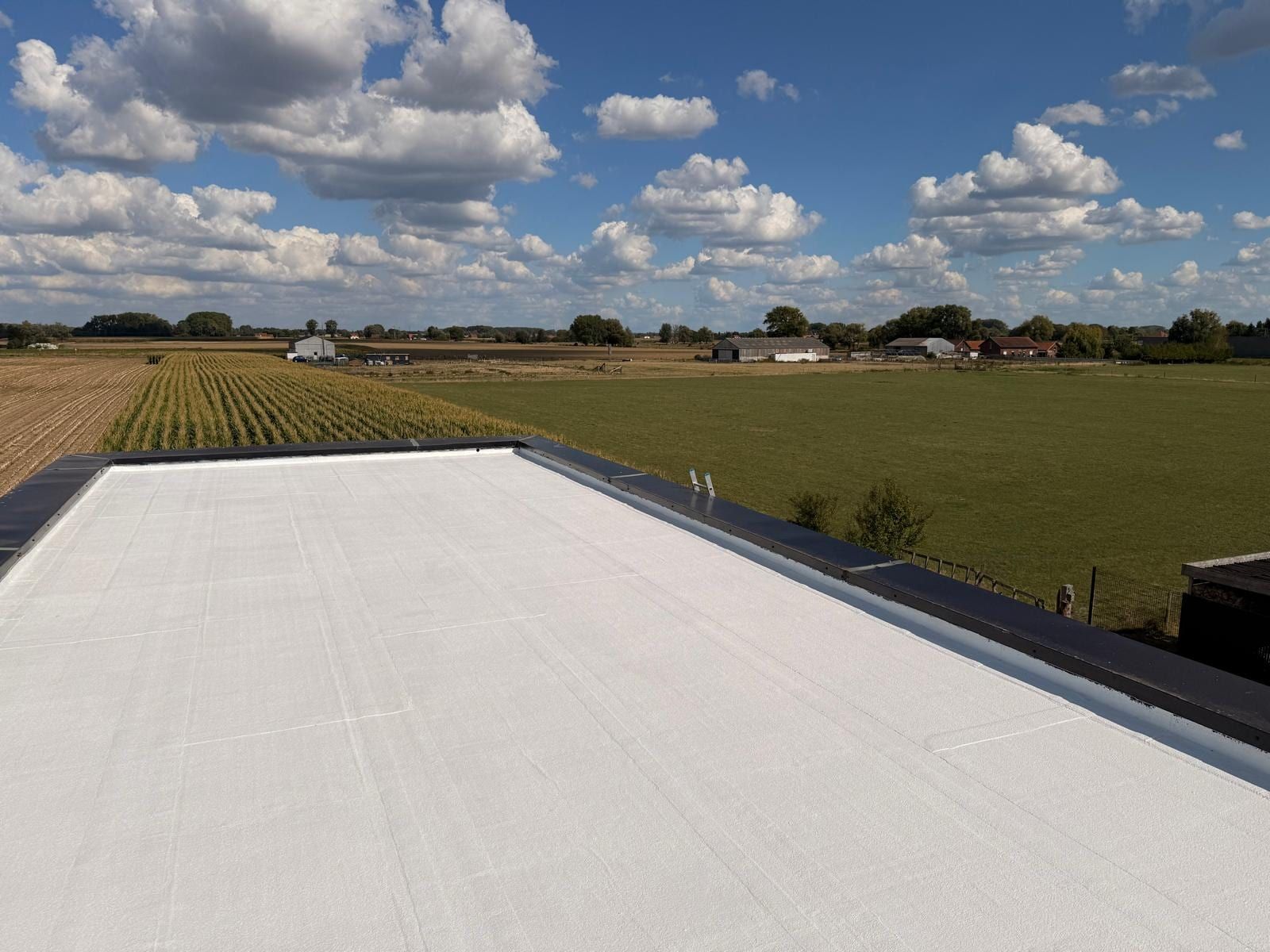
There remains the question that the technical fact sheets do not address in detail: how to make an existing dark steel deck or fibre-cement roof light-coloured, durably, without replacing it. That is the purpose of a cool roof: a coating applied to the existing roof, which sends back most of the radiation instead of turning it into heat.
The effect is measurable. The Lawrence Berkeley National Laboratory measured a black roof 30 °C hotter than a neighbouring white roof, under the same sun. The PrimaTherm® system applied by Hélios shows a solar reflectance of 95 % (ASTM E903-12), an emissivity of 0.89 (ASTM C1371-15) and an SRI of 120 (ASTM E1980): SRI maintained after 4,000 h of accelerated QUV ageing — conventional service life of 20 years (French CEE sheet). A roof that used to climb to 50–70 °C stays between 25 and 35 °C, i.e. up to −30 °C on the roof surface; the infrared handover measurement on the Airbus Marignane project recorded −29 °C on 19 June 2026. Under an uninsulated roof, which is the case of most cattle sheds and barns, the gain is up to −6 °C felt inside, and above all the ceiling stops radiating onto the animals.
Three points specific to farms:
- The substrate. Steel deck is the most favourable substrate; fibre cement is treated only if it contains no asbestos, so on buildings built after 1997 or after a negative survey. Translucent sheets receive the PrimaTherm® LT lacquer, which reduces solar gains by about 25 % in one coat and by about 50 % in two.
- The works. Drums and pumps stay on the ground in the yard, only the hoses go up: no crane or aerial platform in front of the cattle shed, animals in place, biosecurity protocols respected, schedule outside births and the arrival of new batches. The product is water-based and solvent-free.
- Winter. The low sun strikes the façades, not the roofs, and a livestock building is not heated by its roof. See cool roof in winter.
On funding, let us say it plainly: the French energy-savings certificates (CEE), sheet BAT-EN-112, target commercial tertiary buildings heated and cooled by heat pump and do not apply to a livestock building; MaPrimeRénov’ does not cover cool roofs. The French regional farm modernisation schemes are examined case by case with the chamber of agriculture; the cool roof incentives 2026 page takes stock. For processing workshops and air-conditioned wineries, the logic is the same as for the food industry and cold chain: less heat coming in through the roof, less refrigeration to produce. The cool roof for agricultural buildings page describes the buildings concerned, from the poultry house to the cooperative, and how works run on a farm. The free roof study starts from a satellite measurement and the nature of the substrate, with a reply within 48 h; at handover, we provide the before and after measurements, on the roof and at animal height, with the site monitoring sheet and the thickness check.
Key points
- Benchmarks: dairy cow under mild stress from a THI of 68, chicken that cuts its feed intake above 23 °C, pig whose thermoneutral zone drops from 27 to 18 °C with weight.
- French authorities: daily check of the premises and of air renewal, fresh water ad libitum, shade for animals kept outdoors.
- Order of solutions: reduce the radiation from the roof and walls, ventilate naturally, look after the surroundings, and only then mechanical equipment.
- Reflective roof: up to −30 °C on the roof surface and up to −6 °C felt inside, without lifting, animals in place; neither CEE nor MaPrimeRénov’ for agriculture.
Sources
- Heat stress in cattle, ClimatBat, French chambers of agriculture with the Institut de l’élevage.
- Heat stress in poultry, ClimatBat, French chambers of agriculture.
- Heat stress in pigs, ClimatBat, French chambers of agriculture.
- Effect of a high temperature on the body composition of fattening pigs, IFIP, French pork institute.
- Adjustable openings in cattle buildings and Cooling solutions, ClimatBat.
- Planning ahead to face the heatwave in broiler production, ClimatBat.
- High temperatures: how to adapt your livestock buildings?, Ain chamber of agriculture, 2025.
- Modernising livestock buildings to adapt to climate change, Chambres d’agriculture France, 2023.
- “Heatwave” plan: recommendations for livestock farmers and Precautions to take in the event of a heatwave, French Ministry of Agriculture, 2026.
- Preventing heat stroke, ITAVI.
- Cool roofs, Heat Island Group, Lawrence Berkeley National Laboratory.
- Test reports of the PrimaTherm® system, certifications page.
Frequently asked questions
From what temperature is a dairy cow in heat stress?
The French chambers of agriculture place her comfort zone between 2 and 15 °C and note that from 22 °C she can no longer get rid of her excess heat. The benchmark used is the THI, which combines temperature and humidity: mild stress from 68, already with an effect on production, moderate from 72 to 79, severe from 80. The respiratory rate, normally below 60 breaths per minute, can reach 150.
What is the maximum temperature in a poultry house in summer?
Above 23 °C, the chicken reduces its energy intake; above 25 °C, it sheds its heat mainly by panting. A peak of 30 to 31 °C in the afternoon remains bearable if all the other indoor climate parameters are under control, in particular humidity and air speed. Heat stroke, an excessive rise in body temperature, occurs when these conditions are no longer met.
Is ventilation enough to protect animals from the heat?
No, because it does not act on the radiation from the roof, which directly heats the animals’ backs and the living areas. Farm building advisers recommend first reducing this radiation and improving natural ventilation, then adapting practices, and only then adding air-circulation fans, misting or showering. This equipment works all the better when the roof no longer heats the air it moves.
Is a reflective roof useful on an open building?
Yes, and that is even where it is best justified: in an open cattle shed, it is the radiation from the roof that counts, not the outdoor air temperature. A dark roof that has climbed to 50–70 °C radiates towards the animals; treated with a certified reflective coating, it stays between 25 and 35 °C. The ceiling stops heating, and natural ventilation does the rest.
Can a fibre-cement farm roof be treated?
Only if it contains no asbestos, that is, on buildings built after 1997 or after a negative asbestos survey. An asbestos roof can be neither pressure-washed nor coated. On sound fibre cement, the primer binds the chalky surface and the system is applied in 4 layers; steel deck remains the simplest substrate.
Are there incentives for a cool roof on a livestock building?
The French energy-savings certificates (CEE), sheet BAT-EN-112, target commercial tertiary buildings heated and cooled by heat pump: an agricultural building is not eligible. MaPrimeRénov’ does not cover cool roofs. Some French regional farm modernisation schemes examine investments linked to animal welfare case by case, with the support of the chamber of agriculture.