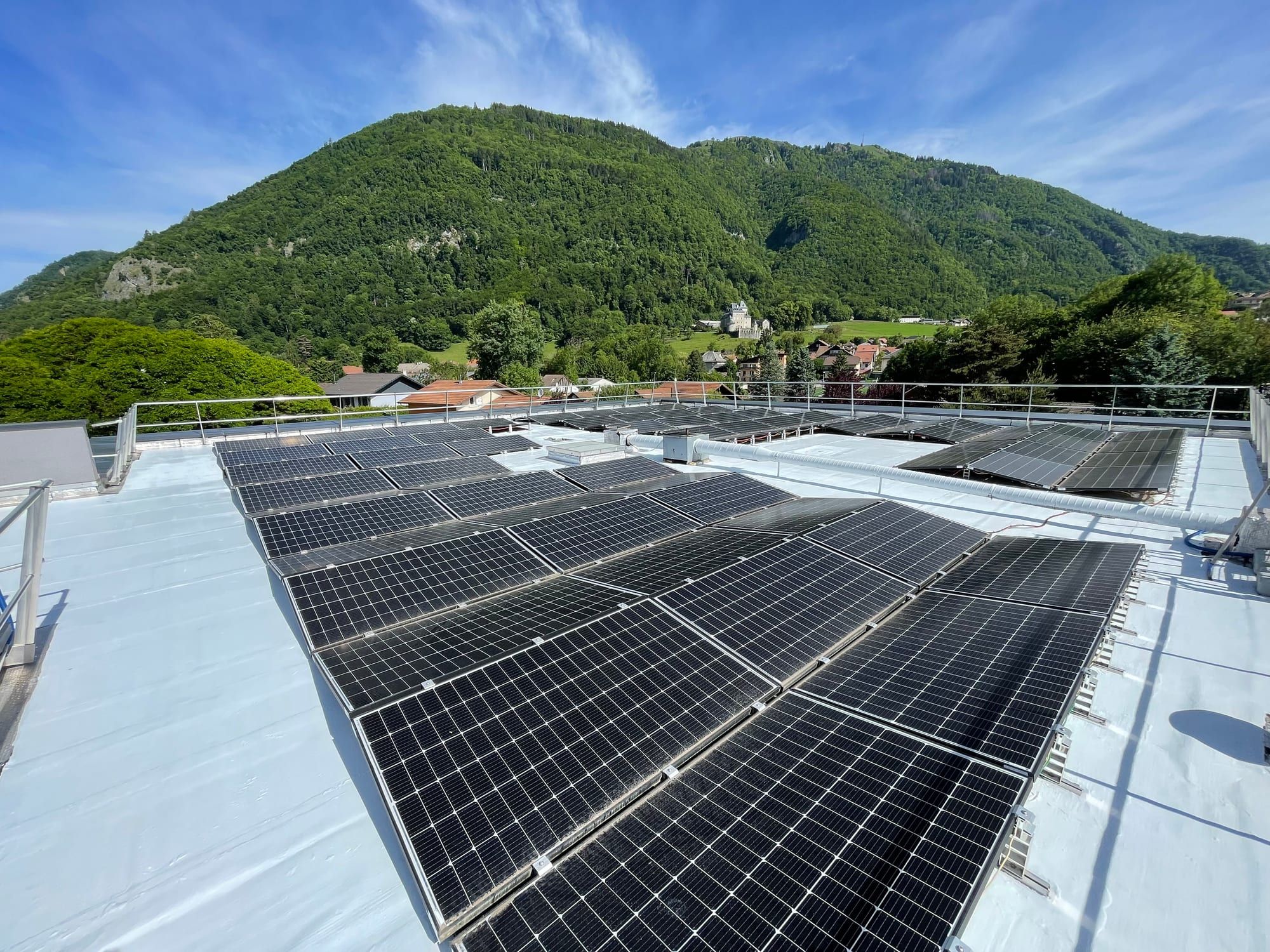
Key takeaways
- Ranges by zone: −15 to −25 % air-conditioning consumption in French climate zone H1, −20 to −30 % in H2, −25 to −40 % in H3; up to −40 %.
- Mechanism: reflectance 95 % and emissivity 0.89 (SRI 120); roof brought down from 50–70 °C to 25–35 °C, up to −30 °C on the surface.
- What modulates the result: roof insulation, share of the roof in the envelope, use, control, efficiency of the air conditioning.
- Associated benefits: lower peak power demand, chillers under less strain, comfort, French tertiary decree.
- Proof: sub-metering and before/after measurements; −29 °C measured by infrared at the handover of a 5,900 m² project in 2026.
Air conditioning, an item that weighs more and more
In an air-conditioned shop, office or warehouse, air conditioning represents, according to ADEME (the French environment and energy agency), a growing share of electricity consumption, concentrated over a few months and on the peak hours when electricity costs the most. Heatwaves lengthen the operating season, and every building that runs air conditioning rejects its heat into the street, which reinforces the urban heat island and the neighbours’ need for cooling.
What many managers do not know is the share of this item that comes from the roof. On a single-storey building — store, platform, workshop, school — the roof is the most exposed and the largest surface. Dark, it absorbs most of the radiation and climbs to 50–70 °C; it then radiates inwards all day and part of the night. The air conditioning spends its time extracting heat that could have been kept out.
How a cool roof reduces the cooling load
Three quantities describe how a roof behaves in the sun, detailed on our page Solar Reflectance Index of a roof:
- solar reflectance, the share of radiation sent back: 5 to 20 % for a dark roof, 95 % for the PrimaTherm® system (ASTM E903-12);
- thermal emissivity, the ability to re-emit absorbed heat towards the sky: 0.89 (ASTM C1371-15);
- the SRI, which combines the two: 120 (ASTM E1980), against 0 for the reference black and 100 for the reference white.
The result on the surface is spectacular and measurable: a roof that drops from 50–70 °C to 25–35 °C, i.e. up to −30 °C. On the largest building at Airbus Marignane, the infrared measurement at handover, on 19 June 2026, gave 57.8 °C on the untreated area against 28.6 °C on the treated area: −29 °C.
Inside, the heat flow through the roof decreases accordingly, the ceiling stops radiating and the felt temperature drops by up to −6 °C depending on insulation. For the air conditioning, this means fewer operating hours, lower peak power demand, and chillers working with less hot outside air above the roof, and therefore with better efficiency.
The ranges by climate zone
We only publish ranges we know we can defend, expressed as a share of air-conditioning consumption, not of the building’s total consumption:
| French climate zone | Territories | Reduction in air-conditioning consumption |
|---|---|---|
| H1 | North, East, Paris region, Massif Central, Northern Alps | 15 to 25 % |
| H2 | West, Centre, South-West, Rhône valley | 20 to 30 % |
| H3 | Mediterranean coast, Corsica | 25 to 40 % |
These ranges go up to −40 % in the most favourable case: single-storey building, poorly insulated roof, continuously air-conditioned, in zone H3. They are refined during the free roof study from your bills and the description of your building.
What makes the result vary
Roof insulation
The more insulated the roof, the less its surface temperature influences the interior: on a well-insulated roof, the gain sits at the bottom of the range; on a single-skin steel deck or a poorly insulated membrane on a slab, at the top. The cool roof does not replace insulation, it complements it; the reasoning is developed in our guide on external roof insulation.
The share of the roof in the envelope
A 3,000 m² single-storey store has a 3,000 m² roof for a few hundred square metres of façades; an office tower has a negligible roof. The higher the ratio of roof to air-conditioned floor area, the more the cool roof weighs.
Use and operating hours
A shop air-conditioned seven days a week in the middle of the day draws the full benefit; an office closed at weekends a little less; a site operating at night benefits above all from emissivity, which speeds up the night-time cooling of the roof.
Control
An air-conditioning system driven by a setpoint reduces its consumption as soon as the load falls; a system running flat out keeps going. The cool roof reveals the value of proper control, and vice versa.
The efficiency of the installation
A chiller drawing in air at 45 °C above a dark roof has a degraded coefficient of performance; above a roof at 35 °C, it works better. This is an indirect, real gain, which the ranges above include cautiously.
What a reflective roof brings beyond the bill
- Peak power: fewer kilowatts drawn at the most expensive hours, which counts in commercial electricity contracts.
- Air-conditioning service life: compressors under less strain and fewer operating hours.
- Resilience: during a heatwave, a system that is no longer saturated keeps holding the setpoint.
- Waterproofing: a membrane that no longer cycles between 20 and 70 °C every day ages more slowly.
- French tertiary decree: the reduction in consumption is declared on OPERAT and feeds the −40 % trajectory for 2030 — see the French tertiary decree and cool roofs.
- Heat island: heat sent back to the sky does not warm the street.
A documented example: the cured-meat plant in Périgny
On a 2,000 m² steel-deck food-processing building in Périgny, the roof-space temperature fell from 50 to 30 °C, and cooling consumption dropped by 35 %. This is not a Hélios project, but it is the same system, on a substrate we treat every week, and the order of magnitude is consistent with the zone H2 range. Our own projects — aerospace, rail, industry, multi-technical maintenance — are presented in our projects.
How to measure the saving on your building
An announced percentage is worth nothing without measurement. Here is the protocol we recommend, and support:
- Before the works: electrical sub-metering of the air conditioning (or reading of the dedicated meter), infrared reading of the roof and of indoor temperatures at fixed times, over several hot days.
- At handover: the same surface measurements, treated area against a control area where possible; this is how the −29 °C in Marignane was established.
- The following summer: air-conditioning consumption compared with the previous summer, corrected for cooling degree days to neutralise the difference in weather.
- Every year: low-pressure water cleaning every 12 to 15 months, and a check that the performance holds.
These data serve three times: for your operational monitoring, for your OPERAT declaration and, where applicable, for your French energy-savings certificates (CEE) file — sheet BAT-EN-112 being conditional (commercial tertiary building, volume heated and cooled by a heat pump; 160, 170 or 270 kWh cumac per m² depending on French climate zone H1, H2 or H3). MaPrimeRénov’ does not cover cool roofs.
Cool roof and other savings levers
The cool roof is not the only action, and it is rarely the only one to carry out. It compares and combines:
| Lever | What it does | What it does not do |
|---|---|---|
| Cool roof | Removes a large share of solar gains through the roof; immediate effect, without stopping activity | Adds no thermal resistance; does not act on gains through glazing |
| Roof insulation | Reduces conducted flows in summer and winter | Heavy works; does not address surface temperature |
| Solar shading on windows | Reduces gains through glazed façades | Does not act on the roof |
| Control and BMS | Adjust consumption to the need | Do not reduce the thermal load |
| High-efficiency air conditioning | Better efficiency for the same load | Investment and maintenance costs; does not remove the cause |
The detailed comparison between a reflective roof and an upgraded air-conditioning system is in our article cool roof vs air conditioning. The strategy we recommend is always the same: reduce the load first, size the equipment afterwards.
Return on investment
With air-conditioning consumption reduced by 15 to 40 % depending on the zone and light works — a few days, without lifting, drums and pumps on the ground —, the return on investment is generally between 3 and 5 years on an air-conditioned building, before counting the extended waterproofing and the comfort. We do not write an amount: your bill, your zone and your roof give yours. The simulator (in French) gives a first range in two minutes; the page cool roof ROI and payback explains the method; the free roof study refines it within 48 h with a satellite measurement.
Sources: ADEME, air conditioning and summer comfort, French Ministry of Ecological Transition, ASTM E903, C1371 and E1980 standards (ASTM International).
Frequently asked questions
By how much does a cool roof reduce air-conditioning consumption?
Between 15 and 25 % in French climate zone H1 (north and east), 20 to 30 % in zone H2 (west and centre), 25 to 40 % in zone H3 (Mediterranean), i.e. up to −40 % of the air-conditioning share. These are cautious ranges, refined during the study from your consumption and your building.
Why does the result depend on the climate zone?
Because the gain is proportional to sunshine and to the number of hours the air conditioning runs. In zone H3, the roof receives more energy, for longer, and tropical nights prevent the building from shedding its heat; every degree avoided on the roof weighs more.
Is a cool roof useful if the building is not air-conditioned?
Yes, but the saving reads differently: in comfort (up to −6 °C felt depending on insulation), in portable air conditioners avoided, in productivity, and in future air conditioning sized smaller. The bill only falls if there is consumption to reduce.
How do I measure the actual saving on my building?
Install sub-metering of the air conditioning before the works, take surface and indoor temperature readings before and after at the same times, and compare consumption from one summer to the next, corrected for cooling degree days. We provide the infrared measurements at handover.
Does the saving decrease over time?
It holds as long as the roof stays clean. The PH107TCL topcoat limits soiling, and low-pressure water cleaning every 12 to 15 months maintains reflectance; the SRI of PrimaTherm® is maintained after 4,000 h of accelerated QUV ageing, with a conventional service life of 20 years used by the French CEE sheet.
Can these percentages be converted into euros?
Yes, from your bill: multiply the air-conditioning share of your consumption by the range for your zone. We do not publish generic amounts, because they would match no real building; the simulator (in French) and the free roof study do it for yours.