Key points
- Text: article L. 174-1 of the French building and housing code (ELAN law), decree no. 2019-771 of 23 July 2019, implementing orders; OPERAT platform run by ADEME.
- Threshold: 1,000 m² of cumulative tertiary floor area, building, part of a building or group of buildings on the same plot.
- Targets: −40 % by 2030, −50 % by 2040, −60 % by 2050 compared with a reference year (2010 to 2019), or an absolute level set by ministerial order according to the activity.
- Declaration: every year before 30 September, previous year’s consumption; digital certificate and Éco Énergie Tertiaire rating.
- Cool roof: a short-payback action on the air-conditioning share — up to −40 % of that share depending on the zone — to be included in the action plan, with measurements before and after.
Where the French tertiary decree comes from
The Éco Énergie Tertiaire scheme stems from article 175 of the French ELAN law of 23 November 2018, codified in article L. 174-1 of the building and housing code. Decree no. 2019-771 of 23 July 2019 set out its terms, supplemented by the order of 10 April 2020 (calculation method, declaration platform) and then by a series of so-called “absolute value” orders which set, category of activity by category, the consumption levels to be reached. An order of 1 August 2025 integrated the annual certificate directly into the OPERAT platform.
The intention is simple: the tertiary building stock weighs heavily in the country’s energy consumption, and a large part of its buildings predates any thermal regulation. Rather than imposing specific works, the legislator chose an obligation of result: reduce consumption, by whatever means each obligated party judges most effective. This is what gives the cool roof its place, without guaranteeing it one in advance.
Who is covered
The decree targets buildings, parts of buildings or groups of buildings located on the same plot or the same site, which house tertiary activities over a cumulative floor area of at least 1,000 m². Tertiary activities are understood broadly: offices, retail and supermarkets, logistics platforms, education, healthcare, hotels and restaurants, sports and cultural facilities, public administration, data centres. An industrial site is not covered for its workshops, but it is for its offices or warehouses if the threshold is crossed.
The obligations fall on the owner and on the tenant, each for what concerns them, according to the allocation set out in the lease; the decree provides that they pass on the necessary information to each other. Temporary structures, places of worship and certain defence or security buildings are excluded.
The targets: relative or absolute
Each obligated party chooses, building by building, between two routes:
- The relative method (Crelat): reduce final energy consumption by 40 % by 2030, 50 % by 2040 and 60 % by 2050 compared with a reference year chosen between 2010 and 2019 (twelve consecutive months, corrected for climatic variations). The more energy-hungry the reference year, the more accessible the relative target; you still need to hold the invoices for it.
- The absolute method (Cabs): reach a consumption level expressed in kWh per m² per year, set by ministerial order for each category of activity, adjusted for climate zone and altitude. It favours buildings that are already efficient, whose reference consumption is too low to bear −40 %.
The target adopted is the less demanding of the two, and it is possible to change method from one deadline to the next. Adjustments are provided for (article R. 174-26 of the building and housing code) in the event of technical, architectural or heritage constraints, a change of activity, or a manifestly disproportionate cost of the actions; they are justified by a technical file, prepared by a professional, filed on OPERAT.
OPERAT: declaring every year
The OPERAT platform (observatory of energy performance, renovation and actions in the tertiary sector), operated by ADEME, is the scheme’s one-stop shop. Each obligated party creates its functional entities there, enters the reference year and declares, before 30 September, the previous year’s consumption, all uses and all energies combined. The platform calculates the targets, issues the annual certificate and assigns the Éco Énergie Tertiaire rating, represented by leaves, from the party that is behind to the one that has reached its target.
This rating is not trivial: it is requested in acquisition audits, financing files and lease negotiations. A poorly rated building lets and sells less well; a credible, documented action plan is an asset argument.
Penalties: what an obligated party risks
The decree favours progressive compliance. In the event of a breach — missing declaration, target not met without justification — the prefect may:
- issue a formal notice to declare or to produce an action plan;
- publish the name of the defaulting party on a government website (name and shame);
- impose an administrative fine, whose amount, set by the French building and housing code, differs for natural and legal persons.
We do not dwell on the amounts: for an asset manager, the real risk is the loss of value of a poorly rated asset, and the growing difficulty of letting it to tenants who are themselves obligated.
Building an action plan
The tertiary decree is rarely won with a single action. A credible plan is organised by order of cost and payback time:
- Uses and management: temperature set points, schedules, switching off, awareness — quick and free gains.
- Controls and building management: programming, sensors, BMS.
- Lighting: switch to LED and presence detection.
- Envelope, roof item: reflective roof, airtightness, insulation when the roof is renovated.
- Equipment: replacement of chillers, ventilation, domestic hot water.
- Renewable generation, which does not reduce the declared final consumption but falls under article L. 171-4 of the building and housing code.
The cool roof sits at point 4, but its payback time — generally 3 to 5 years when the building is air-conditioned — brings it close to the actions in the first category. It requires neither a shutdown nor lifting equipment: drums and pumps on the ground, only the hoses go up onto the roof, and a logistics platform keeps shipping during the works.
The exact place of the cool roof
What it does
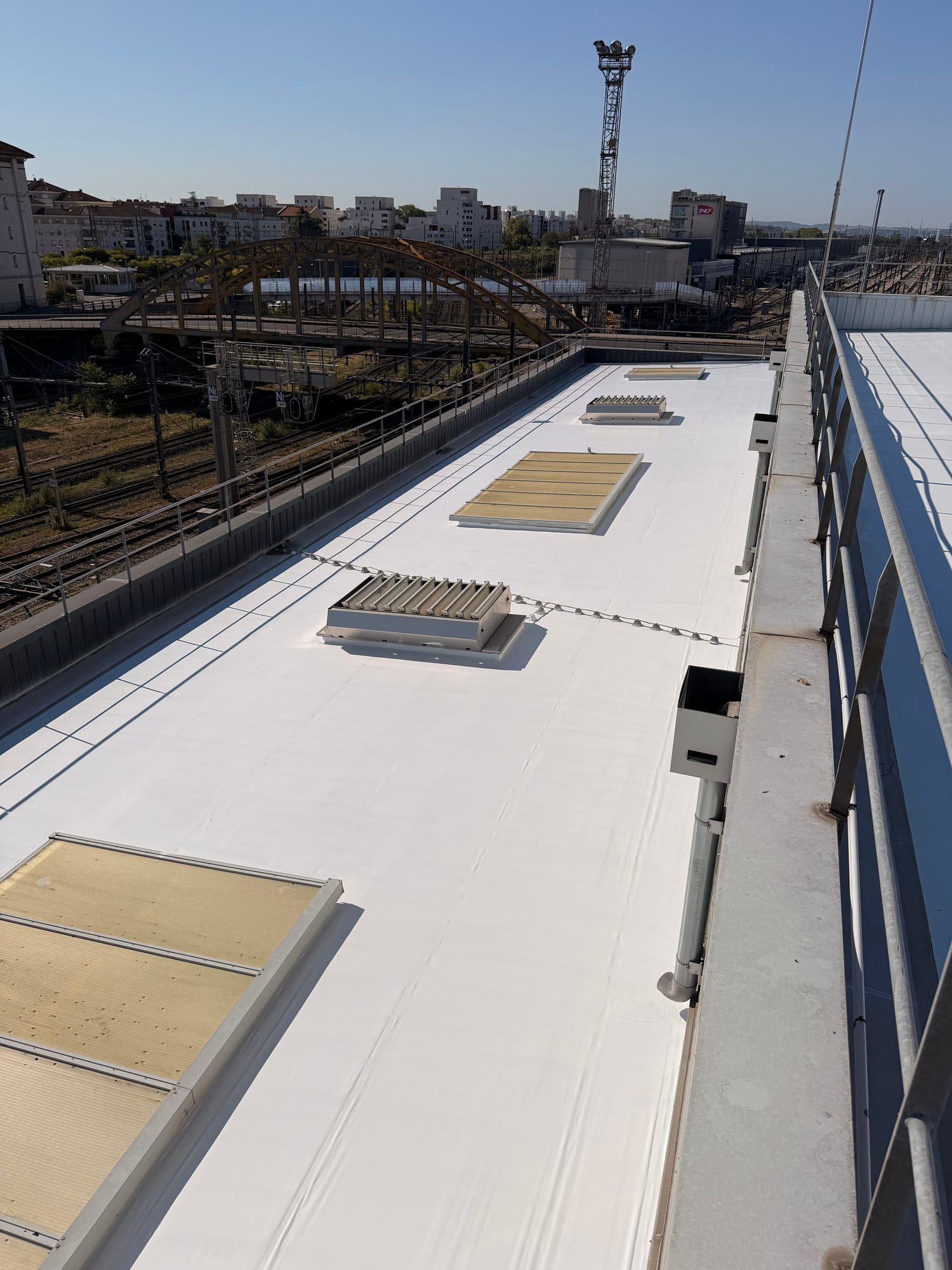
A dark roof reaches 50 to 70 °C under the summer sun; treated with the PrimaTherm® system — reflectance 95 % (ASTM E903-12), emissivity 0.89 (ASTM C1371-15), SRI 120 (ASTM E1980) — it stays between 25 and 35 °C, i.e. up to −30 °C on the roof surface. On the largest building at Airbus Marignane, the infrared measurement at handover gave −29 °C. Heat that does not enter does not have to be extracted: air-conditioning consumption falls by 15 to 25 % in French climate zone H1, 20 to 30 % in H2, 25 to 40 % in H3, i.e. up to −40 % of that share. In a building without air conditioning, the gain is read in comfort — up to −6 °C felt inside depending on insulation — and in portable air conditioners avoided.
What it does not do
It does not reduce heating, lighting or process consumption. The effect on the total declared consumption therefore depends on the weight of air conditioning in your balance: decisive for a shop in zone H3 air-conditioned all season, modest for lightly air-conditioned offices in zone H1. The simulator (in French) gives a first range; the free study refines it from your invoices.
How to prove it
OPERAT only records kilowatt-hours. For the cool roof’s contribution to be legible in your trajectory:
- install sub-metering of the air conditioning before the works, or failing that record consumption by period;
- measure surface temperatures (infrared) and indoor temperatures before and after, at the same times and in the same conditions;
- correct for cooling degree-days to compare two different summers;
- record the action in the action plan filed on OPERAT, with the date, the surface and the certified values of the coating.
For each project we provide the infrared measurements, the thickness checks, the site monitoring sheet and the as-built file that feed this record.
Funding: conditional CEE and VAT
The tertiary decree imposes; it does not fund. The levers to examine:
- French energy-savings certificates (CEE), sheet BAT-EN-112: the premium is conditional. It targets commercial tertiary buildings whose volume is heated and cooled by heat pump, with flat rates of 160, 170 and 270 kWh cumac per m² depending on zone H1, H2 or H3. It does not apply as such to industry, logistics or agriculture, and the amount of the premium depends on the certificate market at the time of the application. The application must precede the signing of the quote (active and incentivising role of the obligated energy supplier).
- MaPrimeRénov’ does not cover the cool roof.
- The French Green Fund (Fonds Vert) and regional calls for projects: for local authorities and subject to annual budgets.
- VAT: the reduced 10 % VAT applies to French homes over two years old, not to tertiary buildings.
Our page on cool roof incentives in France in 2026 details these schemes.
Landlord and tenant: who does what
The tertiary decree targets both the owner and the occupant, and this is often where projects get bogged down. In practice:
- the landlord is responsible for the envelope and the equipment it retains; the roof, and therefore the cool roof, is generally its responsibility;
- the tenant is responsible for its uses and its equipment; it often holds the energy invoices and declares the consumption;
- the lease allocates the obligations and the costs; recent leases include an environmental appendix that organises the exchange of data.
For a property company or an investor, the reflective roof is an investment in the asset: it protects the waterproofing, improves the building’s Éco Énergie Tertiaire rating, and eases the relationship with tenants who are themselves obligated. For a tenant operator, it is an action to propose to its landlord, figures in hand, as part of the joint action plan.
Frequent errors in OPERAT declarations
- Choosing a reference year without holding its complete invoices: the declaration becomes contestable.
- Forgetting an energy: gas, district heating or delivered cooling count as much as electricity.
- Declaring an inaccurate surface: the tertiary floor area determines the threshold and the absolute targets.
- Not documenting the actions: a drop in consumption without an action plan is hard to defend in the event of an inspection; an unexplained rise is even harder.
- Waiting until 2029 to act: roof works are done in dry weather between 12 and 35 °C; an action decided in autumn is measured the following summer and declared the year after. The calendar is short.
Use cases by type of building
| Building | Weight of air conditioning | Cool roof contribution to the trajectory |
|---|---|---|
| Retail, supermarkets (H2, H3) | High, with food refrigeration | Strong: air conditioning and refrigeration less stressed, sales-floor comfort |
| Air-conditioned offices | Medium to high depending on roof area per occupant | Noticeable on low-rise buildings; marginal on a tower |
| Logistics platform | Low (except cold storage or air-conditioned areas) | Operator comfort, protection of the waterproofing, preparation for a future smaller-sized air-conditioning system |
| Education, healthcare | Variable, with high sensitivity to comfort | Summer comfort for users, fewer supplementary air conditioners |
| Hotels, restaurants | High in season | Reduced consumption at the summer peak |
The results of our reference projects (the TGV maintenance centre in Lyon, the aerospace sites at Marignane and Le Bourget, a 1,000 m² warehouse in Marseille, a cured-meat plant in Périgny whose roof space went from 50 to 30 °C with −35 % refrigeration consumption) are presented in our projects, with the before/after measurements.
What a reflective roof changes for the rating
The Éco Énergie Tertiaire rating is calculated from the declared consumption; it does not reward intentions. A roof action carried out in spring is read in the following year’s declaration, provided the summer was comparable or the climate correction was applied. This is why we recommend announcing the action in the plan filed on OPERAT, then documenting it with the measurements: consistency between the plan and the kilowatt-hours is the first thing an inspector looks at.
Practical calendar for an obligated party in 2026
- Before 30 September 2026: declaration of 2025 consumption on OPERAT; check of the reference year and the chosen method.
- Autumn 2026: audit or study of the consumption items; inclusion of the cool roof in the action plan if air conditioning weighs.
- Spring 2027: reflective roof works before the hot season (application between 12 and 35 °C, dry substrate), sub-metering in place.
- Summer 2027: measurements; 30 September 2028: first declaration including a complete treated summer.
- 2030: first deadline; each year gained is a summer of savings and an improved rating.
The role of Hélios
We are not a regulatory consultancy; we are the applicator of the PrimaTherm® system throughout France, with references in aerospace, rail, industry and multi-technical maintenance. What we bring to your tertiary-decree trajectory: a free roof study within 48 h (satellite measurement, substrate analysis, qualification of the air-conditioning share and of the incentives), works without lifting equipment and without shutdown, and measured evidence to include in your action plan. The complete regulatory context — RE2020, article L. 171-4, planning, fire — is described on our dedicated page.
Official sources: decree no. 2019-771 of 23 July 2019 on Légifrance, Éco Énergie Tertiaire scheme, French Ministry of Ecological Transition, OPERAT platform, ADEME, ADEME.
Frequently asked questions
Who is covered by the French tertiary decree?
Owners and tenants of buildings, parts of buildings or groups of buildings on the same plot, housing tertiary activities over a cumulative floor area of at least 1,000 m²: offices, retail, logistics, education, healthcare, hotels, sport, public administration. The obligations are shared between landlord and tenant according to the terms of the lease.
What are the targets and deadlines?
Either a reduction in final energy consumption of 40 % by 2030, 50 % by 2040 and 60 % by 2050 compared with a reference year chosen between 2010 and 2019 (relative method), or reaching a consumption level set by ministerial order for each category of activity (absolute method). The previous year's consumption is declared on OPERAT before 30 September each year.
What are the penalties for non-compliance?
If a declaration is missing or a target is not met, the prefect may issue a formal notice, require an action plan, publish the name of the defaulting party on a government website (the name-and-shame principle) and impose an administrative fine whose amount is set by the French building and housing code. The main risk is reputational and asset-related: the Éco Énergie Tertiaire rating appears in sale and letting files.
Is a cool roof enough to reach −40 %?
No, except in the particular case of a building whose consumption is dominated by air conditioning. The cool roof acts on the cooling share: between 15 and 25 % of that share in French climate zone H1, 20 to 30 % in H2, 25 to 40 % in H3, up to −40 %. It is combined with controls, lighting, ventilation, insulation and usage management to build the complete trajectory.
How is the cool roof taken into account in OPERAT?
OPERAT records consumption, not actions: the effect of the cool roof appears in the drop in kilowatt-hours the following year. We recommend sub-metering the air conditioning and taking temperature measurements before and after, to isolate the roof's contribution in your action plan.
Is the cool roof eligible for French energy-savings certificates (CEE) under the tertiary decree?
Under conditions. Sheet BAT-EN-112 targets commercial tertiary buildings whose volume is heated and cooled by heat pump; the flat rates are 160, 170 and 270 kWh cumac per m² depending on zone H1, H2 or H3. It does not apply as such to industry, logistics or agriculture. The tertiary decree and the CEE are two independent schemes: one imposes, the other funds under conditions.