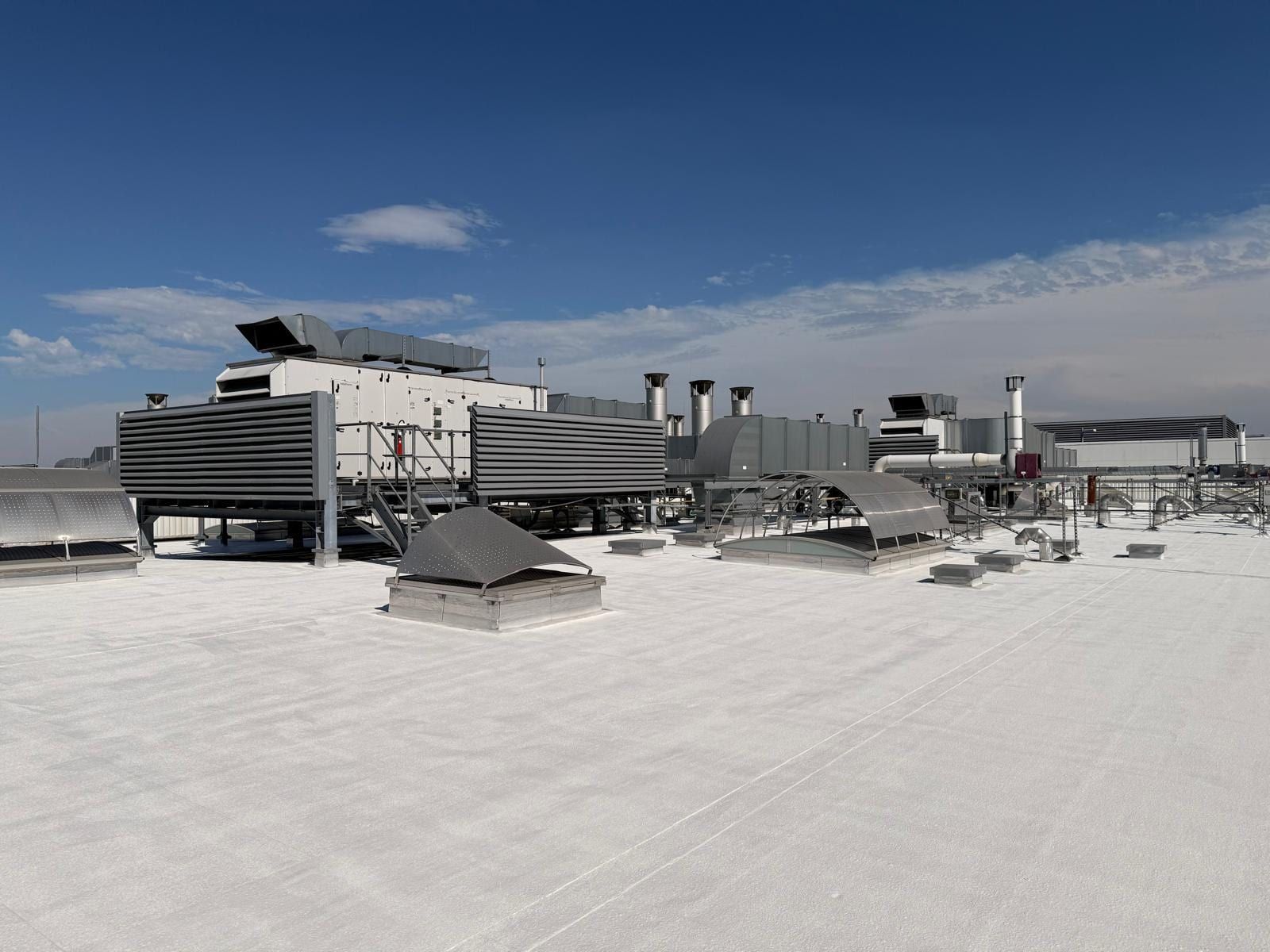
What is the profitability of a cool roof?
The profitability of a cool roof measures what a reflective roof brings in compared with what it costs. Two indicators sum it up:
- the payback time (or ROI in years): the investment net of incentives divided by the annual savings. This is the number of years after which the roof is “paid back”;
- the value over the service life: the cumulative savings over the conventional service life of the system, 20 years according to the French CEE sheet (SRI maintained after 4,000 h of accelerated QUV ageing), minus the investment and maintenance.
On the air-conditioned buildings we study, the payback time is generally 3 to 5 years: shorter in French climate zone H3 and on a heavily air-conditioned site, longer in the north or on a lightly air-conditioned building, where the value comes from elsewhere. The rest of this page explains where the savings come from, how they are calculated, and which variables tip the result. The ROI simulator (in French) applies this method to your data in two minutes; the free roof study takes it up on your actual bills, within 48 h.
The savings levers of a reflective roof
A PrimaTherm® cool roof sends back 95 % of solar radiation (ASTM E903-12), with an emissivity of 0.89 and an SRI of 120: the roof goes from 50–70 °C to 25–35 °C. This drop in temperature translates into five distinct economic levers, which do not carry the same weight depending on your building.
1. Air conditioning: up to −40 % consumption
This is the most direct and most measurable lever. A roof that no longer absorbs heat no longer transmits it to the rooms: the cooling load falls, the chillers run for less time and less hard. The reduction in air-conditioning consumption lies between 15 and 40 % depending on the climate zone, the insulation of the roof, the use of the building and the share of the roof in the gains:
| French climate zone | Reduction in air-conditioning consumption (range) |
|---|---|
| H1 (north, east, centre) | 15 to 25 % |
| H2 (west, south-west, Rhône valley) | 20 to 30 % |
| H3 (Mediterranean rim) | 25 to 40 % |
The gain is highest on single-storey buildings with a large roof (warehouses, stores, workshops, sports halls), where the roof accounts for most of the solar gains; it is lower on a multi-storey building, where only the top floor is concerned. Our article on air-conditioning savings details the mechanism.
2. Chiller maintenance
A chiller that runs for fewer hours and at a lower load wears less: compressors, fans, refrigerants. Corrective maintenance interventions become less frequent, and the replacement of the equipment is pushed back. A cool roof sometimes avoids oversizing or replacing an air-conditioning system that “can no longer keep up” in summer — an item often heavier than the roof itself. Our comparison of cool roof versus air conditioning (in French) puts the two options face to face.
3. Longer-lasting waterproofing
A bitumen membrane or a steel deck that cycles every day between 20 and 70 °C cracks, blisters and corrodes before its time. Below 35 °C, the thermal amplitude is divided by two to three and UV is blocked by the PH107TCL topcoat. The waterproofing replacement — a heavy job, with lifting equipment and interruption — is pushed back. We do not put a figure on years gained; we note that the main ageing factor is removed. See cool roof on waterproofing membranes.
4. Comfort, productivity and safety
Above 28 °C in a workshop or a warehouse, working conditions deteriorate: slower pace, errors, breaks, stoppages, increased risks for physical jobs. A cool roof brings the rooms back below this threshold for several weeks a year (up to −6 °C felt depending on insulation, by removing the radiation from the ceiling). On a non-air-conditioned site, this is the first benefit, and it can be quantified: lost hours avoided, absenteeism, staff turnover, employer obligations during heatwaves.
5. Losses avoided
Heat-sensitive goods (food, pharmaceuticals, cosmetics, electronics), processes that drift with temperature, servers and automated systems that go into safe mode, livestock under heat stress: each sector has its heat losses. On a cured-meat plant in Périgny (2,000 m² of steel deck, a Hélios site), the roof space went from 50 to 30 °C and cooling consumption fell by 35 %.
And in winter?
A legitimate objection: does a white roof lose heating in winter? Marginally. The winter sun is low and strikes the façades, very little the roofs; the days are short and often overcast; nights radiate as much from a dark roof as from a light one. We include this loss in the calculation as a precaution; the annual balance remains positive everywhere in France. The article cool roof in winter gives the details.
What makes up the cost of a cool roof
We display neither a price nor a rate per m² for professional buildings on this page: they would be wrong half the time. The cost of a project is built from six items, which the proposal details one by one after the free study.
- The area and its geometry: real decreasing prices beyond a few thousand m², but also the number of singular points, upstands, penetrations and equipment to work around.
- The roof type and its condition: a clean steel deck is not prepared like a soiled membrane; the primer covers 6 m²/L on bitumen against 10 m²/L on steel deck.
- The preparation: medium-pressure cleaning, anti-moss treatment, localised waterproofing repairs, treatment of fixings.
- Access and site constraints: prevention plan, phasing with operations, safety on the roof — the method without lifting equipment reduces this item, without removing it.
- Additional items: rooflights treated with PrimaTherm® LT lacquer, photovoltaic areas.
- The incentives that can be mobilised: the CEE premium under sheet BAT-EN-112 of the French energy-savings certificates, under strict conditions, the French Green Fund (Fonds Vert) for local authorities, the reduced 10 % VAT on French homes over two years old. MaPrimeRénov’ does not cover cool roofs. See cool roof incentives in France 2026.
For a homeowner or a small area, the PrimaTherm® online shop (in French) displays its prices and calculates the exact quantity of product.
The ROI calculation method, in five steps
Here is the method we apply in every study, and which the simulator reproduces. It is expressed in percentages and kilowatt-hours, not in catalogue euros.
Step 1 — Establish the reference air-conditioning consumption
Starting point: your electricity bills over one year, or better, the readings of the meter or the building management system (BMS) by use. If air conditioning is not sub-metered, it is estimated by the difference between the summer months and the mid-season months, or from the power of the chillers and their operating hours. The result is a share of the bill attributable to cooling — typically 15 to 40 % of the annual electricity bill of an air-conditioned tertiary or commercial building, much more in a cold-storage warehouse.
Step 2 — Determine the share of the roof in the gains
On a single-storey building with a large roof, the roof is the first source of solar gains; on a multi-storey building, it only weighs on the top floor. This share determines the effectiveness of the cool roof on total cooling consumption: it is what places your building at the bottom or the top of the range.
Step 3 — Apply the reduction range
The expected reduction for your climate zone (15 to 25 % in H1, 20 to 30 % in H2, 25 to 40 % in H3), adjusted for the insulation and the share of the roof, is applied to the air-conditioning consumption. An example of the logic, in percentages: if air conditioning represents 30 % of your electricity bill and your building, in zone H3, sits in the middle of the range (about 30 % reduction in cooling), the expected saving is around 9 % of the total electricity bill. In zone H1 with 20 % air conditioning and a 20 % reduction, you get 4 % of the total bill. The difference between these two cases explains why we refuse to publish a single figure.
Step 4 — Establish the net investment
The cost of the proposal, minus the incentives actually obtained: the CEE premium if the building is a commercial tertiary building heated and cooled by a heat pump (flat rate of 160, 170 or 270 kWh cumac per m² depending on H1, H2, H3, valued by your obligated party), the French Green Fund (Fonds Vert) for a local authority, the reduced 10 % VAT for a home. An incentive that has not been obtained does not enter the calculation.
Step 5 — Calculate the payback time and the value over 20 years
Payback time (years) = net investment ÷ annual savings
The annual savings add up the energy (step 3), the maintenance avoided and, if you wish, the losses avoided and productivity — items that we document but leave, as a precaution, out of the standard calculation. Over the conventional service life of 20 years, these savings are accumulated, the investment and maintenance (one cleaning every 12 to 15 months) are deducted, and the net value of the project is obtained. We do not build any energy price increase into the base scenario: if it happens, it works in your favour.
The table of variables
| Variable | Effect on profitability | How we obtain it |
|---|---|---|
| Climate zone (H1, H2, H3) | Sets the cooling reduction range; H3 is the most favourable | Site address |
| Share of air conditioning in the bill | The higher it is, the greater the absolute saving | Bills, sub-metering, BMS |
| Share of the roof in solar gains | Single-storey with a large roof: maximum; multi-storey: top floor only | Plans, number of floors, satellite measurement |
| Roof insulation | Poorly insulated: maximum indoor gain; well insulated: more moderate but real gain on air conditioning | Diagnosis, composition of the roof build-up |
| Roof type and condition | Determines the preparation and the coverage rates, hence the cost | Technical visit |
| Area | Decreasing prices beyond a few thousand m² | Satellite measurement then joint measurement on site |
| Incentives obtained | Reduce the net investment | Eligibility check during the study |
| Electricity tariff | Converts the kWh saved into value | Your contracts |
| Occupancy hours in summer | The more the building is occupied and air-conditioned in summer, the higher the gain | Declared use |
| Sensitive equipment | Adds the losses avoided and maintenance | Interview with the operator |
Three profiles, three profitability logics
To illustrate without inventing amounts, here is how the method behaves on three typical buildings. The percentages are orders of magnitude, to be confirmed on your data.
Air-conditioned store or office floor, zone H3. Air conditioning by reversible heat pump, single-storey or exposed top floor, high summer occupancy. Cooling reduction at the top of the range (25 to 40 %), CEE BAT-EN-112 eligibility to be checked, French tertiary-sector decree if over 1,000 m². This is the profile where the payback time is shortest, often at the bottom of the 3 to 5 year range.
Non-air-conditioned steel-deck logistics warehouse, zone H2. No direct electricity saving on cooling; the value comes from the comfort of the operators (up to −6 °C felt under a single-skin deck), the lost hours avoided during heatwaves, the protection of goods and of the steel sheet. No CEE with the current sheet. The calculation is made in hours, in incident rates and in roof service life, and it is often very favourable for an operator; for a property company, the argument is asset value and tenant retention.
School or public building, zone H1 or H2. Little or no air conditioning; profitability is expressed in user comfort, continuity of service during heat episodes and waterproofing service life. French Green Fund (Fonds Vert) available according to prefectural priorities, works during the holidays. The financial payback time is less relevant than the cost per pupil protected, which the local authority can set against an air-conditioning system it will not install.
Cool roof, air conditioning, insulation, green roof: where profitability stands
A cool roof replaces neither insulation nor waterproofing; it complements them, and it is compared above all with cooling solutions.
- Against additional air conditioning: the cool roof reduces the need instead of adding consumption; it has no moving parts, no refrigerant, no breakdowns. See our comparison of cool roof versus air conditioning (in French).
- Against external insulation: insulation acts on winter losses as well as on summer gains, with heavier works; the two combine well, the cool roof protecting the insulant from overheating. See our article on external roof insulation (in French).
- Against a green roof: cooling by evapotranspiration, but load-bearing structure, maintenance and cost that bear no comparison. See cool roof or green roof.
- Against a white membrane: relevant when the waterproofing is at the end of its life; otherwise, the cool roof is applied on the existing roof, without lifting equipment, with a higher SRI (120 against 90 to 100). See cool roof coating or membrane.
The effect of incentives and the tertiary decree on the payback time
An incentive reduces the net investment, hence the payback time, but only if it is obtained. The CEE premium under sheet BAT-EN-112 is conditional — commercial tertiary building, volume heated and cooled by a heat pump — and we never display its amount in euros. The French tertiary-sector decree is not an incentive, but it weighs in the decision: for a building subject to it, a cool roof is an action with a short payback time, declarable on OPERAT, which contributes to the −40 % expected in 2030. See French tertiary decree and cool roofs and the regulatory context.
How we measure, before and after
An ROI is demonstrated. Every Hélios site is handed over with infrared surface temperature measurements, treated zone against control zone: −29 °C on the largest building at Airbus Marignane on 19 June 2026 (57.8 °C against 28.6 °C), on 5,900 m² of bitumen membrane in total. On request, we add indoor temperature probes and monitoring of air-conditioning consumption over the following season, corrected for outdoor temperatures.
For a multi-site portfolio, we recommend an instrumented pilot site: one building treated, before/after measurements, a report — then the roll-out decision on figures that are your own. Our projects and customer testimonials (in French) show what this gives on aerospace, rail and industrial sites.
From principle to figure
Two tools, in order:
- the cool roof ROI simulator: area, zone, use, share of air conditioning — a first order of magnitude of the temperatures, the indoor gain and the air-conditioning reduction, with no contact details required;
- the free roof study: satellite measurement, analysis of the roof type, check of the incentives, then a detailed line-by-line proposal with the payback calculation on your bills, within 48 h.
The cool roofing guide and the PrimaTherm® reflective coating page explain the physics and the system that make these figures possible; the cool roof applications hub places your building among the typical cases.
Frequently asked questions
What is the return on investment of a cool roof?
Generally 3 to 5 years for an air-conditioned building, shorter in French climate zone H3 and on a heavily air-conditioned building, longer on a lightly air-conditioned building where the value comes mainly from comfort and the protection of the waterproofing. The exact figure is calculated from your actual consumption in the free study; the simulator (in French) gives a first order of magnitude.
How much is saved on air conditioning with a cool roof?
Up to −40 % of air-conditioning consumption: 15 to 25 % in French climate zone H1, 20 to 30 % in H2, 25 to 40 % in H3, depending on the insulation, the use of the building and the roof coverage ratio. In relation to the total electricity bill, the saving depends on the share of air conditioning in your consumption, which we measure or estimate with you.
Why do you not display prices or savings in euros?
Because they would be wrong half the time. The cost depends on the area, the roof type, the preparation, the access and the incentives; the saving depends on your kilowatt-hours and your tariff. We prefer to explain the method, give you the simulator and establish the calculation on your data, in the proposal that follows the free study.
Is a cool roof profitable on a building without air conditioning?
There is no direct energy saving, but there is value: comfort of the teams above 28 °C, productivity, protection of goods and sensitive processes, waterproofing that lasts longer, compliance. On a non-air-conditioned warehouse or workshop, it is this value that justifies the project, and it can be documented too.
Does a cool roof lose money in winter?
Marginally. The winter sun, low on the horizon, strikes the façades and very little the roofs; the days are short and often overcast. The loss of winter solar gain is far lower than the summer savings, everywhere in France. We include it in the calculation as a precaution, and the annual balance remains positive.
How do you verify the ROI after the works?
By measurements: infrared surface temperature of the treated zone against the control zone at handover (−29 °C at the handover of a 5,900 m² site in Marignane on 19 June 2026), indoor temperatures, and monitoring of air-conditioning consumption over the following season, corrected for outdoor temperatures. On a multi-site portfolio, we recommend an instrumented pilot site before roll-out.