Who pays for a roof in a co-ownership
The answer lies in the French co-ownership law of 10 July 1965. Its article 3 lists among the common parts “the structural works of the buildings”: unless the by-laws say otherwise, the roof and its waterproofing belong to everyone. Its article 10 distinguishes two families of charges: those relating to the conservation, maintenance and administration of the common parts, shared among the co-owners in proportion to the relative values of their private units, that is, according to the co-ownership shares (tantièmes) in the by-laws; and those for collective services and shared equipment, shared according to the objective usefulness of those services to each lot.
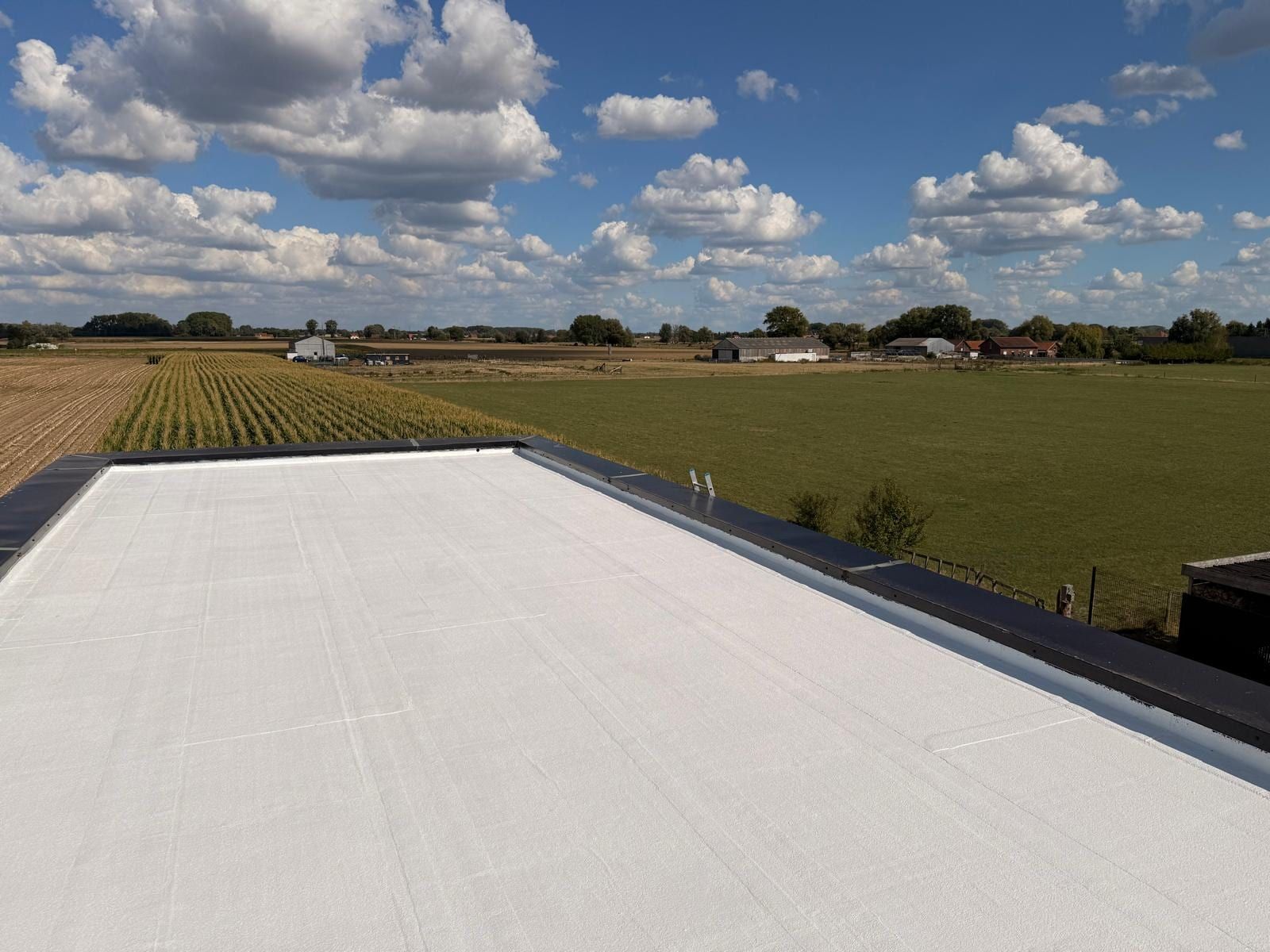
A reflective coating applied to the roof falls into the first category: work on a general common part, shared according to the co-ownership shares among all the co-owners, from the ground floor to the top floor. That is what makes the project fundable, and what rules out limiting the case to the comfort of the flats under the roof: waterproofing protected from thermal shocks and UV, cooler common parts and the value of the building concern every lot. Our page cool roof for residential buildings presents the system and the buildings concerned.
Voting the expense: the majority depends on how the works are classified
The funding is voted at the same time as the works, and the majority required depends on the nature of the operation:
- Article 24 (majority of the votes cast by the co-owners present, represented or voting by post): works necessary for the conservation of the building. A managing agent may adopt this classification if the coating is presented as protection of the existing waterproofing.
- Article 25 (majority of the votes of all the co-owners): its point f) covers energy-saving works and works to reduce greenhouse gas emissions, the most common classification for a reflective roof, which reduces air-conditioning needs.
- Article 25-1: if the resolution gathers at least one third of the votes of all the co-owners without reaching the article 25 majority, the same meeting immediately holds a second vote by the article 24 majority.
The classification adopted appears in the resolution and is settled with the managing agent before the notice of meeting. The French decree of 17 March 1967 requires, except in an emergency, a notice of meeting served at least twenty-one days before the meeting, accompanied, for any contract or quote put to the vote, by its essential terms or, where there is competitive tendering, by those of the contracts proposed. Our guide to convincing the general meeting (in French) provides a model resolution and the answers to the objections; this one focuses on the money.
Three ways to pay
The works fund
Since the French law of 22 August 2021, article 14-2-1 of the 1965 law has required the owners’ associations of buildings used wholly or partly as housing to set up a works fund at the end of a period of ten years after the handover of the building. The obligation came into force in stages: on 1 January 2023 for co-ownerships of more than 200 lots, on 1 January 2024 for 51 to 200 lots, on 1 January 2025 for 50 lots or fewer. The annual contribution may not be less than 5 % of the provisional budget; where the general meeting has adopted a multi-year works plan, it may be less than neither 2.5 % of the amount of the works provided for in that plan nor 5 % of the provisional budget, and the meeting may decide on a higher amount.
The fund finances the drawing up of the multi-year plan, the works it provides for, urgent works, and the works necessary to safeguard the building, to preserve the health and safety of the occupants or to achieve energy savings that are not included in the plan. A reflective roof voted as energy-saving works can therefore be charged to it, if the meeting so decides. Two characteristics matter: the sums paid in are attached to the lots and definitively acquired by the owners’ association, so a seller does not get them back; and the allocation of the fund to an operation is put to the vote.
The call for funds
Where the fund is insufficient, or if the meeting prefers to preserve it, the expense is covered by a specific call for funds, shared according to the general co-ownership shares and payable according to the schedule voted, often aligned with the contract instalments: order, start of works, handover. A schedule spread over two or three financial years is a classic answer to the cost objection, for an operation whose works last only a few days.
The collective loan and the éco-PTZ for co-ownerships
The 1965 law allows the owners’ association to take out a collective loan on behalf of the co-owners who decide to take part in it (articles 26-4 onwards), on the terms set by the general meeting. Among the regulated loans, the French zero-interest eco-loan (éco-PTZ) exists in a version for co-ownerships, open to the owners’ association for buildings completed more than two years ago, on a decision of the meeting. Its scope is precise: thermal insulation of roofs, of walls facing the outside, of glazed surfaces and doors, of ground-floor slabs, heating or domestic hot water systems, equipment using renewable energy, whole-building renovation and non-collective sanitation. A reflective coating on its own falls into none of these categories; only a roof insulation operation, which is eligible, could include it, something the managing agent must have confirmed by the bank before presenting it to the meeting. The simulator (in French) gives a first idea of the payback time, to be set against the payment schedule.
The 10 % VAT: the real tax lever
On a residential building completed more than two years ago, improvement, conversion, fitting-out and maintenance works qualify for the reduced VAT rate of 10 % (article 279-0 bis of the French General Tax Code): the reduced 10 % VAT on French homes over two years old. The tax authorities’ official guidance specifies that the common parts of collective residential buildings are covered as long as at least half of the building’s floor area is used as housing, the rate then applying to all the works on those common parts. The supply and application of a reflective coating on the roof of a co-ownership fall within this framework.
Two clarifications avoid unpleasant surprises. The 5.5 % rate is reserved for a closed list of energy renovation works (thermal insulation, heating and hot water equipment using renewable energy, in particular) that does not include reflective coatings: it is 10 %, not 5.5 %. And since 1 March 2025, the separate certificate is no longer required: the customer certifies on the quote or the invoice that the conditions for the reduced rate are met, and keeps these documents. The managing agent signs for the owners’ association.
What MaPrimeRénov’ does not fund
MaPrimeRénov’, the French home renovation grant, does not cover cool roofs. This sentence also holds for MaPrimeRénov’ Copropriété, whose rules are public: the grant targets an energy renovation of the common parts with a gain of at least 35 % after works, established by an energy audit or a global technical diagnosis, with a mandatory project-management assistant, RGE-certified contractors (the French energy renovation quality label), in a registered co-ownership, built at least fifteen years ago and made up mostly of main residences. The works listed are roof and wall insulation, replacement of the heating system and installation of ventilation. A reflective roof is not among them.
Same answer for the French energy-savings certificates (CEE): sheet BAT-EN-112, which covers reflective roof coatings, is reserved for commercial tertiary buildings whose volume is heated and cooled by heat pump. Collective housing does not qualify. Our article on sheet BAT-EN-112 (in French) details its conditions, and the cool roof incentives 2026 page sums up what really exists.
Local grants, to be checked building by building
French regions, départements, inter-municipal bodies and municipalities sometimes grant aid for works in co-ownerships, under locally defined conditions. ANIL, the French national housing information agency, keeps up to date a search tool for local works grants, by region and by département, which gives the conditions and the contact for each scheme. The local authorities committed to fighting heat islands are those where a light-coloured roof application has the best chance of finding support, never guaranteed in advance. We check this point during the study, before the general meeting, so as not to put to the vote a resolution that counts on a non-existent grant.
What the co-ownership is actually paying for
The cost of a reflective roof depends on the area, the substrate (bitumen, membrane), the preparation, the access and the VAT rate; it exists only in the proposal handed over after the study, and we do not publish a price list. What is being bought can be described: a system in 4 layers (PH169 primer, PH107 reflective base coat in two passes, PH107TCL anti-soiling topcoat), solar reflectance of 95 % (ASTM E903-12), emissivity of 0.89 (ASTM C1371-15), SRI of 120 (ASTM E1980), SRI maintained after 4,000 h of accelerated QUV ageing — conventional service life of 20 years (French CEE sheet), Broof(t3) fire rating (CSTB report RA23-0010).
The result can be measured: a dark flat roof that used to climb to 50–70 °C stays between 25 and 35 °C, i.e. up to −30 °C on the roof surface, with −29 °C recorded by infrared at the handover of the Airbus Marignane project in June 2026; in the top-floor flats, up to −6 °C felt inside depending on the insulation of the flat roof. The waterproofing, protected from the expansion cycles, ages more slowly, which pushes back the item every general meeting dreads; our article on the service life of flat-roof waterproofing (in French) describes the signs of wear. The works are carried out without a crane or scaffolding, drums and pump on the ground, without access to the flats, in a few days. The price factors are explained on the cool roof price per m² page; for a small co-ownership or a house with a flat roof, the same system is available from the online shop (in French).
The timetable of funding that succeeds
- Three months before the general meeting: free roof study, technical visit and detailed proposal, with the VAT rate stated.
- Two months before: owners’ council; choice of the funding method, check of local grants, classification of the works and majority settled with the managing agent.
- One month before: notice of meeting with the proposal and the opinion of the owners’ council, within the twenty-one-day period.
- General meeting: vote on the works, the funding and the authorisation given to the managing agent to file the prior declaration to the town hall (French planning code) for the change of roof colour.
- After the vote: call for funds or allocation of the works fund, signature of the contract, works in dry weather between 12 and 35 °C, handover with infrared measurements and the as-built file.
Key points
- Who pays: the roof is a common part; the expense is shared according to the co-ownership shares (tantièmes) among all the co-owners (articles 3 and 10 of the French law of 10 July 1965).
- Vote: article 25 f) for energy-saving works, with the second vote of article 25-1; article 24 if the resolution concerns the conservation of the waterproofing; notice of meeting twenty-one days before.
- Cash: mandatory works fund (contribution of at least 5 % of the provisional budget), call for funds according to the co-ownership shares, collective loan; the éco-PTZ does not cover a coating on its own.
- Tax: 10 % VAT on supply and application for a French residential building over two years old, certified on the quote or the invoice.
- Incentives: MaPrimeRénov’ and the French energy-savings certificates (CEE) do not cover cool roofs in co-ownerships; local grants are checked before the vote.
Sources
- Law no. 65-557 of 10 July 1965 establishing the status of co-ownership of built property (articles 3, 10, 24, 25, 25-1, 26-4) and article 14-2-1, works fund, Légifrance.
- Decree no. 67-223 of 17 March 1967, articles 9 and 11, Légifrance.
- Works fund set up in co-ownerships, Justice.fr, 2025.
- Co-ownership: the works fund in 6 questions, Institut national de la consommation (French national consumer institute), 2026.
- VAT rates for home renovation works, Service-Public, 2026, and BOI-TVA-LIQ-30-20-90-10, premises covered by the reduced rate, BOFiP, 2025.
- MaPrimeRénov’ Copropriété, France Rénov’.
- Zero-interest eco-loan, French Ministry of Ecological Transition, 2026, and Zero-interest eco-loan for co-ownerships, ANIL, 2026.
- Financing works in a co-ownership and Local works grants, ANIL.
- Test reports of the PrimaTherm® system, certifications page.
Frequently asked questions
Who pays for a reflective roof in a co-ownership?
All the co-owners. The roof is part of the structural works, and therefore of the common parts, and the charges for the conservation and maintenance of the common parts are shared in proportion to the relative values of the private units, that is, according to the co-ownership shares (tantièmes) set out in the by-laws. The top-floor co-owners do not pay alone, even if they benefit the most.
Can the works fund finance a cool roof?
Yes, if the general meeting so decides. The works fund, mandatory in buildings used wholly or partly as housing, can finance the works of the multi-year works plan, urgent works and energy-saving works not included in it. Its allocation to the operation is voted at the same time as the works; failing that, a call for funds shared according to the co-ownership shares covers the expense.
Which VAT rate applies to a cool roof in a co-ownership?
The reduced 10 % VAT on French homes over two years old, applicable to improvement, conversion, fitting-out and maintenance works on residential premises completed more than two years ago, common parts included. The 5.5 % rate is reserved for a closed list of energy renovation works that does not include reflective coatings. Since 1 March 2025, the customer certifies on the quote or the invoice that the conditions are met.
Can MaPrimeRénov’ Copropriété finance a reflective roof?
No. MaPrimeRénov’ does not cover cool roofs, including in its Copropriété strand, which funds a renovation of the common parts with an energy gain of at least 35 %, covering roof and wall insulation, heating and ventilation, with a mandatory audit and a mandatory project-management assistant. The French energy-savings certificates (CEE), sheet BAT-EN-112, do not apply to collective housing either.
Can the zero-interest eco-loan for co-ownerships be used?
The French zero-interest eco-loan (éco-PTZ) is open to the owners’ association for buildings completed more than two years ago, on a vote of the general meeting, but it funds specific categories of works: insulation of roofs, walls, glazed surfaces and ground-floor slabs, heating and hot water, renewable energy, whole-building renovation. A reflective coating on its own falls into none of them. The standard collective loan under the 1965 law remains possible, on the terms voted.
Are there local grants for a reflective roof in a co-ownership?
Sometimes. French regions, départements, inter-municipal bodies and municipalities grant aid for works under locally defined conditions; ANIL, the French national housing information agency, lists them in a search tool by département. Nothing is guaranteed in advance: the check is made before the general meeting, so as not to put to the vote a resolution that counts on a non-existent grant.