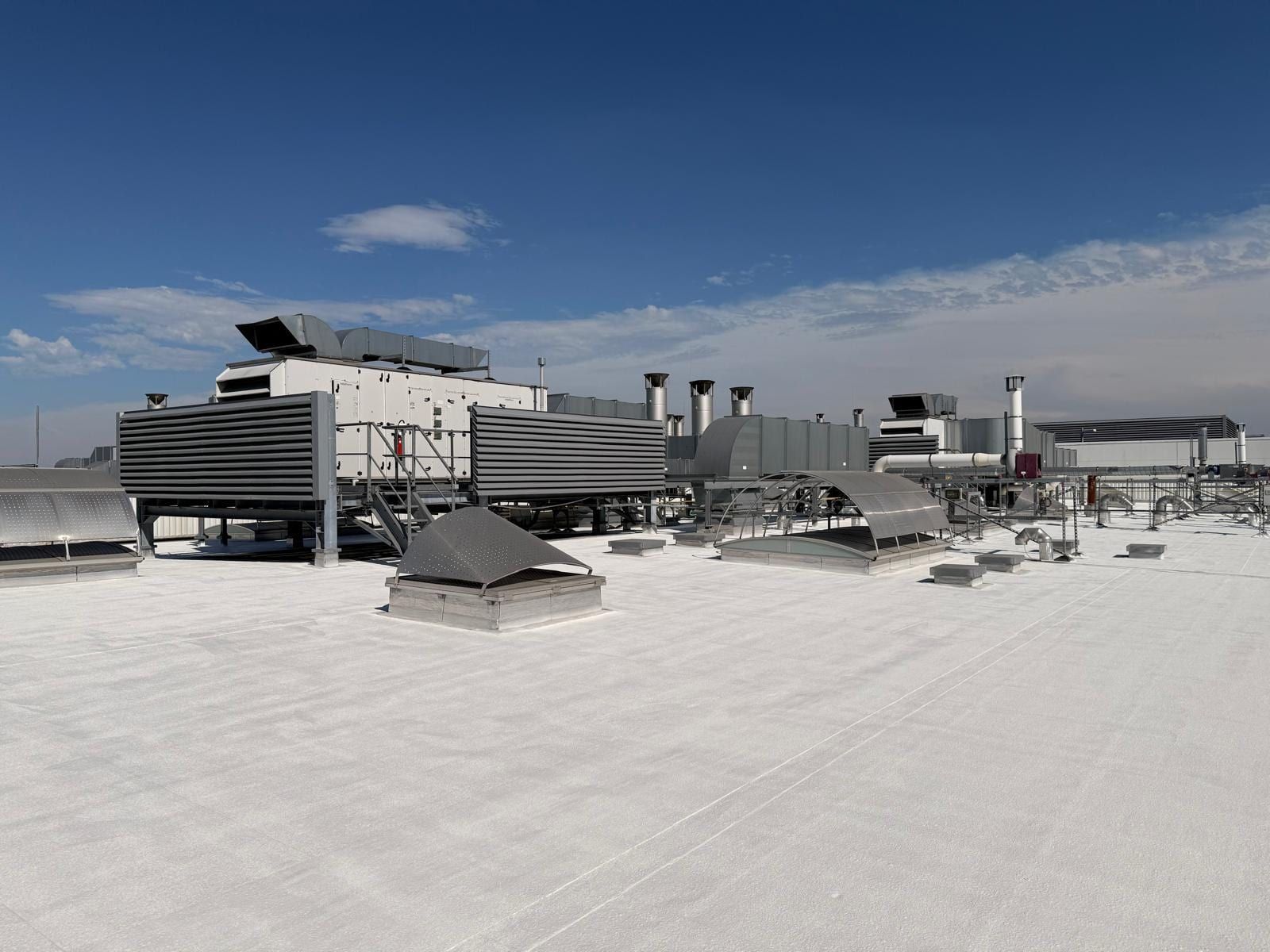
The framework at a glance
| Text or scheme | Who is concerned | What it changes for a cool roof |
|---|---|---|
| French tertiary-sector decree (Éco Énergie Tertiaire) | Tertiary buildings ≥ 1,000 m² | Reduction action declarable on OPERAT: −40 % in 2030, −50 % in 2040, −60 % in 2050 |
| RE2020 | New construction | Roof reflectance enters the summer-comfort calculation (degree-hours) |
| Amendment CS1137 | Roofs of buildings > 500 m², new and major renovation (to be followed) | Aims to recognise the reflective roof among the accepted solutions |
| French planning code, art. R. 421-17 | Any building whose external appearance changes | Prior declaration to the town hall; PLU and protected areas regulate colours |
| Order of 14 February 2003, EN 13501-5 | Roofs exposed to an external fire | PrimaTherm® rated Broof(t3), CSTB report RA23-0010 |
| CEE sheet BAT-EN-112 | Air-conditioned commercial tertiary buildings | Conditional eligibility; 160 / 170 / 270 kWh cumac per m² depending on H1 / H2 / H3 |
| PLU, climate plans | Depending on the municipality | Local obligations or recommendations on light-coloured roofs |
| HQE, BREEAM, LEED | Certified operations | SRI thresholds for heat-island and summer-comfort credits |
Each line is detailed below. The performance values quoted (95 % solar reflectance, emissivity 0.89, SRI 120, Broof(t3)) are those of the test reports listed on the PrimaTherm® certifications page.
French tertiary-sector decree: a trajectory, and the cool roof as a quick action
Decree no. 2019-771 of 23 July 2019, known as the tertiary decree, implements the Éco Énergie Tertiaire scheme provided for by the French ÉLAN law. It applies to any building, part of a building or group of buildings hosting tertiary activities over 1,000 m² or more: offices, shops, education, healthcare, hotels, tertiary logistics, public facilities.
The obligation is a final energy consumption trajectory: −40 % in 2030, −50 % in 2040, −60 % in 2050 compared with a reference year after 2010, or reaching an absolute consumption level set by order according to the activity category. Each obligated party declares its consumption every year on the OPERAT platform run by ADEME, the French environment agency. Failures are published (“name and shame”) and can lead to a formal notice and then an administrative fine.
A cool roof fits naturally into this trajectory: it acts on one of the most dynamic items in the tertiary sector, air conditioning, without heavy works or operational shutdown. A 15 to 40 % drop in cooling consumption depending on the climate zone reads directly in the kilowatt-hours declared. It is one of the actions on the building fabric that the scheme expects, alongside insulation, equipment replacement and operation. We provide for your file: infrared measurements before/after, test reports, site monitoring sheet. The guide French tertiary decree and cool roofs details the declaration method and the special cases (multi-occupant buildings, landlord and tenant, mixed sites).
RE2020: calculated summer comfort, with roof reflectance in it
RE2020, the French environmental regulation for new buildings, has applied to new construction since 2022. It prescribes no material, but it sets three families of requirements calculated by simulation: the bioclimatic need (Bbio), primary energy consumption (Cep) and summer comfort, measured in discomfort degree-hours (DH), with a maximum threshold not to be exceeded and a low threshold below which the building is considered comfortable without air conditioning.
In this calculation, the absorptivity of the roof — the inverse of its reflectance — is an input. A dark roof adds to solar gains and degree-hours; a roof with 95 % reflectance lightens them, even more so on low-inertia buildings and in French climate zones H2 and H3. For a design team, specifying a certified reflective coating from the design stage is a simple lever to meet the DH threshold without adding solar shading or active cooling. Our article RE2020 and cool roofs (in French) gives the orders of magnitude and how to enter the data in the calculation.
Amendment CS1137: the reflective roof among roofing solutions
Amendment CS1137, tabled in 2025 as part of the debates on the environmental performance of buildings, aims to include the reflective roof among the accepted solutions for the roofs of buildings over 500 m², new or undergoing major renovation, alongside photovoltaics and green roofs already provided for by the French construction code. Its interest is to recognise that a high-SRI coating meets the objective of limiting heat islands at a cost and a weight that bear no comparison with a green roof.
We recommend that you check the status of adoption of the text and of its implementing measures before citing it in a file: the article amendment CS1137 and cool roofing (in French) is kept up to date on this subject. Whatever the outcome, a PrimaTherm® roof at SRI 120 exceeds the reflectance thresholds mentioned in the debates.
Planning: PLU, prior declaration and protected areas
Turning a roof from black to white alters the external appearance of the building. Under French planning law, this change generally requires a prior declaration (article R. 421-17 of the French planning code), filed with the town hall, with a review period of one month as a general rule. It is not a building permit, but it is not nothing either: a town hall can demand that a roof altered without a declaration be restored.
Three situations call for particular attention:
- the PLU regulations (local planning rules) may impose roof colours, particularly in residential areas or historic centres; conversely, they may also encourage light-coloured roofs in their bioclimatic provisions;
- the surroundings of historic monuments and remarkable heritage sites: the opinion of the Architecte des Bâtiments de France (the French heritage architect) is required, and it may be unfavourable to white;
- residential buildings under co-ownership: the vote at the owners’ general meeting is added to the prior declaration; see cool roof for residential buildings.
For an industrial or logistics building in a business park, the declaration is most often a formality; for a house or an apartment building in town, it needs preparing. We check the applicable PLU during the study and provide you with the technical elements (appearance, colour, product data sheets) needed for the file.
Local obligations: what some cities require
Since the recent heatwaves, several local authorities have written the fight against urban heat islands into their planning documents and climate plans: recommendations or obligations for light-coloured roofs on certain new buildings or major renovations, albedo criteria in the specifications of development zones (ZAC), exemplarity imposed on public buildings. These rules vary from one municipality to another, change with each PLU revision, and are checked case by case with the planning department. Our file compulsory cool roofs: French cities in 2026 (in French) lists the known provisions and their real scope, and our article on cool roofs and urban heat islands explains why local authorities are taking up the subject.
Fire safety: Broof(t3) and the order of 14 February 2003
A roof must withstand a fire coming from outside: flying embers, incandescent projections, a neighbouring fire. The French order of 14 February 2003 on the performance of roofs and roof coverings exposed to an external fire defines the ratings, according to the European standard EN 13501-5. The Broof(t3) rating corresponds to test t3, the most demanding of the tests used in France, and it is expected by most safety regulations (industry, buildings open to the public, warehouses) as well as by insurers.
The PrimaTherm® reflective coating system is rated Broof(t3) by CSTB European classification report no. RA23-0010 of 18 January 2023, valid for five years from 1 December 2022. In practical terms: applying the cool roof does not degrade the fire rating of your roof, and the report is attached to every proposal for your inspection body and your insurer. Our article on cool roof insurance and building-damage cover (in French) goes into more detail.
Solar roofs: the cool roof, compatible and complementary
The French construction code now requires, for new or heavily renovated commercial, industrial and craft buildings, warehouses and covered car parks above a certain floor-area threshold, the integration of a renewable energy production process or a green-roof system on part of the roof. The cool roof is not, to date, one of the listed solutions — that is the purpose of amendment CS1137 — but it is fully compatible with photovoltaics: applied before the modules, it keeps the roof cooler, feeds the rear face of bifacial panels and protects the waterproofing. See cool roof and solar panels.
Public incentives: what the texts actually provide
- CEE sheet BAT-EN-112 — “reflective roof refurbishment” in tertiary buildings, under the French energy-savings certificates (CEE) scheme. Eligibility is conditional: commercial tertiary building, volume heated and cooled by a heat pump. The flat rate is 160, 170 or 270 kWh cumac per m² depending on French climate zone H1, H2 or H3. It does not apply as such to a non-air-conditioned warehouse, an industrial workshop or an agricultural building. We never display a premium in euros: the amount depends on the obligated party and on the price of the certificates at the time of the operation.
- MaPrimeRénov’: it does not cover cool roofs. We say so clearly to avoid applications filed in vain.
- French Green Fund (Fonds Vert): local authorities can mobilise this fund for climate-change adaptation and the energy renovation of their buildings, according to the year’s prefectural priorities.
- Reduced 10 % VAT: supply and application on a French home completed more than two years ago (residential buildings, houses).
The cool roof incentives in France 2026 page details each scheme, its conditions and its timetable.
Voluntary frameworks: HQE, BREEAM, LEED
Environmental building certifications are not regulatory, but they weigh in calls for tenders, green leases and real-estate strategies. All of them reward a high-reflectance roof under summer comfort and the reduction of heat islands: LEED sets an SRI threshold for roofs (78 for low slopes in the 2009 version, 82 initial and 64 aged in LEED v4), BREEAM and HQE address the subject in their comfort and outdoor environment targets. With an SRI of 120 new and 119 aged, PrimaTherm® documents these credits without difficulty; the roof SRI index guide explains how to read and cite the reports, and our article on cool roofs and HQE, BREEAM and LEED certifications (in French) details each framework.
CSR, reporting and product: what you can write
For a CSR report or sustainability reporting, three facts can be documented: the PrimaTherm® system is manufactured in France (La Rochelle), water-based with a low VOC content, with an environmental product declaration (FDES) and a run-off water analysis available from the manufacturer; the reduction in air-conditioning consumption is measurable on your bills; and durability rests on an SRI maintained after 4,000 h of accelerated QUV ageing — conventional service life of 20 years (French CEE sheet). We do not provide tonnes of CO₂ avoided from a catalogue: the calculation is made from your actual consumption, in the profitability study.
What we document for your files
Every Hélios proposal and every as-built file contains the documents that a planning department, an inspection body, an insurer, a CEE obligated party or a tertiary-decree auditor may ask for:
- Tipee test reports (reflectance ASTM E903, emissivity ASTM C1371, SRI ASTM E1980, new and aged condition);
- CSTB fire classification report RA23-0010, Broof(t3);
- technical data sheets and safety data sheets for the three products (PH169, PH107, PH107TCL);
- site monitoring sheet with thickness checks and coverage rates;
- infrared surface temperature measurements before/after;
- professional liability and ten-year (décennale) insurance certificate;
- elements for the prior declaration (colour, appearance, areas).
These documents are not a sales argument: they are the condition for a cool roof to be compliant, declarable and insurable. That is also why we only write certified values, and why the cool roofing guide starts with the physics before the promises. To locate your building, the cool roof applications hub summarises sectors, roof types and eligibility.
Frequently asked questions
Is a cool roof compulsory?
No, there is no national obligation in France to apply a cool roof to an existing building. However, the French tertiary-sector decree imposes a consumption-reduction trajectory on tertiary buildings over 1,000 m², some local planning rules (PLU) include light-coloured roofs, and RE2020 rewards reflectance in new construction. A cool roof is one of the simplest actions to meet these texts.
Does a cool roof count for the French tertiary-sector decree?
Yes. The Éco Énergie Tertiaire scheme measures the building’s final energy consumption, all actions combined. The reduction in air conditioning obtained with a cool roof (up to −40 % depending on the climate zone) shows up in the consumption declared each year on the OPERAT platform. We provide the before/after measurements and the test reports for your file.
Is planning permission needed for a cool roof?
Changing the colour of a roof alters the external appearance of the building and generally requires a prior declaration to the town hall (article R. 421-17 of the French planning code), with a one-month review period. Some local planning rules (PLU), the surroundings of historic monuments and protected areas regulate colours. We check this point for every project before committing.
Does PrimaTherm® comply with fire regulations?
The system is rated Broof(t3) for external fire exposure under standard EN 13501-5 and the French order of 14 February 2003, CSTB classification report RA23-0010. This is the rating expected for the roofs of industrial buildings, buildings open to the public and sites subject to the opinion of an inspection body or an insurer.
Which public incentives apply to a cool roof?
Sheet BAT-EN-112 of the French energy-savings certificates (CEE), under strict conditions: commercial tertiary building, volume heated and cooled by a heat pump, for 160, 170 or 270 kWh cumac per m² depending on French climate zone H1, H2 or H3. Local authorities can mobilise the French Green Fund (Fonds Vert). MaPrimeRénov’ does not cover cool roofs. The reduced 10 % VAT applies to French homes over two years old.
Does RE2020 require a reflective roof?
No, it prescribes no material. But its summer-comfort indicator, the discomfort degree-hours, is calculated by dynamic thermal simulation in which roof reflectance is taken into account. A roof with 95 % reflectance reduces solar gains and makes it easier to meet the threshold, particularly in French climate zones H2 and H3.