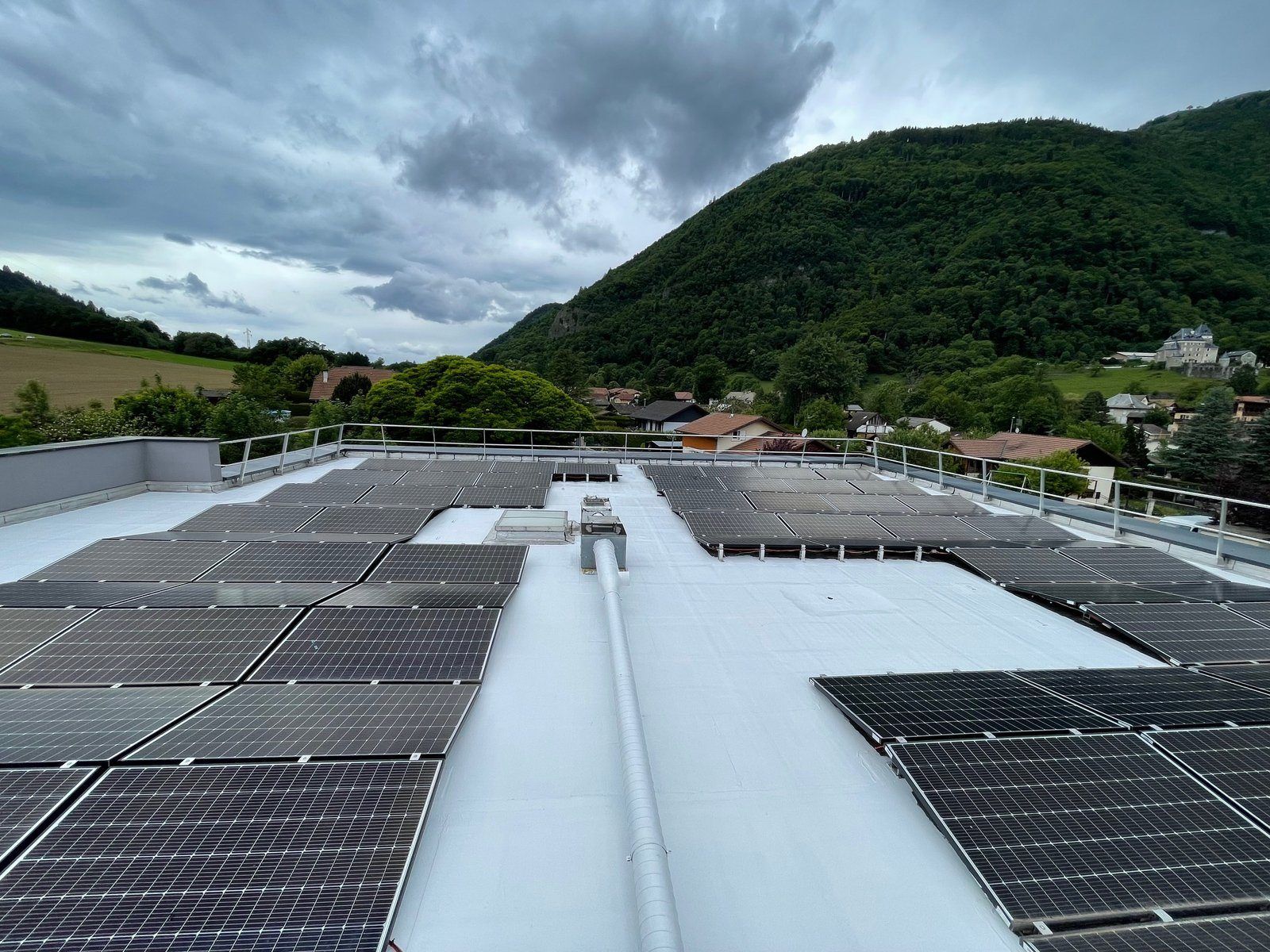
Quick facts — Cool roof and solar panels: a cooler roof and modules that produce more
- Compatibility
- All modules (mono, poly, bifacial) and mounting systems (rails on purlins, ballasted mounts, on-roof mounting)
- Order of works
- Cool roof first, panels after complete drying (48 to 72 h); on existing PV: accessible areas
- Effect on output
- Cooler air and surface under the modules: gain of a few percent, variable depending on mounting and climate
- Bifacial panels
- Roof with 95 % reflectance = reflected light available for the rear face
- Substrates
- Steel deck (primer 10 m²/L), bitumen membrane (6 m²/L), EPDM, PVC over 10 years old
- Glare
- Matt topcoat with diffuse reflection: no mirror effect towards the modules or the neighbours
- References
- Saint-Jeoire 1,500 m² and La Rochelle school 1,000 m² (combined with PV) — Hélios projects, PrimaTherm® system
- Indicative lead time
- About 1 week for 3,000 m², coordinated with the photovoltaic installer
Why heat penalises photovoltaics
A photovoltaic module is characterised by its manufacturer under standard test conditions, at a cell temperature of 25 °C. On a roof in summer, the cell commonly exceeds 60 °C, and more on a dark roof: the bitumen or steel deck under the panels reaches 50 to 70 °C, heats the air circulating underneath and radiates towards the back of the modules.
Yet the data sheets of every manufacturer state a negative power temperature coefficient: power drops by a few tenths of a percent for each degree above 25 °C. The hotter the module, the less it produces — at the very moment when sunshine is at its maximum. A scorching summer thus makes an installation lose a significant share of the production its irradiation would have allowed.
The cool roof acts on the cause: a roof that no longer heats up no longer warms the air under the panels.
What the cool roof brings to a photovoltaic roof
The PrimaTherm® system reflects 95 % of solar radiation (ASTM E903-12), with an emissivity of 0.89 (ASTM C1371-15) and an SRI of 120 (ASTM E1980), maintained at 119 after 4,000 h of accelerated QUV ageing. External fire classification Broof(t3) (CSTB report RA23-0010) — a point that insurers and inspection bodies look at closely on a roof carrying an electrical installation.
1. Modules that work in cooler air
The roof goes from 50–70 °C to 25–35 °C. The air circulating under the modules is cooler, the substrate no longer radiates towards their rear face: the cell temperature drops. The resulting production gain is a few percent, more marked in July-August and in French climate zone H3, lower on a ventilated roof where the modules are mounted high. We stick to this cautious wording: the exact value depends on your configuration, and it is the photovoltaic installer who calculates it from the drawings.
2. A high albedo for bifacial panels
Bifacial modules also capture the light that reaches their rear face, reflected by the ground or the roof. This gain depends directly on the albedo of the surface: a dark roof reflects 5 to 20 % of the radiation, PrimaTherm® reflects 95 %. The reflection is diffuse (matt topcoat), so it is spread over the whole rear face. Mounting height, tilt and row spacing determine the result; for the same configuration, a white roof is the best possible background for bifacial panels.
3. Waterproofing protected where it will be inaccessible
A photovoltaic plant is installed for 20 to 30 years. The membrane or the sheet underneath ages all that time, out of sight but not out of the heat. Renewing the waterproofing under panels means dismantling them. A cool roof applied before installation keeps the membrane below 35 °C, protects it from UV and divides the thermal cycles: it is insurance on the service life of the substrate, at the moment when it costs the least to take out. See cool roof on waterproofing membranes.
4. A cooler building between and around the panels
The panels never cover the whole roof: maintenance aisles, edges, shaded areas, rooflights. All the uncovered surface heats the building as before. Once treated, it contributes to indoor comfort (up to −6 °C felt inside depending on insulation) and to the reduction in air conditioning (up to −40 % depending on the climate zone). The cool roof and photovoltaics do not compete for the roof: they complement each other.
The order of works
Scenario 1: cool roof before the panels (recommended)
This is the ideal configuration, that of new-build projects and planned renovations. The application protocol is carried out over the whole roof: preparation, primer (10 m²/L on steel deck, 6 m²/L on bitumen), PH107 base coat in two passes, PH107TCL topcoat. After complete drying, 48 to 72 h, the photovoltaic installer works as usual: rails on purlins for a steel deck, ballasted mounts or rails on membrane for a flat roof, on-roof mounting over tiles. The cool roof does not change any mounting system; it only requires load-spreading boards under the traffic areas during assembly.
Two points of coordination: the weather window (12 to 35 °C, no rain within 4 h of each layer) and the schedule, so that the panels arrive after drying and not before.
Scenario 2: cool roof on a roof already fitted with panels
Common on industrial and logistics sites. We treat the accessible areas between and around the panels: aisles, perimeter, plant areas, rooflights (PrimaTherm® LT lacquer). The modules are protected during the works and application is done with a roller in the immediate vicinity of the panels, with an airless sprayer elsewhere. The surface under the modules remains untreated; the thermal benefit is reduced accordingly but remains real for the building. Dismantling the panels to treat underneath is rarely justified, unless work on the waterproofing is planned anyway.
Scenario 3: coordinated project
For a new building or a major renovation, we coordinate with the installer and the project manager: application of the cool roof at the end of the roofing works, drying, then installation of the modules straight after. The no-lift method — drums and pumps on the ground, hoses on the roof — avoids adding a crane to an already busy schedule.
Two projects combined with photovoltaics
- Saint-Jeoire (Haute-Savoie), 1,500 m²: industrial roof in membrane, cool roof and photovoltaic panels. Hélios project. See the project page.
- La Rochelle school, 1,000 m²: bitumen membrane, cool roof combined with a photovoltaic installation. Hélios project. See the project page.
These two projects illustrate scenario 1: the coating is applied over the whole roof, then the modules are installed. Our article combining a cool roof and solar panels goes into the technical and economic trade-offs in detail.
What we do not promise
The combination of cool roof and photovoltaics is sometimes sold with double-digit production gains. We do not repeat them. Three reasons.
- Cell temperature depends first on ventilation. A module mounted 30 cm above a ventilated steel deck is already well cooled by the air; a module laid flat on a membrane, much less so. The cool roof helps the second more than the first.
- The effect is seasonal. It counts in July-August, when the roof exceeds 60 °C; it is small in spring and nil in winter. Over the year, the gain remains a few percent.
- Every installation is different. Tilt, orientation, row spacing, type of modules, inverters: only the installer can quantify your case from the drawings, taking the albedo of the roof into account.
What we guarantee are the certified values of the coating — 95 % reflectance, emissivity 0.89, SRI 120 — and before/after measurements on your roof. The rest is demonstrated, not promised.
How to verify the effect on your production
For a site already fitted with panels, the most honest approach is an instrumented pilot site: a treated roof zone, a control zone, and a comparison over one season of three data series that you already have or that we install.
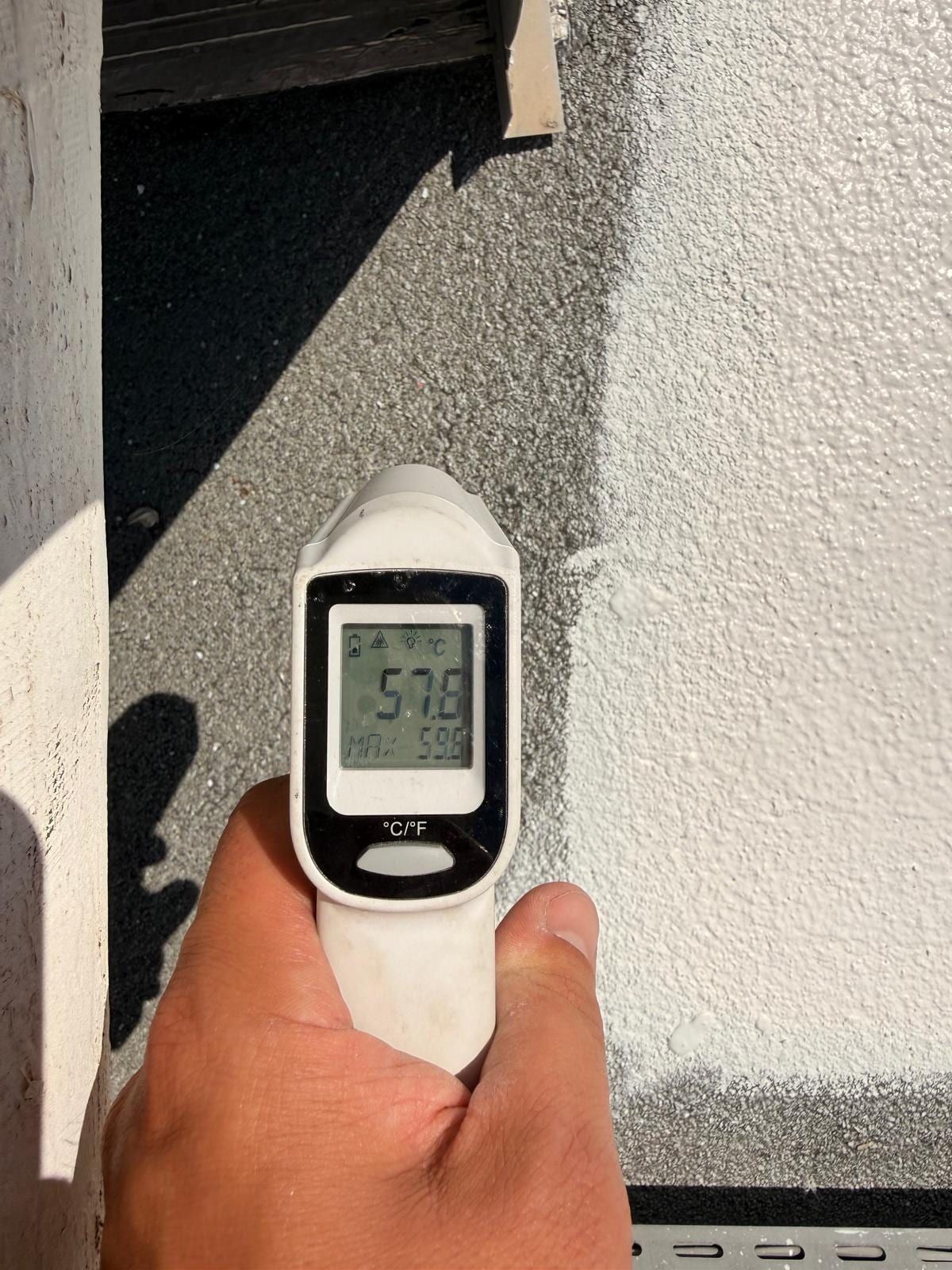
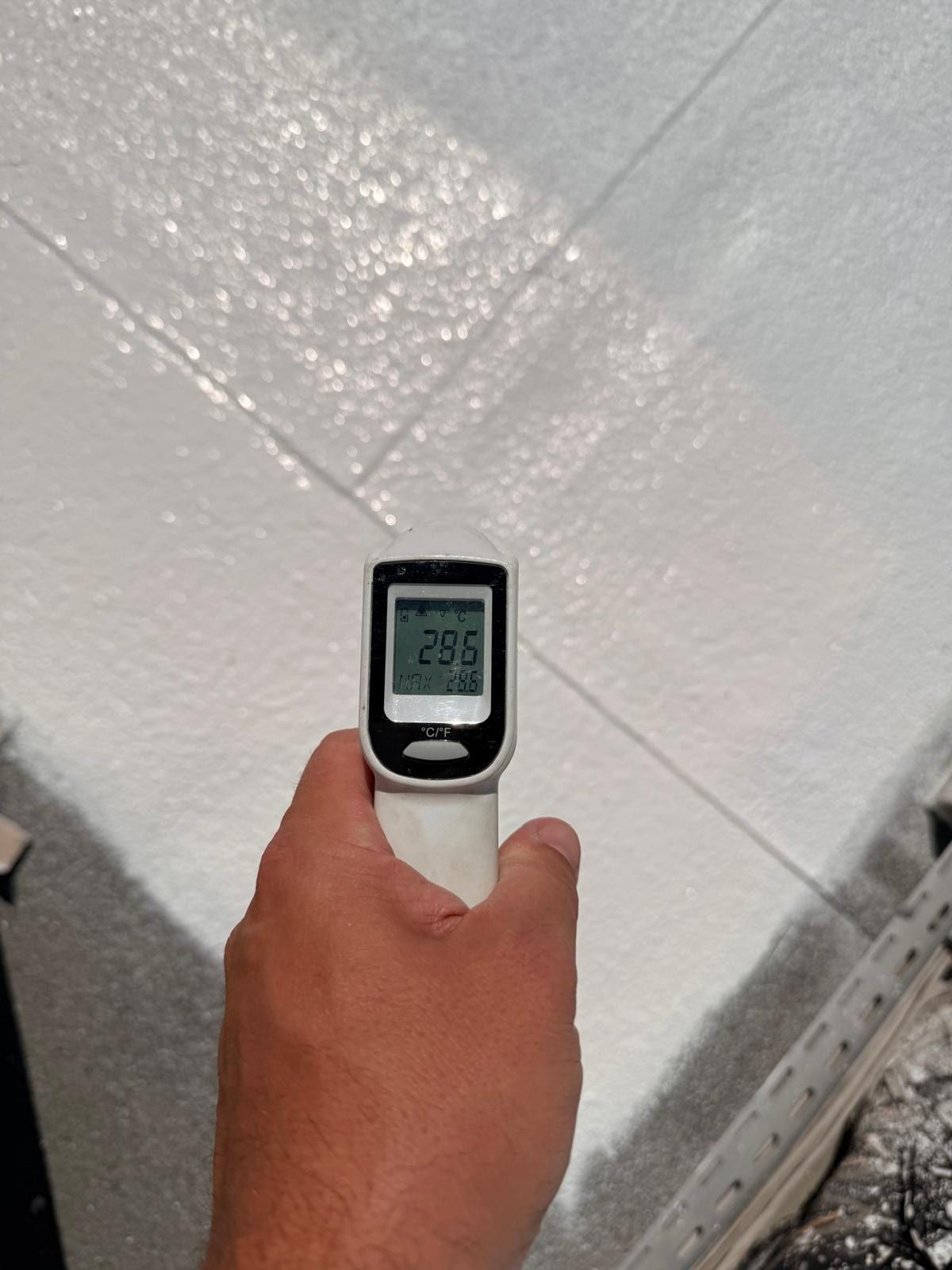
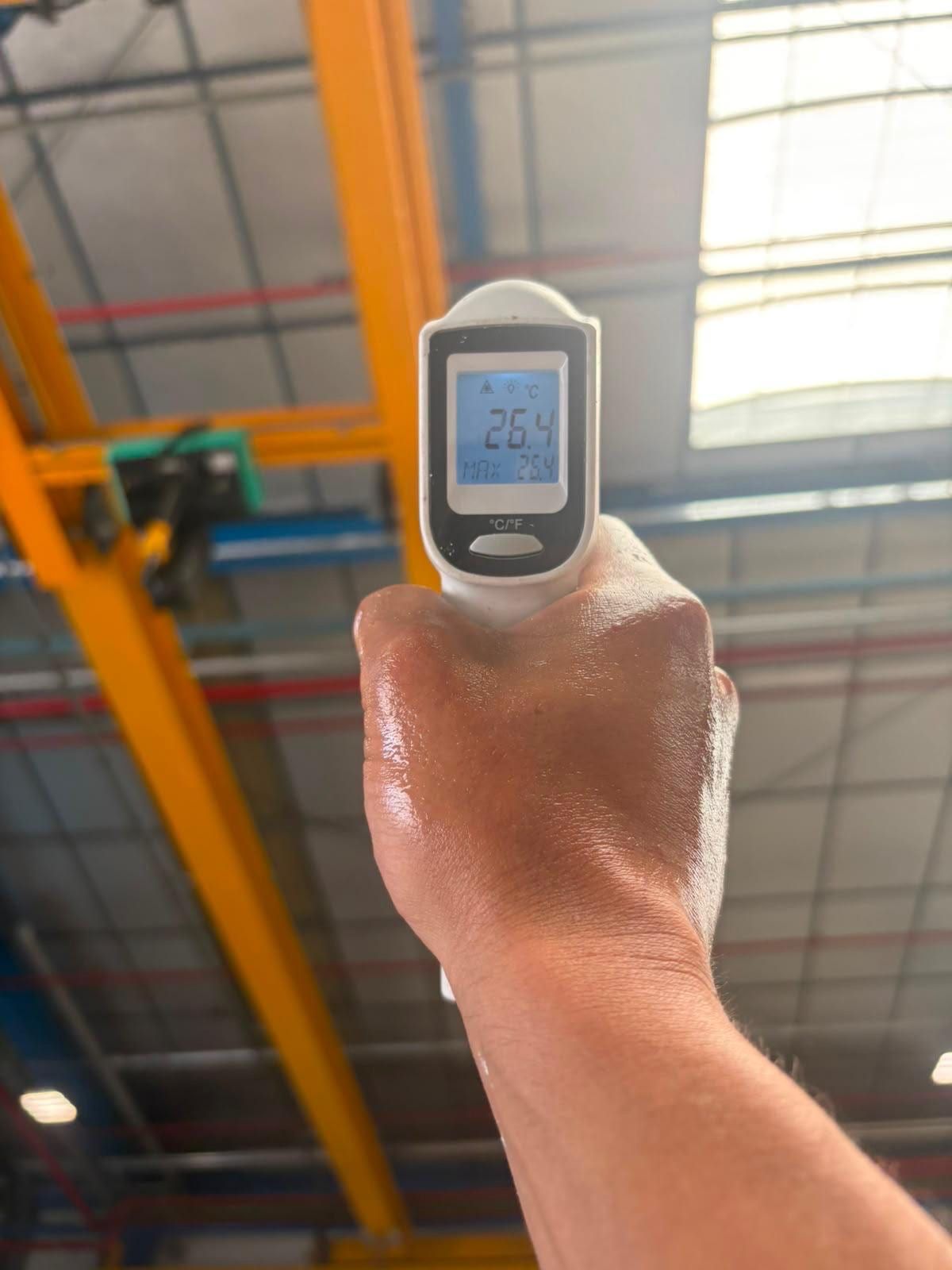
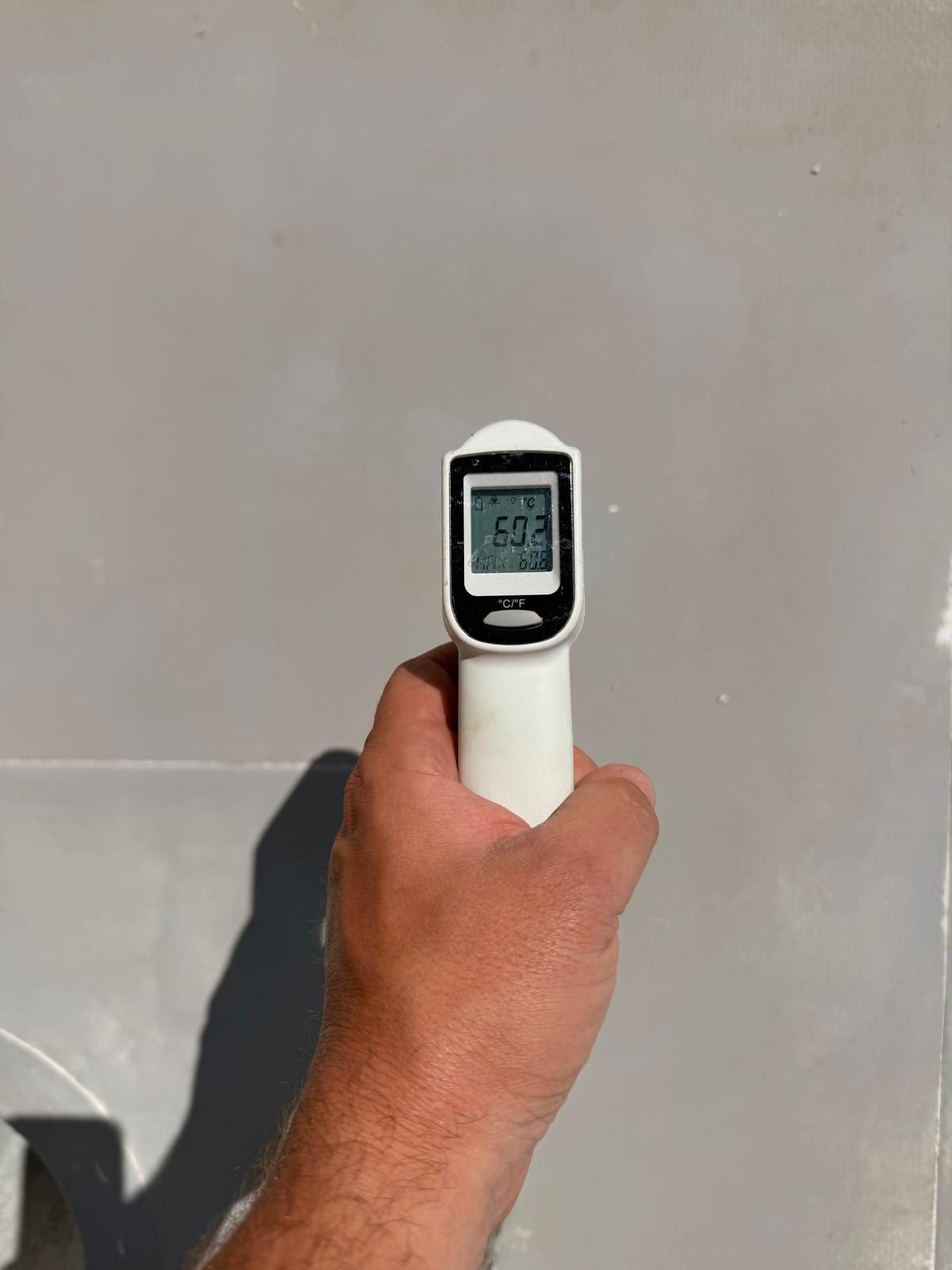
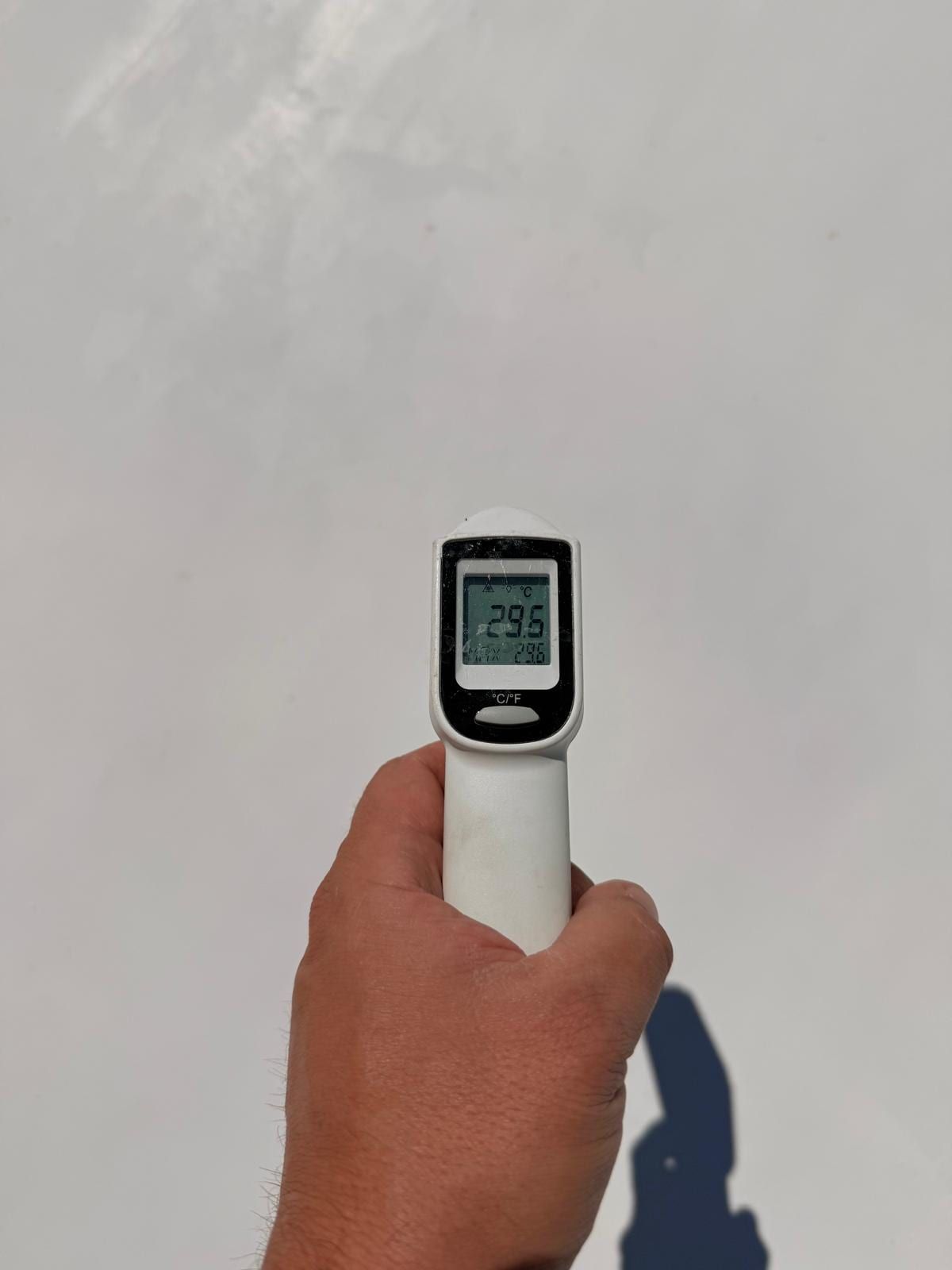
- Surface temperature: infrared measurements of the treated zone against the control zone, as at the handover of every project (−29 °C recorded on the largest building at Airbus Marignane on 19 June 2026, on bitumen membrane).
- Module temperature: rear-face sensors on one string above the treated zone and one string above the control zone.
- Production per string: the monitoring data from your inverters, compared at equal irradiation (performance ratio).
This protocol gives a figure specific to your building, defensible internally, before extending the treatment to the rest of the roof.
Heat and the ageing of modules
Beyond instantaneous production, heat accelerates the ageing of a module’s components: encapsulant, junction box, connectors, and the inverter if it is on the roof. Manufacturers express their power warranties over 25 to 30 years assuming normal operating conditions; summers with a substrate at 60 °C are not part of them. A roof that stays below 35 °C is a gentler environment for the whole installation. We do not quantify years of life gained: we simply note that less heat means less stress.
A panel is not a cool roof
The objection comes up: “my panels already shade the roof”. That is true under the modules, and false elsewhere. A photovoltaic panel is a dark surface designed to absorb radiation; it converts part of the energy into electricity and dissipates the rest as heat, into the air and into the roof. The aisles, the edges, the plant areas and the rooflights remain in full sun. A roof that is 60 % covered remains 40 % dark roof, and the building feels it. The cool roof treats those 40 %, and improves the environment of the remaining 60 %.
Substrates and points to watch
- Steel deck: the most common substrate under industrial photovoltaics. Primer at 10 m²/L, treatment of the fixings, attention to cable trays and cable glands. See the steel deck cool roof guide.
- Bitumen membrane and flat roof: blocking primer at 6 m²/L, upstands, outlets and ponding areas under the ballasted mounts. See cool roof on flat roofs.
- PVC membrane: only beyond 10 years, with the PH107PVC base and a test on three zones.
- Cables and inverters: protected during cleaning and application; no spray on the modules, roller application near them.
- Safety: lifelines, guardrails, electrical lock-out if needed, prevention plan drawn up with the operator and the installer.
- Coordinated maintenance: cleaning of the modules and of the roof (clear water or low pressure, 100 bar maximum, every 12 to 15 months) are planned together.
For which buildings
The combination of cool roof and photovoltaics concerns large roofs first: logistics platforms, industrial sites, retail and agricultural buildings, where the French obligation to install solar on new or renovated roofs over 500 m² (APER law) makes the question systematic. Public buildings and schools follow, with membrane roof terraces.
Incentives and regulations
The two parts fall under separate schemes. Photovoltaics have their own French mechanisms (self-consumption premium, feed-in obligation), handled by your installer. The cool roof may qualify for the French energy-savings certificates (CEE), sheet BAT-EN-112, under strict conditions: tertiary-sector building for commercial use, volume heated and cooled by heat pump, for 160, 170 or 270 kWh cumac per m² depending on the French climate zone H1, H2 or H3; an unconditioned warehouse is not eligible as such. MaPrimeRénov’ does not cover cool roofs. For tertiary-sector buildings over 1,000 m², both actions are declared under the French tertiary-sector decree. The details are on the page cool roof incentives in France 2026, and the return on investment of the cool roof part is calculated from your actual consumption.
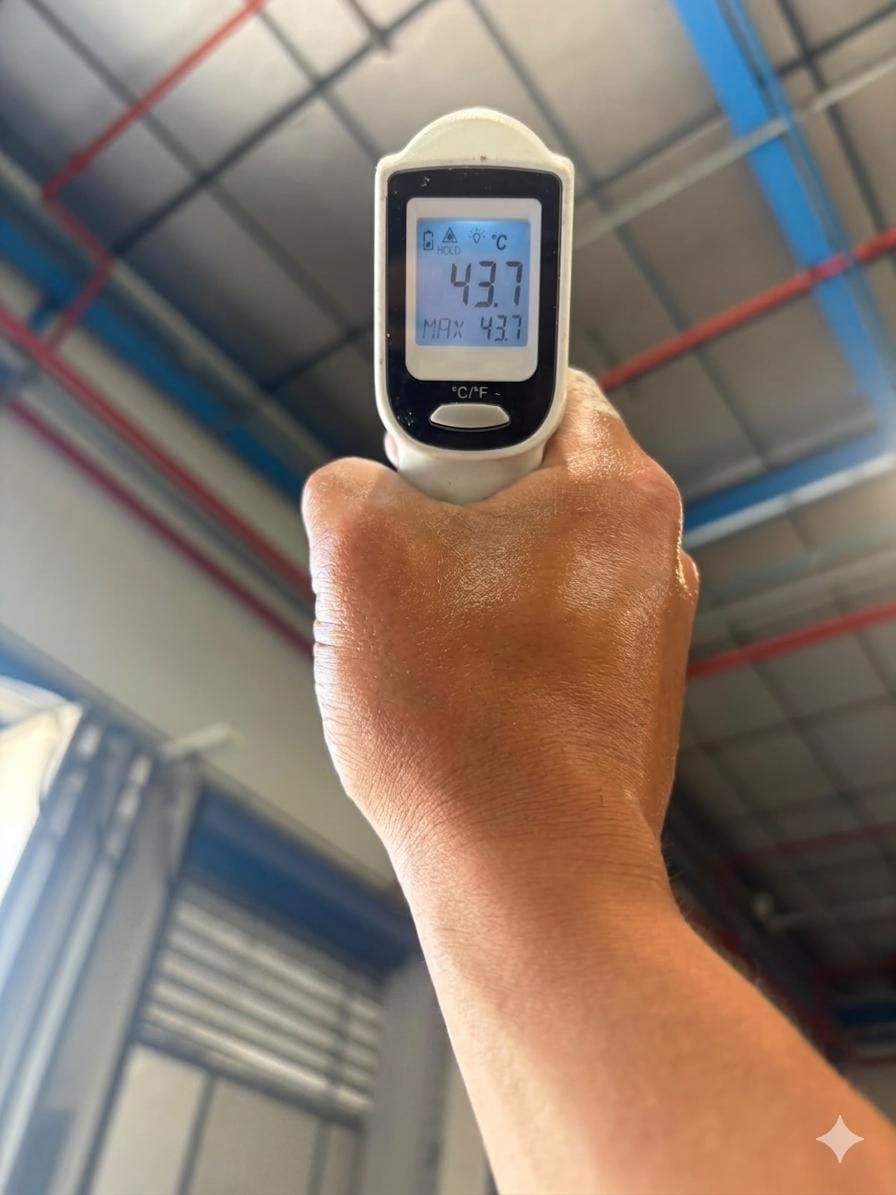
The thermometer, same time of day, before and after.
Frequently asked questions
Does a cool roof really improve the output of photovoltaic panels?
Yes, modestly and for physical reasons: a module loses power as its temperature rises (a few tenths of a percent per degree according to the manufacturers’ data sheets). A roof that goes from 75 to 40 °C lowers the temperature of the air and of the substrate under the panels, hence a production gain of a few percent, more marked in summer and in hot climates. We do not promise a precise figure: it depends on the mounting height, the ventilation and the climate.
Should the cool roof be applied before or after the panels are installed?
Before, whenever possible: the whole roof is treated, including under the modules, and the waterproofing is protected before being covered. The panels are installed after the system has dried completely, 48 to 72 h. On a roof already fitted with panels, we treat the accessible areas between and around the panels, protecting the modules; dismantling is rarely justified.
Is a cool roof useful with bifacial panels?
Particularly so. A bifacial panel also produces with its rear face, from the light reflected by the ground or the roof. A dark surface reflects almost nothing; PrimaTherm® reflects 95 % of the radiation. The gain depends on the height of the modules, their tilt and the row spacing: your installer calculates it from the drawings, using the albedo of the roof.
Does the white roof dazzle the panels, the neighbours or aircraft?
No. The PH107TCL topcoat is matt: it diffuses light in all directions, without mirror-like specular reflection. The modules capture the incident radiation, not a concentrated reflection. It is precisely this diffuse reflection that benefits the rear face of bifacial panels.
Does the cool roof protect the waterproofing under the panels?
Yes, and it is an argument that is often forgotten. A photovoltaic installation is put in place for 20 to 30 years; renewing the waterproofing underneath means dismantling the modules. A cool roof applied before installation keeps the membrane below 35 °C and protects it from UV, which slows its ageing where it will be hardest to reach.
What incentives exist for a combined cool roof and photovoltaic project?
The two parts fall under separate schemes. Photovoltaics come under their own French mechanisms (self-consumption premium, feed-in obligation). The cool roof may qualify for the French energy-savings certificates (CEE), sheet BAT-EN-112, under strict conditions: tertiary-sector building for commercial use, volume heated and cooled by heat pump. MaPrimeRénov’ does not cover cool roofs. We check eligibility during the study.