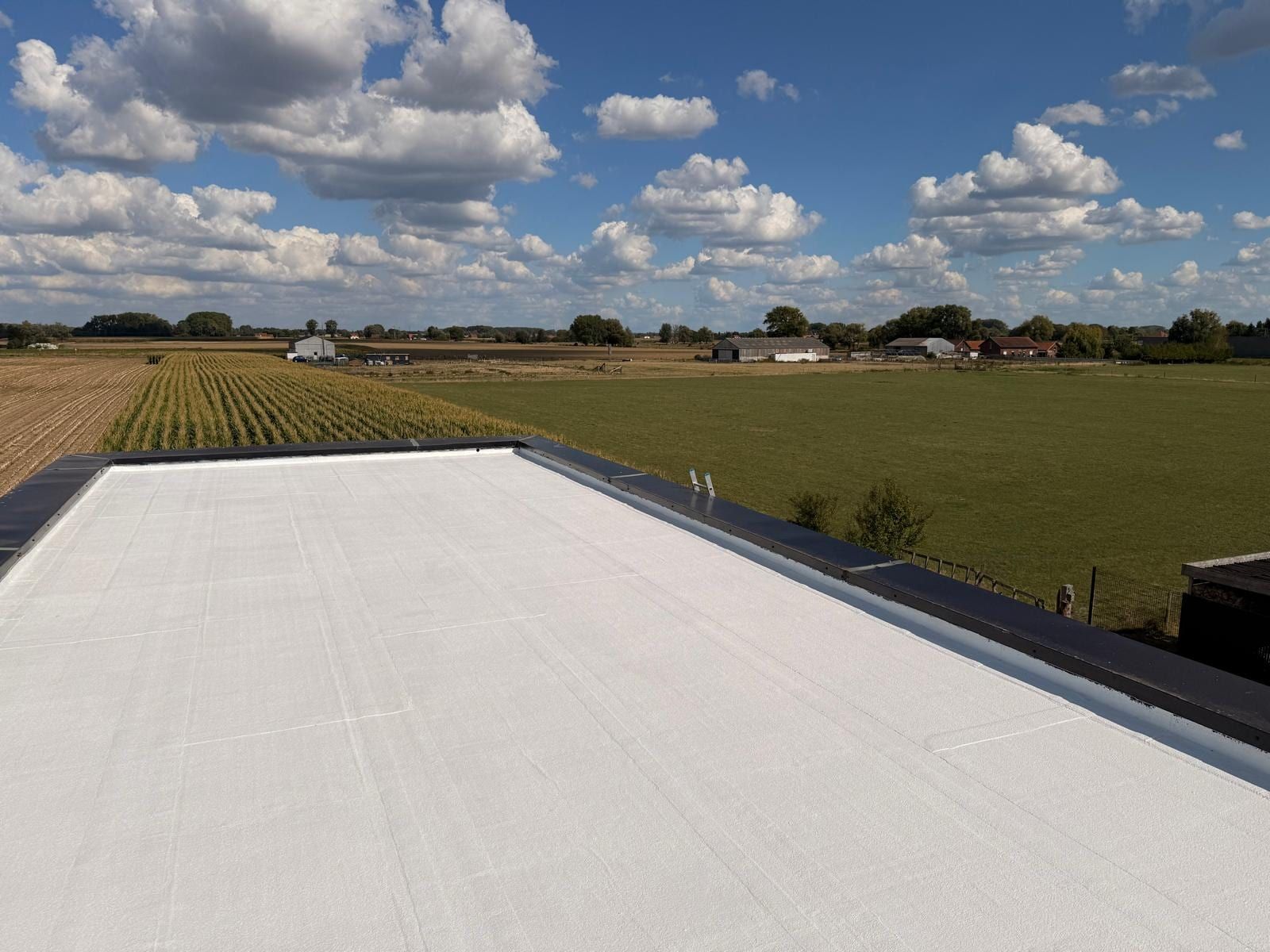
Key points
- In winter, the sun is low: at noon on 21 December, it peaks at 16° above the horizon in Lille, 18° in Paris, 21° in Lyon, 23° in Marseille, compared with 63° to 70° on 21 June. It strikes the façades, and very little the roofs.
- The solar energy received by a horizontal surface in December is several times lower than in June: short days, often overcast skies, grazing radiation.
- An insulated roof transmits little of the heat from its surface to the interior: winter solar gains through the roof are small, with or without a cool roof.
- At night, a light roof and a dark roof radiate the same way: the emissivity of the two is comparable.
- The annual balance is positive everywhere in France as soon as the building has a summer stake (air conditioning, comfort, process); it is massively positive in the south. Borderline cases (altitude, no summer stake) are identified in the free study.
The objection, stated honestly
A reflective roof reflects 95 % of the solar radiation. In summer, that is precisely what we are looking for: the surface goes from 50–70 °C down to 25–35 °C, the ceiling no longer radiates, the air conditioning can breathe. But in winter, that same radiation is a free gain that reduces heating needs. Isn’t reflecting it depriving yourself of welcome heat?
The question deserves an answer in four parts: how much sun a roof receives in winter, what share of it passes through the insulation, what happens at night, and what the balance looks like over twelve months. The short answer: the loss exists, it is small, and it is out of all proportion to the summer gain. The long answer follows.
The winter sun strikes the façades, not the roofs
The height of the sun in the sky varies enormously between seasons. At solar noon on 21 June, the sun peaks at about 63° above the horizon in Lille, 65° in Paris, 68° in Lyon and 70° in Marseille. On 21 December, it does not exceed 16° in Lille, 18° in Paris, 21° in Lyon and 23° in Marseille. These are astronomical data, independent of the weather.
This geometry changes everything for a flat or low-slope roof:
- In June, the radiation arrives almost vertically: the roof receives almost all of the available energy. That is why a dark roof exceeds 60 °C.
- In December, the radiation arrives at a grazing angle: the same amount of energy is spread over a much larger area, and a significant share is reflected by simple geometry, even by a dark surface. It is the south-facing façades, and above all the glazing, that capture most of the winter solar gains.
In other words, the roof is not the building’s solar collector in winter. It is in summer, and that is the problem the cool roof solves.
There is much less solar energy to lose
On top of the height of the sun come the length of the day and cloud cover. At the end of December, the day lasts about 8 h compared with 16 h at the end of June. Winter skies are more often overcast, especially in the northern half of France. As a result, the solar energy received by a horizontal square metre in December is roughly four to eight times lower than in June depending on the French region, the difference being most marked in the north.
Of this already small amount of energy, a dark roof absorbs most and a cool roof absorbs 5 %. The difference between the two, in winter, therefore concerns a small fraction of an amount that is itself reduced. In summer, the difference concerns a large fraction of a very large amount. This asymmetry is what makes the balance.
Insulation blocks the gains in both directions
Suppose a dark roof reaches 25 °C on a fine January afternoon, against 10 °C for a reflective roof. What becomes of that heat?
On an insulated building, most of it is lost to the outside: by convection with the cold air, by radiation towards a very cold winter sky, and by the wind. The share that passes through the insulation towards the interior is small, and all the smaller the better the insulation performs. The higher the thermal resistance of the roof, the more negligible the solar gains through the roof become, with or without a cool roof.
This observation has two practical consequences:
- On a recent or correctly insulated building, the loss of winter gains due to the cool roof is limited to a few percent of the heating needs, often less.
- On a poorly insulated building, all the flows are amplified: summer overheating (which the cool roof corrects) and the loss of winter gains (which the cool roof accentuates). The right answer is then to insulate, or to insulate and treat the roof at the same time. See external roof insulation and cool roofs.
At night, the two roofs behave the same way
A common misconception holds that a white roof “loses more heat”. That is confusing reflectance with emissivity. A roof’s night-time losses occur by infrared radiation towards the sky and by convection with the air. The radiation depends on the emissivity of the surface, not on its colour: a bitumen membrane, a coated steel deck or a PrimaTherm® coating (emissivity 0.89) have emissivities of the same order. At night, a light roof and a dark roof therefore radiate in the same way. Only the daytime sets them apart, and in winter the day is short.
The annual balance, region by region
The relevant question is not “what happens in January?” but “what happens over twelve months?”. Three elements weigh in the balance.
Summer savings. A cool roof reduces air-conditioning consumption by up to −40 %: 15 to 25 % in French climate zone H1, 20 to 30 % in H2, 25 to 40 % in H3. In a building without air conditioning, it brings workshops, warehouses or classrooms back below temperature thresholds where work and teaching remain possible.
Winter loss. A few percent of the heating needs on an insulated building, a little more on a poorly insulated building, very little in the south where winters are mild and short.
The energy carrier. Air conditioning is electric; heating is often gas-fired or by heat pump. The kilowatt-hours avoided in summer and the kilowatt-hours added in winter have neither the same cost nor the same emissions, which further accentuates the interest of the balance.
| Climate zone | Summer stake | Winter loss | Annual balance |
|---|---|---|---|
| H3 (Mediterranean arc, Marseille, Nice, Montpellier) | Very high, almost annual heatwaves | Very low, mild and sunny winters | Very positive |
| H2 (Atlantic coast, south-west, Bordeaux, Toulouse) | High | Low | Positive |
| H1 (north, east, centre, Lyon, Paris, Lille, Strasbourg) | Real, rising heatwaves, air-conditioned buildings | Moderate, longer winters | Positive as soon as there is a summer stake |
| Altitude, non-air-conditioned building without summer discomfort | Low | Moderate to noticeable | To be assessed case by case |
This reading matches that of the laboratories that have studied the question, in the United States as in Europe: the “heating penalty” of a reflective roof is acknowledged, small, and largely offset by cooling savings in all climates where cooling is a stake. We do not publish a single figure because there is none: the result depends on the insulation, the use, the heating system and the zone. That is the purpose of the free roof study, which relies on your actual consumption.
The case of buildings that are little or not heated
The winter objection assumes a continuously heated building. Yet a large share of the roofs we treat cover volumes that are not heated, or barely:
- Warehouses and logistics platforms: most are not heated, or only kept frost-free. The loss of winter solar gains there is nil in practice, while summer overheating is a problem of working conditions and goods preservation. See cool roof for warehouses and logistics.
- Workshops and industrial halls heated by unit heaters or radiant tubes, at low set points (12 to 16 °C) and over limited hours: the winter stake is low, the summer stake is high as soon as teams work under a roof at 60 °C. See cool roof for industrial buildings.
- Agricultural buildings: livestock and storage, where summer heat weighs on animals and produce and where heating is marginal. See cool roof for agricultural buildings.
- Cold rooms and temperature-controlled warehouses: the reflective roof reduces the load on the refrigeration all year round, and by definition there is no heating to penalise. On a 2,000 m² cured-meat site with a steel deck roof in Périgny, the roof-space temperature went from 50 to 30 °C and refrigeration consumption fell by 35 %.
For these buildings, the winter question simply does not arise. It arises for offices, shops, schools, healthcare facilities and housing, heated throughout the cold season, and it is for them that the reasoning of the previous sections applies.
What the scientific work says
The question of the “heating penalty” of reflective roofs has been studied since the 1990s, first in the United States by the Lawrence Berkeley National Laboratory and the Oak Ridge National Laboratory, then in Europe within research projects on cool roofs and heat islands. Three conclusions emerge consistently:
- The penalty exists and is measurable, on heated buildings, as a slight increase in heating needs.
- It is small compared with the cooling savings in all climates where cooling is a stake, including temperate climates with cold winters, because winter solar radiation on a roof is weak and the insulation decouples it from the interior.
- It decreases with the level of insulation and with latitude towards the south; it increases on uninsulated roofs and in climates with cool summers and long winters, where cooling is not a stake.
This is exactly what the solar geometry set out above shows. We do not repeat here a single percentage taken from a foreign study, because it depends on the insulation, the use and the climate studied: for your building, the only value that counts is the one calculated from your consumption and your zone.
Four worked examples
Air-conditioned offices in zone H1, correct insulation. In summer, air conditioning is a significant item on the electricity bill from June to September; the cool roof reduces it by 15 to 25 %. In winter, gas or heat-pump heating increases by a few percent at most. Positive balance, all the more so as the comfort of the floors under the roof improves markedly.
School in zone H2, no air conditioning. The summer stake is comfort in June and September, months during which the classrooms under the roof often exceed 30 °C. In winter, the school is heated; the loss of gains through the roof is small because the roofs of recent or renovated schools are insulated. Positive balance in comfort, neutral to slightly positive in energy; the decision is taken on the conditions in which pupils are received. See cool roof for schools.
Residential block in zone H3, flat roof. The top-floor flats endure nights at 30 °C in summer; the winter is mild and short. The balance is very positive, and the reduced 10 % VAT on supply and installation applies to French homes over two years old. See cool roof for residential buildings.
Workshop at altitude, no air conditioning, no summer discomfort reported. The summer stake is low, the heating season is long: this is the case where we recommend a simulation before concluding, and where we may advise against the project. It is rare, but it exists, and we prefer to say so.
Two reasoning errors to avoid
Counting capacity instead of energy. The capacity of a heating system is sized for the coldest night, without sun: the cool roof changes nothing in this calculation, and no system needs to be resized. Only the amount of energy over the season varies, and only slightly.
Reasoning as if the roof were not insulated. The intuition “the roof heats up in the sun, so it heats the house” comes from the uninsulated lofts of old houses. On an insulated office, industrial or logistics building, the roof surface and the interior are decoupled; that is precisely what insulation is asked to do.
And what about snow?
A snow-covered roof is white, whatever the coating underneath: during snowy spells, a dark roof and a cool roof behave the same way. The cool roof does not noticeably extend the time an insulated roof stays snow-covered, since its surface is in any case close to the outdoor temperature. On low-slope roofs at altitude, the question is one of structural sizing, not of the coating.
What we do in the study
For each project, we look at the climate zone, the roof insulation, the presence and type of air conditioning, the heating system, the uses and the occupancy hours. We estimate the summer gain and the winter loss, and we tell you whether the balance justifies the project. In the rare cases where it does not, we say so too. The payback simulator (in French) gives a first order of magnitude; the cool roof ROI and payback page explains the method.
Sources
- Météo-France, sunshine data and climate normals: https://meteofrance.com/
- ADEME (French environment and energy agency), summer comfort and building adaptation: https://www.ademe.fr/
- ASTM E1980, solar reflectance index: https://store.astm.org/e1980-11r19.html
- PrimaTherm® test reports (reflectance, emissivity, SRI, ageing): certifications page.
Frequently asked questions
Does a cool roof increase the heating bill?
Marginally. In winter, the sun is low on the horizon and strikes mainly the façades; the days are short and often overcast; an insulated roof transmits little of the heat from its surface to the interior. The loss of solar gains through the roof is limited to a few percent of the heating needs of an insulated building, far below the summer air-conditioning savings.
Is a cool roof relevant in the north or east of France?
Yes. Summers there are shorter but heatwaves are now regular, and air-conditioned buildings, warehouses and workshops suffer as much there as anywhere else in July. The winter loss is slightly more noticeable than in the south, but the annual balance remains positive as soon as the building has a comfort or air-conditioning stake in summer.
Do you need to increase the heating capacity after a cool roof?
No. The capacity of a heating system is sized for the coldest night, without sun. Daytime solar gains do not enter into this calculation, with or without a cool roof. Only the amount of energy consumed over the season can vary, and only slightly.
Does a white roof lose more heat at night?
No. Night-time losses by radiation depend on emissivity, and a dark bitumen membrane or a coated steel deck have an emissivity of the same order as a PrimaTherm® coating. At night, a light roof and a dark roof behave the same way; only the daytime sets them apart.
What if my building is poorly insulated?
Insulate first, or at the same time. Weak insulation amplifies all the flows, in both directions: summer overheating as well as the loss of winter gains. On these buildings, the cool roof remains very effective in summer, but the economic priority often goes to insulation, and the combination of the two gives the best annual result.
Are there cases where a cool roof is not recommended?
A building at altitude, without air conditioning, with no summer discomfort and heated for a long season, gains little from a reflective roof. We say so in the free study when that is the case. Everywhere else, the question is settled by an annual balance, not by a winter intuition.