Public buildings and heatwaves: continuity of service and fairness
A municipality manages on average dozens of buildings built between 1960 and 1990: schools and nurseries, sports halls and multipurpose halls, the town hall and its annexes, the media library, the leisure centre, the technical services, premises for associations. Most were designed to retain heat in winter, with dark roofs in bitumen membrane or steel deck, and almost none is air-conditioned. Since 2019, heatwaves have recurred in June and September, that is, during school and community activity. The mayor is responsible for the safety of users and the health of staff: heat inside buildings has become a town council matter.
Schools, nurseries, after-school care: the heatwave plan ends in closure
In a classroom under a dark roof, the temperature exceeds 30 °C from late May and can reach 35 °C during a heatwave. The heatwave protocol provides for night-time ventilation, closed shutters, water distribution; when that is no longer enough, activities are cancelled and the school closes. Nurseries are even more sensitive. Our dedicated page on cool roofs for schools details the case of school buildings; the heatwave and building protection page gathers the steps to anticipate before summer.
Sports halls, multipurpose halls, media libraries, town halls, technical services
A 1,500 m² single-skin steel-deck sports hall is an oven from 11 a.m. in July; clubs cancel, leisure centres no longer use it. A media library or a town hall under a flat roof sees its top-floor offices become unusable in the afternoon, and staff ask for mobile air conditioners that send consumption soaring. The technical services’ workshops, in steel deck, combine hardship and storage of sensitive products. In all these cases, the heat comes first from the roof: treating it at the surface is the simplest and cheapest lever, before considering air conditioning whose consumption the French tertiary decree will penalise.
French tertiary decree: the local authority too
Public buildings over 1,000 m² (grouped schools, sports halls, town halls, media libraries) are subject to the Éco Énergie Tertiaire scheme: −40 % final energy consumption by 2030, −50 % by 2040, −60 % by 2050, with an annual declaration on the OPERAT platform. A cool roof is not a heating measure, but it avoids installing air conditioning and reduces consumption where it already exists (server rooms, air-conditioned offices, central kitchens). See French tertiary decree and cool roofs.
What PrimaTherm® changes on a municipal building
Hélios applies the PrimaTherm® system made in France by Primacoating: a water-based elastomeric coating, applied in 4 layers (PH169 primer, PH107 reflective base coat in two crossed passes, PH107TCL anti-soiling topcoat). Every value is measured in the laboratory and the report is attached to the bid.
| Characteristic | Value | Standard / report |
|---|---|---|
| Solar reflectance | 95 % | ASTM E903-12 |
| Thermal emissivity | 0.89 | ASTM C1371-15 |
| SRI (new) | 120 | ASTM E1980 (119 after ageing) |
| Durability | SRI maintained after 4,000 h QUV | conventional service life of 20 years (French CEE sheet) |
| External fire rating | Broof(t3) | EN 13501-5, CSTB report RA23-0010 |
On a public building, this means:
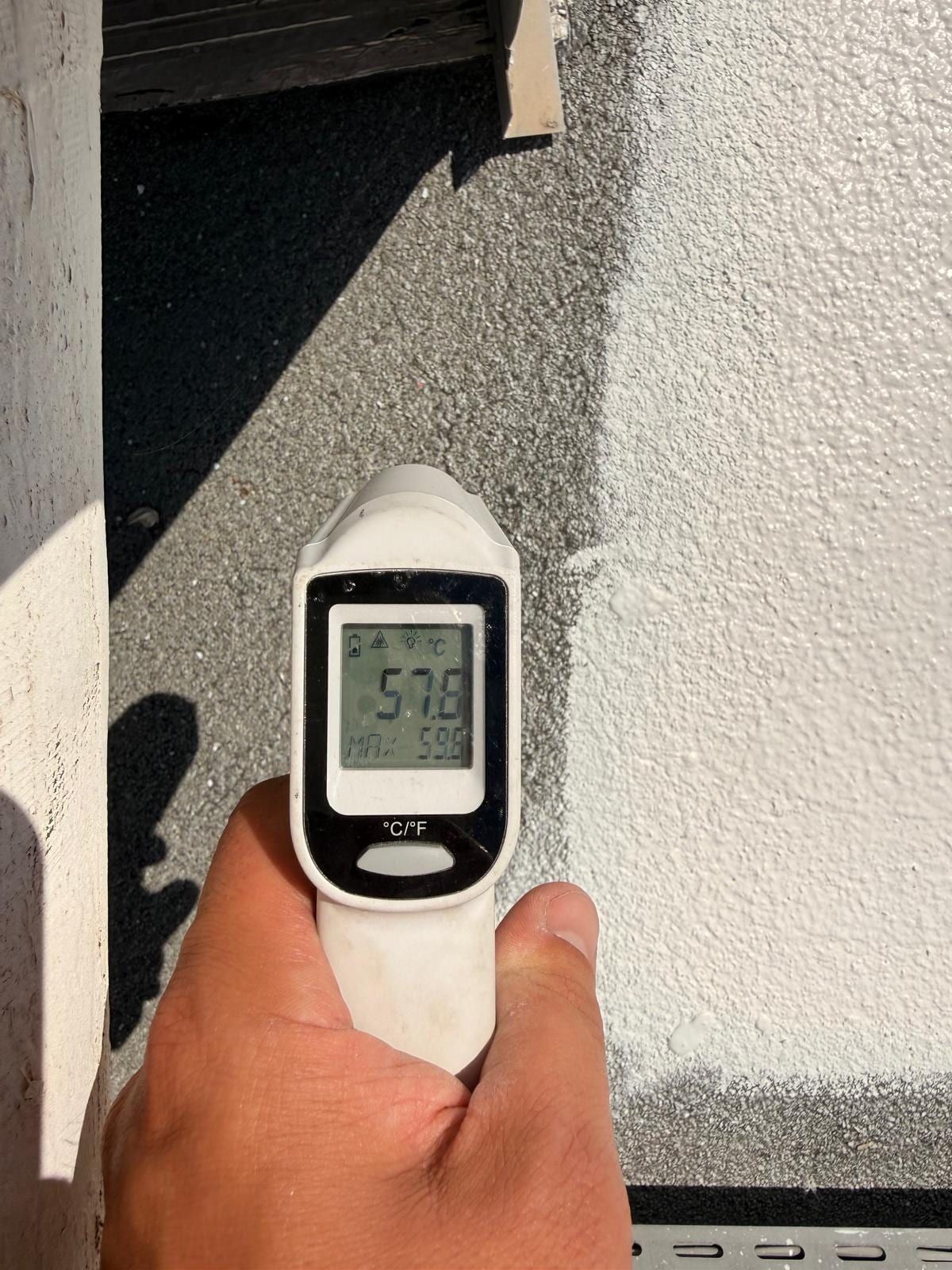
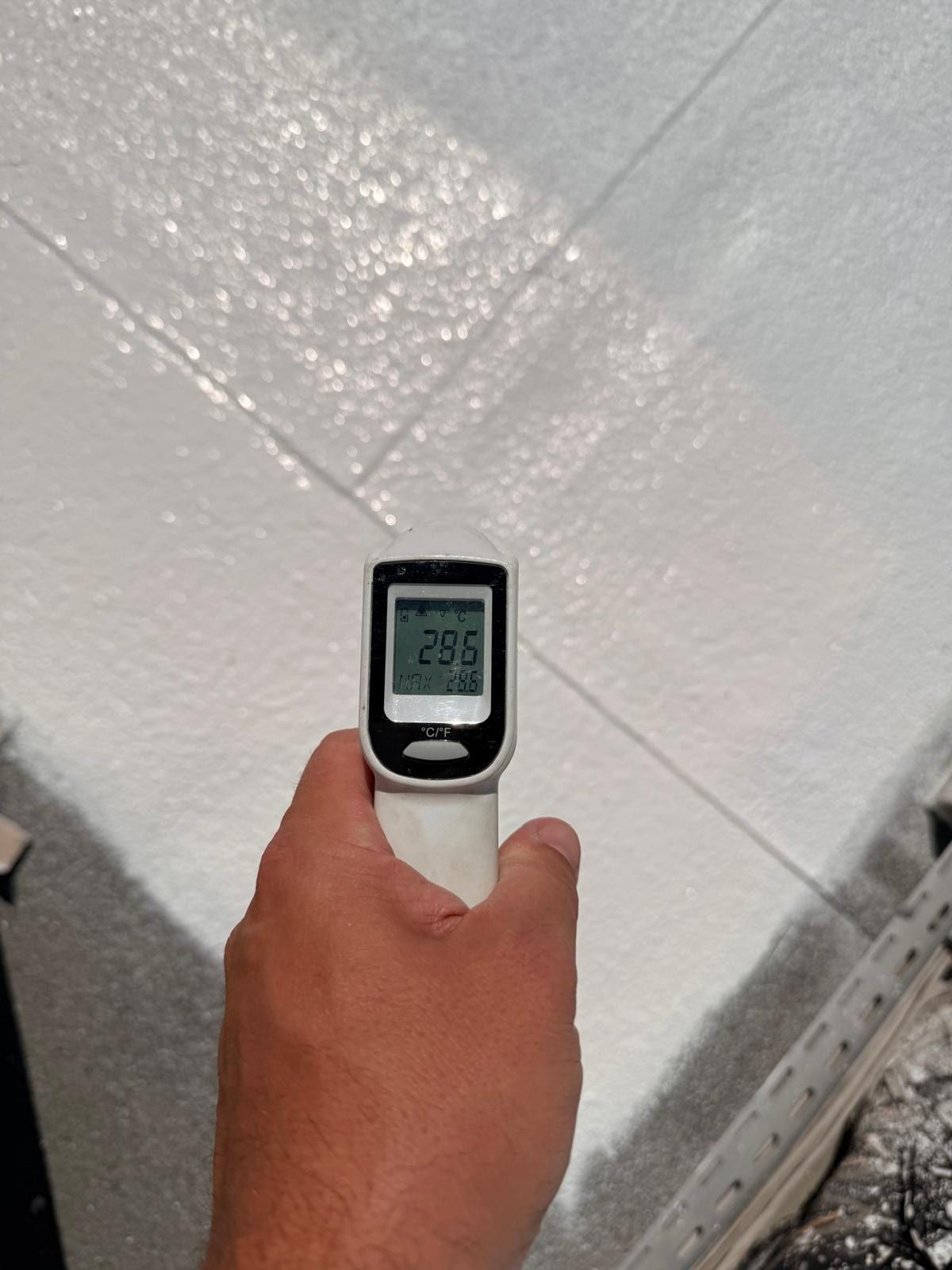
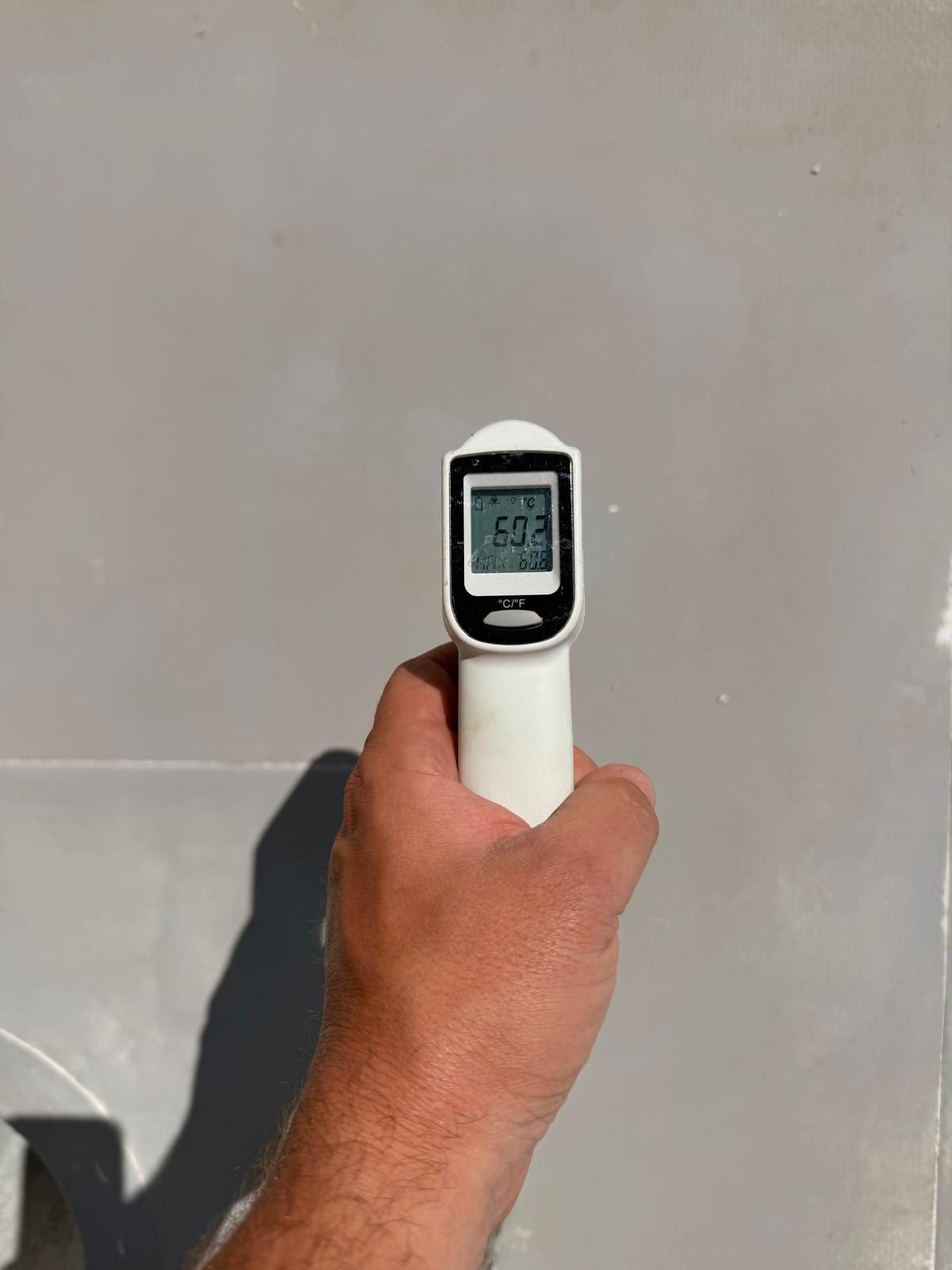
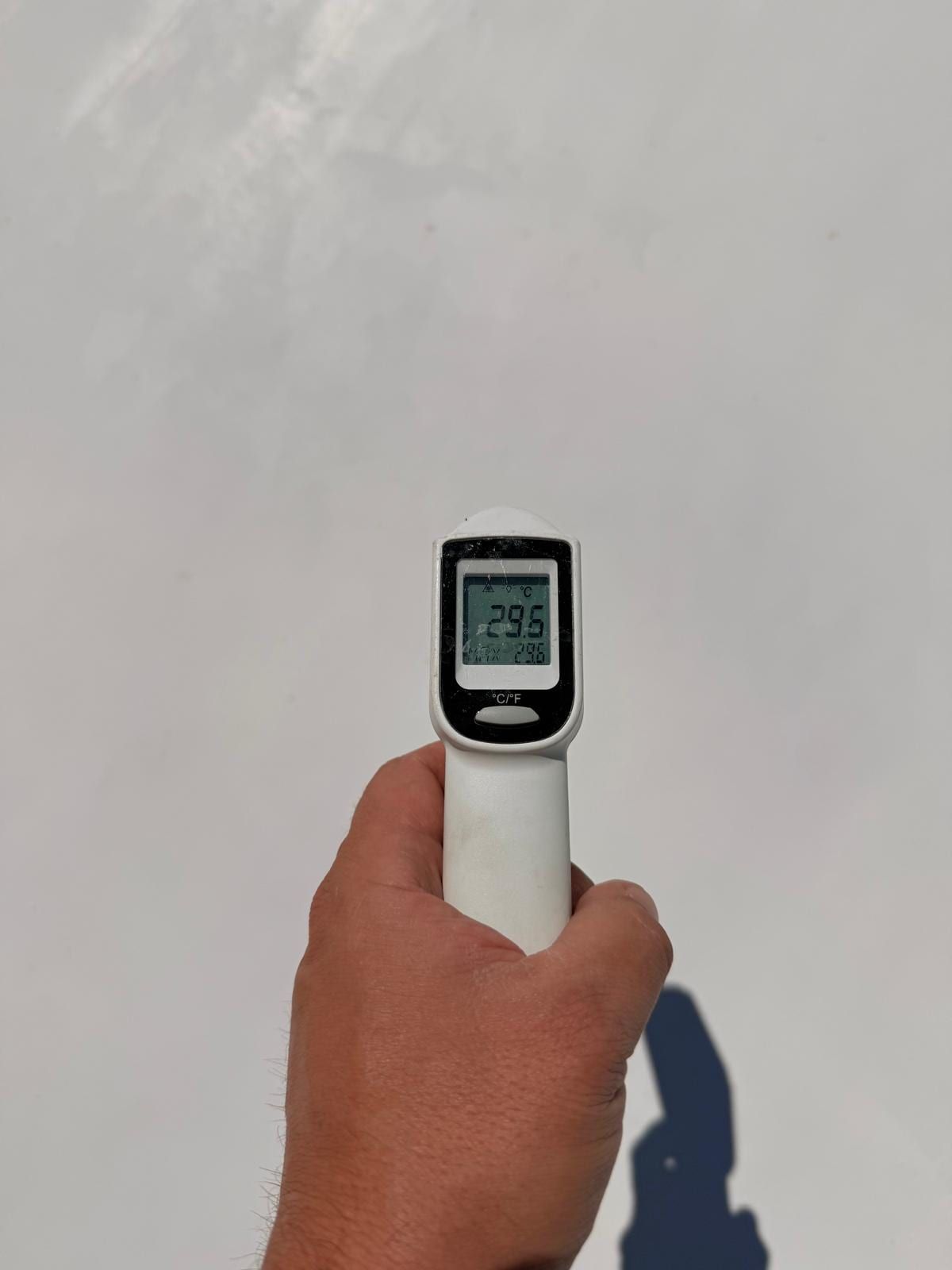
- up to −30 °C on the roof: from 50–70 °C to 25–35 °C, with −29 °C measured by infrared at the handover of a 5,900 m² project in 2026;
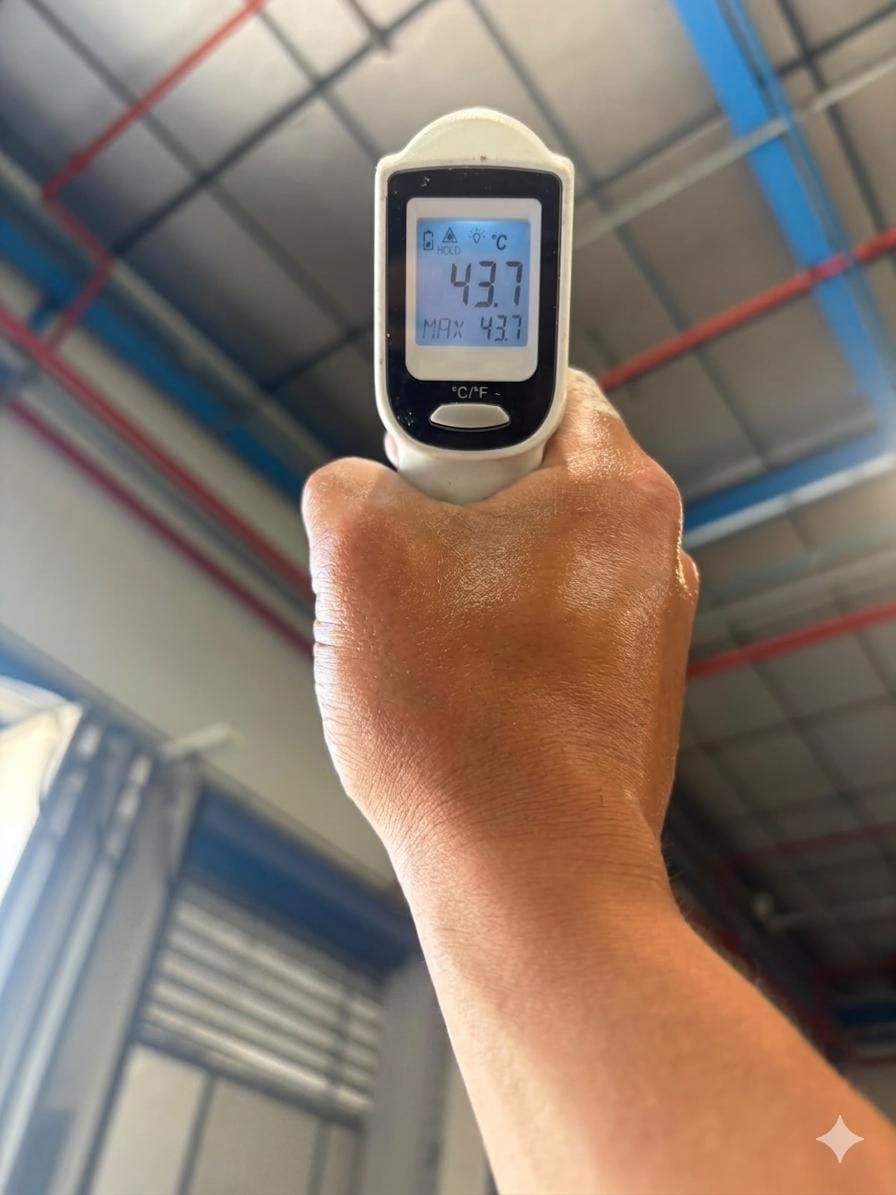
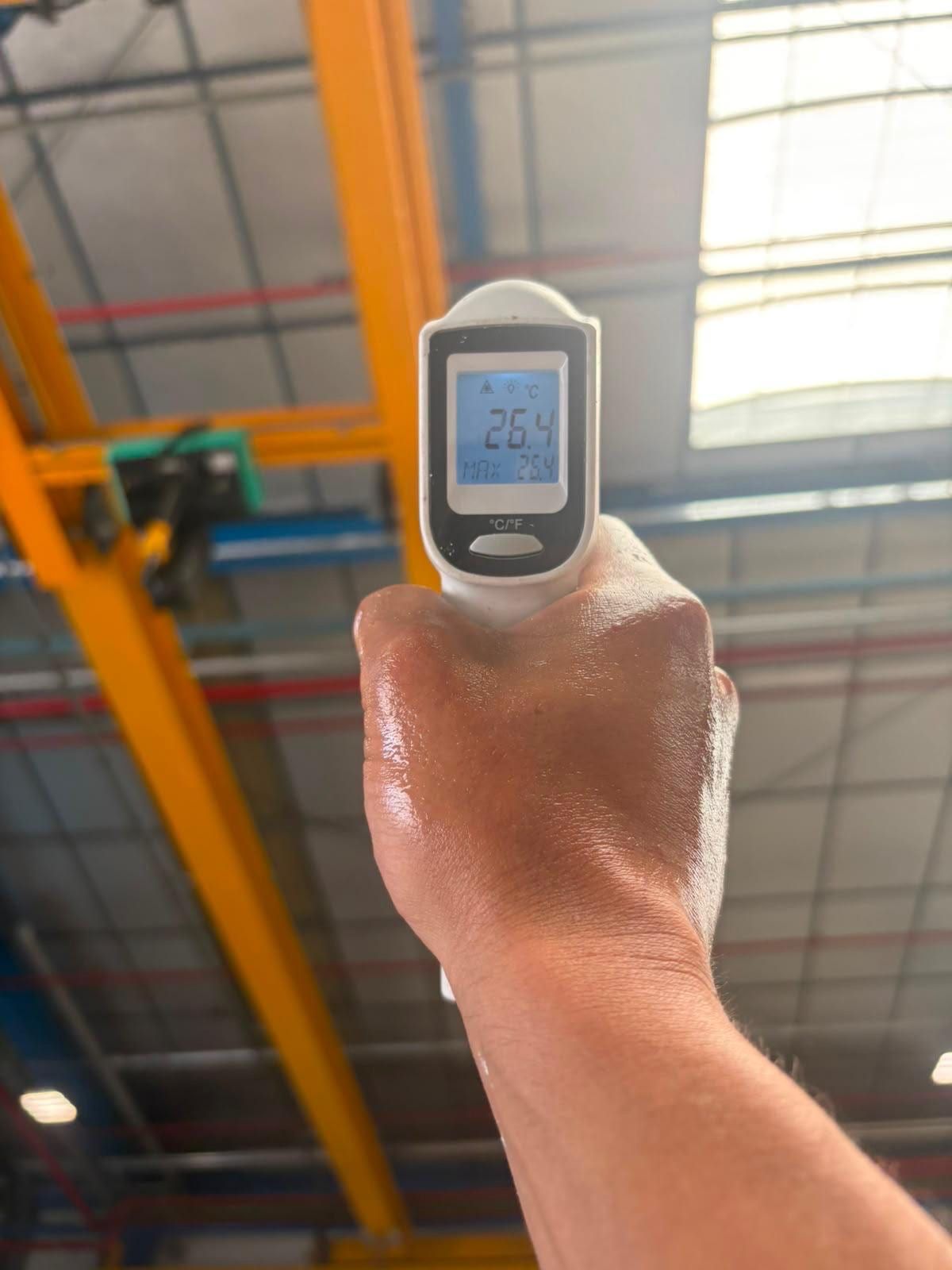
- up to −6 °C felt inside the rooms depending on insulation, and above all the disappearance of the heat radiated by the ceiling, the one that makes a classroom or a sports hall unbearable;
- air conditioning avoided in most rooms, or reduced by 15 to 40 % where it exists;
- waterproofing that lasts longer, because it no longer suffers the daily cycles from 20 to 70 °C; that is a refurbishment pushed back in the multi-year investment plan;
- a visible contribution to the fight against urban heat islands: a white roof sends the heat back to the sky rather than into the street. See cool roofs and urban heat islands.
The reference: a 1,000 m² school in La Rochelle
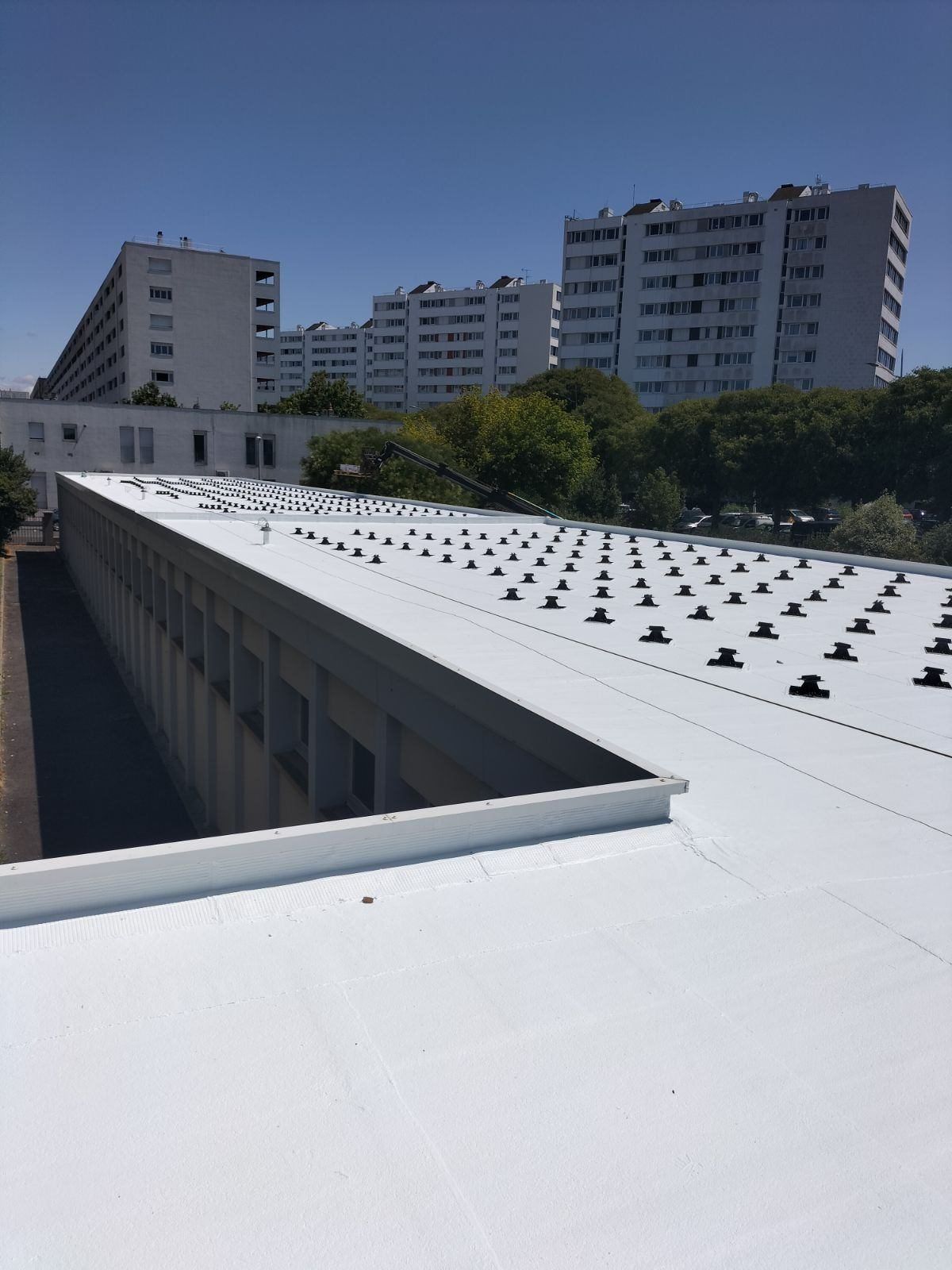
The most telling case for a local authority is a 1,000 m² school in La Rochelle, a Hélios project: bitumen membrane, combined with photovoltaic panels, treated during the holidays. After treatment, the air conditioning the local authority had been considering was no longer needed. The details are on the La Rochelle school page. The same white roof improves the output of the solar panels by lowering the ambient temperature: see cool roof and solar panels.
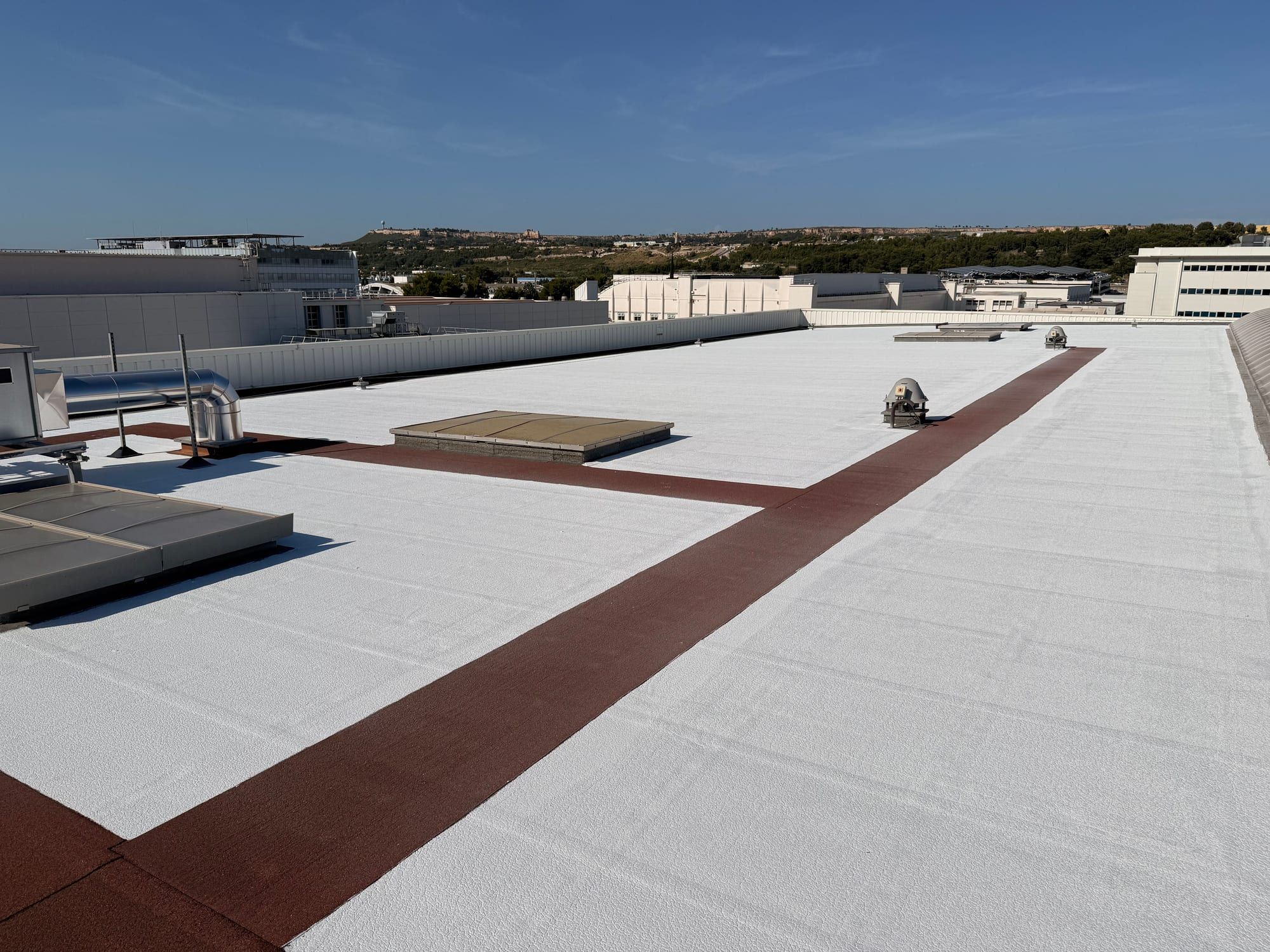
For large roofs, our reference is a 5,900 m² bitumen-membrane project on three buildings, treated from April to June 2026 on an industrial site in operation, with −29 °C measured at handover (57.8 °C on the untreated area against 28.6 °C on the treated area). See the Airbus Marignane project.
Funding a public cool roof: Green Fund, grants, and what the CEE do not do
We prefer to be precise before the application is put together.
- CEE bonus BAT-EN-112: not applicable in the general case. The sheet targets commercial tertiary buildings whose volume is heated and cooled by heat pump; a school, a town hall, a sports hall does not qualify.
- MaPrimeRénov’ does not cover cool roofs, and does not concern local authorities anyway.
- The French Green Fund (Fonds Vert): the fund for accelerating the ecological transition in local areas finances, through the prefectures, energy-renovation actions on local public buildings and climate-adaptation actions, including the fight against building overheating and urban heat islands. The budgets and criteria are set every year; a cool roof is presented in a reasoned application (study, certified values, expected measurements).
- DSIL and DETR: the French local investment support grant and the rural areas equipment grant finance energy-renovation and compliance works on municipal buildings.
- Regional and inter-municipal programmes: local climate, air and energy plans, calls for projects such as “cooler school playgrounds” or “resilient buildings”.
We provide the technical documents for the application (study, test reports, estimate of the thermal potential, schedule); the cool roof incentives 2026 page details the schemes. The cost depends on the area, the roof type, the preparation, the access and the incentives: it exists only in the proposal handed over after the free roof study.
Public procurement: buying a cool roof on measurable criteria
A cool roof is bought like a works contract: a simple consultation below the threshold exempting from formal procedure, an adapted procedure above it, joint purchasing possible at inter-municipal level. What protects the public buyer is to require measured evidence rather than promises:
- Product test reports: reflectance (ASTM E903-12), emissivity (ASTM C1371-15), SRI (ASTM E1980), accelerated ageing (4,000 h QUV), Broof(t3) external fire rating (CSTB report).
- 4-layer application protocol with thickness checks and site follow-up sheet.
- Ten-year insurance and professional liability certificates of the applicator.
- Before/after infrared measurements and as-built file at handover.
- References that can be visited on comparable sites.
We answer each of these points; the PrimaTherm® certifications page provides the reports and the checklist for choosing a cool roof contractor (in French) serves as a template for the specifications.
Buildings open to the public, safety, planning: the constraints of public buildings
- Buildings open to the public (ERP): the fire behaviour of the roof covering is a point checked by the safety committee. PrimaTherm® is rated Broof(t3) (CSTB report RA23-0010) and the supporting document is provided.
- Occupied site: town halls, sports halls and media libraries are treated in operation. The product is water-based, low in VOCs, odourless in the rooms. The no-lifting method leaves drums and pumps on the ground in a cordoned-off area; only the hoses go up to the roof. No crane in the playground, no road closed in front of the school.
- School holidays: schools and nurseries are treated during the holidays, preferably in summer for the weather window (12 to 35 °C, relative humidity below 80 %, no rain within 4 h of each coat).
- Planning: prior declaration to the town hall for a change of colour (article R. 421-17 of the French planning code), opinion of the French heritage architect (Architecte des Bâtiments de France) in a protected area. We check the local planning rules for each building.
- Roof types: bitumen membrane (cool roof on bitumen roofs), flat roof (cool roof on flat roofs), steel deck of sports halls and workshops, EPDM. Fibre cement only when asbestos-free (buildings built after 1997); PVC only if laid more than 10 years ago.
How a cool roof project runs with a local authority
- Free study within 48 h per building: satellite measurement, roof type, use, prioritisation of the building stock (schools and nurseries first).
- Technical visit: condition of the waterproofing, rooftop equipment, adhesion tests, planning check, itemised proposal and documents for the funding application.
- Consultation under the French public procurement code, with the technical evidence listed above.
- Preparation: cleaning at under 130 bar, anti-moss treatment, spot repairs to the waterproofing, 24 to 72 h drying.
- Application without lifting: primer, base coat in two crossed passes, anti-soiling topcoat.
- Checks and handover: thickness checks, before/after infrared measurements, as-built file, ten-year insurance, maintenance plan for the technical services.
The installation process is detailed step by step.
The objections we hear in town councils
- “We would rather insulate.” Insulating a roof from the outside is a heavy and costly operation, and winter insulation does not solve summer: the roof heats up, the insulation delays the heat and then releases it at night. A cool roof removes the heat at source and combines with existing insulation. See external roof insulation (in French).
- “A paint is a gimmick.” An off-the-shelf white paint reflects 70 to 80 % of the radiation and loses its whiteness within two seasons. PrimaTherm® reflects 95 %, keeps its SRI after 4,000 h of accelerated ageing and is applied under a controlled protocol. The industrial clients who chose it do not choose gimmicks.
- “What about winter?” The low sun hits the façades, not the roofs; the loss of winter solar gain is marginal compared with summer comfort. See cool roof in winter.
- “Who maintains it?” A low-pressure wash every 12 to 15 months, which can be included in the technical services’ maintenance plan.
Public buildings concerned
- Schools, nurseries, after-school care: see cool roofs for schools.
- Sports halls, multipurpose halls, indoor swimming pools: large steel-deck volumes.
- Town halls, media libraries, administrative centres: flat roofs, offices under the roof.
- Care homes, health centres, hospitals: vulnerable public, see cool roofs for hospitals.
- Technical services, municipal workshops, fire stations: hardship and storage.
- Buildings of inter-municipal bodies and departments: secondary schools, road maintenance depots, covered recycling centres.
From Saint-Laurent-d’Agny, near Lyon, we travel out for the day to the municipalities of the region (Lyon, Grenoble, Saint-Étienne, Clermont-Ferrand) and work throughout France with a team accommodated on site (Marseille, Nantes, Toulouse, Paris). An immediate estimate of each building’s potential is possible with the cool roof simulator (in French); the free study follows within 48 h.
Frequently asked questions
What temperature gain can be expected in a public building without air conditioning?
On the roof, up to −30 °C on the surface, from 50–70 °C to 25–35 °C; −29 °C was measured by infrared at the handover of a 5,900 m² project in 2026. In the rooms, the gain depends on insulation: 4 to 6 °C felt under a poorly insulated roof, 1 to 3 °C on a well-insulated building. On a 1,000 m² school in La Rochelle treated by Hélios with the PrimaTherm® system, the air conditioning that had been considered was no longer needed after treatment.
Is a public building's cool roof eligible for the French CEE bonus or MaPrimeRénov'?
No to both in the general case. The CEE sheet BAT-EN-112 targets commercial tertiary buildings heated and cooled by heat pump; a school, a town hall or a sports hall does not qualify. MaPrimeRénov' does not cover cool roofs. A local authority's levers are the French Green Fund (Fonds Vert), the DSIL and DETR investment grants, and regional climate-adaptation programmes; we prepare the technical documents for the application.
How do you buy a cool roof in compliance with public procurement rules?
Like any works contract: a simple consultation below the threshold exempting from formal procedure, an adapted procedure above it. We provide the expected documents: technical data sheets, test reports (reflectance ASTM E903-12, emissivity ASTM C1371-15, SRI ASTM E1980, 4,000 h QUV ageing, Broof(t3) fire rating from CSTB), ten-year insurance and professional liability certificates, a technical submission describing the 4-layer protocol and the checks. The technical criteria can require these documents so that bids are compared on measured bases.
Can you work during the school holidays or with the site occupied?
Both. Schools and nurseries are treated during the holidays, preferably in summer for the weather window (12 to 35 °C, dry surface). Town halls, sports halls, media libraries or technical services are treated with the site occupied: application takes place on the roof, without lifting, with drums and pumps on the ground in a cordoned-off area, no crane or road closure, no noise or odour in the rooms (water-based, low-VOC product).
Is planning permission needed to turn a public roof white?
Changing the colour of a roof generally requires a prior declaration to the town hall (article R. 421-17 of the French planning code), and the opinion of the French heritage architect (Architecte des Bâtiments de France) is required in a protected area. On a flat roof or a steel deck not visible from the public space, the question is settled quickly; we check the local planning rules and the protected perimeters for each building before handing you the proposal.
How long does the coating last and what maintenance for the technical services?
The SRI of PrimaTherm® is maintained after 4,000 h of accelerated QUV ageing; the conventional service life used by the French CEE sheet is 20 years. Maintenance is limited to a low-pressure wash every 12 to 15 months, which the technical services can include in their roof maintenance plan. A maintenance plan is handed over with the as-built file.