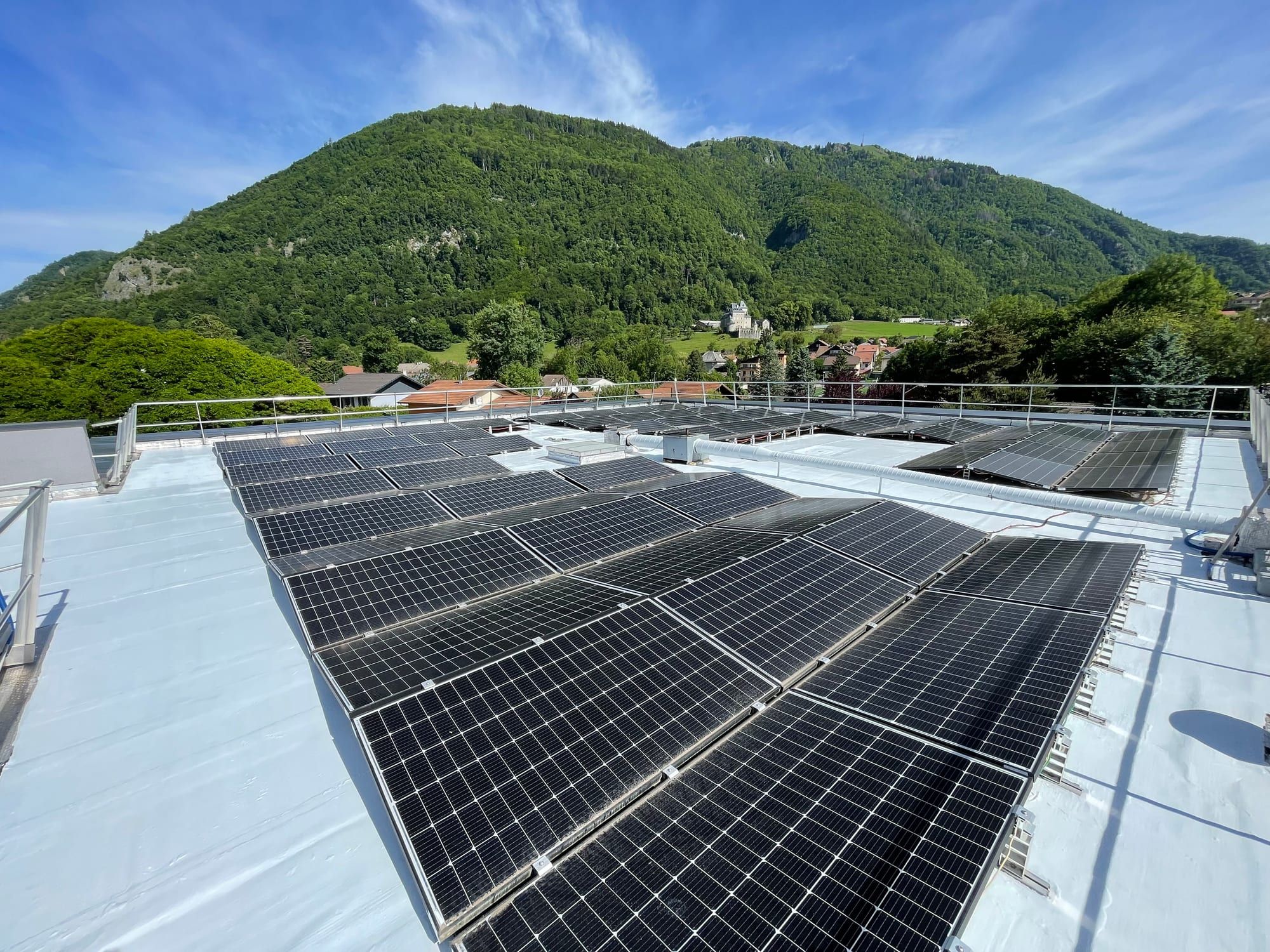
Key takeaways
- Heatwaves are more frequent, longer and earlier: Météo-France has recorded more of them since 2000 than in all the previous decades combined, and France is officially preparing for a warming trajectory of +4 °C by 2100.
- Under the summer sun, a dark roof reaches 50 to 70 °C. It is this surface, not the outside air, that heats the building through the ceiling.
- A PrimaTherm® cool roof (reflectance 95 %, emissivity 0.89, SRI 120) brings the surface down to 25–35 °C, i.e. up to −30 °C, and up to −6 °C inside depending on insulation.
- Air conditioning stops saturating: up to −40 % consumption, with ranges of 15 to 25 % in French climate zone H1, 20 to 30 % in H2 and 25 to 40 % in H3.
- Sensitive sectors (schools, care homes, hospitals, warehouses, workshops, data centres, top floors of apartment buildings) should schedule the application in spring, between 12 and 35 °C, before the first hot spells.
Heatwaves in France: what the official bodies observe
Following the 2026 heatwave in real time
- Heatwave alerts: the Météo-France alert map shows, department by department and for the next 24 hours, the yellow, orange or red level; it is the reference used by prefectures to trigger the heatwave plan.
- Health advice: the extreme heat and heatwave page of Santé publique France recalls the right steps for vulnerable people and workers.
- At work: since 1 July 2025, employers must assess the risk of intense heat and act from the yellow alert onwards; our article on employers’ obligations details the measures.
We do not publish forecasts: they belong to Météo-France and change from one day to the next. This guide explains what a heatwave does to a building and how to prepare for it before summer.
The word “heatwave” (canicule) has a precise meaning in France. Météo-France issues an alert when minimum and maximum temperatures exceed departmental thresholds for at least three consecutive days and nights. In Paris, these thresholds are around 21 °C at night and 31 °C during the day; in Marseille, 24 °C and 35 °C. What matters is therefore not the heat of one afternoon but the absence of night-time respite: a building that could not shed its heat overnight starts the next day with a deficit.
Three findings stand out from the publications of Météo-France and Santé publique France:
- Frequency is increasing. The majority of heatwaves recorded in mainland France since 1947 occurred after 2000. Episodes also start earlier (June) and end later (September), which lengthens the period during which a roof overheats.
- The national record remains vivid in memories: 46 °C measured in the Hérault department on 28 June 2019. Regionalised climate projections (DRIAS portal) show that this type of value, exceptional yesterday, is becoming plausible over a growing share of the country.
- Heat kills silently. The heatwave of August 2003 caused around 15,000 excess deaths in France. Since then, Santé publique France has estimated heat-attributable deaths every summer: they run into the thousands during the hottest summers, and a significant share occurs outside official alert periods, that is during prolonged “ordinary” heat.
Finally, the reference framework has changed. The third national climate-adaptation plan (PNACC-3) asks that buildings and infrastructure be prepared for a reference warming trajectory of +2 °C in 2030, +2.7 °C in 2050 and +4 °C in 2100 compared with the pre-industrial era. We do not know next summer’s weather; we do know which way it is heading.
What a heatwave does to a building
A building exposed to strong heat for several days suffers a chain of consequences that every facility manager will recognise:
- The ceiling radiates. The dark roof, at 50–70 °C, transfers its heat to the structure and then to the top floor. Occupants feel a heat that “falls from above”, the most unpleasant form of discomfort, even when the air temperature remains tolerable.
- Air conditioning saturates. Chillers are sized for a nominal load. When the roof adds a continuous surplus, they run at full power without holding the setpoint, and their outdoor units perform worse as the ambient air heats up. It is on these days that breakdowns occur, precisely when they cost the most.
- Waterproofing ages prematurely. Day/night cycles impose repeated expansion and contraction on bitumen membranes and joints. At these temperatures, repeated every summer day, binders age faster, junctions move, cracks appear. Autumn leaks are prepared in July.
- Processes and stock suffer. Sensitive goods, pharmaceutical products, foodstuffs, servers, machine tools: every activity has a temperature beyond which quality, safety or availability deteriorates.
- Productivity drops. The INRS (French occupational health institute) reminds us that above 28 °C for physical work and 30 °C for sedentary activity, heat becomes an occupational risk in its own right. Since 2025, a decree specifies employers’ obligations during episodes of intense heat: risk assessment, adaptation of work organisation, provision of cool water, adjustment of premises.
In other words, a heatwave is not only a question of energy bills. It is an operational risk, a health risk and, increasingly, a regulatory obligation.
The roof effect: why the roof is the first lever
On a single-storey industrial, logistics or office building, the roof is the largest surface exposed to the sun, often several times that of the façades. It receives radiation at the time it is most intense, between 11 am and 5 pm, at an angle close to vertical in June and July.
A dark steel-deck or bitumen roof reflects only 5 to 20 % of the radiation it receives. All the rest is absorbed, converted into heat, then transmitted inwards by conduction through the insulation, and outwards by convection and infrared radiation. The hotter the surface, the greater the flow through the insulation: insulation slows the transfer, it does not cancel it.
This is why the first adaptation step for an existing building is to reduce the surface temperature of its roof. Additional insulation acts on thermal resistance; a reflective coating acts on the source. The two complement each other, but the second is implemented in a few days, without touching the structure or the ceiling height. Our page on what a cool roof is details this physics.
How a cool roof protects during a heatwave
The PrimaTherm® system applied by Hélios is a water-based elastomeric coating in 4 layers (PH169 primer, PH107 reflective base coat in two passes, PH107TCL anti-soiling topcoat), whose performance is measured in the laboratory:
- Solar reflectance of 95 % (ASTM E903-12): almost all the radiation is sent back to the sky before it becomes heat.
- Thermal emissivity of 0.89 (ASTM C1371-15): the small share absorbed is quickly re-emitted as infrared instead of building up in the mass of the roof.
- SRI of 120 (ASTM E1980), maintained after 4,000 h of accelerated QUV ageing; the conventional service life used by the French CEE sheet is 20 years.
- Broof(t3) fire rating (CSTB report RA23-0010).
In practice, the surface of a dark roof drops from 50–70 °C to 25–35 °C, i.e. up to −30 °C. The most recent proof is Airbus Marignane: 5,900 m² of bitumen membrane treated between April and June 2026 on three buildings, with an infrared measurement at handover on 19 June 2026 of 28.6 °C on the treated area against 57.8 °C on the control area, i.e. −29 °C. The measurement details are on that project’s page.
Day and night
The value of a high-emissivity coating shows above all at night. A dark roof stores heat during the day and releases it slowly after sunset, which prevents the building from cooling down. A PrimaTherm® roof stores little and re-emits quickly: from late afternoon, the surface drops back close to the air temperature. Over a ten-day heatwave, this absence of accumulation makes the difference between a building that “holds” and a building that heats up day after day.
Inside
The indoor gain depends on insulation, ventilation and internal loads: up to −6 °C felt in a poorly insulated building, 1 to 3 °C in a well-insulated one, but in both cases the disappearance of ceiling radiation, which is the most unpleasant component of discomfort. For air conditioning, the reduction in consumption goes up to −40 %: 15 to 25 % in French climate zone H1, 20 to 30 % in H2, 25 to 40 % in H3. These ranges are refined, site by site, from your actual consumption during the free roof study.
Cool roof and air conditioning: complementary, not competing
The question comes back every summer: should you upgrade the air conditioning or treat the roof? The table below sums up the two approaches.
| Criterion | Air conditioning alone | PrimaTherm® cool roof |
|---|---|---|
| Mode of action | Reactive: removes heat once it has entered | Preventive: stops heat entering through the roof |
| Consumption | High, at its maximum during the heatwave | None: passive solution |
| Reliability in a heatwave | Reduced efficiency, risk of breakdown at critical hours | No moving parts, maximum effectiveness at the peak |
| Effect on waterproofing | None | Fewer thermal shocks, membrane preserved |
| Effect on the city | Heat rejected at the façade, adds to the heat island | Sends radiation back to the sky, helps cool the neighbourhood |
| Lead time | Studies, networks, permits, weeks to months | A few days, site in operation |
The most effective combination is a cool roof that reduces the load, and an existing air-conditioning system that returns to normal operating conditions: fewer start-ups, lower power, no saturation, longer service life. Our guide to air-conditioning savings with a cool roof goes further into the economic trade-off.
Sensitive sectors: who should act first
Every building gains from reflecting the sun, but some can no longer afford to wait one more summer.
Schools, nurseries and educational buildings
Almost all French schools have no air conditioning. In June and September, classrooms under the roof regularly exceed 30 °C, which impairs concentration and exposes the youngest. A cool roof is applied during the holidays, without heavy works, and takes effect from the start of the school year. The page cool roof for schools details the constraints (public-access building rules, scheduling, municipal funding). For an example of a Hélios project on a 1,000 m² school with a bitumen membrane and photovoltaic panels, see the La Rochelle school.
Care homes, clinics and hospitals
Elderly people and patients are the first victims of heatwaves. French care homes (EHPAD) must have at least one cooled room and an emergency “blue plan”; healthcare facilities manage rooms under the roof that become hard to live in. A reflective coating lowers the load on the whole top floor, without noise or air flow, which is precious for vulnerable people. See cool roof for hospitals and healthcare facilities.
Warehouses, logistics platforms and workshops
Thousands of m² of steel deck or bitumen, teams working at ground level and on mezzanines, sensitive goods: logistics combines all the risk factors. Hélios’s no-lifting method (drums and machines on the ground, only the hoses go up to the roof) makes it possible to treat a platform in operation, without a crane or road closure. See cool roof for warehouses and logistics and cool roof for industrial buildings. On a 2,000 m² steel-deck food-processing site in Périgny, the roof-space temperature fell from 50 to 30 °C and cooling consumption dropped by 35 %.
Data centres and technical rooms
Every degree gained on the roof relieves the cooling of server rooms and secures availability during peaks. See cool roof for data centres.
Apartment buildings and top floors
Flats under a flat roof endure 30 °C day and night during heatwaves. A cool roof is a collective solution, voted at the owners’ general meeting, with the reduced 10 % VAT on supply and application for French homes over two years old, and a prior declaration to the town hall for the change of colour (article R. 421-17 of the French planning code). See cool roof for residential buildings.
Steps to plan before summer
A building protected in July is a building whose project started in winter. Here is the timeline we recommend.
- November to February: diagnosis. Request a free roof study: satellite measurement, substrate analysis (steel deck, bitumen, membrane, asbestos-free fibre cement), survey of rooflights, equipment and walkways, pre-qualification of incentives. Reply within 48 h.
- February to March: technical visit and proposal. Adhesion tests if necessary, system adapted to the substrate, itemised quotation, schedule. This is also the time to deal with any local waterproofing repairs that appeared in the autumn.
- March to June: application. The system is applied on a dry substrate, between 12 and 35 °C, with no rain forecast. Rooflights receive the PrimaTherm® LT lacquer (one coat ≈ −25 % of transmitted light, two coats ≈ −50 %) to remove the greenhouse effect without losing natural light. The application process is described step by step.
- Before the first heatwave: reference measurements. Infrared reading of the treated roof and of a control area, indoor temperature readings, air-conditioning meter readings: these “before/after” measurements are the proof of the result.
- Every year: maintenance. Low-pressure water cleaning every 12 to 15 months maintains reflectance. See cool roof maintenance and durability.
At the same time, update your internal heat-management plan: staggered hours, cool water, breaks, night ventilation, instructions for vulnerable people. The reflective roof makes these measures effective; it does not replace them.
Hot cities: where the stakes are highest
A cool roof makes sense everywhere in France, but its return is highest where days of extreme heat are counted in dozens. On the Mediterranean arc, Marseille, Aix-en-Provence, Toulon, Avignon, Montpellier and Perpignan see thirty days or more above 30 °C per year, with frequent tropical nights. In the Rhône valley, Lyon, Valence and Montélimar combine summer heat with stagnant air. In the Paris region, Paris suffers above all from the night-time heat island, which can add several degrees in the centre compared with the countryside. Our city pages hub (in French) points to the page for your area, with the local climate, the nearest reference project and the response time from our base in Saint-Laurent-d’Agny.
Incentives and regulatory framework
- French energy-savings certificates (CEE), sheet BAT-EN-112: conditional eligibility, reserved for commercial tertiary buildings whose volume is heated and cooled by a heat pump. The calculation is based on 160, 170 or 270 kWh cumac per m² depending on French climate zone H1, H2 or H3. This sheet does not apply as such to industry, logistics or agriculture. We check eligibility case by case.
- MaPrimeRénov’ (the French home-renovation grant) does not cover cool roofs.
- French tertiary-sector decree (Éco Énergie Tertiaire): tertiary buildings over 1,000 m² must reduce their final energy consumption by 40 % by 2030. A cool roof is an action that can be declared on the OPERAT platform. See the French tertiary decree and cool roofs.
- Planning: changing the colour of a roof generally requires a prior declaration to the town hall (French planning code); some local plans (PLU) and protected areas regulate colours. This point is checked during the study.
Details are on the page cool roof incentives in France 2026.
What changes in 2027
This section will be updated as the texts are published. To date, the known deadlines that shape 2027 projects are as follows:
- Tertiary decree: the 2030 deadline is approaching; managers who have not yet launched short-payback actions will have to do so over the 2027 to 2029 financial years to meet the trajectory declared on OPERAT.
- CEE: the sixth period of the scheme covers 2026–2030. Standard sheets, including BAT-EN-112, may be revised during the period; eligibility conditions must be checked at the time of signing, not at the time of reading an article.
- Adaptation: the PNACC-3 provides for the gradual integration of the +4 °C trajectory into construction and renovation standards. The planning documents of several metropolitan areas are starting to reward roof albedo; our article on French cities that encourage or require cool roofs tracks these developments.
- Occupational health: the heat-risk prevention obligations specified in 2025 will apply in full to the following summers and will weigh on single risk-assessment documents.
None of these developments guarantees an incentive or makes a cool roof compulsory. They point in one direction: protection against heat is becoming a compliance criterion, not only a comfort one.
Sources
- Météo-France, alerts and heatwave monitoring: https://vigilance.meteofrance.fr/ and https://meteofrance.com/
- Santé publique France, extreme heat and heatwaves, heat-attributable mortality reports: https://www.santepubliquefrance.fr/determinants-de-sante/climat/fortes-chaleurs-canicule
- French Ministry of Ecological Transition, PNACC-3 and reference warming trajectory: https://www.ecologie.gouv.fr/
- DRIAS portal, regionalised climate projections: https://www.drias-climat.fr/
- INRS, working in the heat: https://www.inrs.fr/risques/chaleur/ce-qu-il-faut-retenir.html
- ADEME, OPERAT platform (tertiary decree): https://operat.ademe.fr/
- PrimaTherm® test reports (ASTM E903-12, C1371-15, E1980, ISO 16474-3, CSTB RA23-0010): available on request and presented on the certifications page.
Frequently asked questions
How do I know whether a heatwave is under way or forecast?
Check the Météo-France alert map, updated twice a day for the next 24 hours: the yellow level signals a heat peak, orange a heatwave, red an extreme heatwave. Prefectures trigger the heatwave plan from these levels. This guide does not publish forecasts; it explains how to protect a building before summer.
Can a cool roof be applied during a heatwave?
No, and that is precisely why you need to plan ahead. The PrimaTherm® system is applied on a dry substrate, at an ambient temperature between 12 and 35 °C, with no rain forecast. In the middle of a heatwave, the surface of a dark roof exceeds 60 °C: the film would dry too fast. The ideal window runs from March to June, then from September to October.
By how much does a cool roof lower the temperature during a heatwave?
On the surface, a dark roof drops from 50–70 °C to 25–35 °C, i.e. up to −30 °C. At the handover of a 5,900 m² project in Marignane, the infrared measurement of 19 June 2026 recorded 28.6 °C on the treated roof against 57.8 °C on the control area. Inside, the gain goes up to −6 °C depending on insulation and ventilation.
Does a cool roof replace air conditioning during a heatwave?
It does not replace it, it relieves it. By reducing the thermal load entering through the roof, it lets chillers hold the setpoint instead of saturating, and cuts their consumption by 15 to 40 % depending on the climate zone. In a building without air conditioning, it makes the heat bearable where it no longer was.
Which buildings are a priority before summer?
Those that house vulnerable people or sensitive activities: schools and nurseries, care homes and healthcare facilities, workshops and warehouses with staff on site, technical rooms and data centres. The top floors of apartment buildings and offices under a flat roof come just after.
Are there incentives for a cool roof before summer 2026?
The French energy-savings certificates (CEE) bonus via sheet BAT-EN-112 is possible under strict conditions: commercial tertiary building, volume heated and cooled by a heat pump. MaPrimeRénov’ does not cover cool roofs. We check your site’s eligibility during the free roof study, without asserting anything beforehand.
How long does it take between the request and a protected roof?
Allow 48 h for the free roof study, then a technical visit and a proposal. The works themselves are quick: a roof of several thousand m² is treated in one to two weeks without stopping activity, thanks to the no-lifting method. The limiting factor is the weather, hence the value of launching the study in winter.