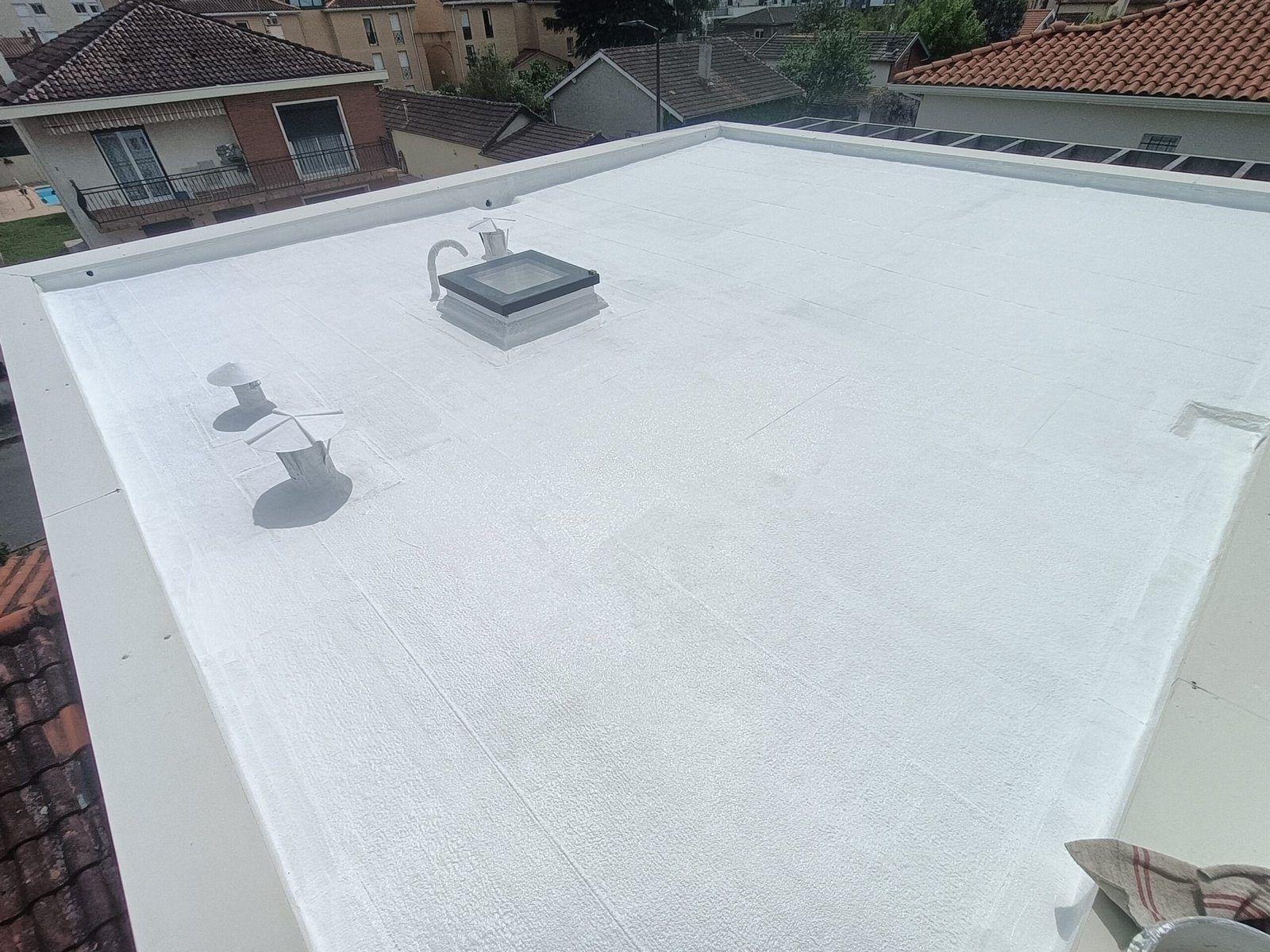
Quick facts — Cool roof on flat roofs: roof terraces, upstands, rooflights and flat-roofed houses
- Substrate
- Roof terrace in bitumen membrane, EPDM, PVC (over 10 years old); gravel to be removed
- Primer
- PH169 — 6 m²/L on bitumen, coverage rate checked at the diagnosis on EPDM
- Base coat and topcoat
- PH107 in two passes — 2 m²/L; PH107TCL — 10 m²/L
- Rooflights
- PrimaTherm® LT lacquer: 1 coat ≈ −25 % heat gain, 2 coats ≈ −50 %
- Preparation
- Cleaning below 130 bar, clearing of the outlets, repair of the upstands, 24 to 72 h drying
- Points to watch
- Slope and ponding water, parapet upstands, rainwater outlets, foot traffic, accessible terraces
- Homeowners
- Online shop for under 500 m², prior declaration to the town hall, 10 % VAT on supply and installation for French homes over 2 years old
- Indicative lead time
- 1 to 2 days for a house roof, about 1 week for 3,000 m²
Why a flat roof heats up more than a pitched roof
A roof terrace combines three handicaps against the sun. Its horizontal surface receives the radiation head-on during the hottest hours, whereas a pitched slope only catches part of it. Its covering is almost always dark: bitumen membrane, EPDM, all absorb most of the energy received and rise to 50 to 70 °C. And air does not circulate under a flat roof as it does under ventilated tiles: the heat passes through the build-up, loads the insulation, then radiates into the rooms of the top level.
The result is felt wherever there is a flat roof: top-floor offices unusable in the afternoon, apartments under the roof in co-owned buildings, classrooms, bedrooms in a flat-roofed house. And the waterproofing, subjected to daily cycles of 50 to 60 °C in amplitude, ages before its time.
A cool roof on a flat roof is the most direct answer: the coating reflects the radiation right at the surface, and the heat no longer gets in.
What a PrimaTherm® cool roof changes on a roof terrace
The PrimaTherm® system reflects 95 % of solar radiation (ASTM E903-12), with an emissivity of 0.89 (ASTM C1371-15) and an SRI of 120 (ASTM E1980), maintained at 119 after 4,000 h of accelerated QUV ageing. External fire classification Broof(t3) (CSTB report RA23-0010).
| Indicator | Dark flat roof | Flat roof + PrimaTherm® |
|---|---|---|
| Solar reflectance | 5 to 20 % | 95 % |
| SRI | 0 to 20 | 120 |
| Surface temperature (35 °C outside) | 50 to 70 °C | 25 to 35 °C |
| Gain felt on the top level | — | up to −6 °C depending on insulation |
| Air conditioning | — | up to −40 % depending on the climate zone |
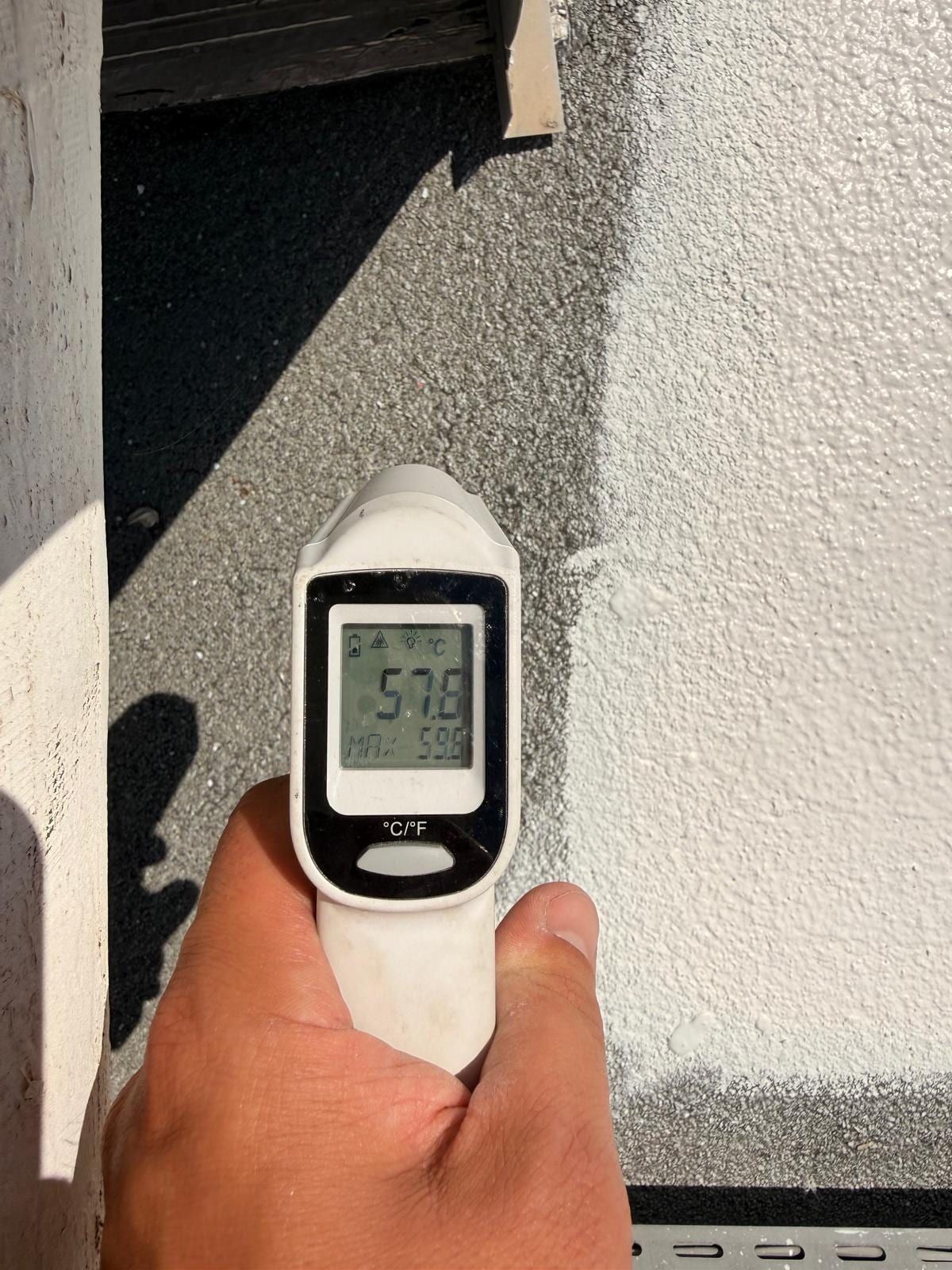
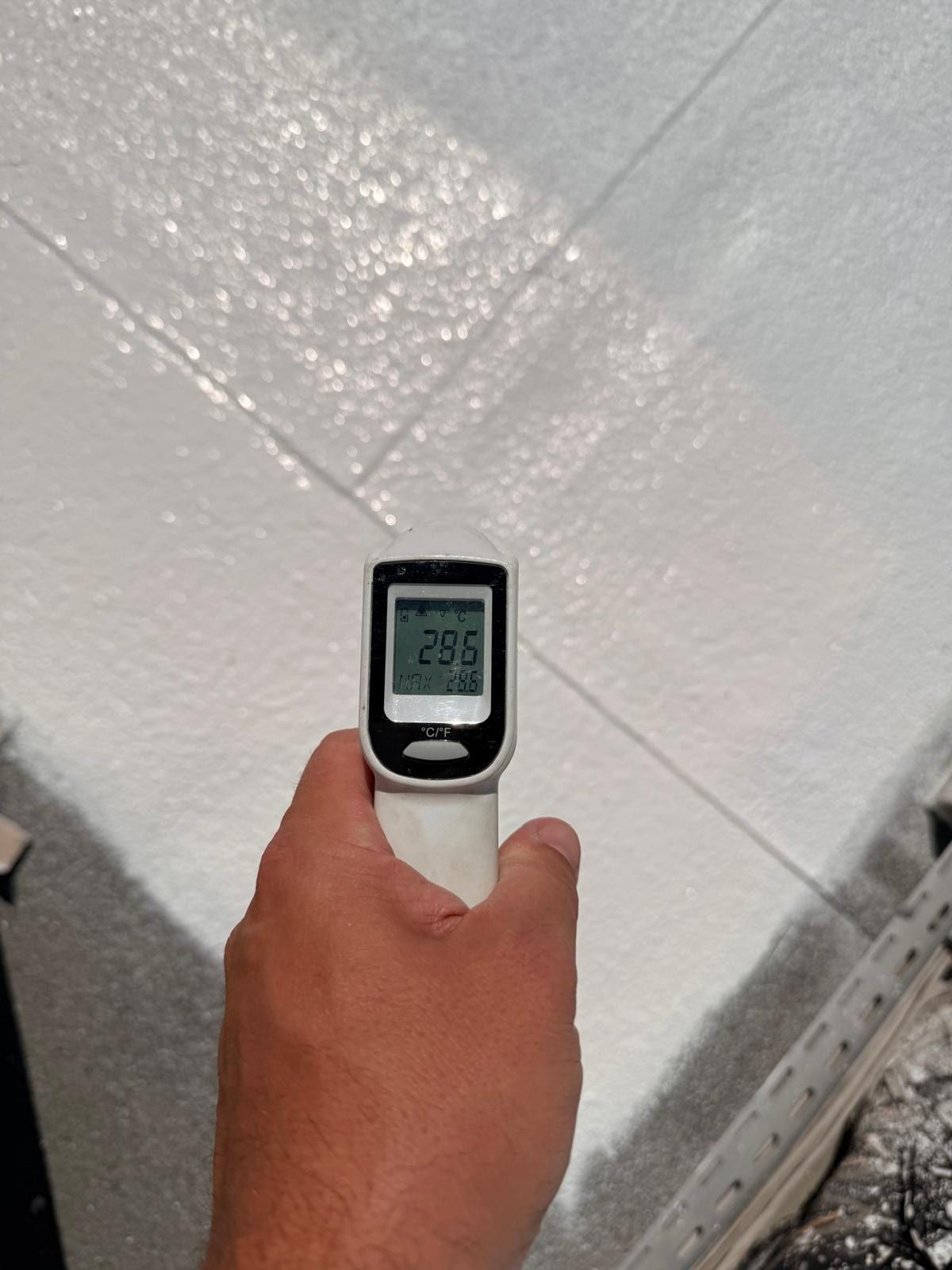
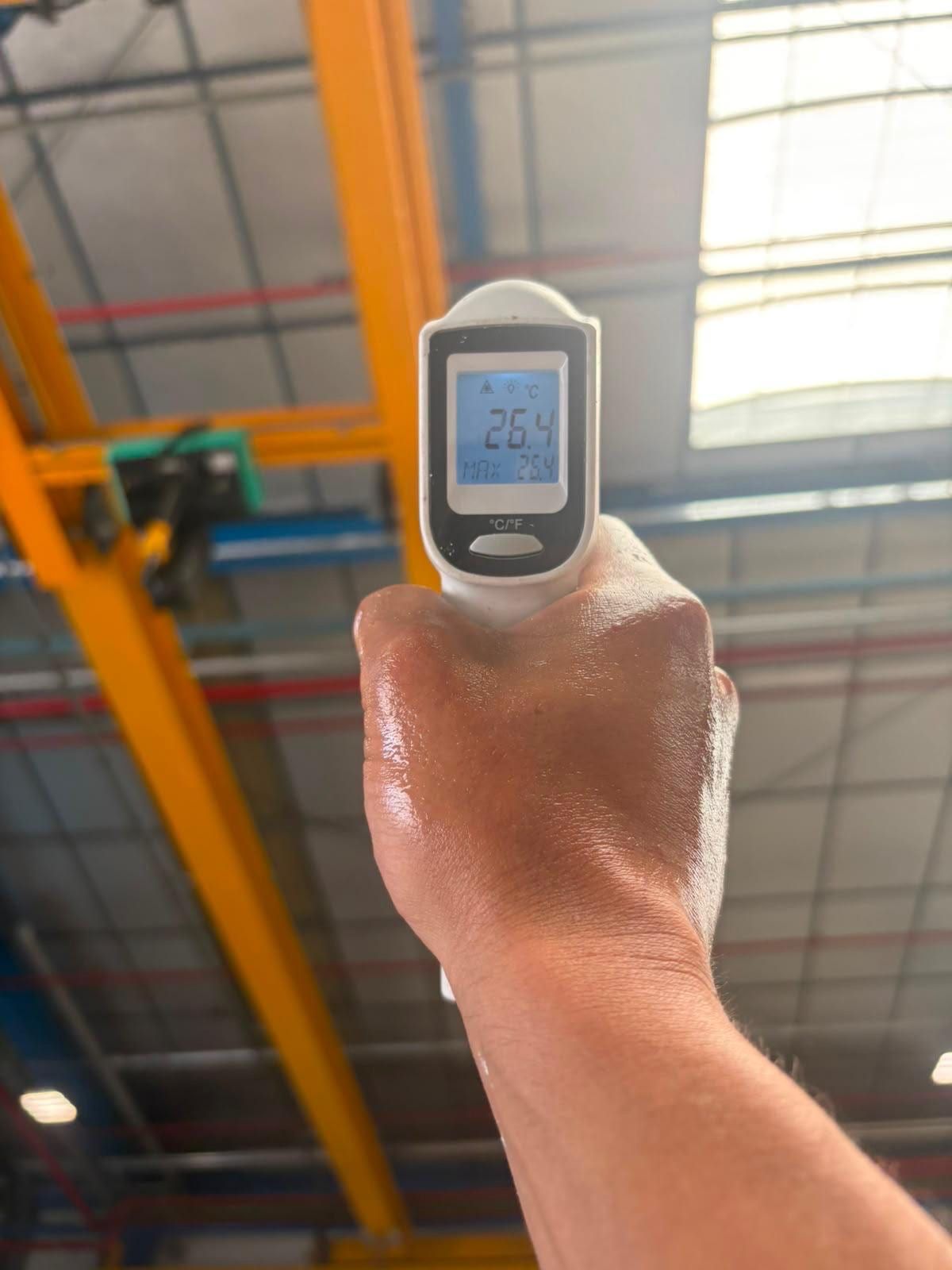
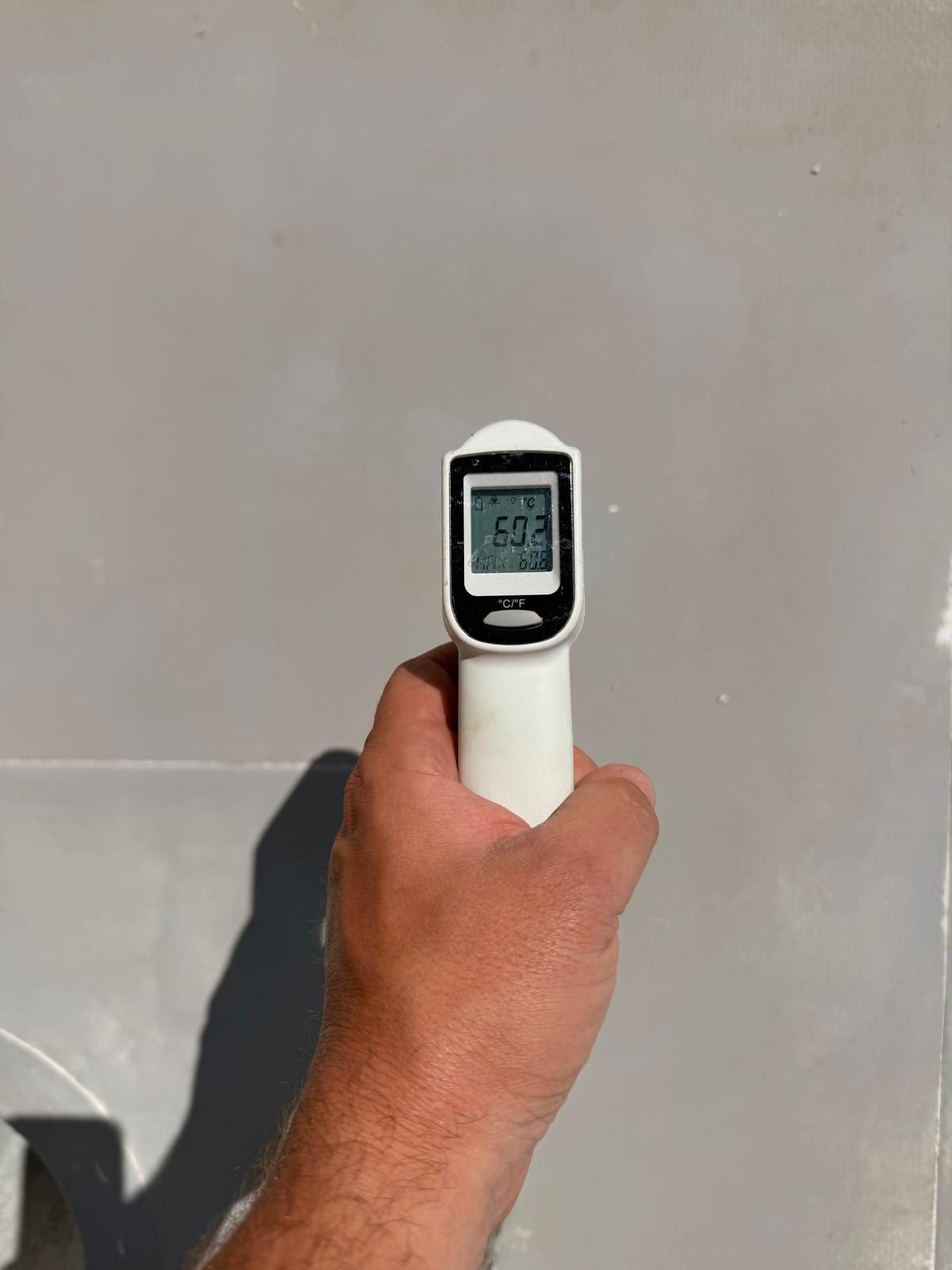
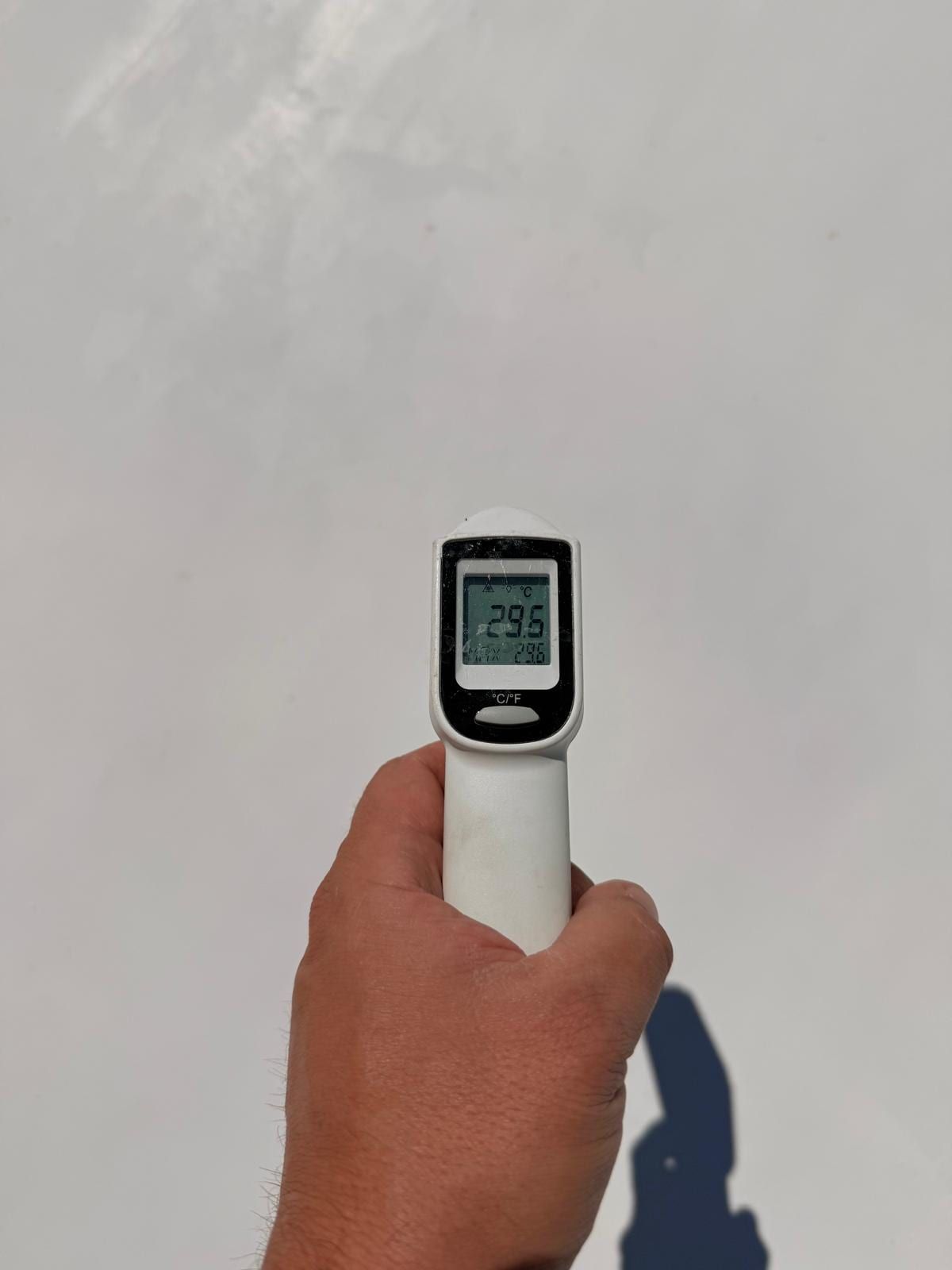
On a bitumen membrane roof terrace, the reference is Airbus Marignane: 5,900 m² on three buildings, −29 °C measured by infrared at handover (57.8 °C on the control zone against 28.6 °C on the treated zone, 19 June 2026). On a flat-roofed house, the effect is the same at the scale of the home: the bedrooms under the roof become liveable again in summer.
Points to watch specific to flat roofs
Slope and ponding water
A flat roof is never entirely flat: the minimum slope leads the water to the outlets. When it is insufficient or the substrate has deformed, puddles persist. The diagnosis identifies the ponding areas (water still present 48 h after rain). The PrimaTherm® system tolerates temporary standing water; a permanent puddle, on the other hand, signals a problem to be corrected before any coating: slope correction, unblocking or adding an outlet.
Parapet upstands and singular points
The upstands (where the membrane turns up against the parapets), the rainwater outlets, the overflows, the equipment plinths and the expansion joints concentrate the movements of the roof. They are prepared and treated by hand, with a roller or a cutting-in brush, and repaired with membrane or compatible sealant if they are detached. A cool roof that stops at the foot of the upstand leaves a dark line that heats up: we take the system up the upstands.
Rooflights, domes and glazed roofs
A flat roof on an office or school building often has 5 to 10 % of its area in polycarbonate rooflights, which let heat through as much as light. The PrimaTherm® LT lacquer, semi-transparent, is applied on them: one coat reduces heat gain (and transmitted light) by about 25 %, two coats by about 50 %. You choose the level of brightness.
Rooftop equipment
Air handling units, chillers, aerials, cable trays: they are protected during the works and the system is applied right up to their plinths. A cooler roof around a chiller also improves its efficiency, since the air drawn in is less hot.
Foot traffic and accessible terraces
The film can be walked on after 48 to 72 h of drying for maintenance. On an accessible terrace, a heavily used plant roof or under maintenance areas, plan walkways (slabs, grating) or load-spreading boards. A terrace with paving slabs on pedestals is not treated: the membrane is already in the shade of the slabs.
Gravel
A gravelled roof terrace protects its membrane with a layer of loose gravel: you cannot paint gravel. Two options, to be studied case by case: remove the gravel (and check that the membrane underneath is suitable for direct exposure), or leave the roof as it is. We tell you from the study.
Substrate by substrate
- Bitumen membrane: PH169 bleed-blocking primer at 6 m²/L with a long-pile roller, then base coat in two passes and topcoat. See the guide cool roof on bitumen roofs.
- EPDM: cleaning, degreasing, adhesion test, standard system.
- PVC: only beyond 10 years, with the PH107PVC bonding base and a test on three zones of 30 m². See cool roof on waterproofing membranes.
- Fibre cement: asbestos-free only, buildings later than 1997.
The installation process is the same: free study within 48 h, technical survey, preparation (medium-pressure cleaning below 130 bar, 24 to 72 h drying, moisture below 5 %), application of the 4 layers without lifting equipment, film thickness checks and infrared measurements, as-built file.
The mistakes to avoid on a flat roof
A flat roof is less forgiving than a pitched roof: water stays on it, defects show. Five mistakes come up again and again on the roof terraces we take over.
- Painting over the puddles. An uncorrected ponding area lifts any coating within one winter. Slope and outlets are dealt with first.
- Stopping at the foot of the upstands. The parapet upstands are the most stressed area of the roof; left dark, they heat up and move. The system goes up over them.
- Applying on a damp membrane. The grain of a membrane holds water for several days after rain: 24 to 72 h of drying and less than 5 % moisture, measured, not estimated.
- Forgetting the rooflights. On a tertiary-sector roof terrace, they can be the first source of heat gain once the rest has been treated. The PrimaTherm® LT lacquer deals with them.
- Skipping the prior declaration. A roof that turns white is visible from neighbouring buildings; a town hall can demand that it be restored. One month of processing avoids months of dispute.
What we measure at handover
Every treated flat roof is the subject of a documented inspection: infrared surface temperature measurement, treated zone against a control zone kept for the duration of the measurement; rainwater flow test; film thickness check and reconciliation of the quantities used against the coverage rates of the protocol; photographic record of the upstands and singular points. Everything is handed over in the as-built file, with the product test reports, the technical data sheets and the ten-year insurance certificate.
When to schedule the works
The application window runs from April to October depending on the region: 12 to 35 °C, relative humidity below 80 %, no rain within 4 h of each layer. On a flat roof, two calendars dominate: the school holidays for schools and public buildings, and spring for co-owned buildings and offices, so as to be protected before the first heat episode. A house roof is treated in 1 to 2 days; a 3,000 m² roof terrace in about a week, by zones if operations require it.
Flat roof on a detached house: what a homeowner needs to know
Contemporary flat-roofed houses, extensions and garages with a roof terrace heat up exactly like an office building — at the scale of a family. Three points before you start.
The online shop for small areas. Below 500 m², the PrimaTherm® online shop (in French) sells the three products of the system (PH169, PH107, PH107TCL) with a quantity calculation per m² and the application guide. The coverage rates are the same as on our projects: 6 m²/L for the primer on bitumen, 2 m²/L for the base coat in two passes, 10 m²/L for the topcoat. An 80 m² roof is treated in a weekend, in dry weather and between 12 and 35 °C. We warn you about the conditions before the purchase.
The prior declaration. Turning a roof from black to white changes the external appearance of the building: it requires a prior declaration to the town hall (Article R. 421-17 of the French planning code), with one month of processing as a general rule. Some local planning rules (PLU), the surroundings of historic monuments and protected areas regulate colours. Find out before ordering.
The 10 % VAT. For a French home completed more than 2 years ago, supply and installation by a professional qualify for the reduced 10 % VAT. Co-owned buildings benefit from it too: the vote at the general meeting is organised with our presentation file, described on the page cool roof for residential buildings. MaPrimeRénov’ does not cover cool roofs: we say so clearly, rather than letting you hope for an incentive that does not exist.
The cost of a flat roof treated by our teams depends on the area, the substrate, the preparation, the access and the incentives available; the detailed proposal follows the free study. Our page on the price of a cool roof for a house explains what drives the cost, item by item.
Flat roofs and solar panels
A flat roof is the preferred substrate for photovoltaic installations on ballasted mounts. The cool roof is preferably applied before the modules: a cooler roof improves their output by a few percent, and the reflective surface feeds the rear face of bifacial panels. On a roof already fitted with panels, we treat the accessible areas. The details are on the page cool roof and solar panels.
For which flat-roofed buildings
- Co-owned residential buildings: the top-floor apartments, the 10 % VAT, the vote at the general meeting.
- Offices and tertiary sector: the French tertiary-sector decree and the comfort of office floors under the roof.
- Schools and public buildings: roof terraces everywhere, classrooms under the roof, works during the holidays.
- Hospitals and care homes: vulnerable people on the top levels.
- Shopping centres: large roof terraces with numerous pieces of equipment.
Incentives, regulations, maintenance
The French energy-savings certificates (CEE), sheet BAT-EN-112, target tertiary-sector buildings for commercial use, with a volume heated and cooled by heat pump (160, 170 or 270 kWh cumac per m² depending on the French climate zone H1, H2 or H3); they do not apply to a house. The details of the schemes are on the page cool roof incentives in France 2026.
Maintenance: annual inspection of the outlets and upstands, cleaning with clear water or low pressure (100 bar maximum) every 12 to 15 months. The SRI is maintained after 4,000 h of accelerated QUV ageing — conventional service life of 20 years (French CEE sheet). The guide maintaining a cool roof gives the full plan.
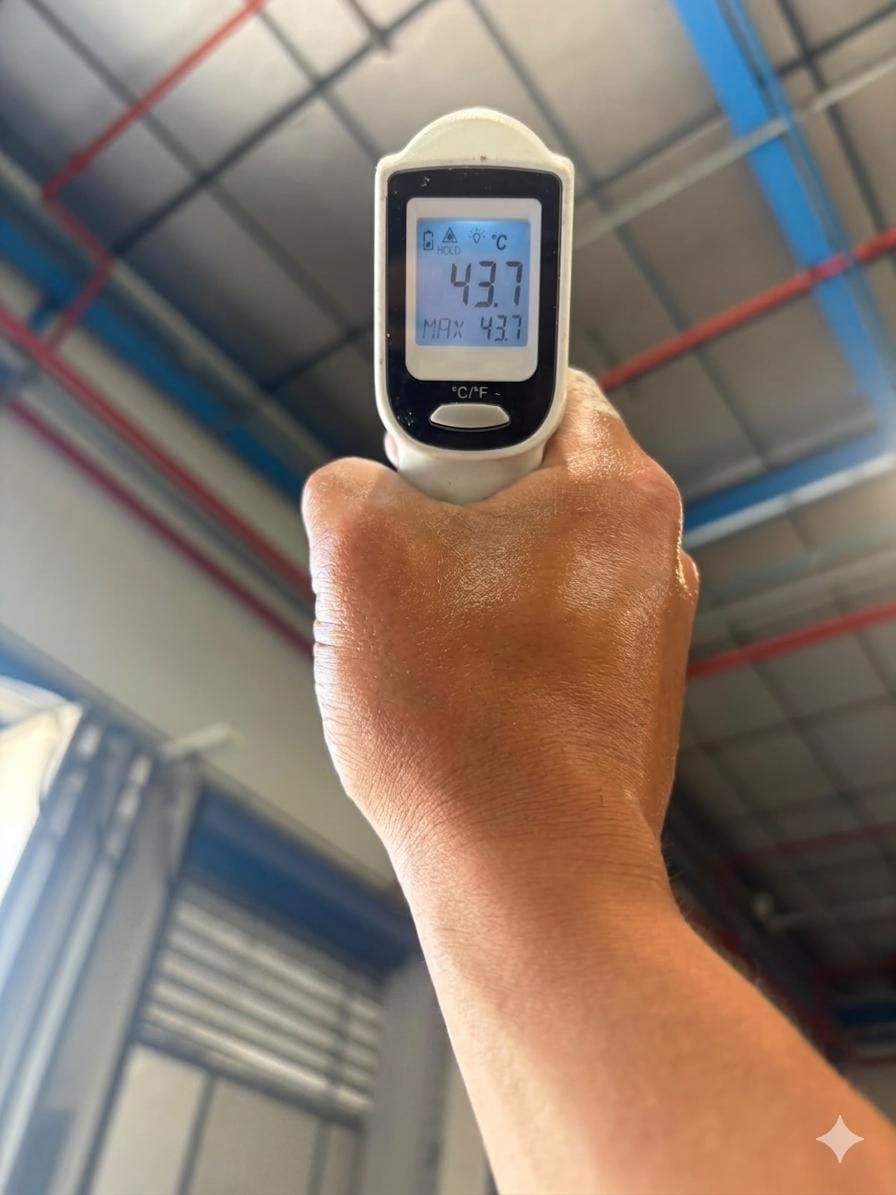
The thermometer, same time of day, before and after.
Frequently asked questions
Does a cool roof work on every flat roof?
On most of them: bitumen membrane, EPDM and PVC membrane installed more than 10 years ago (with the PH107PVC bonding base). A gravelled roof must be cleared of its gravel, and a terrace with paving slabs on pedestals is not treated, as the membrane is already in the shade. The diagnosis decides case by case.
Can a homeowner apply a cool roof to a flat roof themselves?
Yes, for a house or an extension under 500 m²: the PrimaTherm® online shop sells the three products of the system with the quantity calculation per m² and the application guide. The conditions to respect are the same as for our teams: sound, dry substrate, temperature between 12 and 35 °C, no rain within 4 h, four layers in the right order.
Is a permit needed to turn a flat roof white?
In general, yes: changing the colour of a roof requires a prior declaration to the town hall (Article R. 421-17 of the French planning code), and some local planning rules (PLU) or protected areas regulate colours. Allow one month for processing. For a co-owned building, the vote at the general meeting comes on top of this step.
Does the cool roof withstand puddles on a flat roof?
The system tolerates temporary standing water after rain. On the other hand, a puddle that persists more than 48 h signals a slope defect or a blocked outlet: we correct it or have it corrected before application, otherwise no coating lasts.
Can you walk on a treated flat roof?
Yes, after complete drying, 48 to 72 h, for maintenance and technical interventions. For an accessible terrace or frequent foot traffic, lay walkways (slabs, grating) or load-spreading boards: the film is elastic but is not designed for daily trampling.
What gain can be expected on the top floors?
Up to −6 °C felt under a poorly insulated roof, 1 to 3 °C under a well-insulated roof. In both cases, it is the ceiling that stops radiating: the sensation of heat disappears even before the thermometer moves. On the surface, the roof goes from 50–70 °C to 25–35 °C.