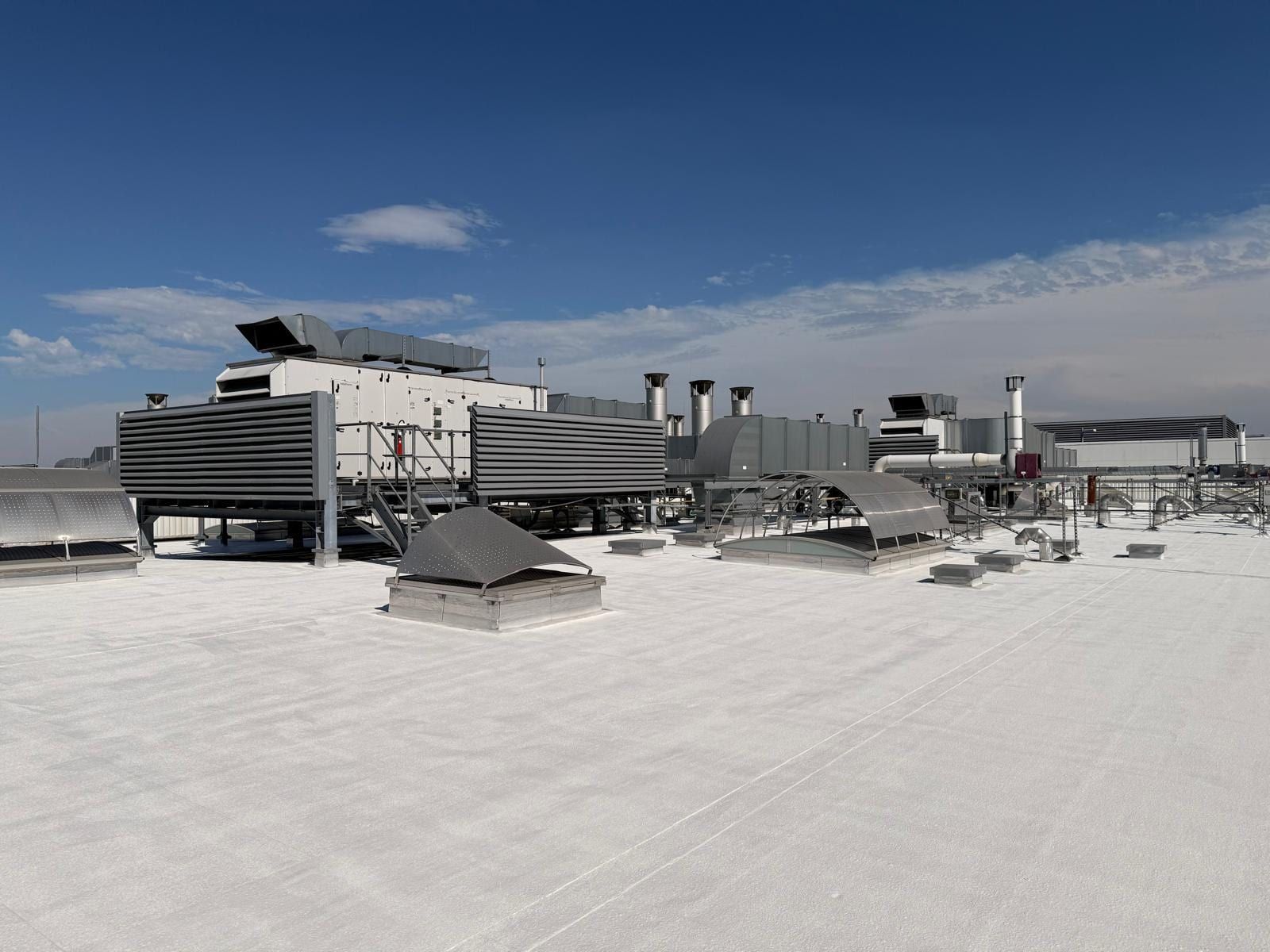
Why in-use certifications look at the roof
An office building, a shopping centre or a logistics platform in operation is not certified like a new-build project. The in-use schemes — HQE for the use phase, BREEAM In-Use, LEED for Operations and Maintenance — assess an occupied building on what it actually delivers: metered consumption, occupant satisfaction, ability to get through a heatwave, condition of the envelope, quality of management. For an asset manager, these are the certifications that count in acquisition due diligence or a lease renegotiation, because they concern the building as it is let.
The roof holds a particular place in them. On a low-rise tertiary building, it is the largest surface exposed to the sun; when dark, it reaches 50 to 70 °C in summer, loads the air conditioning, degrades the comfort of the top floors and heats the air of the neighbourhood. The three schemes approach it through different doors: summer comfort, heat island, measured energy, resilience. Our guide to HQE, BREEAM and LEED certifications (in French) deals with the design-stage schemes; this one focuses on the in-use versions and on the evidence they expect.
HQE in operation: the reference framework applied to use
The HQE approach, the French sustainable building certification, rests on the sustainable building reference framework promoted by the Alliance HQE-GBC, structured around four cross-cutting commitments: quality of life, respect for the environment, economic performance and responsible management. These commitments apply to all phases — design, construction and operation — the latter being defined as the period during which the building is made available to its occupants and operated by an operator, public or private. Certification of tertiary buildings is issued by Certivéa, that of housing by Cerqual.
For the operation phase, the Alliance HQE-GBC lists three families of issues: environmental (energy consumption and production, water, resources, waste), social and health-related (summer thermal comfort, indoor air quality, acoustics, accessibility, resilience) and economic (operating charges, maintenance costs, durability of components). A high-SRI roof acts on all three: the surface temperature of the roof governs that of the ceiling of the top floors, the component of comfort that occupants feel most and the simplest to measure; less heat coming in through the roof means air conditioning under less strain and a building that holds its setpoint during episodes of intense heat; waterproofing that no longer cycles every day between 20 and 70 °C ages more slowly, which bears on maintenance costs and the service life of components.
The applicable scheme and its auditor decide the level achieved; we do not publish a scoring scale. What we guarantee is the quality of the evidence: certified values, documented durability, on-site measurements.
BREEAM In-Use V6: Asset Performance and Management Performance
BREEAM In-Use, developed by BRE, is used to assess and compare the sustainability of all types of assets in operation. Version 6 distinguishes two parts that can be certified separately: Part 1, Asset Performance, and Part 2, Management Performance. The certificate is valid for three years, and the rating scale runs from Acceptable to Outstanding by way of Pass, Good, Very Good and Excellent. The categories are weighted: Energy accounts for 25 % of the score in Part 1 and 27 % in Part 2, Health and Wellbeing for 20 % and 17 %, and Resilience, a new category in version 6, for 13 % and 11 %.
Four issues directly concern a reflective roof:
- Hea 07, User comfort controls (Part 1) and Hea 14, Thermal comfort (Part 2). The latter, which was called “Operating temperature” in the 2015 version, is refocused on the thermal comfort felt by the occupants rather than on setpoint temperatures alone. A roof that no longer exceeds 35 °C reduces the hours of discomfort on the top floor, which shows up in indoor temperature readings and surveys.
- Rsc 04, Future adaptation (Part 1, formerly the “Building adaptation” issue), in the Resources category. A reflective roof is an adaptation measure against heat episodes, one that can be documented and is already in place. The Resilience category (coded Rsl), introduced in version 6 to encourage the consideration and proactive management of the physical and climate-related risks weighing on the asset, builds on the same observation.
- Rsc 01, Condition survey: the condition of the roof and its waterproofing is part of the survey; a coating that protects the membrane from UV and thermal shocks has its place in it.
- The Energy category, the heaviest in both parts: the drop in the cooling load can be read in the data, provided there is sub-metering.
We do not claim that an issue is secured: the BREEAM assessor applies the exact wording of the version in force for your scheme. We supply the documents that allow the assessor to decide.
LEED v5 O+M: the heat island credit and measured performance
LEED for Operations and Maintenance is aimed at buildings and interior spaces that have been fully operational and occupied for at least one year. Version 5, available for the BD+C, ID+C and O+M rating systems, organises the credits around three impact areas: decarbonisation, quality of life, and ecological conservation and restoration; the November 2025 O+M rating system totals 110 possible points, with data tracking on the Arc platform and periodic recertification.
SSc1 Heat Island Reduction: 1 point, calculated over the whole site
The heat island reduction credit, in the Sustainable Sites category, is worth 1 point in O+M. Its equation combines three strategies: shaded or reflective ground surfaces (nonroof measures), high-reflectance roof and vegetated roof. Each compliant area is divided by a coefficient (0.5 for nonroof measures, 0.75 for the high-reflectance roof, 0.5 for the vegetated roof) and the sum must reach the total paving and roof area of the site; a compliant reflective roof therefore counts for more than its area. An approach based on a weighted average of SRI and solar reflectance values is accepted. For the roof, the rating system requires an aged SRI at least equal to the values in the table or, if no aged value is available, an initial SRI at least equal to them:
| Roof slope | Minimum initial SRI | Minimum aged SRI |
|---|---|---|
| Low-sloped (up to 2:12) | 82 | 64 |
| Steep-sloped (above 2:12) | 39 | 32 |
The roof area taken into account excludes the areas covered by mechanical equipment, solar panels and rooflights, which calls for a precise roof plan; the areas under panels are still worth treating for the temperature of the modules, as our cool roof and solar panels page explains. The Cool Roof Rating Council, whose directory of rated products serves as a reference for LEED teams, confirms these thresholds and the single point of the O+M system. PrimaTherm®, at 120 when new and 119 after 4,000 h of accelerated QUV ageing, exceeds them by a wide margin, and the margin matters, because it is the aged value that the rating system favours. The solar reflectance index (SRI) page explains how to read these values.
Energy, resilience and occupant experience
Three other elements of the O+M rating system concern a reflective roof, without it being the sole condition for them:
- EAc1 and EAc2, Greenhouse Gas Emissions Reduction Performance and Optimized Energy Performance, 12 points each: the scoring is based on measured consumption; the drop in the air-conditioning share, up to −40 % air-conditioning consumption depending on the climate zone, appears in the data for the year following the works if sub-metering isolates it.
- IPp1, Climate Resilience Assessment, a prerequisite: the project identifies the observed and projected natural hazards, including extreme heat, selects at least two priority hazards and describes the operating strategies that respond to them. A reflective roof is a documented response to the extreme heat hazard.
- EQc3, Occupant Experience Performance, 1 to 3 points depending on the share of occupants satisfied with the indoor environment — more than six, eight or nine out of ten — measured by survey over twelve months: the summer comfort of the top floors weighs directly on this result.
Theme by theme: what each certification looks at, what has to be proved
| Theme | HQE in operation | BREEAM In-Use V6 | LEED v5 O+M | Evidence to provide |
|---|---|---|---|---|
| Summer comfort | “Summer thermal comfort” issue, quality of life commitment | Hea 07 (Part 1), Hea 14 (Part 2) | EQc3, satisfaction survey | Indoor temperature readings before and after, occupant survey |
| Heat island and adaptation | “Resilience” issue | Rsc 04 Future adaptation (Resources), Resilience category (Rsl) | SSc1 Heat Island Reduction (SRI 82 or 64 aged), IPp1 | New and aged SRI reports, roof plan with excluded areas |
| Energy | “Energy consumption” issue | Energy category (25 % and 27 %) | EAc1, EAc2 on measured data | Air-conditioning sub-metering, twelve months of data |
| Envelope and charges | “Durability of components” and “maintenance costs” issues | Rsc 01 Condition survey | Current facilities requirements and O+M plan (IPp4) | Condition of the waterproofing, maintenance plan, application certificate |
The evidence file for a roof treated on a building in operation
An in-use auditor does not score an intention. The file we put together for each project answers the four rows of the table.
The product. Solar reflectance of 95 % (ASTM E903-12), emissivity of 0.89 (ASTM C1371-15), SRI of 120 (ASTM E1980), SRI maintained after 4,000 h of accelerated QUV ageing — conventional service life of 20 years (French CEE sheet), Broof(t3) fire rating (CSTB report RA23-0010). The SRI, according to the ASTM E1980 standard, expresses the temperature reached by a horizontal or low-sloped surface relative to a reference black (0) and a reference white (100), from its measured reflectance and emissivity; it is the quantity that the three schemes recognise. These reports are presented on our PrimaTherm® certifications page.
The application. System in 4 layers (PH169 primer, PH107 reflective base coat in two passes, PH107TCL anti-soiling topcoat), thickness check, application certificate with the areas actually treated, roof plan distinguishing equipment, rooflights and photovoltaic areas, as-built file.
The measurement. Infrared surface readings on a treated area and a control area at the same time of day, indoor temperatures on the top floor, air-conditioning sub-metering installed before the works. The Lawrence Berkeley National Laboratory measured a black roof 30 °C hotter than a neighbouring white roof; on our projects, the surface goes from 50–70 °C to 25–35 °C, i.e. up to −30 °C on the roof surface, and the indoor gain is up to −6 °C felt inside depending on insulation. The TGV maintenance centre of SNCF Voyageurs at Lyon Gerland, more than 10,000 m² on three buildings handed over without reservations on 17 September 2026, shows the scale at which these measurements are made, without stopping operations and without lifting.
Upkeep. In-use certifications check that performance lasts: low-pressure water cleaning every 12 to 15 months, annual inspection, warranties in force. Our article on maintaining a cool roof (in French) details this protocol, which also answers the logic of LEED’s aged SRI.
Linking the certification with the French tertiary-sector decree
For a tertiary building of more than 1,000 m², the data required by in-use certifications are those declared on the OPERAT platform: annual consumption, all uses. Air-conditioning sub-metering installed before the works feeds both the certification file and the action plan of the French tertiary-sector decree (Éco Énergie Tertiaire), in which the reflective roof features among the levers with a short payback time (in French). On offices heated and cooled by heat pump, the French energy-savings certificates (CEE), sheet BAT-EN-112, can be added, under conditions; MaPrimeRénov’ does not cover cool roofs. The cool roof for offices page describes how works run without vacating the office floors, the shopping centres page covers the case of large roofs air-conditioned continuously, and our article on cool roofs and urban heat islands the effect on the neighbourhood that the LEED credit measures.
A reflective roof brings neither thermal resistance, nor stormwater management, nor biodiversity, nor energy production: on these themes, the schemes score other solutions. Nor does it secure a credit on its own when that credit is calculated over the whole site, like the heat island credit in LEED, where car parks and roadways weigh as much as the roof. Its strength lies elsewhere: a light action, applied in a few days without lifting, whose effect on comfort, energy and resilience can be measured from the first summer and documented for the life of the certificate. The free roof study includes the satellite measurement, the analysis of the substrate and the list of supporting documents suited to your scheme, with a reply within 48 h.
Key points
- HQE in operation: four commitments of the HQE reference framework; issues of summer thermal comfort, energy, resilience, durability of components; tertiary certification by Certivéa.
- BREEAM In-Use V6: Part 1 Asset Performance, Part 2 Management Performance, three-year certificate; issues Hea 07 and Hea 14 (comfort), Rsc 04 (Future adaptation), Rsc 01 (Condition survey), Energy at 25 % and 27 % of the score.
- LEED v5 O+M: SSc1 Heat Island Reduction, 1 point, aged SRI 64 or initial SRI 82 for low-sloped roofs, calculated over the whole site; measured energy (EAc1, EAc2), climate resilience prerequisite, occupant survey.
- PrimaTherm®: solar reflectance 95 %, emissivity 0.89, SRI 120 new and 119 aged, Broof(t3); no points score announced before the file has been read.
- Evidence: test reports, application certificate, roof plan, infrared and indoor measurements, sub-metering, maintenance plan.
Sources
- LEED v5 Reference Guide for Operations and Maintenance, November 2025 Edition, U.S. Green Building Council (SSc1, IPp1, EAc1, EAc2, EQc3).
- LEED certification for existing buildings and spaces and LEED v5, U.S. Green Building Council.
- LEED certification, SRI thresholds, Cool Roof Rating Council.
- BREEAM In-Use, BRE, and BREEAM In-Use International Commercial V6: Summary of changes, BRE Global.
- Alliance HQE-GBC and Sustainable operation, Alliance HQE-GBC.
- ASTM E1980, Standard Practice for Calculating Solar Reflectance Index of Horizontal and Low-Sloped Opaque Surfaces, ASTM International.
- Cool roofs, Heat Island Group, Lawrence Berkeley National Laboratory.
- Test reports of the PrimaTherm® system, certifications page.
Frequently asked questions
What is the difference between a design-stage certification and an in-use certification?
A design or construction certification assesses a project on simulations, drawings and choices of materials. An in-use certification assesses an occupied building on real data: measured consumption, occupant surveys, condition of the equipment, management plans. A reflective roof applied to an existing building is therefore credited through before and after measurements, not through a calculation note.
What SRI is needed for the LEED O+M heat island credit?
The LEED v5 rating system for operations requires, for a low-sloped roof, an aged SRI of at least 64 or, if no aged value is available, an initial SRI of at least 82; for a steep-sloped roof, 32 aged or 39 initial. The credit is then calculated over the whole site, roof and ground surfaces, and is worth 1 point. PrimaTherm® shows an SRI of 120 when new and 119 after accelerated ageing.
Does BREEAM In-Use take summer comfort into account?
Yes. Version 6 includes, in its Health and Wellbeing category, a user comfort controls issue in the Asset Performance part, and a thermal comfort issue in the Management Performance part, refocused on the comfort felt by the occupants rather than on setpoint temperatures alone. The Resilience category, new in version 6, deals with the physical and climate-related risks weighing on the asset; the future adaptation of the building falls under issue Rsc 04, in the Resources category.
How many points does a reflective roof earn under HQE or BREEAM?
No score can be announced before the file has been read: the result depends on the scheme, its version, the building type and what the rest of the operation contributes on the same themes. We supply the evidence — test reports, before and after measurements, maintenance plan — and your certification consultant places it in the grid.
What evidence does an auditor expect for a roof treated on a building in operation?
First the test reports of the coating with the measurement standards and the aged value, then the application certificate with the areas actually treated and the roof plan distinguishing the excluded areas. Next the infrared measurements before and after against a control area, the indoor temperatures or the air-conditioning sub-metering over twelve months. Finally the maintenance plan that justifies that the performance is maintained.
Is it worth crediting a cool roof in an in-use certification for a building without air conditioning?
Yes, on themes other than energy: occupants’ summer thermal comfort, adaptation to heatwaves, heat island reduction, protection of the waterproofing and maintenance costs. The evidence consists of the surface and indoor temperature measurements, the satisfaction survey and the building management plan.