Who must carry out an energy audit
The obligation comes from the European directive on energy efficiency. Directive (EU) 2023/1791 asks Member States to ensure that enterprises whose average annual energy consumption exceeded 85 TJ over the previous three years implement a certified energy management system by 11 October 2027 at the latest, and that those which exceeded 10 TJ carry out a first energy audit by 11 October 2026 at the latest, then at least every four years. It adds a new requirement: the audited enterprises “shall draw up a concrete and feasible Action Plan” on the basis of the recommendations, and publish this plan and the recommendation implementation rate in their annual report.
France transposed these thresholds through law no. 2025-391 of 30 April 2025, in force since 1 October 2025, in articles L. 233-1 et seq. of the French energy code: an energy management system from 23.6 GWh of annual final energy consumption, an energy audit every four years from 2.75 GWh for legal entities registered in the trade and companies register that do not have such a system. The audit is “carried out independently by auditors whose competence has been recognised”, and any company exceeding 2.75 GWh declares its annual final energy consumption. The French ministry specifies that a management system certified to ISO 50001 exempts a company from the audit, that the methodology is set by the order of 10 July 2025 and that the supporting documents are filed on ADEME’s collection platform, which is checked by the DREAL, the regional state directorates for the environment. In the event of a breach, article L. 233-4 provides for a fine of up to 2 % of turnover excluding tax, raised to 4 % in the event of a further violation.
Before 2025, the obligation targeted large companies according to their headcount and their turnover; the switch to a consumption criterion brings in property companies, multi-site retail chains and operators of tertiary property portfolios that were not concerned, and takes others out. The threshold is calculated across all energy carriers combined: electricity, gas, district heating and cooling networks, fuels.
What an energy audit contains
The French order of 10 July 2025 makes standard NF EN 16247-1 (general requirements) mandatory, supplemented by part 2 for buildings, part 3 for processes and part 4 for transport. The approach is always the same: kick-off meeting, collection of invoices and metering data, site visits, analysis of uses, ranking of actions, report and presentation of the findings. The order requires covering, for each audited site, the uses that account for more than 10 % of the site’s consumption, with a minimum of three uses, and it classifies the recommendations into four categories according to their payback period: one year or less; one to three years; three to five years; more than five years. The auditors must demonstrate training and experience suited to the field audited.
For a tertiary building, the report describes the envelope (roof, façades, glazing), the systems (heating, air conditioning, ventilation, lighting, hot water), the controls and the uses, then quantifies each action in kilowatt-hours avoided, in cost and in payback period. The 2025 review published by ADEME, the French environment and energy agency, on the period from April 2021 to April 2025 gives the order of magnitude of the potential: a median gain of 10 % in energy savings identified by the audits. Our guide to building energy efficiency (in French) goes through this method item by item.
Audit, tertiary decree and OPERAT: three tools, a single trajectory
These schemes overlap without being the same thing:
| Tool | Who | What | Where |
|---|---|---|---|
| Energy audit (French energy code, L. 233-1) | Companies above 2.75 GWh a year | Diagnosis and recommendations every four years | ADEME audit collection platform |
| French tertiary decree (building and housing code, R. 174-22 to R. 174-32) | Tertiary buildings of at least 1,000 m² | Obligation of result: −40 % by 2030, −50 % by 2040, −60 % by 2050 | OPERAT platform, annual declaration |
| Energy management system (ISO 50001) | Companies above 23.6 GWh a year | Certified continuous improvement | Certification body |
The French tertiary decree does not impose an audit: it imposes a result, measured on OPERAT from the consumption declared each year. But it needs one in two cases. First, to build the action plan that the prefect may require in the event of a breach, and which our article on the twelve levers of the action plan (in French) sets out in detail. Second, for the adjustment of the targets: article R. 174-26 of the French building and housing code provides that any adjustment, except the one linked to the volume of activity, “is the subject of a technical file drawn up under the responsibility of the owner and, where applicable, of the tenant”, and that an order sets, according to the nature of the actions, the payback periods beyond which their cost is deemed disproportionate. An audit compliant with standard NF EN 16247 is the natural basis for this file. The rules of the scheme, the reference year and the penalties are in our guide to the French tertiary decree and cool roofs.
For a company subject to both texts, the timetable falls into place as follows: audit before the four-year deadline, action plan published, actions launched, consumption declared before 30 September each year, and a check of the consistency between the two by the same energy manager. A building that shows a fall on OPERAT with no action documented in the audit, or the reverse, will be the first question in an inspection.
Where to place the cool roof in the action plan
In a building audit, the reflective roof comes under the envelope, under the “solar gains” item, and its effect can be read on the air-conditioning use, sometimes on process cooling. The auditor can quantify it from measured data:
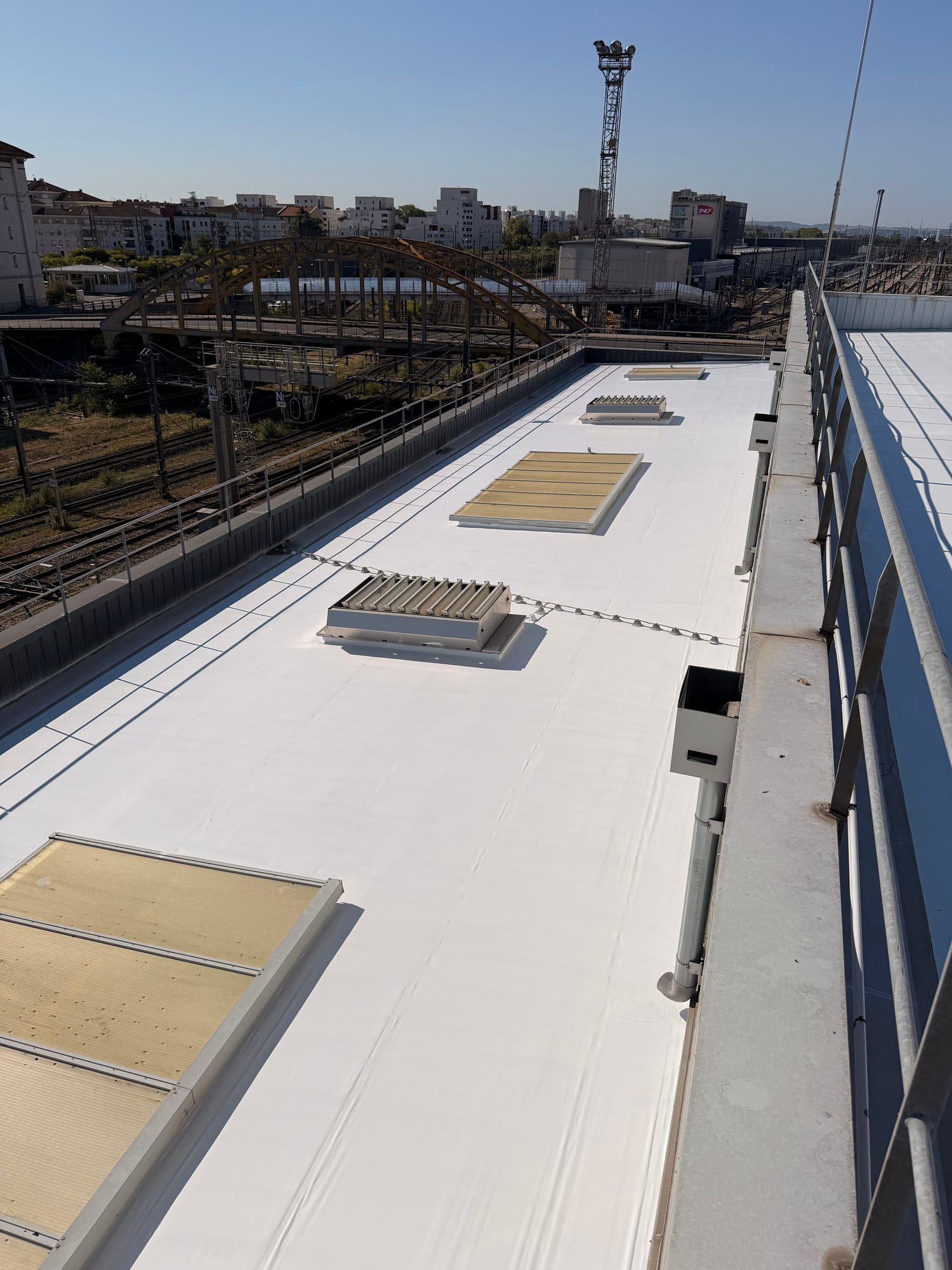
- Effect on the roof: a dark roof reaches 50 to 70 °C in summer; the PrimaTherm® system — reflectance 95 % (ASTM E903-12), emissivity 0.89 (ASTM C1371-15), SRI 120 (ASTM E1980), Broof(t3) (CSTB report RA23-0010) — brings it down to between 25 and 35 °C, i.e. up to −30 °C on the roof surface. At Airbus Marignane, on 5,900 m² of bitumen membrane, the infrared handover measurement of 19 June 2026 showed 28.6 °C on the treated zone against 57.8 °C on the control zone, i.e. −29 °C.
- Effect on consumption: air conditioning falls by 15 to 25 % in French climate zone H1, 20 to 30 % in H2, 25 to 40 % in H3, i.e. up to −40 % of this item; in a building without air conditioning, the gain is read in comfort, up to −6 °C felt inside depending on insulation.
- Payback category: on an air-conditioned building, generally three to five years, which places the action in the third category of the order, sometimes in the second when air conditioning dominates and the French CEE bonus applies.
- Implementation: a few days, with no interruption of activity and without lifting — drums and machines on the ground, only the hoses go up —, in 4 layers (PH169 primer, PH107 reflective base coat in two passes, PH107TCL anti-soiling topcoat), SRI maintained after 4,000 h of accelerated QUV ageing — conventional service life of 20 years (French CEE sheet).
For the action to be verifiable in the next audit and on OPERAT, we recommend instrumenting it as a measurement and verification plan would: sub-metering of the air conditioning installed before the works, infrared readings of the surface and of indoor temperatures before and after at the same hours, correction of the climate differences between two summers. Our offices and cool roof ROI and payback pages describe the calculation method we apply in the study.
On the funding side, the audit must cite the incentives with caution: the French energy-savings certificates (CEE), sheet BAT-EN-112, are conditional, reserved for tertiary buildings for commercial use whose volume is heated and cooled by heat pump, with flat rates of 160, 170 and 270 kWh cumac per m² depending on French climate zone H1, H2 or H3; the sheet does not apply as such to industry, logistics or agriculture, and MaPrimeRénov’ does not cover cool roofs. Our article on sheet BAT-EN-112 (in French) details its conditions. The free roof study provides your auditor with a quantified note within 48 h: satellite measurement, substrate, share of air conditioning, CEE eligibility.
Key points
- Thresholds: energy audit every four years from 2.75 GWh of annual consumption, energy management system from 23.6 GWh (French energy code, L. 233-1, in force since 1 October 2025; Directive (EU) 2023/1791: 10 TJ and 85 TJ).
- Content: standard NF EN 16247, uses above 10 % of the site’s consumption, recommendations classified into four payback categories (French order of 10 July 2025); median identified gain of 10 % according to ADEME’s 2025 review.
- How they fit together: the audit is an obligation of means on the company, the French tertiary decree an obligation of result on the building; the technical file for adjusting the targets and the action plan rely on the audit.
- Cool roof: an envelope action on solar gains; up to −30 °C on the roof surface, −29 °C measured, up to −40 % air-conditioning consumption depending on the climate zone, payback generally three to five years, to be instrumented before and after.
- Penalties: fine of up to 2 % of turnover excluding tax, 4 % in the event of a further violation (L. 233-4).
Sources
- French energy code, articles L. 233-1 to L. 233-4: energy audits and energy management systems, Légifrance.
- Energy audits and energy management systems in companies, French Ministry of Ecological Transition.
- French order of 10 July 2025 on the procedures for carrying out energy audits in companies, Légifrance.
- Directive (EU) 2023/1791 on energy efficiency, Article 11, EUR-Lex.
- Energy audit collection platform, ADEME.
- 2025 review of the regulatory energy audits of large companies, ADEME.
- French building and housing code, articles R. 174-22 to R. 174-32, Légifrance.
- Éco Énergie Tertiaire, French Ministry of Ecological Transition, and OPERAT platform, ADEME.
- Test reports of the PrimaTherm® system, certifications page.
Frequently asked questions
Who is covered by the mandatory French energy audit?
Since 1 October 2025, legal entities registered in the French trade and companies register whose annual final energy consumption reaches 2.75 GWh must carry out an energy audit every four years, unless they have put in place an energy management system, which is mandatory from 23.6 GWh. The threshold is calculated across all energy carriers combined and the obligation stems from Directive (EU) 2023/1791.
What is the difference between the energy audit and the French tertiary decree?
The audit is an obligation of means that falls on the company: a diagnosis and recommendations every four years. The French tertiary-sector decree is an obligation of result that falls on the building: −40 % consumption by 2030 for tertiary floor areas of at least 1,000 m², declared every year on OPERAT. The audit supplies the figures, the decree sets the target.
What does an energy audit report contain?
Compliant with standard NF EN 16247, it describes the uses that account for more than 10 % of the site’s consumption, quantifies each action in energy avoided, cost and payback period, and classifies the recommendations into four categories: one year or less, one to three years, three to five years, more than five years. The 2025 review by ADEME, the French environment and energy agency, notes a median identified gain of 10 %.
Is the audit mandatory for declaring on OPERAT?
No. The annual declaration concerns consumption, not studies. A technical file does, however, become necessary to request an adjustment of the targets, and an action plan may be required by the prefect in the event of a breach; in both cases, a compliant audit is the most solid basis.
How does the cool roof appear in an audit?
As an action on the envelope, under solar gains, with a quantified effect on air conditioning: up to −30 °C on the roof surface and up to −40 % air-conditioning consumption depending on the climate zone, for a payback period generally of three to five years on an air-conditioned building. The auditor adds the conditions of the French CEE bonus, sheet BAT-EN-112, when the building is eligible for it.
What are the penalties if no audit is carried out?
Article L. 233-4 of the French energy code provides for a fine proportionate to the seriousness of the breach, within the limit of 2 % of turnover excluding tax, raised to 4 % in the event of a further violation. The DREAL, the regional state directorates for the environment, check the supporting documents filed on ADEME’s platform.