Why schools are on the front line
The circular of 27 May 2026 establishing the ministerial heatwave management plan notes it: in 2025, France experienced two episodes, in June and in August, and the first affected the operation of a large number of schools. Météo-France forecasts heatwaves that may occur as early as May and extend into October, and the French Ministry of Ecological Transition reckons that the number of heatwave days will be multiplied by five by 2050 compared with the 1976-2005 period. Young children are more sensitive to them: dehydration, fainting and, in extreme cases, death.
The report of the French public health agency (Santé publique France) on the summer of 2025 gives the measure of the risk: more than 5,700 deaths attributable to heat over the surveillance period, including more than 1,900 during the heatwave episodes alone, and children under 15 accounted for 24 % of the heat-related consultations of SOS Médecins, the French emergency doctors’ network. The school calendar aggravates the exposure: late June concentrates the exams, the start of the school year in September falls on episodes that are now frequent, and the buildings, designed for winter, combine bitumen flat roofs, covered playgrounds under steel deck and top-floor classrooms. Our page cool roof for schools describes these buildings; this article focuses on the framework and the measures.
The framework: a national plan, a health instruction, a ministerial plan
The French national heatwave management plan
Presented on 8 June 2023 and updated in 2024, it comprises 27 actions, including 15 flagship measures, organised around four audiences: the general public, young people and vulnerable people, workers and businesses, sportspeople and spectators. Two actions directly concern schools. Action 9 provides for an annual check, in spring, of the proper operation of the summer comfort equipment (opening of the windows, presence and operation of the blinds, mechanical ventilation, presence of a cooled room) to be carried out in all schools and nurseries, under the responsibility of the head teacher or principal, in liaison with the owner of the buildings, most often the municipality. Action 10 organises the check of the cooled premises able to host the brevet and baccalauréat exams. Finally, the plan refers to two decision-support sheets for the closure of primary schools and of group childcare facilities for minors.
The interministerial instruction of 27 May 2024
Signed in particular by the French ministers of the Interior, of Health and of Education, it organises the health management of heatwaves during the summer surveillance period, from 1 June to 15 September, within the framework of the specific ORSEC (civil protection) provision of each département. It fixes the vocabulary: “heatwave alert” (alerte canicule) at orange warning level, “extreme heatwave alert” (alerte canicule extrême) at red warning level. For employers, the instruction of the French Directorate-General for Labour of 22 May 2026 takes up its calendar and recalls the obligations arising from the decree of 27 May 2025, detailed in our article on employers’ obligations in the face of heat (in French).
The ministerial plan of the French Ministry of Education
Published in Official Bulletin no. 22 of 28 May 2026, it is the first plan for managing this risk that is specific to the ministry. It applies to public and private primary and secondary schools, in partnership with the local authorities, the prefectures and the regional health agencies. Each académie adapts it, including in the overseas territories, and adjusts “the reference thresholds and the thresholds that trigger the measures”. Three obligations structure the scheme:
- a heat vulnerability diagnosis of schools, drawn up with the local authorities that own them, and a map of the most exposed establishments, used to adapt their operation and to prioritise the funding of renovations;
- arrangements for monitoring, alert and reporting entrusted to the académies’ defence and security services, with awareness-raising actions for staff, pupils and families;
- during a heatwave, measures to protect people and adapt operation, exams included, closure being decided only as a last resort, after dialogue between the prefect, the education authorities and the mayor, with activation of the educational continuity plan.
Météo-France warnings: levels and thresholds
The heatwave warning system (vigilance canicule) operates from 1 June to 15 September, a period that can be brought forward or extended. Forecasters compare the forecasts with the biometeorological indices established with Santé publique France: the minimum and maximum temperatures averaged over three rolling days, compared with thresholds specific to each département. The maps are updated at least twice a day, for the current day and the next.
| Level | Situation | What it implies for a school |
|---|---|---|
| Green | No particular warning | Seasonal watch, spring check of the equipment |
| Yellow | Heat peak of one or two days, or persistent episode of more than three days | Organisational measures; for staff, the employer must act from this level |
| Orange | Heatwave (canicule): intense heat for at least three consecutive days and three consecutive nights | Heatwave alert: reinforced measures, dialogue between prefect, académie and mayor |
| Red | Heatwave that is extreme in its duration, its intensity and its extent | Extreme heatwave alert: maximum adjustments, closure possible |
Temperature thresholds: what exists and what does not
No national threshold triggers the closure of a classroom on its own: the ministerial plan entrusts the académies with adapting the thresholds, and the decision takes account of the local intensity, the performance of the buildings and how accustomed the area is to heat. Three benchmarks nevertheless serve as a compass.
- Comfort: the Bâti scolaire guide considers that an air temperature between 24 and 27 °C, with a relative humidity of 30 to 70 %, is a satisfactory summer value, and sets for a cooled room a setpoint above 26 °C while limiting the difference with the outside to 7 °C.
- Staff: the INRS uses 28 °C for physical work and 30 °C for sedentary activity as benchmarks for preventive action.
- The employer: since 1 July 2025, decree no. 2025-482 (articles R. 4463-1 to R. 4463-8 of the French Labour Code), applicable to public employers, requires them to assess the risk of intense heat, defined by the yellow, orange and red warning levels, and to take measures: organisation, fresh drinking water, and “devices limiting solar radiation or the build-up of heat” in the premises.
Immediate measures during the episode
The guide “Improving the thermal comfort of school buildings during heatwaves”, circulated in June 2020 by the ministry’s Bâti scolaire unit, lists the low-cost actions that the national plan asks to be recalled every year:
- purge-ventilate at night and in the morning, as soon as the outdoor air is about 3 °C cooler than the indoor air, then keep the windows closed during the day;
- keep the shading closed (shutters, external blinds) on the sunlit façades, and check that it works before the summer;
- keep the air moving and open a cooled refuge room, preferably a large enclosed space;
- have pupils drink regularly, encourage them to wet their skin, adapt meals;
- reduce physical activities and cancel outings at the hottest hours;
- adapt the timetable where possible: start earlier in the morning, as three schools in Montélimar tested in June 2024; exams, on the other hand, are a matter for national decisions.
Passive building solutions: what the Bâti scolaire guide recommends
The same guide devotes its second part to works, and its self-diagnosis weights the factors of summer comfort. Two of them concern the roof, rated among the most influential: “the level of insulation, the nature and the colour of the roofs” and “the solar protection of the roofs (greening, reflective devices)”.
| Measure | What the guide says | Implementation |
|---|---|---|
| External solar shading | Light-coloured external blinds or shutters, fixed devices on the south side | Maintenance and major upkeep |
| Night-time purge ventilation | Secured opening windows, automation of the mechanical ventilation | Adjustment, automation |
| Insulation of roofs and lofts | High exposure of the roofs, insulation with a high thermal lag, ventilation of the lofts | Major renovation |
| Colour and treatment of the roof | Light colours for the building envelope, reflective materials on flat roofs, “protective or reflective devices on the roof, or whitening it”, with an effect in particular on the upper floors | A few days, during the holidays |
| Playgrounds and surroundings | Permeable, light-coloured surfacing, greening, shaded areas, misters depending on the water resource | Multi-year programming |
The common thread is clear: before cooling the air, the heat must be prevented from coming in, and the roof is the most exposed surface of a single-storey school complex. The French Green Fund (Fonds Vert) 2026 (in French) supports these works within a whole-building energy renovation project, and explicitly the protection of roofs in the overseas territories.
The role of the reflective roof
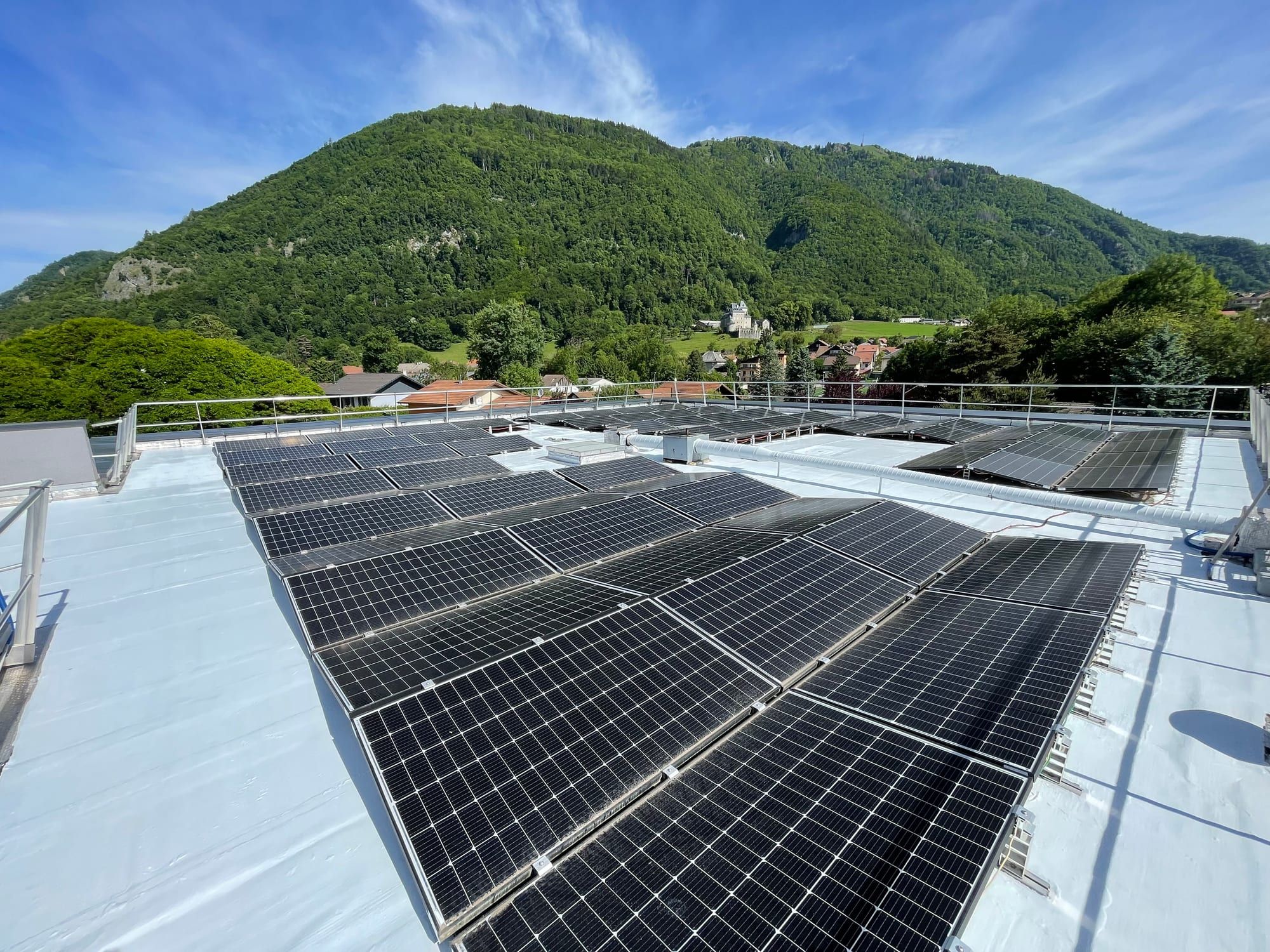
A bitumen flat roof or a dark steel deck reaches 50 to 70 °C in full sun and radiates towards the classrooms below until the evening. Treated with the PrimaTherm® system in 4 layers (PH169 primer, PH107 reflective base coat in two passes, PH107TCL anti-soiling topcoat), it stays between 25 and 35 °C, i.e. up to −30 °C on the roof surface; −29 °C was measured by infrared at the handover of a 5,900 m² project on 19 June 2026. The performance is measured in the laboratory: solar reflectance 95 % (ASTM E903-12), emissivity 0.89 (ASTM C1371-15), SRI 120 (ASTM E1980), maintained at 119 after 4,000 h of accelerated QUV ageing, Broof(t3) fire rating (CSTB report RA23-0010), which answers the fire safety committee of a public-access building. In the classrooms, the gain is up to −6 °C felt inside depending on insulation, and above all the heat that “falls from the ceiling” disappears, without consuming a single kilowatt-hour or adding any noise.
That is the choice the municipality made for the school of Saint-Laurent-d’Agny: 600 m² of bitumen membrane treated during the summer of 2026, with no crane or reserved roadway, drums and pump on the ground within the school grounds, water-based products. The rooflights of covered playgrounds and canteens receive the PrimaTherm® LT lacquer, one coat for about −25 % of transmitted light, two for about −50 %, described in our article on polycarbonate rooflights (in French). Changing the colour of a roof generally requires a prior declaration to the town hall (article R. 421-17 of the French planning code), which we check with the municipality.
The timetable lines up with that of the plan: vulnerability diagnosis and spring check, then free roof study within 48 h, works during the summer holidays between 12 and 35 °C, temperature measurements at the start of the school year to feed the map and the funding application. The neighbouring public buildings — sports halls, nurseries and holiday clubs — follow the same logic; for those that are air-conditioned, the simulator (in French) gives a first range of savings.
Key points
- Three texts frame heatwaves at school in France: the national heatwave management plan (27 actions, updated in 2024), the health instruction of 27 May 2024 (surveillance from 1 June to 15 September) and the ministerial plan of the French Ministry of Education of 27 May 2026.
- The ministerial plan requires a vulnerability diagnosis, a map of the exposed establishments and closure only as a last resort, after dialogue between prefect, académie and mayor.
- The Météo-France warning system (yellow, orange, red) is based on three-day temperature averages compared with thresholds for each département; employers, public ones included, must act from the yellow level.
- The Bâti scolaire guide ranks the colour and the reflective protection of roofs among the most influential factors of summer comfort.
- A PrimaTherm® cool roof brings the roof from 50–70 °C down to 25–35 °C, up to −6 °C felt inside the classrooms depending on insulation, applied during the holidays, with no crane; the French energy-savings certificates (CEE) and MaPrimeRénov’ do not apply, the French Green Fund (Fonds Vert) can, under conditions.
Sources
- French Ministry of Ecological Transition, heatwaves and national plan: https://www.ecologie.gouv.fr/politiques-publiques/vagues-chaleur ; heatwave management plan, 2024 update: https://www.ecologie.gouv.fr/sites/default/files/documents/Plan%20gestion%20des%20vagues%20de%20chaleur%20MAJ%202024%20V18-06-2024.pdf ; “measure 28” sheet of the French national adaptation plan, continuity of school education: https://www.ecologie.gouv.fr/sites/default/files/documents/Mesure28%20-%20services%20essentiels%20-%20%C3%A9ducation.pdf
- Interministerial instruction of 27 May 2024 on the health management of heatwaves in mainland France (BO Santé no. 2024/11): https://sante.gouv.fr/IMG/pdf/instruction_vague_de_chaleur_2024.pdf ; DGT instruction of 22 May 2026 on the management of heatwaves in 2026: https://bulletins-officiels.social.gouv.fr/instruction-ndeg-dgtbpsitct3202668-du-22-mai-2026-relative-la-gestion-des-vagues-de-chaleur-en-2026
- French Ministry of Education, ministerial heatwave management plan, circular of 27 May 2026 (BO no. 22 of 28 May 2026), presented by the French resource centre for adaptation to climate change: https://www.adaptation-changement-climatique.gouv.fr/agir/espace-documentaire/plan-ministeriel-gestion-des-vagues-chaleur
- Météo-France, what is the heatwave warning (vigilance canicule): https://meteofrance.com/comprendre-la-meteo/temperatures/vigilance-canicule ; warning map: https://vigilance.meteofrance.fr/fr/canicule
- Bâti scolaire, guide “Improving the thermal comfort of school buildings during heatwaves”, June 2020: https://batiscolaire.education.gouv.fr/guide-vagues-de-chaleur-240301 (PDF: https://batiscolaire.education.gouv.fr/sites/default/files/2022-01/guide-canicule-menj-mtes-2020-pdf-38010.pdf)
- INRS, working in the heat: https://www.inrs.fr/risques/chaleur/ce-qu-il-faut-retenir.html
- Decree no. 2025-482 of 27 May 2025 on the protection of workers against heat-related risks: https://www.legifrance.gouv.fr/jorf/id/JORFTEXT000051676074 ; Code du travail numérique (French digital labour code): https://code.travail.gouv.fr/information/fortes-chaleurs-canicule-quelles-mesures-lemployeur-doit-il-mettre-en-place ; French civil service portal: https://www.fonction-publique.gouv.fr/toutes-les-actualites/chaleur-intense-canicule-et-travail-des-agents-publics-les-precautions-prevues-par-la-reglementation
- Santé publique France, “Heat and health, review of summer 2025”, 26 February 2026: https://www.santepubliquefrance.fr/sites/default/files/rdd/document/bullnat_chaleur_bilan_2025.pdf
- PrimaTherm® test reports (ASTM E903-12, ASTM C1371-15, ASTM E1980, CSTB RA23-0010): certifications page.
Frequently asked questions
Is there a regulatory maximum temperature in a classroom?
To our knowledge, no French national text sets a maximum temperature for pupils: the 2026 ministerial plan leaves it to each académie (regional education authority) to adapt the reference thresholds and the thresholds that trigger the measures. For staff, the INRS (French occupational health institute) gives as prevention benchmarks 28 °C for physical work and 30 °C for sedentary activity, and the decree of 27 May 2025 requires employers, public ones included, to assess the risk and to act from the Météo-France yellow warning level.
Who decides to close a school during a heatwave?
Closure is exceptional. The ministerial plan provides that it happens only if no arrangement makes it possible to receive pupils and staff safely, following a dialogue between the prefect, the education authorities and the mayor, with activation of the educational continuity plan. The national heatwave management plan provides a decision-support sheet for primary schools.
What do the colours of the heatwave warning mean?
Yellow signals a heat peak of one or two days or a persistent episode of more than three days; orange a heatwave (canicule), that is, intense heat for at least three consecutive days and three consecutive nights; red a heatwave that is extreme in its duration, its intensity and its geographical extent. The forecasts are compared with thresholds specific to each département, from 1 June to 15 September.
Is a reflective roof enough to make a school comfortable in June?
No, and the Bâti scolaire guide does not claim so: it combines solar shading of the windows, night-time purge ventilation, loft insulation, greening of the playgrounds and light-coloured roofs. A cool roof removes the heat radiated by the ceiling, up to −6 °C felt inside depending on insulation, and makes the other measures effective; it replaces neither water, nor shade, nor the organisation of the school day.
How can the treatment of a school roof be funded?
Not with the French energy-savings certificates (CEE), sheet BAT-EN-112, reserved for commercial tertiary buildings heated and cooled by heat pump, nor with MaPrimeRénov’, which does not cover cool roofs. A local authority’s levers are the French Green Fund (Fonds Vert), within a whole-building energy renovation project or in the French overseas territories, where protecting roofs against solar radiation is explicitly supported, the State investment grants and the regional programmes. We supply the technical documents for the application.
When can the works be carried out without disrupting the school year?
During the summer holidays, which coincide with the application window of the system, between 12 and 35 °C on a dry substrate. A school of a few hundred m² is treated in a few days, with no crane in the playground: drums and pump on the ground, only the hoses go up to the roof. The technical visit takes place in spring, in step with the annual check of the summer comfort equipment.