One lease, two obligated parties
The French Éco Énergie Tertiaire scheme, known as the tertiary-sector decree, covers buildings, parts of buildings or groups of buildings that house tertiary activities over at least 1,000 m² of floor area, with a reduction in final energy consumption of 40 % by 2030, 50 % by 2040 and 60 % by 2050, or the achievement of an absolute value set for each category of activity. Our guide to the French tertiary decree and cool roofs details the mechanism; this one focuses on the relationship between landlord and tenant.
Article L. 174-1 of the French building and housing code leaves no choice: “the owners of buildings or parts of buildings and, where applicable, the tenants under a lease are subject to the obligation” for the actions that fall within their respective responsibilities, as defined by the contractual provisions. The same article adds that “they define together the actions intended to meet this obligation and implement the corresponding means, each for what concerns them”, and that “each party ensures the annual transmission of the energy consumption” of the areas that concern it. A commercial lease that stays silent therefore makes no obligation disappear: it simply leaves both parties with no ground rules.
Who declares on OPERAT
The declaration is made on ADEME’s OPERAT platform, every year by 30 September at the latest, for the previous year’s consumption (order of 10 April 2020, article 13). Articles R. 174-27 and R. 174-28 of the building and housing code organise the allocation:
- the annual declaration is made by the owner or by the tenant, according to their respective responsibility, as it results from the contracts that bind them;
- each may delegate the transmission of its consumption data to a service provider or to the grid operator; the tenant may also delegate it to the owner.
In practice, three configurations cover most commercial leases.
| Situation | Who declares what | Point to watch |
|---|---|---|
| Single-tenant building, meters in the tenant’s name | The tenant declares all of its consumption; the landlord declares that of the equipment it still operates | Provide for the tenant to send the landlord a copy of the declaration and of the certificate |
| Multi-tenant building or shopping centre | The landlord declares the common areas and the shared equipment; each tenant declares its unit, or mandates the landlord | A single functional entity per premises on OPERAT; avoid double declarations |
| Lease with charges included, energy re-invoiced by the landlord | The landlord holds the data and most often declares on the tenant’s behalf, with a written mandate | The tenant remains an obligated party: it must receive the data and the certificate |
The 1,000 m² threshold is assessed at the level of the building or of the group of buildings, not of each lease: a tenant located in an obligated shopping centre is covered for its unit.
The annual certificate: to be displayed and appended to the lease
Each validated declaration generates an annual digital certificate (article R. 174-29), with the Éco Énergie Tertiaire rating that describes the progress towards the target. Two texts give it contractual weight: article L. 174-1 provides that the assessment of compliance with the obligation is appended, for information, to the preliminary sale agreement and, in the case of a letting, to the lease; article R. 174-32 requires the consumption and the targets to be published on the basis of the certificate, by visible display or by any other relevant means.
The order of 1 August 2025 transferred the production of the certificate to OPERAT and provided for a transitional measure: until 1 July 2026, this assessment and this display remained optional. Since 1 July 2026, the tolerance has ended. For any lease or renewal signed today, the certificate must exist on the day of signing, which presupposes an up-to-date declaration and consumption data obtained from the tenant in good time. A landlord that has not declared finds itself with no certificate to append; a tenant that has not passed on its consumption data is the most frequent cause.
Who pays for the works: what the French commercial code allows
The tertiary decree does not allocate the works: it sets a result. The allocation of expenditure is a matter for the commercial lease, which has been regulated since the law of 18 June 2014 and the decree of 3 November 2014:
- article L. 145-40-2 of the French commercial code requires a precise and exhaustive inventory of the categories of charges, taxes, duties and fees with their allocation between landlord and tenant, an annual summary statement and, when the lease is signed and then every three years, a forecast schedule of works for the following three years with a budget, together with a summary of the works carried out over the previous three years and of their cost;
- article R. 145-35 lists what cannot be charged to the tenant: the major repairs of article 606 of the French civil code and the related fees, as well as works intended to remedy dilapidation or to bring the property or the building into compliance when they fall within those major repairs;
- article 606 of the civil code defines major repairs: main walls and vaults, the restoration of beams and of entire roofs, dykes, and retaining and boundary walls; “all other repairs are maintenance repairs”.
The inventory applies to leases signed or renewed since 1 September 2014, and the list of non-chargeable costs to those signed or renewed since the publication of the decree of November 2014. These rules concern only re-invoiced charges: improvement works decided by mutual agreement, their funding, their depreciation and their possible reflection in the rent remain free, provided they are put in writing.
Where does a reflective roof fit in? It is not the complete renewal of a roof covering, but a coating that protects the existing waterproofing and reduces solar gains. Its classification, as a maintenance repair, as improvement works or as compliance works, depends on the wording of the lease and on the condition of the roof, and deserves the opinion of your legal adviser. The useful reflex is not to leave it undefined: enter it in the forecast schedule of works and give it a clause of its own.
The environmental appendix: the tool designed to organise all this
For leases of premises of more than 2,000 m² used as offices or shops, article L. 125-9 of the French environmental code requires an environmental appendix, known as a green lease. The text provides that “the tenant and the landlord communicate to each other all useful information relating to the energy consumption of the leased premises”, that the tenant allows the landlord access to the premises for works to improve energy performance, and that the appendix may set obligations on the tenant to limit consumption. Articles D. 174-19 to D. 174-21 of the building and housing code set its content: the list and the energy characteristics of the heating, cooling, ventilation, lighting and waste treatment equipment, the actual annual consumption of energy and water, supplied by each party for what it operates, then a periodic review of energy and environmental performance and an improvement action programme undertaken by both parties.
This action programme is the right place to write in the tertiary-decree trajectory, the exchange of data, the sub-metering and the works on the envelope, including the roof. Below 2,000 m², nothing prevents the parties from adopting the same appendix voluntarily: it avoids precisely the discussions of 30 September. The complete regulatory context, RE2020, planning and fire, is described on our dedicated page.
The clauses to negotiate
- Allocation of the declarations: who creates the functional entity on OPERAT, who declares, with what written mandate.
- Transmission of the data: format, internal deadline, for example 30 June, and access to the grid operators’ data.
- Reference year and method, relative or absolute, chosen by mutual agreement with the invoices that justify them.
- Action programme: list, timetable, person responsible for each action, measurement of the effect.
- Funding of improvement works: borne by the landlord, shared, offset in the rent, or a tenant contribution proportionate to the savings in charges it draws from them.
- Access to the roof and to the premises for the works and the measurements, with the notice periods, and incentives: who prepares the application for French energy-savings certificates (CEE) and is its beneficiary, given that the application must precede the signing of the works.
- Certificate and end of lease: communication to the tenant, appending at each renewal, display, what becomes of the data and of the metering equipment.
The place of a cool roof in this allocation
The roof belongs to the envelope, and therefore to the landlord; its effects show first in the tenant’s charges. That is what makes it a textbook case for negotiation.
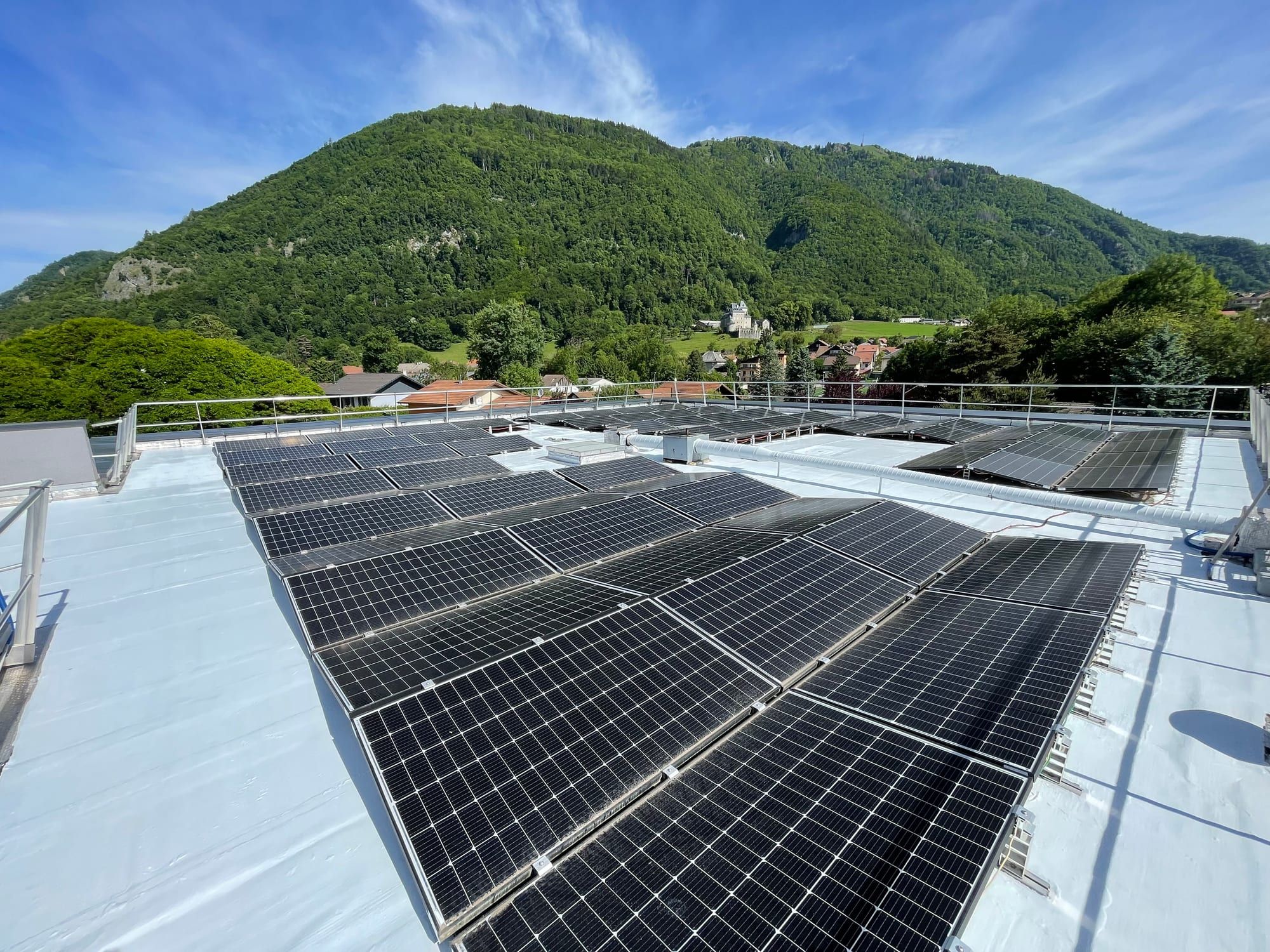
A dark roof reaches 50 to 70 °C in summer. Treated with the PrimaTherm® system in 4 layers (reflectance 95 % ASTM E903-12, emissivity 0.89 ASTM C1371-15, SRI 120 ASTM E1980, Broof(t3) CSTB report RA23-0010), it stays between 25 and 35 °C, i.e. up to −30 °C on the roof surface: −29 °C was measured by infrared at the handover of the 5,900 m² of Airbus Marignane on 19 June 2026. Heat that does not enter does not have to be extracted: air-conditioning consumption falls by 15 to 25 % in French climate zone H1, 20 to 30 % in H2, 25 to 40 % in H3, i.e. up to −40 % of that item. The works are carried out without lifting equipment and without closing the site: drums and pumps on the ground, only the hoses go up onto the roof.
For the landlord, it means waterproofing protected from thermal shock, an improved certificate and rating for the building, and an argument for re-letting; the landlord decides, funds the envelope and gives access to the roof, and enters the project in the forecast schedule of works and in the action programme of the environmental appendix. For the tenant, it means lower air-conditioning charges, comfort for staff and customers, and a contribution to its own declaration; the tenant brings the consumption data before and after, the sub-metering and, where applicable, a contribution linked to the savings, provided for by a clause.
On the funding side, the premium under the French energy-savings certificates (CEE), sheet BAT-EN-112, is conditional: a commercial tertiary building whose volume is heated and cooled by heat pump; flat rates of 160, 170 and 270 kWh cumac per m² in zones H1, H2 and H3; application to be filed before signing. It does not apply as such to logistics or industry, and MaPrimeRénov’ does not cover the cool roof; our article on sheet BAT-EN-112 (in French) details the conditions. The most favourable cases are air-conditioned shopping centres and office buildings, where the air-conditioning share weighs in the declared kilowatt-hours; our article on the twelve levers of an action plan places the roof among the other actions, and the simulator gives a first range from your invoices (both in French).
Key takeaways
- Landlord and tenant are both obligated parties, each for what concerns them; they define the actions together and each passes on its consumption data (article L. 174-1 of the French building and housing code).
- The OPERAT declaration, before 30 September, is made by the owner or by the tenant depending on the lease; the tenant may delegate the transmission of its data to the owner (articles R. 174-27 and R. 174-28).
- Since 1 July 2026, the annual certificate is no longer optional: it is appended to the lease and displayed (article L. 174-1, article R. 174-32, order of 1 August 2025).
- The major repairs of article 606 of the French civil code, which include entire roofs, cannot be re-invoiced to the tenant (article R. 145-35 of the commercial code); the rest is negotiated and put in writing, preferably in the environmental appendix.
- A cool roof is a landlord’s investment in the envelope whose effect the tenant sees in its charges: up to −30 °C on the roof surface, up to −40 % air-conditioning consumption depending on the climate zone, conditional CEE premium.
Sources
- French building and housing code, article L. 174-1: https://www.legifrance.gouv.fr/codes/article_lc/LEGIARTI000041569865 ; articles R. 174-22 to R. 174-32: https://www.legifrance.gouv.fr/codes/section_lc/LEGITEXT000006074096/LEGISCTA000043819497/ ; articles D. 174-19 to D. 174-21 (environmental appendix): https://www.legifrance.gouv.fr/codes/id/LEGISCTA000043819489/
- Order of 10 April 2020 on the obligations to take action to reduce final energy consumption in tertiary-use buildings, article 13: https://www.legifrance.gouv.fr/loda/id/JORFTEXT000041842389/ ; order of 1 August 2025 amending it: https://www.legifrance.gouv.fr/jorf/id/JORFTEXT000052198856
- French commercial code, article L. 145-40-2: https://www.legifrance.gouv.fr/codes/article_lc/LEGIARTI000029103688 ; article R. 145-35: https://www.legifrance.gouv.fr/codes/article_lc/LEGIARTI000029704677
- French civil code, article 606: https://www.legifrance.gouv.fr/codes/article_lc/LEGIARTI000006429505
- French environmental code, article L. 125-9: https://www.legifrance.gouv.fr/codes/article_lc/LEGIARTI000025118427
- French Ministry of Ecological Transition, Éco Énergie Tertiaire scheme: https://www.ecologie.gouv.fr/politiques-publiques/eco-energie-tertiaire-eet ; ADEME, OPERAT platform: https://operat.ademe.fr/
- PrimaTherm® test reports (ASTM E903-12, ASTM C1371-15, ASTM E1980, CSTB RA23-0010): certifications page.
Frequently asked questions
Can the tenant be solely responsible for the OPERAT declaration?
No. French law makes both the owner and the tenant subject to the obligation, each for the actions that fall within its contractual responsibility. The annual declaration is made by one or the other depending on the lease, and the tenant may delegate the transmission of its consumption data to the owner, but no clause makes the other party’s obligation disappear.
What happens if the lease says nothing about the tertiary decree?
The obligations apply all the same: each party declares the consumption of the equipment it operates and passes on its data. The practical risk is a double declaration or no declaration at all, and a landlord with no certificate to append to the lease. An amendment or an environmental appendix settles the question in one page.
Can the landlord re-invoice a cool roof to the tenant?
The major repairs of article 606 of the French civil code, which include entire roofs, and the dilapidation or compliance works that fall within them cannot be charged to the tenant for leases signed or renewed since November 2014. A reflective coating is not the complete renewal of a roof covering: its classification depends on the lease and on the condition of the roof. The safe solution is a clause that states who funds it, with a possible tenant contribution proportionate to the savings in charges.
Must the OPERAT certificate be appended to a commercial lease?
Yes. Article L. 174-1 of the French building and housing code provides that the assessment of compliance with the obligation is appended, for information, to the lease. The order of 1 August 2025 made this assessment and its display optional until 1 July 2026; since that date, the tolerance has ended.
Is a tenant with less than 1,000 m² in a shopping centre covered?
The 1,000 m² threshold is assessed at the scale of the building, the part of a building or the group of buildings on the same site, not of each lease. A tenant located in an obligated shopping centre or office building is covered for its unit, to the extent of the consumption it controls.
Who receives the CEE premium if the landlord funds the reflective roof?
In principle the party that orders and pays for the works, subject to eligibility: sheet BAT-EN-112 of the French energy-savings certificates (CEE) targets commercial tertiary buildings whose volume is heated and cooled by heat pump, with flat rates of 160, 170 and 270 kWh cumac per m² depending on the zone. The application must precede the signing of the works, and MaPrimeRénov’ does not cover the cool roof. The lease can state who prepares the application and how the premium is shared.