Key points
- Condensation on the underside appears when the sheet falls below the dew point of the indoor air: steel conducts heat, does not absorb water and cools quickly on a clear night. The remedy lies in ventilation (a continuous air gap of at least 4 cm), insulation and the vapour barrier; an anti-condensation felt limits the consequences without removing the cause.
- Corrosion attacks where water stagnates without air: overlaps, cut edges, screw heads and washers. White rust consumes the zinc; red rust signals bare steel.
- The zinc of a Z275 deck (275 g/m² over both faces, about 20 µm) is consumed at a rate of 0.1 to 8.4 µm per year depending on the corrosivity of the atmosphere: countryside, industrial area and seaside do not age a sheet in the same way.
- The diagnosis covers the inside (drops, humidity, ventilation) and the outside (coating, overlaps, fixings, gutters), then decides: making good, replacement of screws, treatment of rust spots or replacement of sheets.
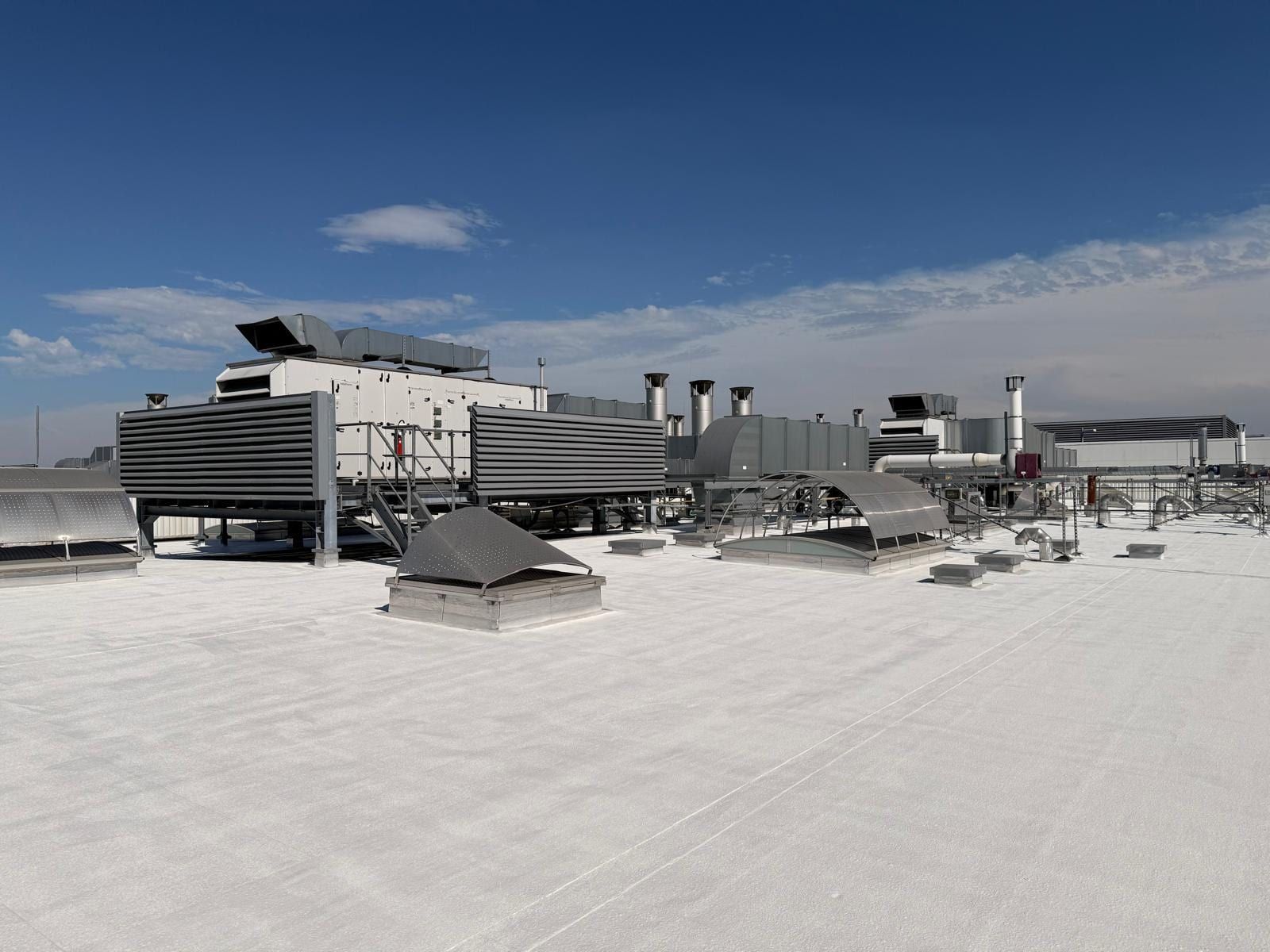
- A PrimaTherm® cool roof lowers the sheet from 50–70 °C to 25–35 °C, reduces the expansion cycles and protects the upper face; it changes neither the ventilation, nor the humidity of the premises, nor a corroded fixing.
Steel deck, a substrate that reacts in both directions
Steel deck covers the majority of warehouses, workshops and agricultural buildings. A sheet less than a millimetre thick has no thermal inertia: it reaches 50 to 70 °C under the summer sun and falls, on a clear night, below the air temperature. The US Environmental Protection Agency (EPA) notes that bare metal reflects part of the radiation but emits very poorly — an emissivity of 0.05 to 0.30 for an unpainted corrugated sheet — and can reach 66 to 77 °C, whereas a reflective roof with high emissivity peaks between 43 and 46 °C. These daily cycles fatigue the fixings, open up the overlaps and, at night, make the indoor moisture condense on the underside.
Two pathologies follow, often confused because both show up as water: condensation, which comes from the air in the premises, and corrosion, which comes from water, air and pairs of dissimilar metals. The cool roof on steel deck roofs guide describes the reflective treatment; this article deals with what must be diagnosed beforehand.
Condensation on the underside: the dew point
The dew point is, according to the US National Weather Service (NWS), “the temperature to which air must be cooled in order to reach saturation”, at constant pressure and water vapour content. The warmer and more humid the indoor air, the higher its dew point. The French construction quality agency (Agence Qualité Construction, AQC) describes the mechanism under a metal roof: the roofing material “may be at a lower temperature than the plenum, down to a point called the dew point, below which condensation occurs”; since metal is not porous, the drops fall onto the insulation, the suspended ceilings or the goods.
The French Building Federation (FFB) points out why metal roofs are naturally exposed to it: the high thermal conductivity of the material and its low porosity. The reference framework is the French standard NF DTU 40.35 (roofing in ribbed sheets made from coated steel), which applies to buildings with low or medium humidity, in mainland France, at an altitude of no more than 900 m; premises with high humidity (swimming pool, laundry, certain food processes) fall outside its scope and call for a specific design.
Three causes, three levers
The AQC identifies three causes: insufficient ventilation under the roof, excess indoor humidity (occupancy, steam production, heating, poorly adjusted ventilation) and design or workmanship defects, in particular the discontinuities in the vapour barrier through which water vapour migrates towards the cold sheet. The levers mirror them:
- ventilate: on a cold roof (insulation below the purlins), a continuous ventilated air gap of at least 4 cm under the sheets, with air inlets and outlets sized according to the humidity of the premises; on a warm roof (insulation on top of the deck), careful sealing of the edges and penetrations;
- insulate and close: the FFB is clear, “only insulating the roof reduces the risk of condensation on the underside”, with a continuous vapour barrier on the warm side;
- regulate: on an uninsulated building, an anti-condensation felt (the French régulateur de condensation) — an absorbent fleece bonded to the underside of the sheet, which holds the drops and then dries when the air is renewed — or a felt stretched over the purlins limit the consequences of the phenomenon but, the FFB specifies, “may prove insufficient depending on the climatic conditions”.
In practice, a dry, ventilated warehouse sees condensation a few nights a year; a workshop heated by forced warm air, a livestock building or a packing unit see condensation throughout the cold season if the roof was not designed for them. The tell-tale signs: drops on the underside in the early morning, water rings on the top pallets, insulation that is damp to the touch.
Corrosion: overlaps, cut edges and fixings
A steel deck is protected by a continuously applied zinc coating and then, on pre-painted decks, by a factory paint. The most common designation, Z275, corresponds to 275 g of zinc per m² over both faces, i.e. about 20 µm according to the steelmaker ArcelorMittal. The zinc sacrifices itself in place of the steel, slowly: the American Galvanizers Association (AGA) puts its corrosion rate, by ISO corrosivity category, at between 0.1 and 0.7 µm per year in a lightly polluted atmosphere (C2), 0.7 to 2.1 µm in an urban area or a few kilometres from the sea (C3), 2.1 to 4.2 µm in an industrial area or less than a kilometre from the coast (C4) and 4.2 to 8.4 µm in the most aggressive atmospheres (C5). Five factors govern this rate: temperature, humidity, rainfall, sulphur dioxide and the salinity of the air. DTU 40.35 draws a consequence from this, recalled by the FFB: the choice of the coating of the sheets “must take account of the atmospheric exposure” — rural, urban, marine — defined in its annex A.
Three areas concentrate the defects:
- The overlaps, where water rises by capillary action and stagnates without air. These are the conditions in which the AGA describes white rust: a white or grey deposit produced by accelerated corrosion of the zinc when galvanised surfaces stay damp, tightly packed and poorly ventilated. When light, it does not compromise the sheet; when thick, it consumes the zinc down to the steel. Where the slope requires it, the DTU provides for a supplementary seal in the transverse overlap (end lap), whose length is then between 150 and 200 mm.
- Cut edges and scratches down to the metal: the sacrificial protection of the zinc covers the edges only over a narrow width; beyond that, red rust appears, the sign of bare steel.
- The fixings. The DTU requires fixing at the crown of the rib and self-drilling screws “only with suitable sealing washers”; the manufacturer Onduline sums up the role of the EPDM washer, “additional protection against water ingress and corrosion”. Over time, the washer hardens and cracks, the screw works loose under the expansion cycles, the head rusts. Then there is the galvanic couple: the French hot-dip galvanising association Galvazinc, drawing on the British guide PD 6484, rates zinc–austenitic stainless steel contact in the atmosphere at 0 to 1 (slight to moderate additional corrosion) and reports an increased risk with copper and brass; the electrolyte is moisture. In a marine or polluted atmosphere, manufacturers point towards screws in hot-dip galvanised steel (ISO 1461) or in A2/A4 stainless steel, always with an EPDM washer.
The diagnosis before treatment
A cool roof applied to an ailing deck is money wasted; applied to a diagnosed deck, it protects it. Here is the outline of our technical visit, after the free roof study based on satellite images.
| Where | What we look for | Decision |
|---|---|---|
| Underside, early in the morning | Drops, runs, water rings on the insulation or the stock | Active condensation: ventilation, insulation, vapour barrier, anti-condensation felt, to be dealt with by the roofer |
| Premises | Humid activity, forced warm-air heating, ventilation, vapour barrier | Design to be reviewed if the actual humidity is high |
| Upper face | Chalking of the paint, delamination, moss | Cleaning below 130 bar, degreasing, PH169 primer |
| Overlaps | White rust, red rust, missing supplementary seal | Brushing, treatment of the spots, seal made good |
| Fixings | Rusted heads, cracked washers, screws that are loose, missing or of a different metal | Retightening, replacement of the washers or screws, then primer |
| Cut edges, roof edges, gutters | Red rust, perforations, debris | Spot treatment; perforated sheet replaced |
| Test area | Adhesion of the primer and of the system | Test before any commitment |
Two rules come out of it. Superficial rust can be treated (brushing, local rust removal, primer); a perforated sheet must be replaced, sheet by sheet, before any application. And active condensation cannot be painted over: it is corrected at the source, otherwise the water will come back under a white deck just as under a grey one. Our article on the 10 signs that a building needs a cool roof (in French) helps to set priorities.
What a cool roof changes, and what it does not
The PrimaTherm® system — solar reflectance 95 % (ASTM E903-12), emissivity 0.89 (ASTM C1371-15), SRI 120 (ASTM E1980), maintained at 119 after 4,000 h of accelerated QUV ageing, Broof(t3) fire rating according to CSTB report RA23-0010 — is applied in 4 layers (PH169 primer, PH107 reflective base coat in two passes, PH107TCL anti-soiling topcoat), with a long-pile roller or by airless spray, without lifting.
What it changes. The sheet goes from 50–70 °C to 25–35 °C in the sun, i.e. up to −30 °C on the roof surface: the amplitude of the daily cycles is divided by two or three, the fixings work less, the overlaps open up less. The upper face, paint or zinc, receives an elastic, rainproof film that protects it from UV; the screw heads and washers, treated and primed, are wrapped rather than weakened. Under a single-skin deck, the gain is up to −6 °C felt inside, and the end-of-day thermal shocks, which cause the summer condensation episodes, are softened. On a 1,000 m² warehouse in Marseille and on a 2,000 m² food-processing site in Périgny, both with steel deck roofs, the effect was measured; our projects give the details.
What it does not change. A cool roof alters neither the ventilation of the volume, nor the humidity produced by the activity, nor the continuity of the vapour barrier: at night, a sheet cooled by a clear sky reaches the dew point of the indoor air with or without a coating, and a white deck with high emissivity radiates towards the sky as much as a painted deck. It replaces neither an anti-condensation felt nor insulation, does not stop corrosion that has set in under an overlap, does not replace a cracked washer and does not plug a perforation: all of that is a matter for the preparation, recorded in the site monitoring sheet, or for the roofer. Its durability calls for light maintenance — annual inspection of the fixings and overlaps, low-pressure water cleaning every 12 to 15 months — described in our guide to maintaining a cool roof (in French).
For which buildings
Logistics platforms combine large steel deck roofs, uninsulated storage units and goods sensitive to condensation; industrial sites add humid processes and corrosive atmospheres; single-skin agricultural buildings concentrate both problems. In all three cases, the diagnosis comes before the treatment, and the installation process includes making good the fixings and the rust spots before the first coat.
Sources
- National Weather Service (NOAA), glossary, dew point: https://forecast.weather.gov/glossary.php?word=dew%20point
- Agence Qualité Construction (AQC), building pathology sheet on condensation on the underside of metal roofs: https://qualiteconstruction.com/ressource/fiches-pathologie-batiment/condensation-sous-face-couvertures-metalliques/
- FFB, recommendations against the risks of condensation on ribbed metal sheet roofs: https://www.ffbatiment.fr/techniques-batiment/enveloppe-du-batiment/couverture/dossier/quelles-sont-les-preconisations-contre-les-risques-de-condensation-sur-les-couvertures-en-plaques-me
- FFB, metal roofs, insulating to avoid condensation: https://www.ffbatiment.fr/techniques-batiment/enveloppe-du-batiment/couverture/dossier-bam/isoler-pour-ne-pas-condenser-1
- FFB, steel deck roofs, DTU 40.35: https://www.ffbatiment.fr/techniques-batiment/enveloppe-du-batiment/couverture/dossier/couverture-bac-acier
- CSTB, NF DTU 40.35, roofing in ribbed sheets made from coated steel: https://boutique.cstb.fr/Detail/Documents-Techniques-Unifies/DTU-NF-DTU/40-Couverture/DTU-40-35-Couverture-en-plaques-nervurees-issues-d
- ArcelorMittal e-steel, galvanised sheet DX51D + Z275 to EN 10346: https://e-steel.arcelormittal.com/FR/fr/Tole/Tole-Acier-/Tole-acier/p/000000000002010331
- American Galvanizers Association, corrosion of zinc in the atmosphere: https://galvanizeit.org/hot-dip-galvanizing/how-long-does-hdg-last/in-the-atmosphere
- American Galvanizers Association, zinc corrosion rates by ISO category: https://galvanizeit.org/knowledgebase/article/hdg-corrosion-rates-for-iso-categories-c1-c5-x
- American Galvanizers Association, white rust (wet storage stain): https://galvanizeit.org/knowledgebase/article/wet-storage-stain
- Galvazinc, contact between zinc and other metals: https://www.galvazinc.com/contact-zinc-autre-metaux
- Onduline, which screw to choose for a steel deck roof: https://fr.onduline.com/fr/professionnels/outils/news/actus/quelle-vis-choisir-pour-une-toiture-bac-acier
- EPA, Reducing Urban Heat Islands compendium, Cool Roofs chapter (emissivity of bare metals): https://www.epa.gov/sites/default/files/2014-06/documents/coolroofscompendium.pdf
- PrimaTherm® test reports (ASTM E903-12, C1371-15, E1980, ISO 16474-3, CSTB RA23-0010): certifications page.
Frequently asked questions
Why does condensation form on the underside of a steel deck?
Because the sheet, a good conductor and non-porous, falls at night below the dew point of the indoor air, that is, the temperature at which that air reaches saturation. The water vapour then condenses on the metal and the drops fall onto the insulation or the stock. The more humid and poorly ventilated the premises, and the more discontinuous the vapour barrier, the more frequent the phenomenon.
What is an anti-condensation felt, and is it enough?
It is an absorbent fleece bonded to the underside of the sheet (the French régulateur de condensation), which holds the drops of condensation and then dries when the air is renewed. It limits the consequences of the phenomenon on an uninsulated building, but the French Building Federation (FFB) warns that it may prove insufficient depending on the climatic conditions; only insulating the roof, with proper ventilation and a proper vapour barrier, reduces the risk at the source.
White rust, red rust: what is the difference?
White rust is a white or grey deposit produced by the accelerated corrosion of zinc when the sheet stays damp, tightly packed and poorly ventilated, typically in an overlap; when light it is harmless, when thick it eats into the protection. Red rust is that of the steel itself: it means that the zinc has disappeared at that spot, on a cut edge, a scratch or around a screw.
Do the screws have to be replaced before applying a cool roof?
Not all of them, but every one is checked. A loose screw is retightened, a hardened or cracked sealing washer is changed, a rusted head is brushed and treated, a screw that is missing or made of a metal incompatible with the sheet is replaced. The whole then receives the PH169 primer like the rest of the roof, and the elastic film wraps the heads without weakening them.
Does a cool roof reduce condensation?
It reduces the thermal shocks of the day and of the end of the day, and therefore the summer condensation episodes linked to a scorching sheet that cools abruptly. On the other hand, it changes neither the ventilation, nor the humidity produced by the activity, nor the vapour barrier: on a clear winter night, a white sheet reaches the dew point just as a grey sheet does. Condensation is treated at the source; the cool roof treats the heat.
Can a cool roof be applied to a rusty steel deck?
On superficial rust, yes, after brushing, treatment of the spots and primer; on a sheet that is perforated or deeply corroded, no: the sheet is replaced before application. The diagnosis says so sheet by sheet, and a test area checks the adhesion of the system before any commitment.