What the cold chain requires of a store
The foundation is European. Regulation (EC) No 852/2004 requires every food business operator to apply procedures based on the HACCP principles and specifies, in its Annex II, that foodstuffs likely to support the reproduction of pathogenic micro-organisms “are not to be kept at temperatures that might result in a risk to health” and that “the cold chain is not to be interrupted”. Regulation (EC) No 853/2004 then sets temperatures by family of products of animal origin: no more than 7 °C for meat of ungulates, 3 °C for offal, 4 °C for poultry, 2 °C for minced meat, 4 °C for meat preparations, and a temperature “approaching that of melting ice” for fresh fishery products.
In France, the order of 21 December 2009 takes up these values for retail, storage and transport, and supplements them in its Annex I. Quick-frozen foods are also covered by Directive 89/108/EEC: −18 °C at all points of the product, with brief upward fluctuations of no more than 3 °C during transport and local distribution.
| Foodstuff (French order of 21 December 2009, Annex I) | Maximum temperature |
|---|---|
| Ice cream, frozen minced meat and frozen fishery products | −18 °C |
| Other frozen foodstuffs | −12 °C |
| Minced meat, mechanically separated meat, fresh fishery products | +2 °C |
| Offal of ungulates, prepared culinary dishes | +3 °C |
| Poultry, meat preparations, raw milk, egg products, highly perishable foodstuffs | +4 °C |
| Carcasses of ungulates | +7 °C |
| Perishable foodstuffs | +8 °C |
These maxima apply “at all points of the product”. For frozen products and ice cream, the order allows a deviation of 3 °C at the surface for brief periods, during loading, unloading or display for sale; it does not allow a stockroom at 30 °C all afternoon. For quick-frozen foods, Regulation (EC) No 37/2005 requires, in warehouses and in transport, temperature recorders that comply with standards EN 12830, EN 13485 and EN 13486, with dated records kept for at least one year; retail display cabinets and cold rooms of less than 10 m³ may make do with a visible thermometer. These records are the store’s memory: an official inspection starts there.
Where a supermarket’s electricity goes
Food refrigeration is the first item. A measurement campaign carried out for ADEME, the French environment and energy agency, on a medium-sized supermarket (Enertech report, 2001) put the share of refrigeration appliances at 56 % of annual electricity consumption, ahead of lighting; refrigeration and lighting together accounted for 83 % of the total. Above all, the share of refrigeration rose to about 60 % in summer, against half in winter, and the seven months from April to October concentrated 61 % of the year’s consumption: the report notes that refrigeration consumption is “strongly linked to the outdoor temperature”.
Regulation (EU) 2019/2024, which sets the ecodesign requirements for refrigerating appliances with a direct sales function, says something important for a store manager: the performance of refrigerated display cabinets is measured in an ambient environment of 25 °C and 60 % relative humidity (30 °C and 55 % for ice-cream freezers). An open cabinet placed on a sales floor at 28 or 30 °C operates outside its rated conditions: the air curtain deteriorates, frosting increases, defrost cycles multiply and the set point becomes hard to hold at busy hours.
A store of more than 1,000 m² is also subject to the French tertiary-sector decree (Éco Énergie Tertiaire), which requires it to cut its final energy consumption by 40 % by 2030; our article on the French tertiary decree sets out its rules in detail. Refrigeration cannot be switched off: what has to be reduced is whatever makes it work.
The role of the roof in the load on the refrigeration units
A supermarket is a single-storey building: its roof is often the largest surface exposed to the sun, far more so than its façades. In steel deck, bitumen or dark membrane, it reaches 50 to 70 °C under the summer sun and transmits this heat towards the sales floor, the stockrooms and the preparation areas, by conduction through the insulation and then by radiation from the ceiling. This mechanism, described on our what is a cool roof page, can then be read in four places:
- In the open cabinets, which exchange constantly with the air of the sales floor: every extra degree is an additional load.
- On the refrigeration units. The condensers are on the roof or on the façade, in the hottest air on the site; the hotter this air, the higher the condensing temperature rises and the more the compressors consume to reject the same heat.
- In the cold rooms and stockrooms, located under the roof, where the permanent heat flow lengthens the evaporator cycles and weakens the set points on the loading docks, the weak link of the cold chain as described on our food industry and cold chain page.
- On comfort air conditioning, which adds to food refrigeration at the same hours and makes the summer peak the most expensive period of the year.
This mechanism has been measured. The Lawrence Berkeley National Laboratory instrumented a large retail store of 9,300 m² in Austin (Texas) before and after its black membrane was replaced with a white membrane: the maximum surface temperature of the roof went from 76 °C to 52 °C, daily air-conditioning consumption fell by 11 % (39 Wh per m² of roof per day), the power demand between 1 pm and 4 pm by 14 %, and the air in the plenum under the roof went from 38 °C to 35 °C. Yet the building did have roof insulation, described as moderate by the authors: the effect comes from the heat source, not from the insulation.
The solutions, from the cabinet to the roof
The known levers of retail remain valid and add up: glass doors on chilled cabinets (an operation covered by French CEE sheet BAT-EQ-124), night blinds, LED lighting of the cabinets, head-pressure control according to the outdoor temperature, condenser cleaning, heat recovery from the units. All of them act on the way refrigeration is produced or conserved. Only one acts on the amount of heat that enters the building: the roof.
What a reflective roof changes on a store
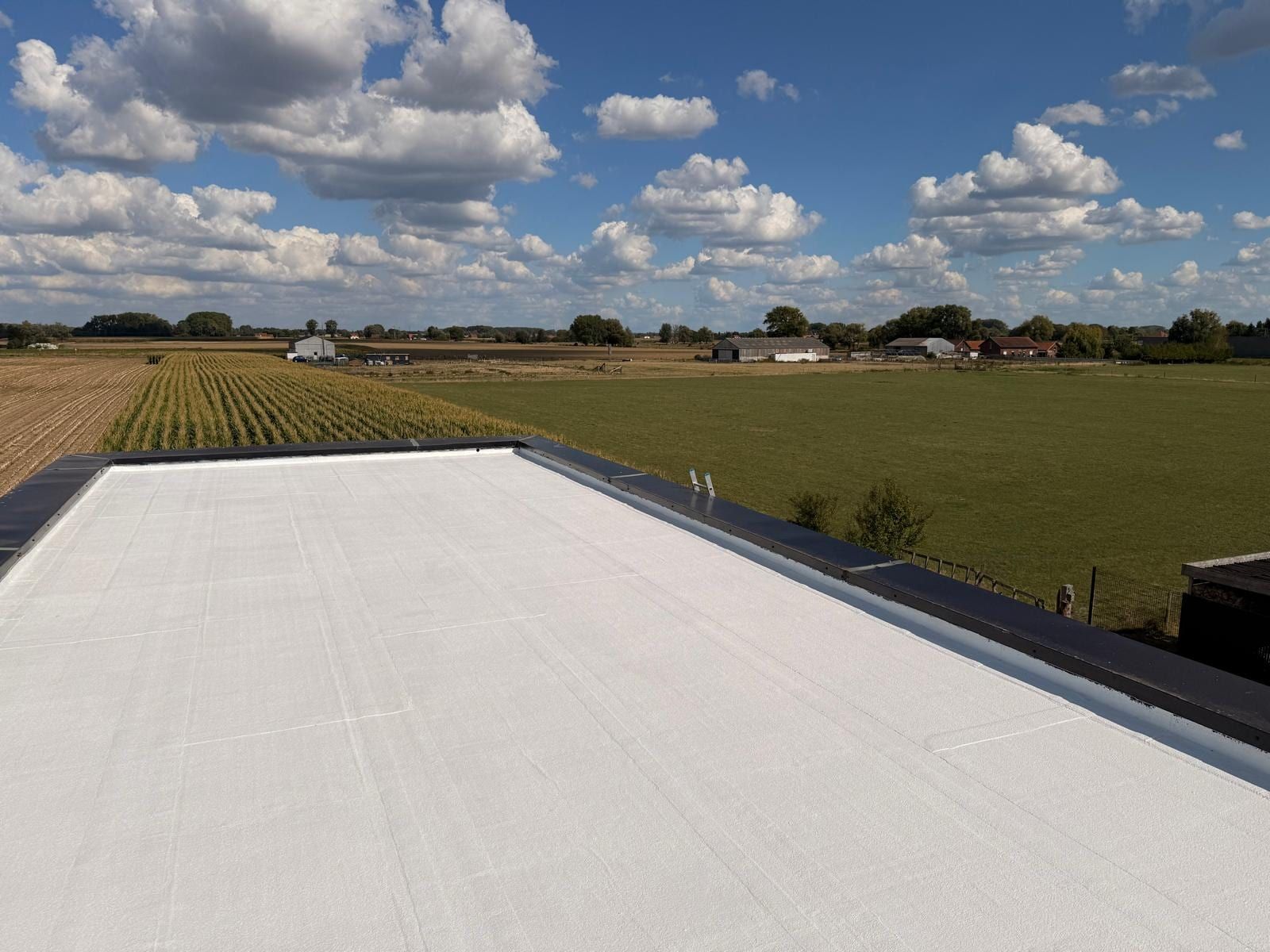
The PrimaTherm® system applied by Hélios is a 4-layer coating — PH169 primer, PH107 reflective base coat in two passes, PH107TCL anti-soiling topcoat — whose performance is measured in the laboratory: solar reflectance of 95 % (ASTM E903-12), emissivity of 0.89 (ASTM C1371-15), SRI of 120 (ASTM E1980), SRI maintained after 4,000 h of accelerated QUV ageing — conventional service life of 20 years (French CEE sheet) —, Broof(t3) fire classification (CSTB report RA23-0010).
On the roof, the surface goes from 50–70 °C to 25–35 °C, i.e. up to −30 °C on the roof surface; at the handover of the Airbus Marignane project (5,900 m² of bitumen membrane), the infrared measurement of 19 June 2026 showed 28.6 °C on the treated zone against 57.8 °C on the control zone, i.e. −29 °C. For a store, this means less heat radiated onto the sales floor (up to −6 °C felt inside depending on insulation), open cabinets that regain an environment close to their test conditions, condensers that work in cooler air, and air conditioning whose consumption falls by 15 to 25 % in French climate zone H1, 20 to 30 % in H2, 25 to 40 % in H3, i.e. up to −40 % of this item. The refrigeration units are no longer pushed to their limit at peak hours: this is the first benefit that technical managers report, even before the bill.
The works are carried out with the store open, with no crane in the car park and without taking the loading docks out of service: drums and machines stay on the ground in a cordoned-off area, only the hoses go up to the roof. Application requires a dry substrate and a temperature of 12 to 35 °C, which places the ideal window in spring. Rooflights receive the PrimaTherm® LT lacquer to remove the greenhouse effect without losing the light (one coat, about −25 % of transmitted light; two coats, about −50 %).
On the funding side, the French energy-savings certificates (CEE), sheet BAT-EN-112, target precisely tertiary buildings for commercial use whose volume is heated and cooled by heat pump; the flat rates are 160, 170 and 270 kWh cumac per m² depending on French climate zone H1, H2 or H3, and eligibility is checked site by site before signing. MaPrimeRénov’ does not cover cool roofs. Our guide to sheet BAT-EN-112 and kWh cumac (in French) details the procedure; our retail and supermarkets and shopping centres pages describe the phasing by zones: sales floor, stockrooms, click-and-collect unit, shopping arcade.
For your food safety management plan, we provide the infrared measurements before and after, the thickness checks and the as-built file; your temperature recorders will show the rest. The free roof study — satellite measurement, substrate analysis, share of refrigeration and air conditioning in your bills, CEE pre-qualification — is delivered within 48 h.
Key points
- Regulations: Regulations (EC) No 852/2004 and No 853/2004, French order of 21 December 2009 (Annex I), Directive 89/108/EEC (quick-frozen foods at −18 °C), Regulation (EC) No 37/2005 (temperature recording).
- Energy: refrigeration is the first electricity item of a supermarket (56 % over the year, about 60 % in summer according to the ADEME/Enertech campaign) and follows the outdoor temperature.
- Roof: a dark roof at 50–70 °C loads the open cabinets, the condensers, the stockrooms and the air conditioning; in Austin, a white roof cut the daily air-conditioning consumption of a 9,300 m² store by 11 %.
- PrimaTherm®: reflectance 95 %, emissivity 0.89, SRI 120, Broof(t3); up to −30 °C on the roof surface, up to −40 % air-conditioning consumption depending on the climate zone, works with the store open and without lifting.
- Incentives: French CEE sheet BAT-EN-112 under conditions; MaPrimeRénov’ does not cover cool roofs.
Sources
- Regulation (EC) No 852/2004 on the hygiene of foodstuffs, EUR-Lex.
- Regulation (EC) No 853/2004 on food of animal origin, EUR-Lex.
- French order of 21 December 2009, Annex I, Légifrance.
- All about the cold chain, French Ministry of Agriculture.
- Directive 89/108/EEC on quick-frozen foodstuffs, EUR-Lex.
- Regulation (EC) No 37/2005 on the monitoring of temperatures of quick-frozen foodstuffs, EUR-Lex.
- Regulation (EU) 2019/2024 on ecodesign of refrigerating appliances with a direct sales function, EUR-Lex.
- Electrical audit of a medium-sized supermarket, Enertech for ADEME Picardie, 2001.
- Konopacki and Akbari, reflective roof membrane on a large retail store in Austin, LBNL-47149, 2001, Lawrence Berkeley National Laboratory.
- PrimaTherm® test reports, certifications page.
Frequently asked questions
What temperatures must a supermarket comply with?
Annex I of the French order of 21 December 2009 sets maximum temperatures at all points of the product: −18 °C for quick-frozen foods and ice cream, +2 °C for minced meat and fresh fishery products, +3 °C for offal, +4 °C for poultry, meat preparations, raw milk and highly perishable foodstuffs, +7 °C for carcasses of ungulates and +8 °C for perishable foodstuffs. For frozen products, a deviation of 3 °C at the surface is tolerated for brief periods, during loading or when displayed for sale.
Does a store have to record temperatures?
For quick-frozen foods, Regulation (EC) No 37/2005 requires temperature recorders in warehouses and means of transport, with dated records kept for at least one year; retail display cabinets and small cold rooms may be limited to a visible thermometer. For everything else, the food safety management plan based on the HACCP principles provides for regular readings and corrective actions in the event of drift.
Why does the roof weigh on the refrigeration units?
On a single-storey store, the roof is the largest surface exposed to the sun and climbs to 50–70 °C if it is dark. This heat warms the sales floor, and therefore the open cabinets, and the air in which the condensers work; the higher the condensing temperature, the more the compressors consume. The measurement campaign carried out for ADEME, the French environment and energy agency, also shows a higher share for refrigeration in summer than in winter.
Is a cool roof enough to secure the cold chain?
No: it reduces the heat that enters through the roof, up to −30 °C on the roof surface and up to −40 % air-conditioning consumption depending on the climate zone, but it replaces neither closed cabinets, nor controls, nor maintenance of the units. It adds to these levers and gives them back some headroom at peak hours, when the sales floor and the condensers no longer endure a roof at 65 °C.
Does the store have to close during the works?
No. The drums and machines stay on the ground in a cordoned-off area, only the hoses go up to the roof: no crane in the car park, no loading dock out of service, no work in the food areas. The works are phased by zones and the system is applied on a dry substrate between 12 and 35 °C, ideally in spring.
Is a supermarket eligible for the French CEE bonus for a cool roof?
Under conditions. The French energy-savings certificates (CEE), sheet BAT-EN-112, target tertiary buildings for commercial use whose volume is heated and cooled by heat pump, with flat rates of 160, 170 or 270 kWh cumac per m² depending on French climate zone H1, H2 or H3. Eligibility is checked site by site before the quote is signed, and MaPrimeRénov’ does not cover cool roofs.