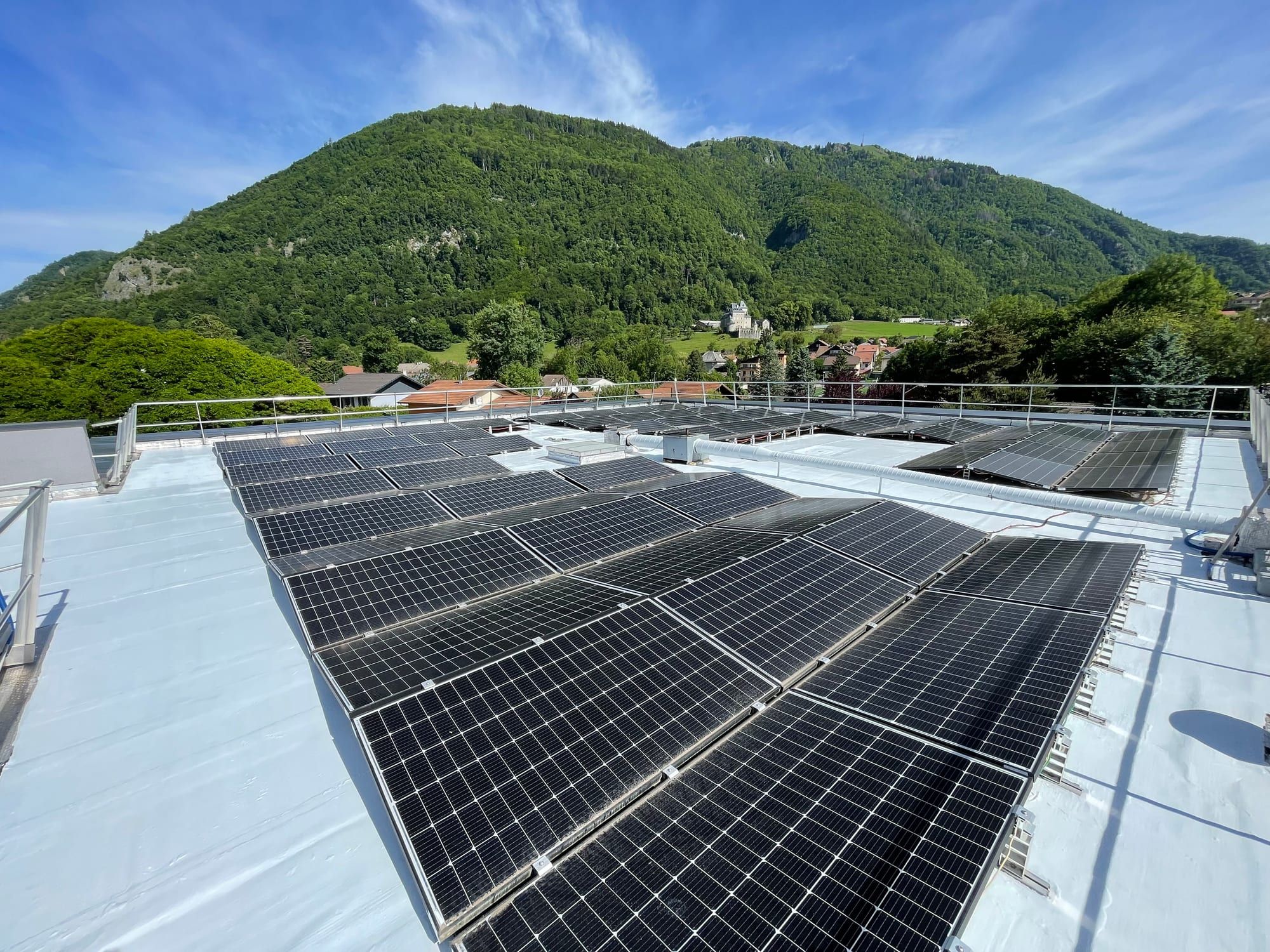
Solar canopies and raised rows: why the surface under the modules matters
A solar canopy is a structure that carries photovoltaic modules at height: above a car park, where it is usually called a solar carport, above a loading dock or a logistics yard, or above a flat roof when the rows rest on portal frames that leave the roof covering accessible. In France, their development has been accelerated by article 40 of the law of 10 March 2023 on accelerating the production of renewable energy: outdoor car parks of more than 1,500 m² must be fitted, over at least half of their area, with canopies incorporating a renewable energy generation process. The initial deadlines, 1 July 2026 for car parks over 10,000 m² and 1 July 2028 between 1,500 and 10,000 m², have since been relaxed by several texts, with mixed arrangements and conditional time extensions.
On these structures, a growing share of the modules is bifacial: they convert the light received on the front side and the light that the surface underneath reflects towards their rear side. The International Energy Agency’s report on bifacial systems (IEA PVPS Task 13, 2021) sums it up: ground reflectance, or albedo, and module bifaciality are generally the two most important factors in bifacial gain. Under a canopy or a raised row, the colour of the ground or of the roof is therefore part of the installation. Our page on cool roofs and solar panels describes this type of roof; this article focuses on albedo and temperature.
Albedo: definition and published values
Albedo is the fraction of solar radiation that a surface reflects, between 0 (everything is absorbed) and 1 (everything is reflected). Design software distinguishes the “project” albedo, which describes the ground in the distance in front of the installation, from the “bifacial” albedo, that of the surface directly seen by the rear side of the modules; it is the second that drives rear-side production, which is directly proportional to it according to the PVsyst documentation. The published values converge:
| Surface | Albedo | Source |
|---|---|---|
| Dry asphalt | 0.09 to 0.15 (new 0.09, aged 0.18) | PVsyst; IEA PVPS |
| Urban environment (default value in simulations: 0.20) | 0.14 to 0.22 | PVsyst |
| Grass | 0.15 to 0.26 | PVsyst; IEA PVPS |
| Concrete | 0.25 to 0.35 | PVsyst |
| Red tiles | 0.33 | PVsyst |
| Traditional dark roof / grey roof | 0.10 / 0.20 | LBNL Heat Island Group |
| Clean white roof | 0.80 | LBNL Heat Island Group |
| Fresh snow | 0.82 (0.55 to 0.98 depending on its condition) | PVsyst; IEA PVPS |
| Aluminium | 0.85 | PVsyst |
| New PrimaTherm® system (solar reflectance) | 0.95 | ASTM E903-12 |
Two readings stand out. The asphalt of a car park and a bitumen membrane sit at the very bottom of the scale: a canopy installed above them offers its modules a “ground” that reflects less than a fifth of the light. And the reflectance measured in the laboratory on a new product is not the albedo in operation: soiling, the angle of incidence and the shadows of the structures lower it. That is why the SRI of the PrimaTherm® system is verified after accelerated ageing (120 when new, 119 after 4,000 h QUV, ASTM E1980), and why cleaning every 12 to 15 months is part of operating the roof.
Bifacial gain: what the studies say
Bifacial gain is the extra production of a bifacial module compared with the same module in a monofacial version. The published results are consistent with one another.
- IEA PVPS Task 13 (2021). On trackers installed above natural ground with an albedo of 0.2 to 0.3, bifacial gain is generally below 10 %; it rises sharply when the ground is covered with snow. The report lists raised car-park canopies and fixed-tilt installations on white flat roofs among the configurations that also benefit from edge effects. It reports, on a Norwegian site where the albedo measured under snow reached 0.79, instantaneous gains of 18 ± 3 % under a clear sky and 30 ± 5 % under an overcast sky and, on a Finnish roof with a very low-albedo bitumen membrane, an average gain of 5 % in a vertical east-west configuration.
- Sun, Khan, Deline and Alam, Applied Energy (2018). With an albedo of 0.25, the bifacial gain of ground-mounted modules stays below 10 % everywhere in the world; raising the albedo to 0.5 and elevating the modules by one metre takes it up to 30 %.
- Kim et al., Nanophotonics (2023). Under bifacial modules, a radiative-cooling coating with an albedo of 0.96 lowered the temperature of the modules by about 3 °C compared with the control and increased their photocurrent.
Between a dark membrane (albedo 0.10 to 0.20) and a clean white roof (0.80 according to LBNL), the light available to the rear side is multiplied by four to eight. The actual gain then depends on the height of the modules, the row spacing, the tilt, the bifaciality and the soiling: only a simulation using the actual albedo of the roof, carried out by your installer, gives a figure. We promise none.
Bifaciality and temperature coefficient: reading a datasheet
Bifaciality is the ratio between the efficiency of the rear side and that of the front side. The IEA PVPS report puts n-PERT modules at around 80 % and heterojunction modules above 92 %; LONGi states about 80 % for its Hi-MO 7 range. The higher this factor, the more the albedo pays off.
The temperature coefficient of power indicates the loss of power per degree above 25 °C, the temperature of standard test conditions. LONGi datasheets give −0.340 %/°C for the bifacial Hi-MO 5, −0.28 %/°C for the Hi-MO 7 and −0.260 %/°C for the Hi-MO 9; the educational reference site PVEducation gives 0.4 to 0.5 %/°C for conventional crystalline silicon. A module operating 20 °C above its rated temperature therefore loses, depending on its technology, in the order of 5 to 7 % of its power, at the very moment when sunshine is at its peak. The IEA PVPS report illustrates this with field data: on trackers carrying two modules in portrait, which therefore stand higher, a gain of 1.3 % was attributed solely to the drop in average operating temperature.
A dark roof reaches 50 to 70 °C in summer and heats the air circulating under the modules. Treated with the PrimaTherm® system, it stays between 25 and 35 °C, i.e. up to −30 °C on the roof surface: −29 °C was measured by infrared on 19 June 2026 on the 5,900 m² of Airbus Marignane. The modules then work in cooler air, above a substrate that no longer radiates towards their rear side. Albedo acts on production, temperature acts on efficiency, and the two point in the same direction.
Compatibility with a cool roof: the bright roof as the canopy’s “ground”
The PrimaTherm® system applied by Hélios is a water-based elastomeric coating in 4 layers (PH169 primer, PH107 reflective base coat in two passes, PH107TCL anti-soiling topcoat): solar reflectance 95 % (ASTM E903-12), emissivity 0.89 (ASTM C1371-15), SRI 120 (ASTM E1980), fire rating Broof(t3) (CSTB report RA23-0010). Four points govern its compatibility with a bifacial installation; our article on combining a cool roof and solar panels (in French) details how the roof is organised.
- Diffuse reflection, no mirror effect. The topcoat is matt: light is reflected in all directions, which lights the rear side evenly and dazzles neither the modules, nor the neighbours, nor the operators.
- The order of the works. Cool roof first, over the whole roof, including under the future rows; support pads, portal frames or canopies are installed after complete drying (48 to 72 h), on load-spreading plates. On a roof that is already equipped, the treatment is carried out around and under the accessible rows, as on the industrial building in Saint-Jeoire: 1,500 m² of bitumen membrane, panels kept in place, roof temperature halved.
- Waterproofing under an installation planned for thirty years. Manufacturers’ power warranties run for 30 years; the membrane underneath has to last just as long. A coating that keeps it below 35 °C and shelters it from UV reduces thermal cycling, where re-roofing would mean dismantling the solar plant. See cool roof on waterproofing membranes.
- Fire and insurance. The Broof(t3) rating answers the question that technical inspection bodies raise about a roof covering that carries an electrical installation.
The configuration does the rest. Modules laid flush with the roof receive almost no rear irradiance, as the IEA report notes: the gain is limited to the drop in temperature. Tilted rows on support pads see the roof between the rows and under the modules, and the gain grows with height and spacing. A canopy or a raised portal frame sees the whole roof, with edge effects: this is the configuration the IEA cites for white flat roofs. On a car park, finally, dark asphalt caps the gain, unless the ground surface is given a light-coloured coating.
Points to watch for the building owner
- Get the actual albedo into the simulation: ask the installer for a study in which the bifacial albedo is that of the treated roof, with a cautious assumption for soiling, and not the default urban value of 0.20; an albedometer set one or two metres above the roof gives the field value before and after treatment, alongside the infrared measurements that we provide at handover.
- Do not darken what you have just brightened: dark walkways, black slabs under the ballast and cables laid flat on the surface all take light away from the rear side; low-pressure water cleaning every 12 to 15 months maintains the reflectance.
- Check the planning rules: in France, changing the colour of a roof generally requires a prior declaration to the town hall (article R. 421-17 of the French planning code), to be processed together with the file for the solar installation.
The large flat roofs of logistics and industry, where French law already requires a share of solar coverage on new buildings, are the first concerned; our free roof study, delivered within 48 h, qualifies the substrate, the areas that can be treated and the coordination with your installer.
Key takeaways
- Under a canopy or raised rows, the albedo of the surface and the bifaciality of the modules are the two leading factors in bifacial gain (IEA PVPS Task 13).
- Asphalt, dark membranes and natural ground reflect 0.09 to 0.3 of the light; a clean white roof reflects 0.80 according to LBNL, and PrimaTherm® 95 % when new (ASTM E903-12).
- Published gains: less than 10 % over ground with an albedo of 0.25, up to 30 % with an albedo of 0.5 and one metre of height (Applied Energy, 2018); the figure for your roof comes from a simulation using the actual albedo.
- Temperature coefficient: −0.26 to −0.34 %/°C depending on the modules; a roof at 25–35 °C instead of 50–70 °C also benefits module efficiency.
- Cool roof first, structures afterwards; matt topcoat with no glare; Broof(t3); membrane protected under an installation planned for thirty years.
Sources
- IEA PVPS Task 13, Bifacial Photovoltaic Modules and Systems: Experience and Results from International Research and Pilot Applications, report T13-14:2021: https://www.iea-pvps.org/wp-content/uploads/2021/04/IEA-PVPS-T13-14_2021-Bifacial-Photovoltaic-Modules-and-Systems-report.pdf
- Sun X., Khan M. R., Deline C., Alam M. A., “Optimization and performance of bifacial solar modules: A global perspective”, Applied Energy, vol. 212, 2018, pp. 1601-1610: https://doi.org/10.1016/j.apenergy.2017.12.041 (abstract: https://research-hub.nlr.gov/en/publications/optimization-and-performance-of-bifacial-solar-modules-a-global-p-2/)
- Kim H. et al., “High albedo daytime radiative cooling for enhanced bifacial PV performance”, Nanophotonics, 2023: https://pmc.ncbi.nlm.nih.gov/articles/PMC11501292/
- PVsyst, usual albedo coefficients and bifacial systems: https://www.pvsyst.com/help/physical-models-used/irradiation-models/albedo-usual-coefficients.html and https://www.pvsyst.com/help/project-design/bifacial-systems/index.html
- Lawrence Berkeley National Laboratory, Heat Island Group, Cool Roofs: https://heatisland.lbl.gov/coolscience/cool-roofs
- LONGi, product sheets for the bifacial Hi-MO 5, the Hi-MO 7 and the Hi-MO 9: https://www.longi.com/us/products/modules/hi-mo-5-bifacial/ , https://www.longi.com/en/products/modules/hi-mo-7/ , https://www.longi.com/en/products/modules/hi-mo-9/
- PVEducation, Effect of Temperature: https://www.pveducation.org/pvcdrom/solar-cell-operation/effect-of-temperature
- French law no. 2023-175 of 10 March 2023, article 40 (canopies on car parks): https://www.legifrance.gouv.fr/jorf/id/JORFTEXT000047294244 ; ministerial reply published by the French Senate in 2025: https://www.senat.fr/questions/base/2025/qSEQ250404145.html ; French State services in the Oise department: https://www.oise.gouv.fr/Actions-de-l-Etat/Amenagement-durable-du-territoire/Transition-Ecologique-et-Energetique/Energies-renouvelables/La-loi-d-acceleration-pour-les-energies-renouvelables/Les-panneaux-photovoltaiques-sur-parkings
- PrimaTherm® test reports (ASTM E903-12, ASTM C1371-15, ASTM E1980, CSTB RA23-0010): certifications page.
Frequently asked questions
Which albedo should be used in a photovoltaic simulation for a roof treated as a cool roof?
The solar reflectance of the new PrimaTherm® system is 95 % (ASTM E903-12) and its SRI goes from 120 to 119 after 4,000 h of accelerated ageing. In a simulation, your installer uses a cautious value for the bifacial albedo, one that allows for soiling and for the shadows cast by the structures, and not the default urban value of 0.20. An on-site albedometer measurement, before and after treatment, removes the doubt.
What production gain can be expected from bifacial modules on a white roof?
Publications give orders of magnitude, not a promise: less than 10 % bifacial gain over ground with an albedo of 0.25, up to 30 % with an albedo of 0.5 and modules raised by one metre, according to the study published in Applied Energy in 2018. A white roof reflects even more, but the result depends on the height, the row spacing, the tilt and the bifaciality of the modules. Only a simulation using the actual albedo of your roof gives a figure.
Does a cool roof really lower the temperature of photovoltaic modules?
Yes, in two ways: the air circulating under the modules is cooler, and the substrate no longer radiates towards their rear side. A study published in Nanophotonics in 2023 measured about 3 °C less on bifacial modules installed above a surface with an albedo of 0.96. With a temperature coefficient of −0.26 to −0.34 %/°C depending on the modules, every degree gained shows in the power delivered.
Do you need a solar canopy to benefit from the albedo of a bright roof?
No. Tilted rows mounted on support pads already see the roof between the rows and under the modules. Modules laid flush with the roof covering, by contrast, receive very little rear light, as the IEA PVPS report points out. A canopy or a raised portal frame is the most favourable configuration, with the added benefit of edge effects.
In what order should the cool roof and the bifacial installation be carried out?
Cool roof first, over the whole roof, including under the future rows; the support pads, portal frames or canopies are installed once the system has dried completely, 48 to 72 h. On a roof that is already equipped, we treat the accessible areas around and under the rows, protecting the modules and the connectors. The membrane is thus protected where it will be hardest to reach for the next twenty-five to thirty years.
Does a white roof cause glare for the modules, the operators or the neighbours?
No. The PH107TCL topcoat is matt: light is reflected diffusely, in all directions, with no mirror-like specular reflection. It is precisely this diffuse reflection that lights the rear side of bifacial modules evenly.