Key points
- Colour drives reflectance: solar radiation is split between ultraviolet (about 5 %), visible light (about 43 %) and near infrared (about 52 %). A coloured pigment absorbs part of the visible light; that is what gives it its colour, and that is what costs it in performance.
- PrimaTherm® white is the measured reference: 95 % reflectance (ASTM E903-12), 0.89 emissivity (ASTM C1371-15), SRI 120 (ASTM E1980), maintained after 4,000 h QUV. These certified values apply to the white.
- Light tints with infrared-reflecting pigments (“cool colours”) stay much cooler than a dark roof, but always below white; dark tints are not cool roofs.
- A regulation (local planning plan, opinion of the French heritage architect in a protected perimeter) may impose a tint; a change of colour generally requires a prior declaration to the town hall.
- With no regulatory constraint or architectural choice, choose white. With a constraint, choose the lightest accepted tint, documented by a test report.
Why colour drives performance
The solar radiation reaching a roof is not visible light only. It is split approximately between 5 % ultraviolet, 43 % visible light and 52 % near infrared. A reflective coating must send back all three components; its performance is measured over the whole spectrum, according to the ASTM E903 standard, and expressed as its solar reflectance. Our article on the solar reflectance index explains how this reflectance and emissivity combine in the SRI.
The pigments decide what is sent back:
- White (titanium dioxide) reflects almost all of the visible light and the near infrared. That is why it is the reference for cool roofs, and why the laboratory white of the ASTM E1980 standard serves as the benchmark for SRI 100.
- A coloured pigment absorbs part of the visible light: this selective absorption is what gives the perceived colour. Every visible photon absorbed becomes heat. A light tint absorbs little, a dark tint absorbs almost everything.
- So-called “cool colour” pigments, which reflect in the infrared, were developed to limit the damage: they absorb the visible light needed for the colour but reflect the near infrared, i.e. more than half of the energy. A tint formulated with these pigments is markedly cooler than a conventional tint of the same appearance. It remains below white, because it still absorbs part of the visible light.
There is therefore no “miracle colour”: for a given appearance, physics sets a performance ceiling, and white is that ceiling.
White: the measured reference
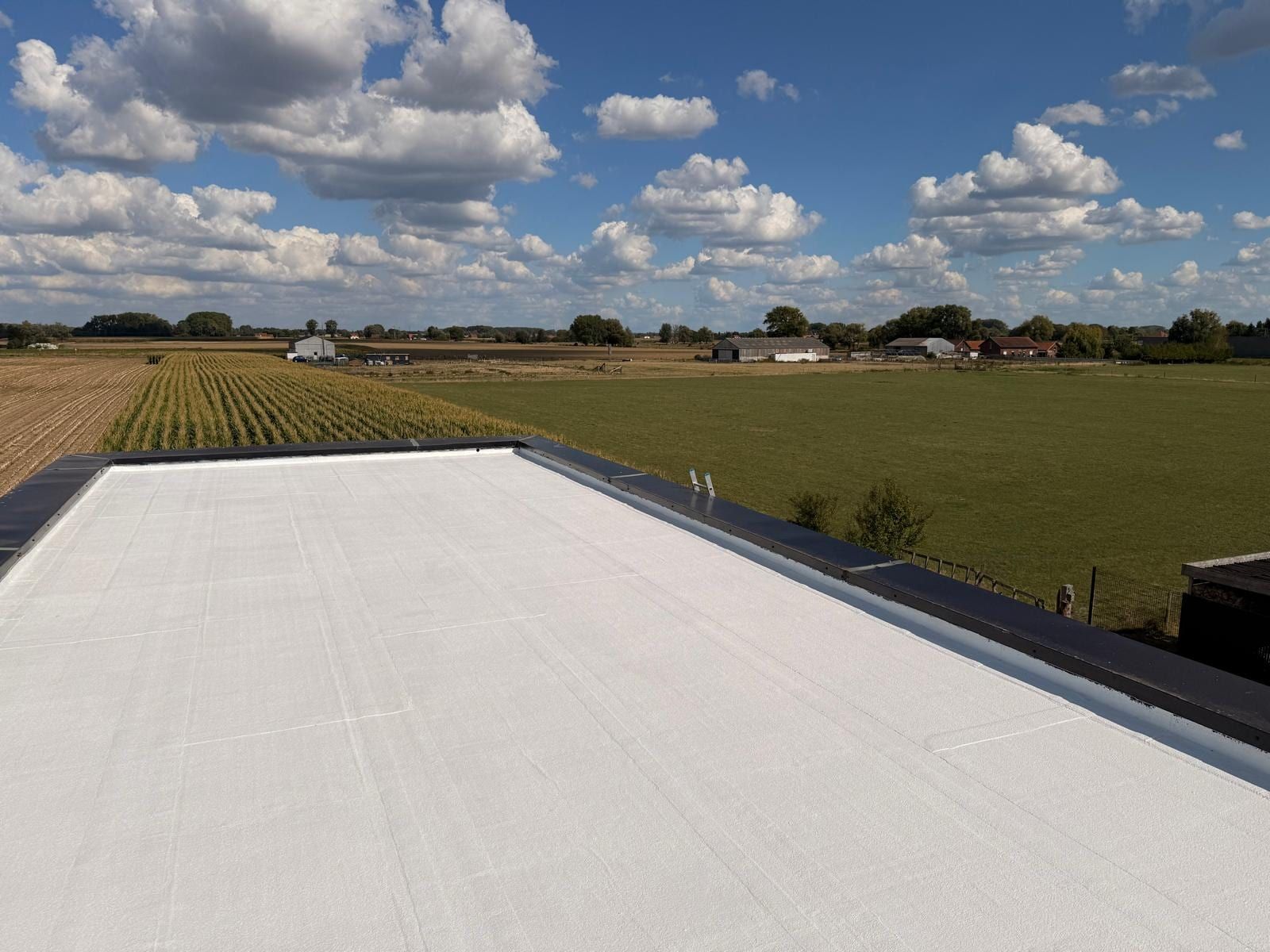
The PrimaTherm® system applied by Hélios is a white. Its performance is measured by laboratories according to the reference standards: solar reflectance of 95 % (ASTM E903-12), thermal emissivity of 0.89 (ASTM C1371-15), SRI of 120 (ASTM E1980), maintained after 4,000 h of accelerated QUV ageing (119). The external fire classification is Broof(t3) (CSTB report RA23-0010).
On a roof, this means a surface that goes from 50–70 °C down to 25–35 °C in the height of summer, i.e. up to −30 °C, as on the 5,900 m² of Airbus Marignane, where the infrared measurement at handover recorded −29 °C between the treated area and the control area. The details of the 4-layer system (PH169 primer, PH107 reflective base coat in two passes, PH107TCL anti-soiling topcoat) are on the cool roof coating page.
These certified values apply to the white. We publish no value for a tint that does not have its own test report, and we recommend that you demand the same rigour from any supplier.
Tints: what you can reasonably expect
The technical literature and the registers of measured products (such as that of the Cool Roof Rating Council in the United States) give useful orders of magnitude for reasoning, in the absence of values specific to each product:
| Tint family | Behaviour under the sun | Cool roof status | Use cases |
|---|---|---|---|
| White | Maximum reflectance, highest SRI | Reference | Industrial, logistics and office roofs, flat roofs, any project without constraint |
| Off-white, very light grey | Slight shortfall compared with white | Cool roof | Understated architectural choice, partially visible roofs |
| Beige, sand, light grey | Noticeable shortfall, partly offset by infrared pigments | Cool roof if test report | Protected perimeters, local plans imposing light tones |
| Ochre, terracotta, light brick | Significant shortfall; infrared reflected, visible light largely absorbed | Borderline case, to be documented | “Clay tile” local plans, heritage sites, with a well-argued file |
| Medium to dark grey, brown, green, blue | Majority absorption | Not a cool roof | To be ruled out; if imposed, the thermal benefit is marginal |
| Saturated bright colours, metallics | Strong absorption or formulation incompatibility | Not a cool roof | To be ruled out |
Two reading rules:
- Demand a test report for each tint. A reflectance announced for a whole range, without a measurement per reference, is worthless. The measurements must cite ASTM E903 or an equivalent standard, ASTM C1371 and ASTM E1980, with the laboratory and the date.
- Reason in terms of the gap from a dark roof. A well-formulated light tint remains far ahead of a bitumen or grey steel deck roof, which reflect only 5 to 20 % of the radiation. The choice is not “tint or nothing”; it is “white if possible, documented light tint otherwise”.
What the regulations allow and impose
The prior declaration
Changing the colour of a roof modifies the external appearance of a building. It generally requires a prior declaration to the town hall (article R. 421-17 of the French planning code), whether the building is a house, a residential block or a commercial building. The processing time is one month as a general rule, extended to two months in perimeters where the opinion of the French heritage architect (ABF) is required. This point is checked during the study, before any commitment. See the regulatory context.
The local planning plan
Some local planning plans (PLU) regulate roof tints, especially in municipalities with a strong architectural identity: clay-tile tones in Provence, slate or zinc in some historic centres, palettes of “warm” tints on hillsides. These rules primarily target pitched roofs visible from public space; flat roofs and low-slope industrial roofs are often exempt or little affected. In Aix-en-Provence, Avignon or Nice, reading the written regulation and the zone in which the building stands is the first step of the project.
The French heritage architect
In the surroundings of a historic monument and in remarkable heritage sites, the prior declaration is subject to the opinion of the Architecte des Bâtiments de France (ABF). This opinion is binding in most of these perimeters: a refusal is imposed on the mayor. The ABF assesses integration into the urban landscape; a white roof visible from a monument or a historic street may be refused, a flat roof invisible from public space is generally accepted, and a light tint is often the compromise.
Three elements clearly improve the chances of an agreement:
- photographs and a photomontage showing the actual visibility of the roof from public space;
- samples of light tints with their test reports;
- an argument on the thermal stakes (occupant comfort, reduced air conditioning, contribution to the fight against heat islands), which local climate plans increasingly support.
We prepare these documents with you. The fact remains that the ABF retains its discretionary power: we never promise an agreement.
How to choose: a decision guide
No regulatory constraint, roof barely or not visible. Choose white. This is the case for almost all industrial, logistics, retail and office roofs, and for most flat roofs of residential blocks and public buildings. Maximum performance, certified system, standard maintenance.
Contemporary architectural choice, partially visible roof. White remains the best choice; an off-white or very light grey, if documented, allows a more discreet integration with a limited shortfall.
Local plan imposing light or warm tones. First study whether the roof is covered by the rule (flat or low-slope roofs are often excluded). If it is, select the best-performing acceptable light tint, with a test report, and request white on the non-visible areas.
ABF perimeter. Put together a well-argued file with photomontage and samples. Propose white on the invisible parts and a documented light tint on the visible parts. Accept that a refusal is possible and that a light tint is better than a dark roof.
Rule imposing a dark tint. The benefit of a dark “reflective” coating is marginal. We tell you so, and we direct you towards the other summer-comfort levers (insulation, solar protection, night ventilation) rather than selling you a cool roof that is not one.
Application: what changes with a tint, and what does not
The application protocol remains that of the 4-layer system: substrate preparation, adhesion primer, reflective base coat in two passes, topcoat. The tint is carried by a specific formulation whose test report must accompany the proposal; the coverage rates, the weather window (12 to 35 °C, dry substrate, no rain forecast) and the thickness checks do not change. Three points, however, require particular attention:
- The on-site sample. A tint is judged on the roof, in daylight, next to the neighbouring materials (tiles, renders, zinc), not on a colour chart. We apply a one-square-metre sample before validating with you and, where applicable, with the ABF.
- The junctions. On a roof that is partly white and partly tinted, the boundaries must follow existing lines (parapets, valleys, changes of slope, technical strips) to remain discreet. They are drawn on the plan before the works.
- Visible soiling. Dirt shows more on a uniform light surface than on a tint; the anti-soiling topcoat and cleaning every 12 to 15 months apply to both. On a tint, cleaning also restores its reflectance, which drifts away from its original value faster than that of white if nothing is done.
Rooflights and translucent strips are treated independently of the roof colour, with PrimaTherm® LT lacquer (one coat ≈ −25 % of transmitted light, two coats ≈ −50 %): they are often the first source of overheating, whatever the coating chosen around them.
Two typical situations
A logistics warehouse on the outskirts. 8,000 m² steel deck roof, invisible from public space, outside any protected perimeter, business-park local plan with no tint requirement. The choice is white, without discussion: maximum performance (95 %, SRI 120), simple prior declaration, works without lifting equipment, site in operation. See cool roof for warehouses and logistics.
An office building in a historic centre. 900 m² flat roof in the surroundings of a historic monument, visible from a bell tower and from the upper floors of a neighbouring building. The approach: visibility photomontage, proposal of white on the two thirds of the roof that are not visible and a documented very light grey tint on the third exposed to view, ABF file with samples and thermal argument, prior declaration within two months. Agreement is never guaranteed; the approach maximises its chances and, if white is refused, the light tint remains far ahead of the original dark roof.
Aesthetics, neighbours and glare
A white roof sometimes worries the neighbours in taller buildings. Two factual answers: the PrimaTherm® topcoat is matt, it diffuses light instead of reflecting it like a mirror; and a white roof only reflects light during the day, from a surface that is no brighter than a light-coloured wall or a light gravel surface. Special cases (glazed offices directly overlooking a large roof) are examined during the study, and a very light tint can address them.
On the aesthetic side, a uniform, clean and well-maintained white roof conveys the image of a well-kept building. Maintenance (low-pressure water cleaning every 12 to 15 months) preserves this uniformity; see cool roof maintenance. In a residential block, this argument counts at the general meeting; see cool roof for residential buildings.
What we do during the study
- Reading of the local planning plan and checking of protected perimeters for the building’s address.
- Analysis of the roof’s visibility from public space.
- Proposal of a solution: white, partial white, or documented light tint.
- Preparation of the documents for the prior declaration and, where applicable, the ABF file.
- Costing after a technical visit; the cost depends on the surface, the substrate, the preparation, the access and the incentives available.
Sources
- French planning code, article R. 421-17 (prior declaration for a change of external appearance): https://www.legifrance.gouv.fr/
- French Ministry of Culture, surroundings of historic monuments and remarkable heritage sites (ABF opinion): https://www.culture.gouv.fr/
- ASTM E1980, SRI calculation; ASTM E903 and C1371: https://www.astm.org/
- Cool Roof Rating Council, register of measured products: https://coolroofs.org/
- PrimaTherm® test reports: certifications page.
Frequently asked questions
Is a coloured cool roof really effective?
A light tint formulated with infrared-reflecting pigments stays markedly cooler than a dark roof, but it always falls short of white: that is the physics of pigments. PrimaTherm®'s certified values (95 % reflectance, SRI 120) apply to the white; any tint must be documented by its own test report before being selected.
Which colours are incompatible with a cool roof?
Dark tints (anthracite, brown, navy blue, dark green) and saturated bright colours absorb too large a share of the radiation to qualify as reflective, even with special pigments. If a regulation imposes them, the thermal benefit becomes marginal, and we say so before proposing anything.
Can the French heritage architect (ABF) refuse a white roof?
In protected perimeters (surroundings of historic monuments, remarkable heritage sites), the opinion of the Architecte des Bâtiments de France is required and may be binding. A refusal of white is possible, especially for roofs visible from public space. A well-argued file, samples and proof that the roof is barely visible improve the chances of an agreement, possibly on a light tint.
Do you need authorisation to change the colour of your roof?
In general, a change to the external appearance of a building requires a prior declaration to the town hall (article R. 421-17 of the French planning code). Some local planning plans (PLU) regulate roof tints. We check this point during the study, before any commitment.
Does the colour of a cool roof change over time?
Any exposed surface gets dirty and ages. For PrimaTherm® white, the 4,000 h QUV accelerated ageing test gives an SRI of 119 against 120 when new; the anti-soiling topcoat and cleaning every 12 to 15 months maintain both appearance and performance. For a tint, durability depends on the pigments used and must be documented.
Can white and a tint be mixed on the same roof?
Technically yes: white on the areas invisible from the street, a tint on the slopes exposed to view. It is a frequent compromise on protected sites. You then have to accept visible junctions and different surface temperatures from one area to another.