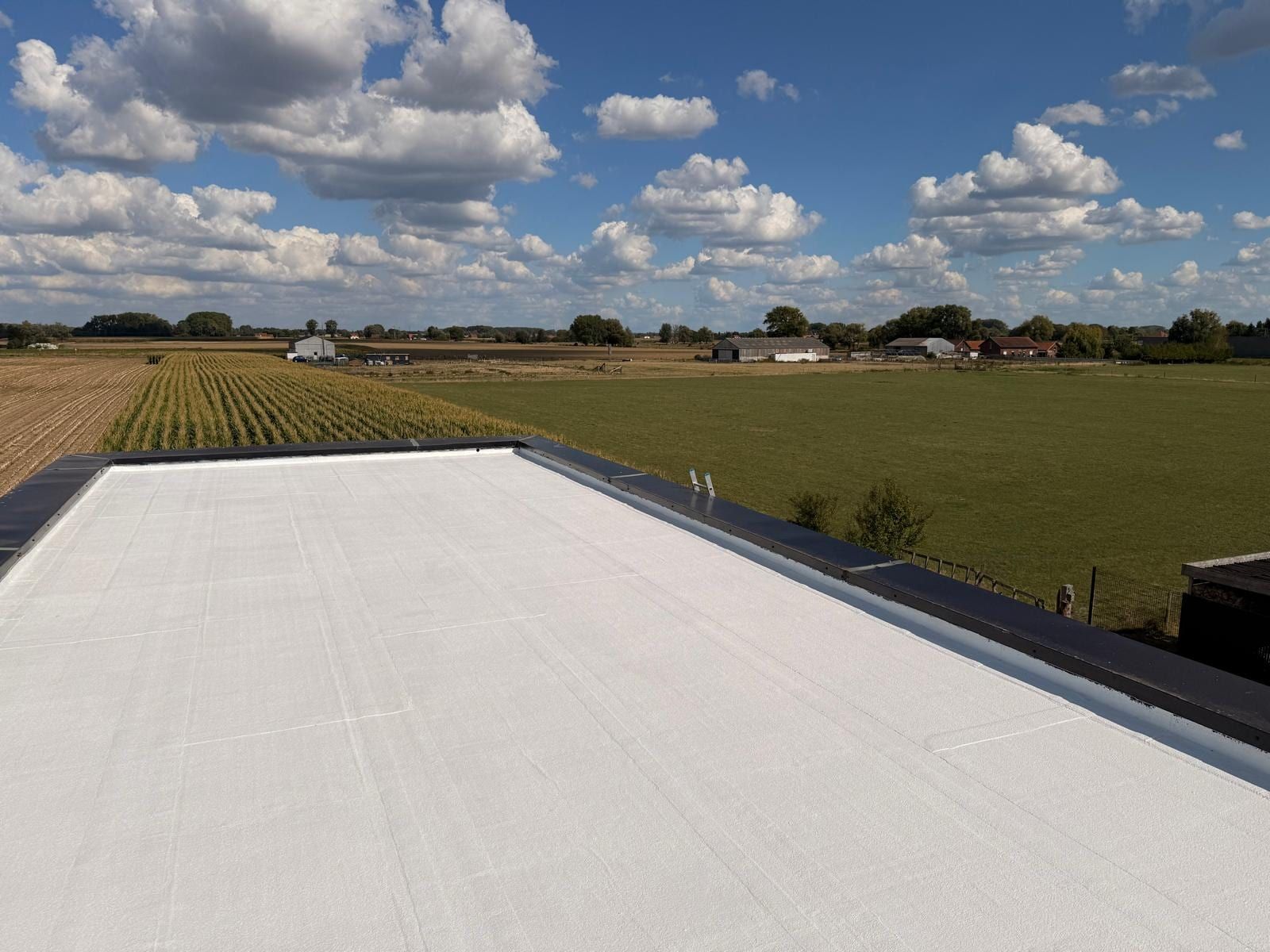
Why the question arises
A reflective roof is presented as a gesture for the climate. A site director or a CSR manager is entitled to ask for better than a slogan: how much the coating costs in carbon, how much it avoids, and over what period. The question becomes concrete as soon as the company draws up a greenhouse gas emissions report, answers a customer’s questionnaire or declares its consumption under the French tertiary-sector decree (Éco Énergie Tertiaire). And cooling is not a marginal item: according to the International Energy Agency, air conditioners and fans account for nearly 20 % of the electricity used in the world’s buildings, and energy demand for space cooling could more than triple by 2050 if the efficiency of the equipment does not improve.
The method: a life cycle, three items, a boundary
For a construction product, the reference framework in France is the FDES (fiche de déclaration environnementale et sanitaire), the French environmental and health product declaration, published on INIES, the reference database of environmental and health data for buildings. It divides the life of the product into stages: manufacture (A1 to A3), transport and installation (A4 and A5), use (B), end of life (C). Its “climate change” indicator, in kilograms of CO₂ equivalent, groups together, according to INIES, all the greenhouse gas emissions of the product throughout its life cycle.
Avoided emissions belong to another boundary, that of the building. They are calculated by multiplying the kilowatt-hours saved by an emission factor, published by ADEME in the Base Empreinte, the official French public database of emission factors. The French government portal notre-environnement.gouv.fr points out that these factors include both the combustion and the production of the energy; for French electricity, the average content was 57 g of CO₂ equivalent per kilowatt-hour in 2018, with higher values by use, for example 147 g for heating. One rule follows: avoided emissions are never subtracted from manufacturing emissions without saying so; the two are presented side by side, with their sources.
Item 1 — manufacturing the products
The PrimaTherm® system comprises three products in 4 layers: PH169 primer, PH107 reflective base coat in two passes, PH107TCL anti-soiling topcoat. Its manufacturer, Primacoating, presents it as a cool roof system made up of water-based paints, formulated and manufactured in France, near La Rochelle, from components of French or European origin. A water-based paint contains no organic solvent as a thinner, and the volatile organic compound content of paints is capped by Directive 2004/42/EC.
What order of magnitude for manufacture? We do not publish a value for PrimaTherm®: that would be a matter for an FDES from the manufacturer. We do, however, cite a verified declaration, published on INIES, for a product of the same chemical family. The FDES of a water-based matt finishing paint (INIES no. 20240940416, verified on 7 November 2024, valid until 31 December 2029) declares, for 1 m² of interior wall protected over a reference service life of 10 years, a total climate change indicator of 0.426 kg of CO₂ equivalent, of which 0.240 kg for manufacture. A roofing system applies more material, about 0.7 L of product per m², of which 0.5 L for the reflective base coat, against one or two thin coats for a decorative finish: its manufacturing item is therefore higher, while remaining in the order of magnitude of a paint, to be compared with the values for a new roof given below.
Item 2 — applying without lifting or stripping
In a paint FDES, application weighs less than manufacture: 0.152 kg of CO₂ equivalent against 0.240 kg for the declaration cited. On a roof, application adds the transport of the team and of the drums, the medium-pressure water cleaning and the energy of the pumps. It adds neither a crane, nor lorry rotations to take away an old roof, nor new materials: the Hélios method leaves drums and machines on the ground, only the hoses go up onto the roof, and the coating is applied over the sound existing roof after localised repairs. The how we work page details these steps.
Item 3 — what the roof avoids
Air conditioning
This is the item that tips the balance. A dark roof reaches 50 to 70 °C under the summer sun; treated with a coating with a reflectance of 95 % (ASTM E903-12), an emissivity of 0.89 (ASTM C1371-15) and an SRI of 120 (ASTM E1980), it stabilises between 25 and 35 °C. Heat that does not enter does not have to be extracted: air-conditioning consumption falls by 15 to 25 % in French climate zone H1, by 20 to 30 % in H2 and by 25 to 40 % in H3, i.e. up to −40 % of that share. LBNL sets out the physics: on a summer afternoon, a white roof that reflects 80 % of the radiation stays about 31 °C cooler than a grey roof that reflects only 20 %.
To convert these kilowatt-hours into emissions, your data are needed: air-conditioning consumption before and after, ideally on a sub-meter, and the emission factor of your supply. That is why we publish no tonnage: we provide the measurements, you apply your factor. Our guide to air-conditioning savings explains how to isolate the contribution of the roof.
The postponed renewal
The second avoidance is less visible and just as real. By dividing the temperature swing endured by the waterproofing, a cool roof slows the ageing of the binders and of the joints, and therefore pushes back the renewal, that is, a new system to manufacture and to install. The collective FDES of the French waterproofing trade association (Chambre syndicale française de l’étanchéité, CSFE) for a two-layer polymer-modified bitumen system (INIES no. 20250141456, January 2025) declares, for 1 m² of roof waterproofed over a reference service life of 30 years, a total climate change indicator of 13.3 kg of CO₂ equivalent, of which 9.50 kg for manufacture and 3.07 kg for installation. Every year gained before that deadline is a year in which those emissions are not incurred. See cool roof on bitumen roofs.
The albedo effect, documented by research
Beyond the building, a light-coloured surface sends back to space part of the solar radiation that would have been converted into heat. Researchers at the Lawrence Berkeley National Laboratory have quantified this effect at the scale of all the world’s urban areas: by increasing the albedo of roofs by about 0.25 and that of paved surfaces by about 0.15, Akbari, Menon and Rosenfeld (Climatic Change, 2009) obtain a negative radiative forcing equivalent to offsetting about 44 gigatonnes of CO₂; Menon and co-authors (Environmental Research Letters, 2010) arrive, with a climate model, at about 57 gigatonnes for the same assumptions.
Three precautions when reading these figures. It is a direct cooling effect, expressed in CO₂ equivalent so as to be comparable, and not an avoided emission within the meaning of a GHG report. It is a one-off: a surface that stays light maintains the effect, it does not accumulate it every year as an energy saving does. It cannot be attributed to a single building but to a stock of roofs, which brings us back to the adaptation policies described in our feature on cool roofs and urban heat islands.
Conventional service life and end of life
The standardised operation sheet BAT-EN-112, which frames the French energy-savings certificates (CEE) for reflective roof coatings, uses a conventional service life of 20 years and requires an SRI above 100 when new and above 90 when aged, the latter being understood as after 4,000 hours of artificial ageing in accordance with ISO 16474-3. The SRI of PrimaTherm® is maintained after this accelerated ageing, at 119 against 120 when new. The premium remains conditional: commercial tertiary building, closed and air-conditioned volume, heating and cooling produced by heat pump, with 160, 170 or 270 kWh cumac per m² depending on zone H1, H2 or H3.
At the end of its life, the coating is not stripped: on a sound substrate, it is cleaned, inspected and recoated with a new base coat and a new topcoat. Where a membrane that has reached the end of its 30-year reference service life produces waste to be taken away, the cool roof renews only the useful layers. The test reports are presented on the PrimaTherm® certifications page.
Cool roof or renewal: a qualitative comparison
| Item | Cool roof on a sound substrate | Waterproofing renewal |
|---|---|---|
| Material manufactured | Three water-based products, about 0.7 L/m² | New two-layer system, 13.3 kg CO₂e/m² over 30 years (CSFE FDES) |
| Works | No lifting, no stripping, site in operation | Stripping, disposal, lifting of the rolls, area closed off |
| Waste | No membrane waste | Old build-up to be processed |
| Effect on air conditioning | Up to −40 % depending on the zone | None, unless the new build-up is light-coloured |
| Duration | 20 conventional years, can be recoated | 30 years of reference service life |
| Limit | Does not repair waterproofing at the end of its life | Necessary when the waterproofing is beyond use |
The two are not opposed: a cool roof protects sound waterproofing and pushes back its renewal; a renewal remains necessary when the substrate is beyond use, and can then be given a light-coloured finish from new. Our comparison of cool roofs and green roofs widens the comparison to the other roofing solutions.
The role of the reflective roof in your report
In a greenhouse gas emissions report, the reflective roof appears in the electricity consumption, and therefore in the indirect emissions linked to purchased energy. For it to be legible, three conditions: sub-metering of the air conditioning or, failing that, a reading by period before the works; surface temperature measurements at handover, treated area against control area; a correction for the differences in climate between two summers. For each project we provide the infrared measurements, the thickness checks and the as-built file.
The same file feeds the trajectory of the French tertiary decree for buildings over 1,000 m², the heat-island credits of the HQE, BREEAM and LEED schemes (article in French) and the adaptation section of a CSR report. The overview of the environmental effects is presented on our page on the environmental impact of cool roofing, the system itself on the cool roof coating page, and the free roof study sets, site by site, the measurement protocol that will make the report defensible.
Key takeaways
- Three items: manufacturing (water-based paint), applying (no lifting, no stripping), avoiding (air conditioning, postponed renewal).
- Manufacture: a verified FDES for a water-based finishing paint declares 0.426 kg CO₂e/m² over its life cycle; a new two-layer bitumen system, 13.3 kg CO₂e/m² (CSFE collective FDES).
- Avoidance: up to −40 % air-conditioning consumption depending on the climate zone; the tonnage is calculated with your kilowatt-hours and the ADEME emission factor, never before the study.
- Albedo: a radiative effect documented by LBNL at the scale of cities (44 to 57 gigatonnes of CO₂ equivalent for all the world’s urban areas), not attributable to a single building.
- Duration: 20 conventional years (French CEE sheet BAT-EN-112), SRI maintained after 4,000 h QUV, coating that can be recoated with no membrane waste.
Sources
- International Energy Agency, “The Future of Cooling”: https://www.iea.org/reports/the-future-of-cooling
- ADEME, Base Empreinte: https://base-empreinte.ademe.fr/
- French government portal notre-environnement.gouv.fr, “Les facteurs d’émission de gaz à effet de serre” (greenhouse gas emission factors): https://www.notre-environnement.gouv.fr/themes/climat/les-emissions-de-gaz-a-effet-de-serre-et-l-empreinte-carbone-ressources/article/les-facteurs-d-emission-de-gaz-a-effet-de-serre
- INIES: https://www.inies.fr/ ; climate change indicator of FDES declarations: https://www.inies.fr/faq/a-quoi-correspond-lindicateur-changement-climatique-des-fdes-et-des-pep/
- FDES of a water-based matt finishing paint, INIES no. 20240940416, verified on 7 November 2024, available on the INIES database: https://www.inies.fr/
- CSFE collective FDES “Système d’étanchéité de toiture – Bicouche bitumineux” (roof waterproofing system, two-layer bitumen), INIES no. 20250141456, January 2025: https://dxb-france.payloadcms.app/api/document/file/Bicouche_bitumineux_FDES.pdf
- Standardised operation sheet BAT-EN-112, French Ministry of Ecological Transition: https://www.ecologie.gouv.fr/sites/default/files/documents/BAT-EN-112%20vA38-1%20%C3%A0%20compter%20du%2031-07-2021.pdf
- Akbari, Menon, Rosenfeld, “Global cooling: increasing world-wide urban albedos to offset CO2”, Climatic Change, 2009: https://heatisland.lbl.gov/publications/global-cooling-increasing-world-wide-urban-albedos-offset-co2-0
- Menon et al., “Radiative forcing and temperature response to changes in urban albedos and associated CO2 offsets”, Environmental Research Letters, 2010: https://iopscience.iop.org/article/10.1088/1748-9326/5/1/014005
- LBNL Heat Island Group, “Cool Roofs”: https://heatisland.lbl.gov/coolscience/cool-roofs
- Directive 2004/42/EC (volatile organic compounds in paints and varnishes): https://eur-lex.europa.eu/legal-content/FR/TXT/?uri=CELEX:32004L0042
- Primacoating, manufacturer of the PrimaTherm® system: https://www.primacoating.com/
Frequently asked questions
Is the carbon footprint of a cool roof favourable?
Over its service life, yes, as soon as the roof covers an air-conditioned volume or avoids the installation of air conditioning. The manufacture and the application of a water-based paint weigh little compared with the kilowatt-hours of cooling avoided every summer for 20 years. The exact balance depends on your air-conditioning share and on your emission factor; it is calculated after the study, not before.
How many tonnes of CO₂ does a cool roof avoid?
We do not publish that figure. It is obtained by multiplying the kilowatt-hours of air conditioning avoided, measured on your meters, by the emission factor of your electricity supply, taken from ADEME’s Base Empreinte, the French public database of emission factors. Any tonnage announced before your consumption is known would be an invention.
Is a reflective paint polluting to manufacture?
The system applied is water-based and solvent-free, and the volatile organic compound content of paints is capped by European Directive 2004/42/EC. For a water-based finishing paint, a verified environmental declaration on the French INIES database puts the climate change indicator below half a kilogram of CO₂ equivalent per square metre over the whole life cycle. A roofing system in 4 layers uses more product; the order of magnitude remains that of a paint, not that of a new roof.
Does the albedo effect count in my greenhouse gas report?
No. The work of the Lawrence Berkeley National Laboratory describes a radiative effect: a light-coloured surface sends back to space part of the radiation that would have been converted into heat, which the researchers express in CO₂ equivalent at the scale of all the world’s cities. It is not an avoided emission within the meaning of a corporate GHG report, and it cannot be attributed to a single building. You can mention it in a CSR report as a contribution to adaptation, not as a tonnage.
Cool roof or waterproofing renewal: which emits less?
On a sound substrate, the cool roof adds only a film of paint and extends the life of the waterproofing in place. A renewal involves manufacturing and installing a new system, whose impact the trade’s collective declaration puts at around ten kilograms of CO₂ equivalent per square metre, plus the stripping and disposal of the old build-up. The cool roof postpones that deadline; it does not replace waterproofing that has reached the end of its life.
What happens to the coating after 20 years?
The conventional service life of 20 years is the one used by the French CEE sheet BAT-EN-112; the SRI is maintained after 4,000 h of accelerated QUV ageing. At the end of that period, on a sound substrate, the coating is cleaned, inspected and recoated with a new base coat and a new topcoat, with no stripping and no membrane waste.