Data centres: why the roof matters for PUE
PUE is the ratio of the total energy consumed by the site to the energy consumed by the IT. Everything that is not IT, that is mainly cooling, conversion losses and lighting, degrades the indicator. A recent free-cooling site approaches 1.2; a previous-generation building or a corporate server room often sits between 1.5 and 2. In these installations, cooling represents 30 to 40 % of total energy, and it depends directly on two parameters that the roof influences: the heat entering through the envelope and the temperature of the air drawn in by the heat-rejection equipment.
The heat transmitted through the envelope
On a hyperscale facility, the IT load dwarfs the envelope load and we would be dishonest to claim otherwise. But on a corporate server room of a few hundred m², an edge site, a telecom room, a university computing centre or a 2000s data centre under steel deck or bitumen membrane, the roof is a significant heat source: it climbs to 50–70 °C in full sun and radiates into the halls, the technical galleries and the electrical rooms. Every kilowatt that enters through the roof is a kilowatt the CRAC units have to extract.
The air drawn in by chillers, dry coolers and condensers
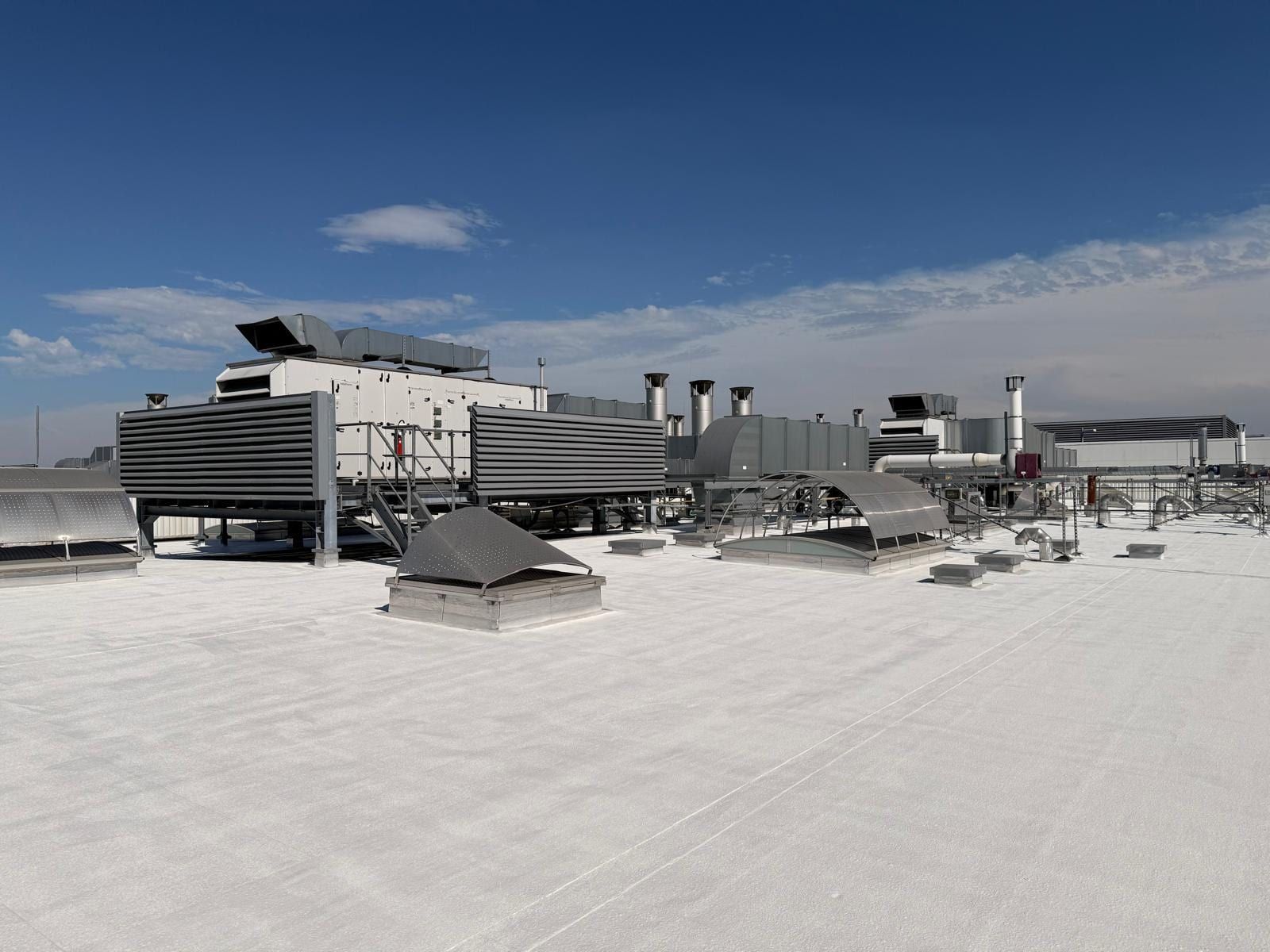
This is the most universal lever. The heat-rejection equipment is installed on the roof and draws in air less than two metres above a surface at 50–70 °C. Its efficiency decreases with the air inlet temperature; as it approaches its maximum operating temperature, it loses capacity at the exact moment when demand peaks. Lowering the roof surface to 25–35 °C lowers the temperature of that air and increases the hours during which free cooling or economiser mode remain possible.
Technical rooms, UPS, batteries
Electrical rooms are rarely air-conditioned as rigorously as the IT halls. Main low-voltage switchboards, UPS, battery rooms and cable galleries under the roof heat up all summer. The service life of a lead-acid UPS battery is roughly halved for every 10 °C above 25 °C; drives and PLCs go into fault above 40 °C ambient. A white roof protects these rooms without a single extra kilowatt-hour.
Heatwaves and resilience
During the heatwave of July 2022, several European operators suffered cooling incidents and service outages. A data centre is sized for a reference outdoor temperature that heatwaves now exceed. Reducing the thermal load of the roof and the air inlet temperature of the chillers is one of the passive measures that push back the breaking point. See also heatwaves and building protection.
What PrimaTherm® changes on a data centre
Hélios applies the PrimaTherm® system, made in France by Primacoating: a water-based, solvent-free elastomeric coating applied in 4 layers (PH169 primer, PH107 reflective base coat in two cross passes, PH107TCL anti-soiling topcoat). Every value is measured in the laboratory, and the reports are attached to the proposal.
| Characteristic | Value | Standard / report |
|---|---|---|
| Solar reflectance | 95 % | ASTM E903-12 |
| Thermal emissivity | 0.89 | ASTM C1371-15 |
| SRI (new) | 120 | ASTM E1980 (119 after ageing) |
| Durability | SRI maintained after 4,000 h of accelerated QUV ageing | conventional service life of 20 years (French CEE sheet) |
| External fire classification | Broof(t3) | EN 13501-5, CSTB report RA23-0010 |
On an IT hosting site:
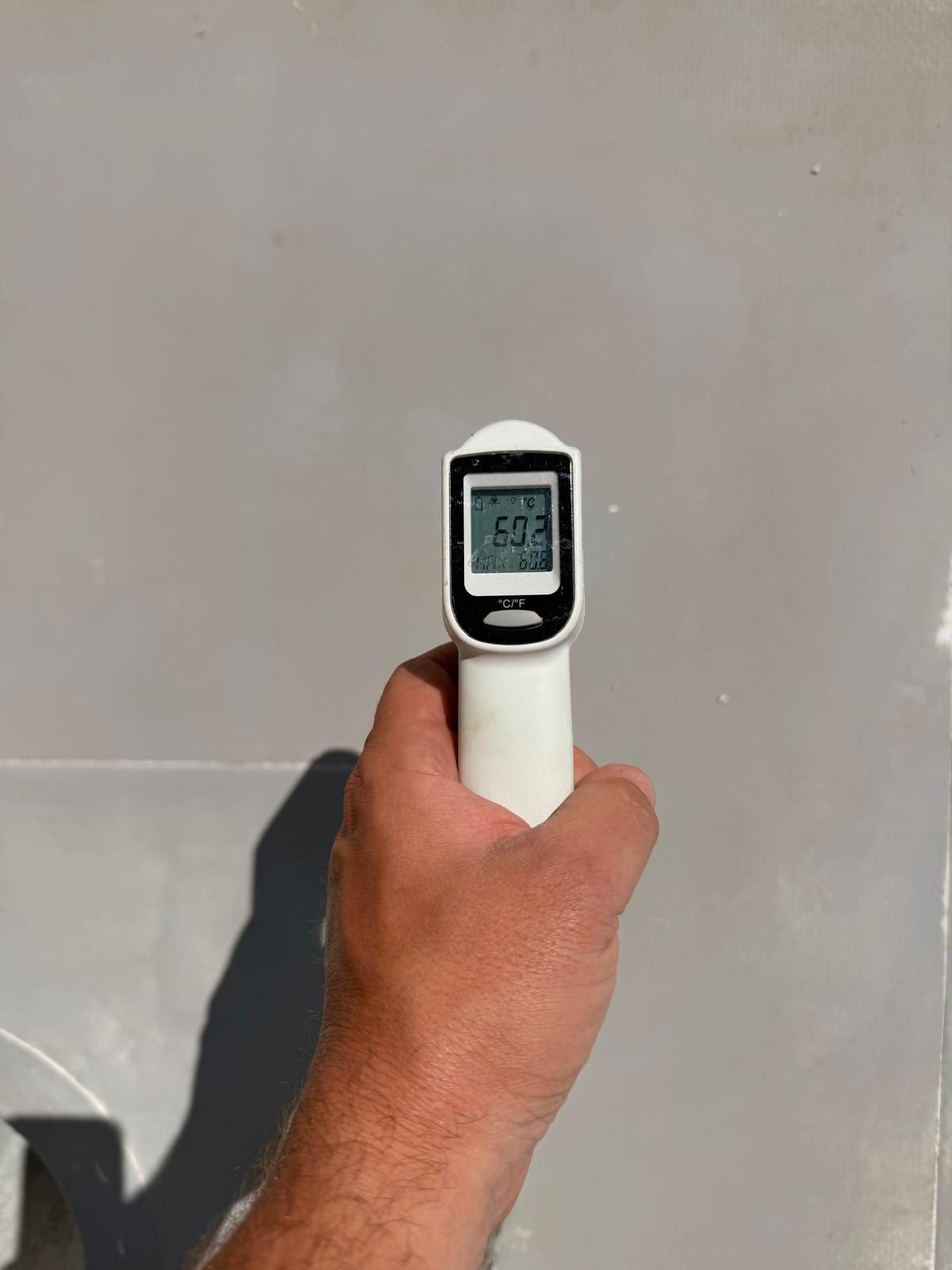
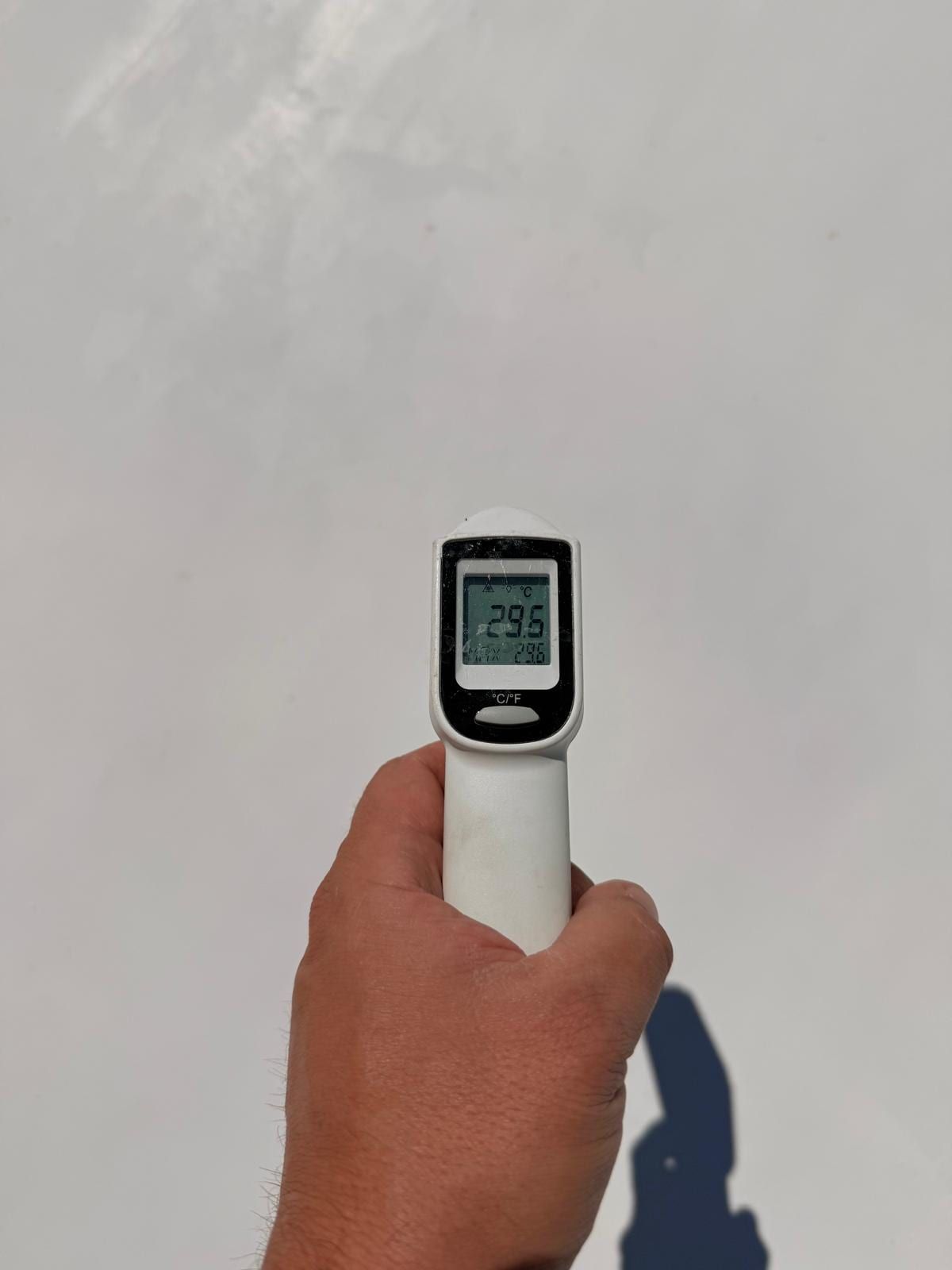
- up to −30 °C on the roof surface: from 50–70 °C down to 25–35 °C, with −29 °C measured by infrared at the handover of a 5,900 m² project in 2026;
- cooler air at the inlet of chillers, dry coolers and condensers, hence better efficiency during peak hours and more hours in economiser mode;
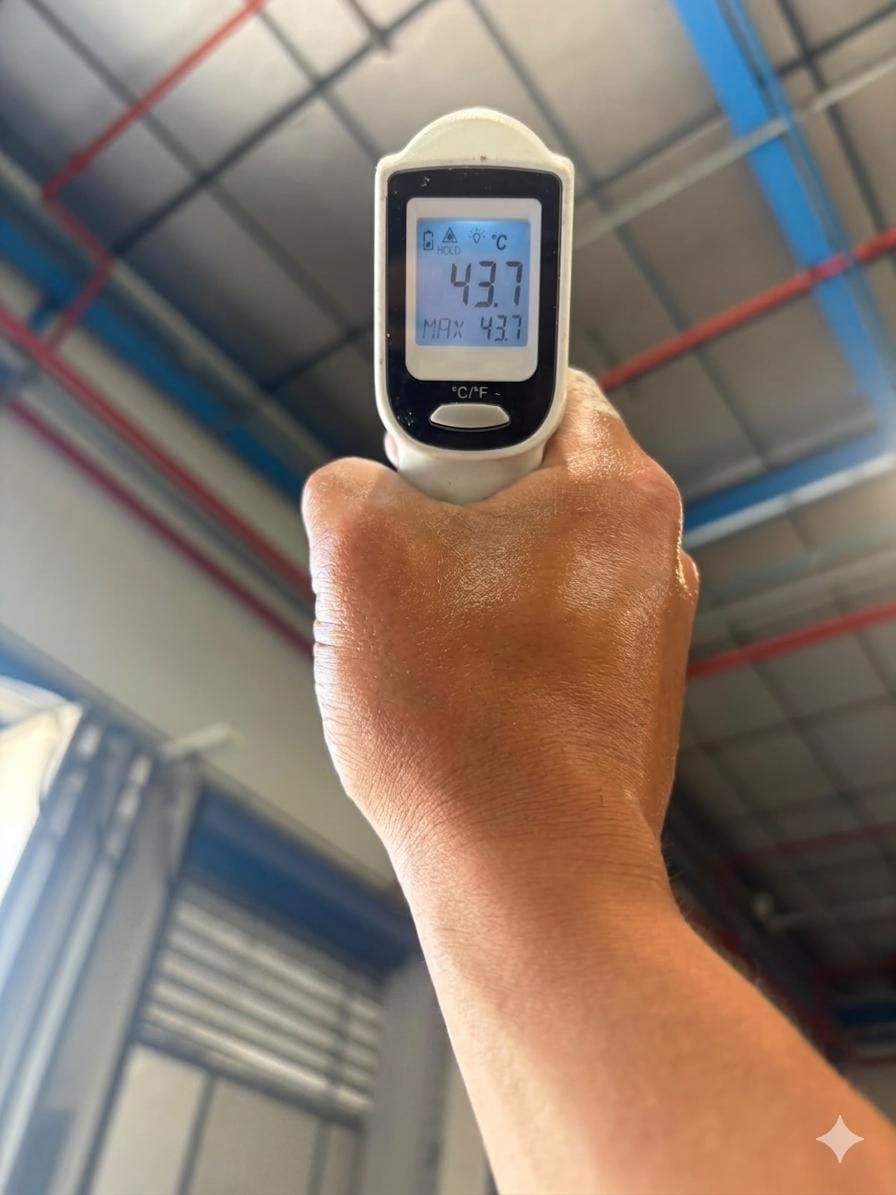
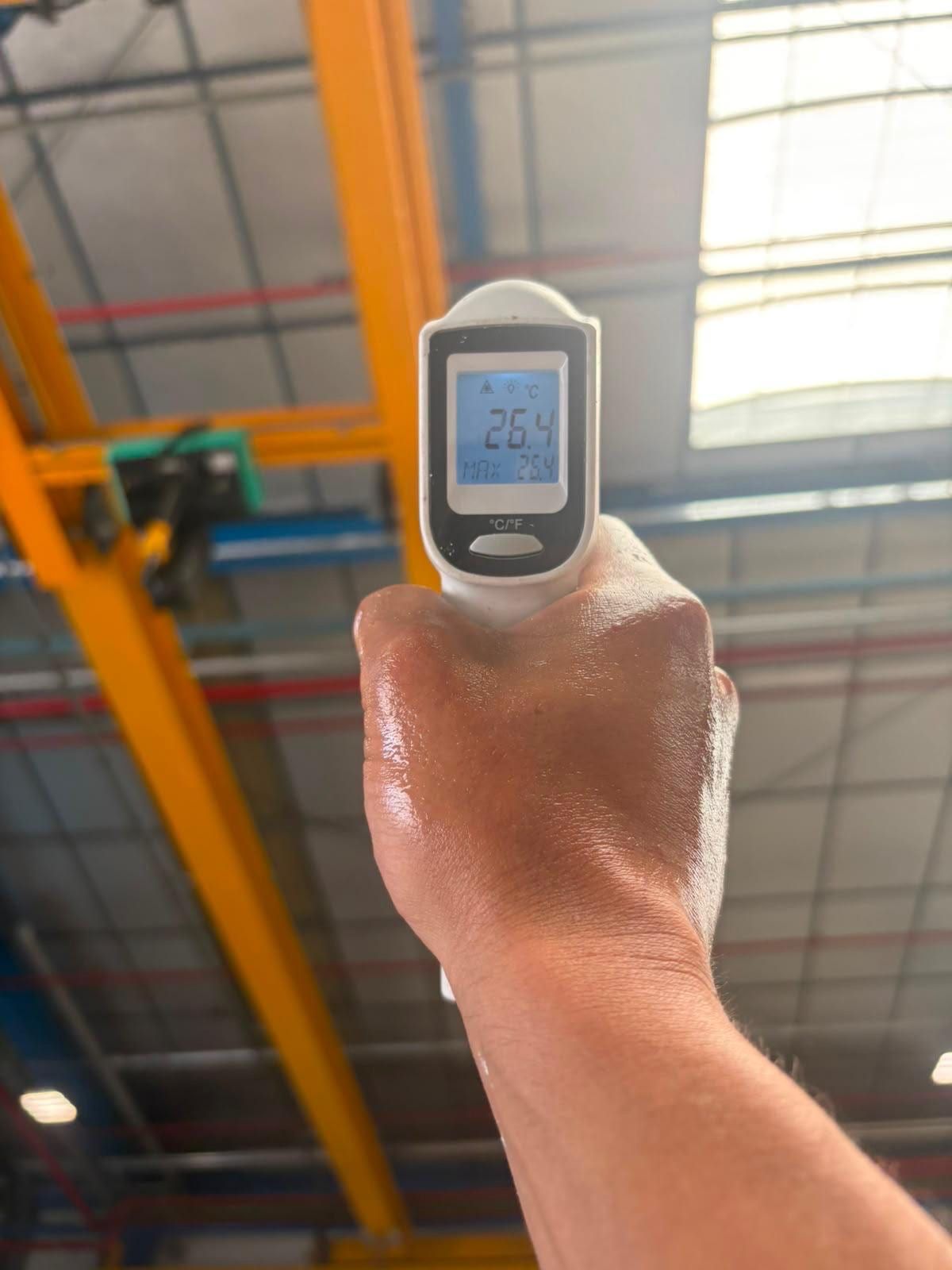
- a reduced envelope load on the halls and technical rooms under the roof, up to −6 °C felt in non-air-conditioned rooms depending on insulation;
- up to −40 % air-conditioning consumption on the envelope volumes concerned, depending on the climate zone;
- waterproofing that ages more slowly, a point that matters on a building where any leak is a major incident.
We do not promise a catalogue PUE gain. The payback study starts from your readings (air inlet temperatures, chiller consumption, free-cooling hours) and proposes a before/after measurement protocol.
No operational downtime: the method on a critical site
No suspended load above the equipment
On a data centre, the real risk of roof work is not the product: it is the crane. A load flying over a chiller, a transformer or an IT hall is unacceptable. Our no-lift method removes this risk: the 150 to 200 L drums and the airless pumps stay on the ground, in a cordoned-off area defined with site security; only the hoses, up to 80 m long, go up to the roof. No crane, no heavy aerial platform, no internal road closed, no impact on the access to the generator sets or the fuel deliveries.
Phasing by zone, no outage
The roof is divided into zones defined with operations: each zone is prepared, coated, checked and handed over before the next, outside peak loads and maintenance windows. No equipment is shut down or moved. A 3,100 m² industrial building was treated in one week, site in operation; a data centre of comparable size is planned the same way.
Security, authorisations, cleanliness
- Prevention plan, authorisations, badges, escort, respect for restricted-access zones and confidentiality rules.
- Protection of the heat exchangers and air intakes of dry coolers, condensers, AHUs and generator sets during cleaning at under 130 bar and during application; wash water contained, no run-off towards the equipment.
- Water-based product, solvent-free, odourless, low in VOCs: no risk to the air quality of the halls.
- Broof(t3) external fire classification documented (CSTB report RA23-0010).
- Roof mapping: cable trays, antennas, lightning rods, lifelines, rooflights (PrimaTherm® LT lacquer possible: one coat around −25 % heat gain and light, two coats around −50 %).
Substrates found
Steel deck on recent buildings (cool roof on steel deck roofs guide), bitumen or EPDM membranes on refurbished buildings (cool roof on waterproofing membranes). PVC membranes only if laid more than 10 years ago, with the PH107PVC adhesion base; fibre cement only when asbestos-free (buildings from after 1997).
CEE, tertiary-sector decree, ISO 50001: what applies to a data centre
- French energy-savings certificates (CEE), sheet BAT-EN-112: no. The sheet targets commercial-use tertiary buildings whose volume is heated and cooled by heat pump; a data centre does not qualify. MaPrimeRénov’ does not cover cool roofs.
- French tertiary-sector decree: sites over 1,000 m² come under the Éco Énergie Tertiaire scheme, with arrangements adapted to their energy intensity; the cool roof is an action that can be declared on OPERAT. See the French tertiary-sector decree and cool roofs.
- ISO 50001 and the EU Code of Conduct for data centre energy efficiency: any measurable action on cooling fits in, with the before/after measurement protocol we supply.
- Reporting: the reduction in cooling consumption feeds the environmental indicators requested by colocation customers and by the regulations on the digital footprint.
- Planning: prior declaration to the town hall for a change of colour (article R. 421-17 of the French planning code) depending on the local planning rules (PLU); we check for each site.
The cool roof incentives in France 2026 page details the schemes. The cost depends on the surface, the substrate, the preparation, the access and the security constraints: it only exists in the proposal handed over after the free study.
References on controlled-access sites
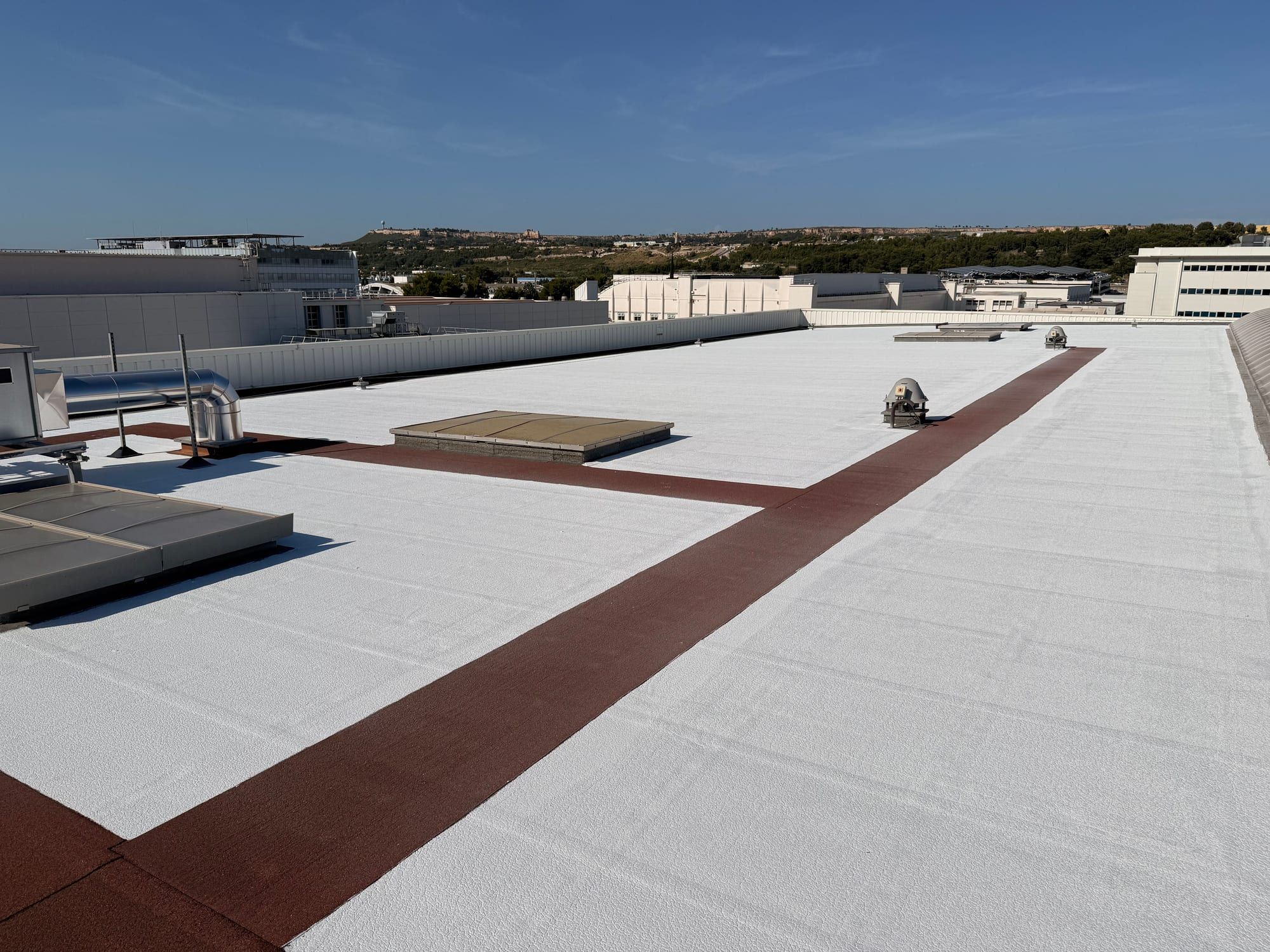
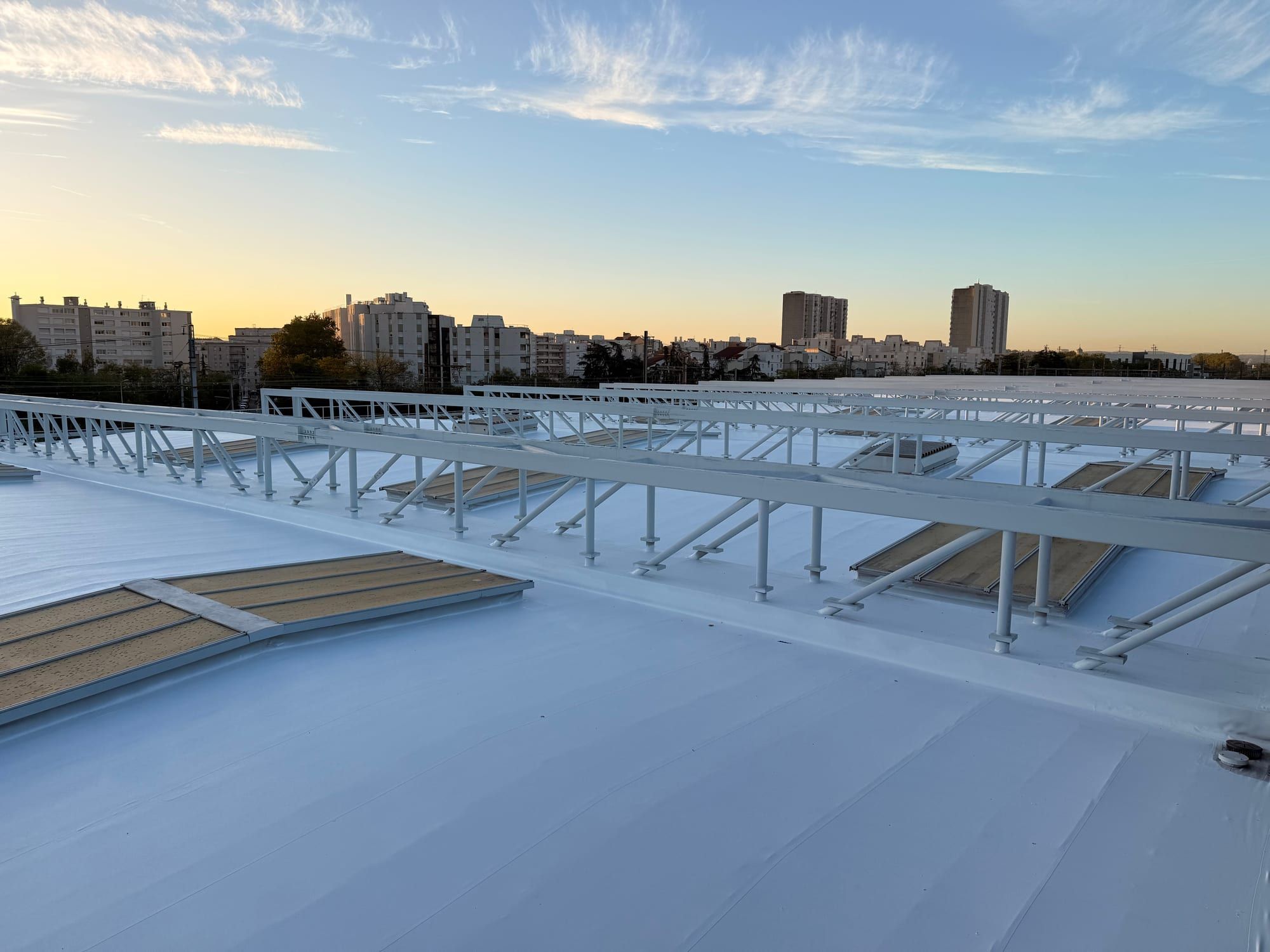
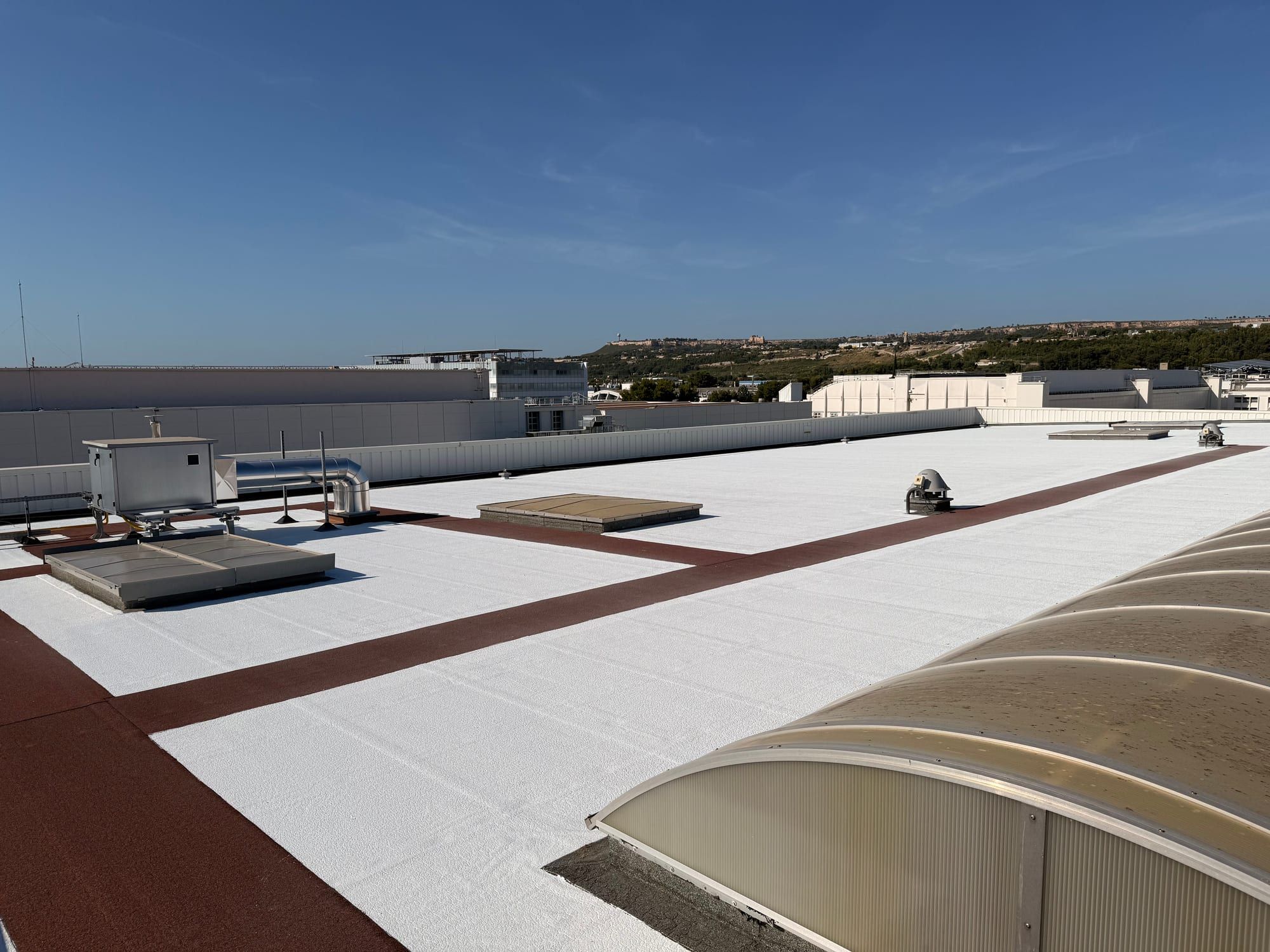
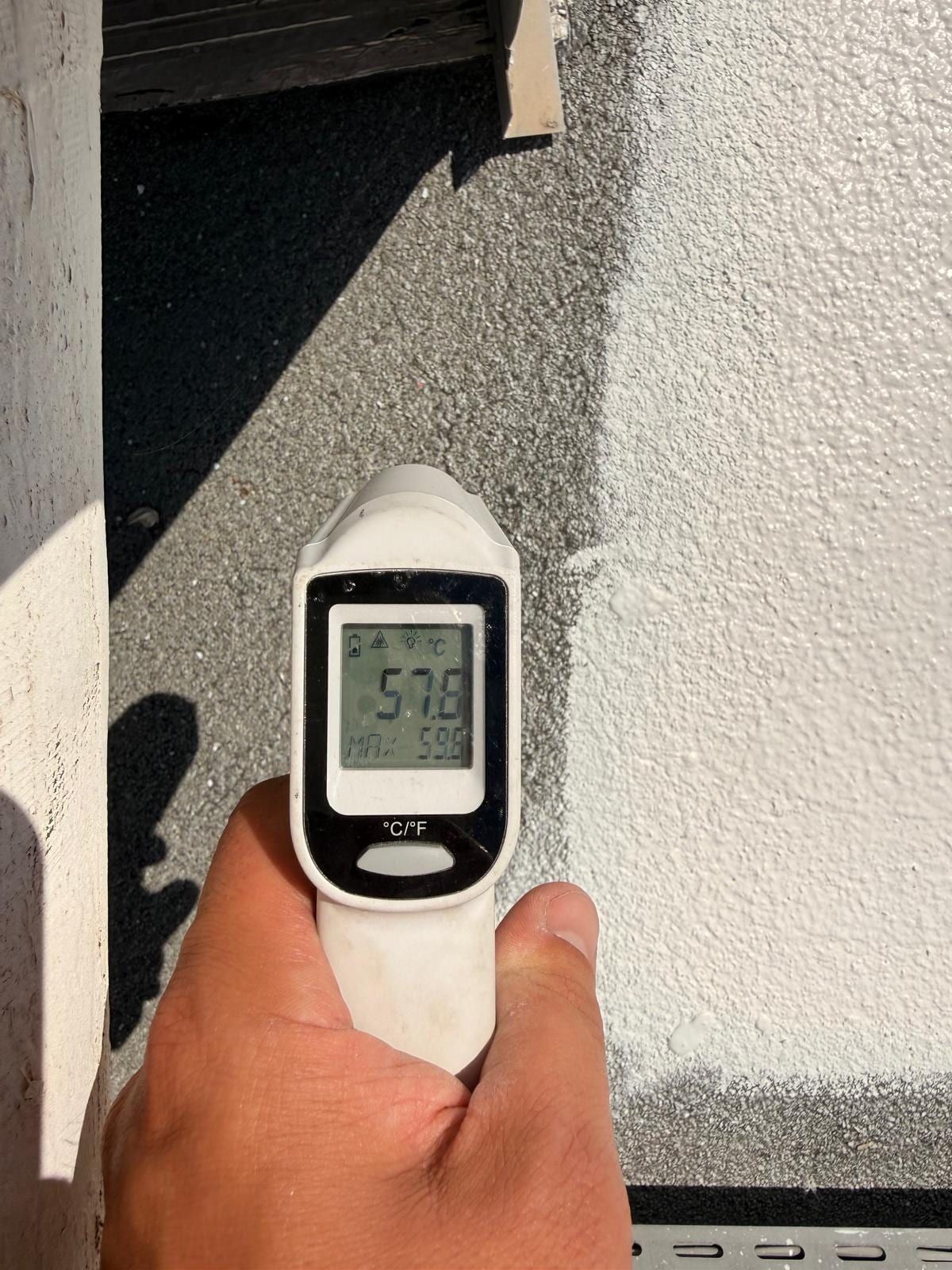
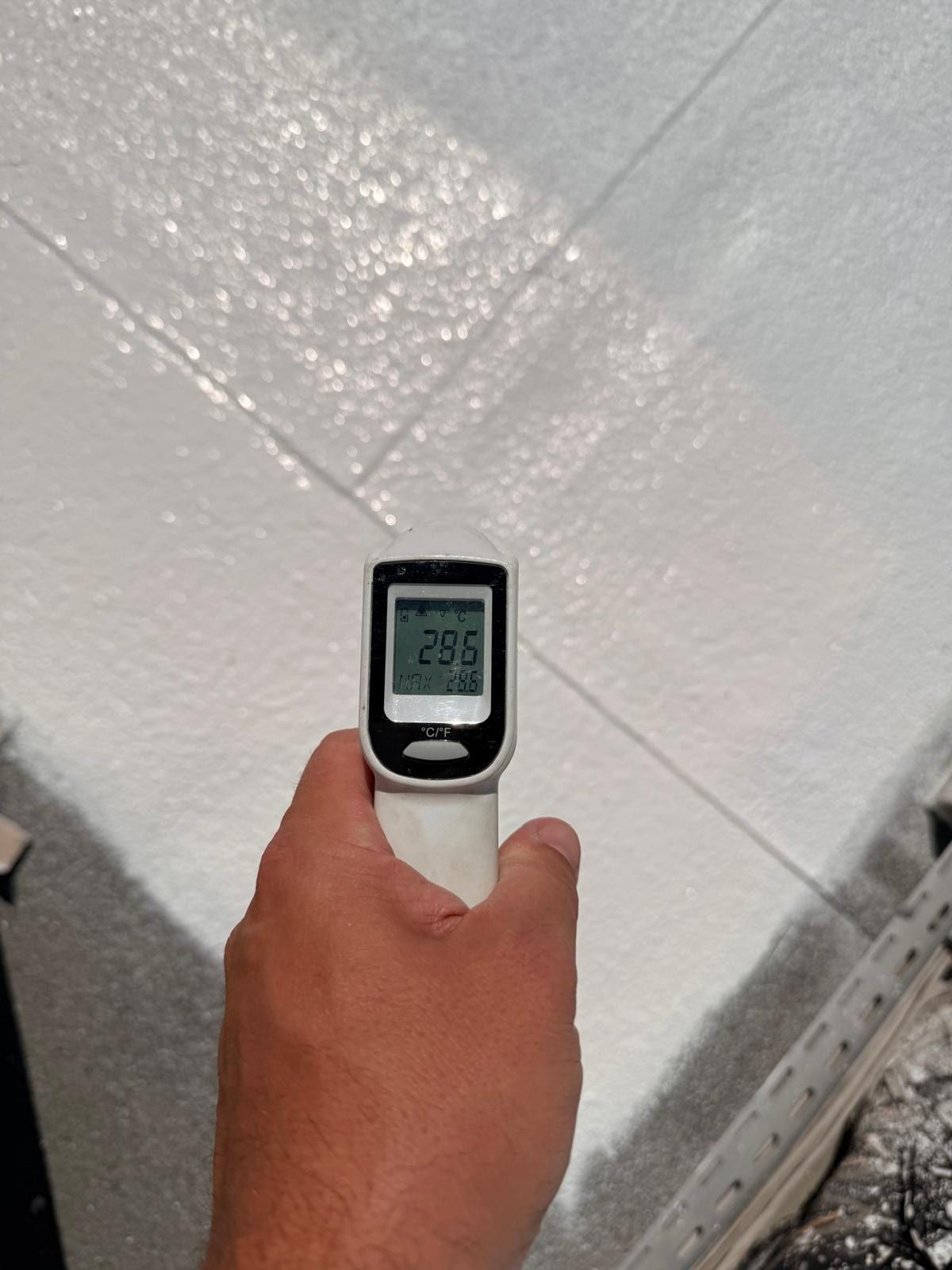
Our largest project: 5,900 m² of bitumen membrane on three buildings, treated from April to June 2026 on an aerospace site in operation, −29 °C measured at handover (57.8 °C on the untreated area versus 28.6 °C on the treated area). Our aerospace and rail references are secure industrial sites in continuous operation, with strict prevention plans and roofs crowded with equipment: the same constraints as a data centre. See the Airbus Marignane project and our rail project in Lyon.
How a data centre cool roof project unfolds
- Free study within 48 h: satellite measurement, substrate, map of the visible roof equipment, first orders of magnitude.
- On-site technical audit with operations and security: survey of the equipment, air intakes, access, condition of the waterproofing, adhesion tests, definition of the zones and of the measurement protocol (air inlet temperatures, chiller consumption).
- Prevention plan and schedule outside peak loads, within the weather window (12 to 35 °C, humidity below 80 %, no rain in the 4 h following each coat).
- Preparation: cleaning at under 130 bar with protection of the heat exchangers, anti-moss treatment, local repairs, 24 to 72 h drying.
- No-lift application: primer, base coat in two cross passes, anti-soiling topcoat, zone by zone.
- Checks and handover: thickness checks, infrared measurements before/after, check of the equipment, as-built file, ten-year liability cover (French décennale), maintenance plan.
The installation process is detailed step by step.
The objections we hear from operators
- “The IT load dwarfs everything, the roof does not matter.” On a hyperscale facility with free cooling, the envelope gain is marginal, and we say so. On the chillers on the roof, on the technical rooms and on any corporate server room or edge site, the roof matters, and the before/after measurement shows it.
- “Our equipment covers the whole roof.” That is the case of most of the sites we treat; the mapping and the phasing by zone are designed for that.
- “The slightest risk is unacceptable.” Hence the total absence of lifting, the protection of the heat exchangers, the absence of solvent and work under a prevention plan.
- “What about free cooling in winter?” A white roof does not warm anything in winter: the low sun hits the façades, and winter free cooling remains intact. See cool roofs in winter.
- “A coating is a gimmick.” An off-the-shelf white paint reflects 70 to 80 % of the radiation and loses its whiteness within two seasons. PrimaTherm® reflects 95 %, keeps its SRI after 4,000 h of accelerated ageing and is applied under a controlled protocol.
Sites concerned
- Previous-generation colocation data centres, under steel deck or membrane, with heat rejection on the roof.
- Corporate server rooms and computing centres at universities or industrial sites, where the envelope weighs more.
- Edge sites, telecom rooms, points of presence: small surfaces, immediate gain on the technical rooms.
- Computer rooms of hospitals and industrial sites: see cool roof for hospitals and cool roof for industrial buildings.
From Saint-Laurent-d’Agny, near Lyon, we work on sites across the region on day trips (Lyon, Saint-Quentin-Fallavier, Grenoble) and anywhere in France with a team accommodated on site (Paris, Marseille, Lille, Strasbourg). The cool roof simulator (in French) gives a first order of magnitude; the free study follows within 48 h.
Frequently asked questions
Does a cool roof really improve a data centre’s PUE?
It acts on two measurable levers: the heat transmitted through the envelope, significant on a corporate server room, an edge site or a previous-generation building, and the temperature of the air drawn in by the heat-rejection equipment on the roof, which determines its efficiency and its free-cooling hours. We do not promise a catalogue PUE figure: the gain depends on the cooling architecture, and the free study qualifies it from your readings.
Does the application require a shutdown or a maintenance window?
No. The work takes place exclusively on the roof, zone by zone, without ever touching the equipment in service. Our no-lift method keeps the drums and the pumps on the ground in a cordoned-off area; only the hoses go up. No crane flies over the chillers or the transformers, no suspended load above the building, no outage. The schedule is approved with operations and site security.
How do you protect the air intakes and equipment during cleaning?
Every piece of equipment is mapped during the preliminary audit: dry coolers, condensers, AHUs, generator sets, antennas, cable trays. The heat exchangers and air intakes are protected during cleaning at under 130 bar and during application; the wash water is contained, the dusty phases are scheduled outside peak loads. The product is water-based, solvent-free and odourless.
Is the work compatible with the security requirements of a critical site?
Yes. We work under a prevention plan, with authorisations, badges, escort if necessary and respect for restricted-access zones. Our projects on secure aerospace and rail sites, with controlled access and continuous activity, were carried out under these conditions. The Broof(t3) external fire classification of the system (CSTB report RA23-0010) is documented.
Is a data centre eligible for the French CEE incentive, sheet BAT-EN-112?
No. This sheet targets commercial-use tertiary buildings whose volume is heated and cooled by heat pump; a data centre does not qualify. MaPrimeRénov’ does not cover cool roofs. The action can however be recognised in an ISO 50001 approach, in the EU Code of Conduct for data centre energy efficiency and in the trajectory of the French tertiary-sector decree for sites over 1,000 m².
What service life and what maintenance for the coating?
The SRI of PrimaTherm® is maintained after 4,000 h of accelerated QUV ageing; the conventional service life used by the French CEE sheet is 20 years. Maintenance is limited to low-pressure water cleaning every 12 to 15 months, which can be scheduled with the maintenance of the roof equipment. A maintenance plan is handed over with the as-built file.