Technical questions
What is a cool roof, in practical terms?
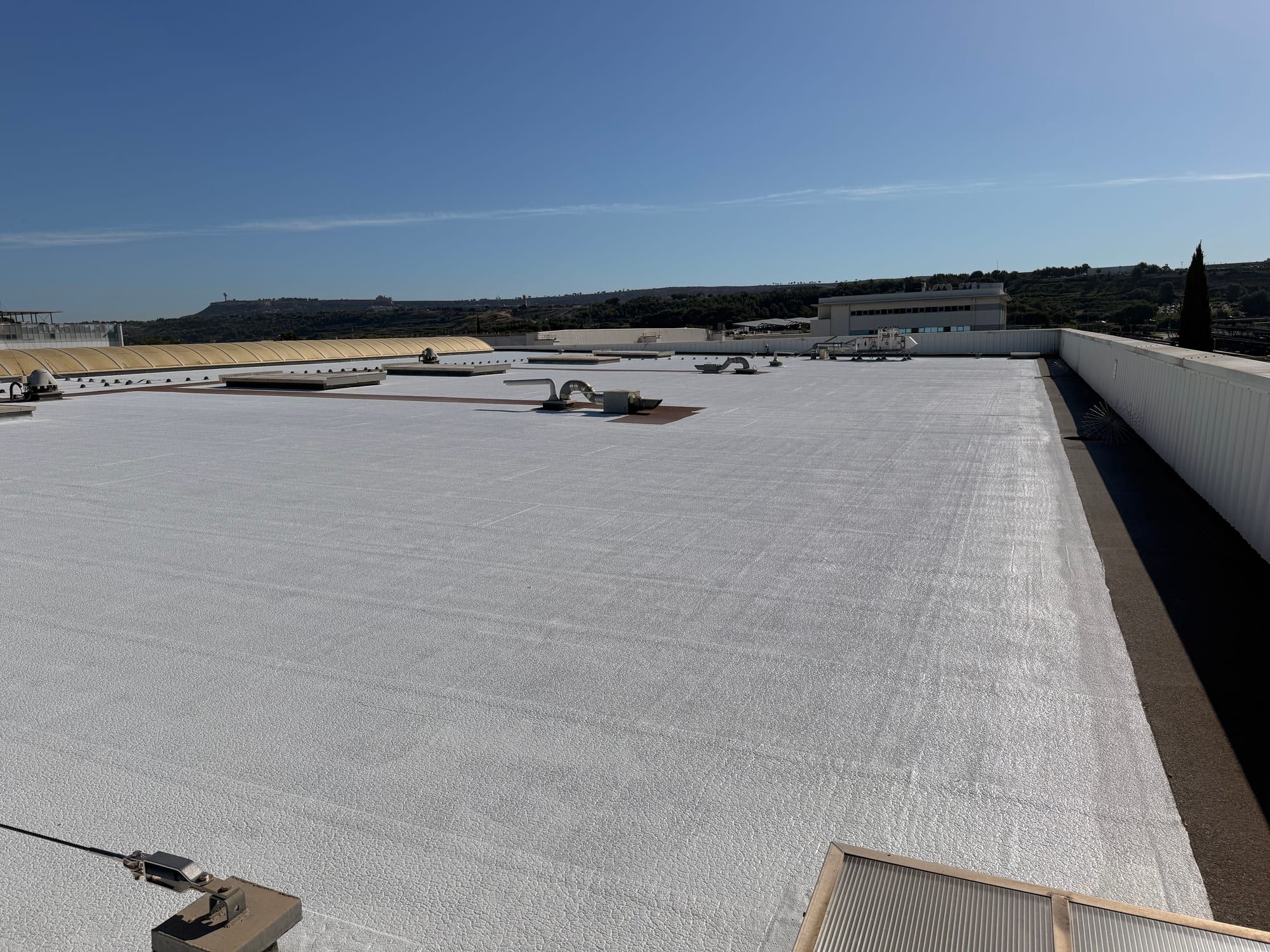
A cool roof is a roof made reflective so that it sends solar radiation back instead of absorbing it. A dark bitumen or steel-deck roof absorbs most of the energy it receives and climbs to 50–70 °C in summer; this heat moves down into the building and loads the air conditioning. The PrimaTherm® system applied by Hélios sends back 95 % of solar radiation (ASTM E903-12), re-emits the residual heat with an emissivity of 0.89 (ASTM C1371-15) and shows an SRI of 120 (ASTM E1980). The roof stays at 25–35 °C. The cool roofing guide develops the principle.
What is the difference between a cool roof coating and white paint?
An ordinary white paint generally reflects 70 to 80 % of the radiation, absorbs part of the infrared and loses its whiteness within a few seasons. A certified cool roof system reflects across the whole solar spectrum, re-emits heat well and keeps its properties: the SRI of PrimaTherm® is maintained after 4,000 h of accelerated QUV ageing, thanks to its PH107TCL anti-soiling topcoat. The difference shows in the second summer, not the first. The cool roof coating page details the system.
What does SRI 120 mean?
The SRI (Solar Reflectance Index, ASTM E1980) combines reflectance and emissivity on a scale where the reference black is 0 and the reference white is 100. A surface cooler than that white exceeds 100: PrimaTherm® obtains 120.1 ± 2.8 when new (Tipee report ES-PJ000106-015) and 119 after ageing. Our roof SRI index guide explains the calculation and gives benchmark values for common roofs.
By how much does the temperature drop?
On the surface, up to −30 °C: a roof that goes from 50–70 °C to 25–35 °C. At the handover of the largest building at Airbus Marignane, on 19 June 2026, the infrared measurement gave 57.8 °C on the control zone against 28.6 °C on the treated zone, i.e. −29 °C. Inside, up to −6 °C felt depending on insulation: 4 to 6 °C under a single-skin steel deck or a poorly insulated roof, 1 to 3 °C under a well-insulated roof. In every case, it is the radiation from the ceiling that disappears.
On which roof types can a cool roof be applied?
Pre-coated or galvanised steel deck, bitumen membrane (SBS, APP, slate-finished, aluminium-faced), EPDM after an adhesion test, fibre cement only if asbestos-free (buildings built after 1997), and PVC membrane only if it was laid more than 10 years ago, with the PH107PVC adhesion base coat. TPO membrane: contact us. Each roof type has its guide: steel deck, bitumen roofs, waterproofing membranes, flat roofs, solar panels.
Does a cool roof replace insulation or waterproofing?
No. It reduces summer solar gains; it is neither an insulant in the regulatory sense nor a waterproofing layer in the sense of the French technical standards (DTU). It protects sound waterproofing by keeping it below 35 °C and blocking UV, which slows its ageing, but a leaking membrane must be repaired or replaced first. It combines well with insulation: see our article on external roof insulation (in French).
Does a white roof cause glare?
No. The PH107TCL topcoat is matt: it scatters light in all directions, with no mirror-like specular reflection. It is precisely this diffuse reflection that benefits the rear face of bifacial photovoltaic panels.
Is a cool roof compatible with photovoltaic panels?
Yes, and preferably applied before they are installed. A cooler roof lowers the temperature of the modules, which lose power when they heat up: a gain of a few percent, variable depending on the installation and the climate. The reflective surface feeds bifacial panels, and the waterproofing under the modules is protected. See cool roof and solar panels.
Price, profitability and incentives
How much does a cool roof cost?
We do not publish a price per m² for professional buildings on this page, because a price list would be wrong half the time. The cost depends on the area and its geometry, the roof type and its condition, the preparation required, the access and the constraints of the site, the additional items (rooflights, photovoltaic areas) and the incentives that can be mobilised. It only exists in the proposal sent after the free roof study, within 48 h, line by line. For a house or a small area, the online shop (in French) displays its prices and calculates the quantity of product.
How much is saved on air conditioning?
Up to −40 % of air-conditioning consumption: 15 to 25 % in French climate zone H1, 20 to 30 % in H2, 25 to 40 % in H3, depending on the insulation, the use of the building and the share of the roof in solar gains. In relation to the total electricity bill, the saving depends on the share of cooling in your consumption. We never put a euro figure on this saving in a catalogue: the study starts from your bills.
What is the return on investment?
Generally 3 to 5 years for an air-conditioned building: shorter in zone H3 and on a heavily air-conditioned site, longer in the north. On a non-air-conditioned building, the value comes from the comfort of the teams, the lost hours avoided during heatwaves, the protection of goods and of the waterproofing. The cool roof profitability page details the levers, the method and the variables; the simulator (in French) gives a first order of magnitude.
Which incentives can I obtain?
The CEE premium under sheet BAT-EN-112 of the French energy-savings certificates, under strict conditions: commercial tertiary building, volume heated and cooled by a heat pump, for a flat rate of 160, 170 or 270 kWh cumac per m² depending on French climate zone H1, H2 or H3 — we never announce a premium in euros. The French Green Fund (Fonds Vert) for local authorities, according to the year’s prefectural priorities. Variable regional incentives, to be checked. The reduced 10 % VAT on supply and application on a French home over two years old. Everything is detailed on the cool roof incentives in France 2026 page.
Can I count on MaPrimeRénov’ for a cool roof?
No. MaPrimeRénov’ does not cover cool roofs, neither for a house nor through MaPrimeRénov’ Copropriété: reflective coating is not among the eligible works. We say so from the first exchange to avoid applications filed in vain.
Is a logistics warehouse or a factory eligible for the CEE?
Not with sheet BAT-EN-112 as it is written: a non-air-conditioned warehouse, an industrial workshop or an agricultural building do not fall within the scope of “commercial tertiary building air-conditioned by heat pump”. The other levers remain: depreciation, the French tertiary-sector decree, regional incentives, and above all the savings and the productivity.
Application and works
How do the works proceed?
In four steps: free study within 48 h (satellite measurement, roof type, incentives); technical visit and proposal (adhesion tests if necessary); preparation and application of the 4 layers without lifting equipment; thickness checks, infrared measurements before/after and as-built file. How we work describes the process step by step.
Why 4 layers?
Because the system is certified on a film of a given thickness, applied in a given order: PH169 primer (10 m²/L on steel deck, 6 m²/L on bitumen, where it blocks bitumen bleeding), PH107 reflective base coat in two cross passes (2 m²/L in total), PH107TCL anti-soiling topcoat (10 m²/L). Three products, four layers. Skip the primer or apply the base coat in a single thick pass, and the performance measured in the laboratory will not be found on the roof.
Does the activity have to stop during the works?
No. The Hélios method uses no lifting equipment: 150 to 200 L drums and airless pumps stay on the ground, only the hoses (up to 80 m) go up to the roof. No crane, no road closure, no nuisance in the workshops or the sales areas. On our Marignane site, a 3,100 m² building was treated in one week, with the site in operation.
How long does the application take?
About a week for 3,000 m² in good weather conditions, preparation and drying included; 1 to 2 days for a house roof; 3 to 5 weeks in zones beyond 10,000 m². The application window runs from April to October depending on the region: 12 to 35 °C, humidity below 80 %, no rain within 4 h of each layer.
How do you prepare the roof?
Anti-moss treatment if necessary (chlorine-free), medium-pressure cleaning with cold water below 130 bar, localised waterproofing repairs, treatment of fixings on steel deck, protection of outlets and equipment, drying for 24 to 72 h with a surface moisture content below 5 %, checked with a moisture meter. Nothing holds on a dirty or damp surface.
What do you check at handover?
The film thickness, the reconciliation of the quantities consumed with the coverage rates of the protocol (recorded in the site monitoring sheet), the infrared surface temperature of the treated zone against the control zone, water run-off, uniformity. The as-built file contains photos, test reports, technical data sheets, the ten-year (décennale) insurance certificate and maintenance recommendations.
Durability and maintenance
What is the service life of a cool roof?
The SRI of PrimaTherm® is maintained after 4,000 h of accelerated QUV ageing (119 against 120 when new, Tipee report ES-PJ000911-003) — conventional service life of 20 years (French CEE sheet). We do not write “20-year guarantee”: what is certified is the retention of the SRI. The PrimaTherm® certifications page lists the reports.
What maintenance should be planned?
A visual inspection once a year and cleaning with clean water or at low pressure (100 bar maximum) every 12 to 15 months. No chemicals, no moving parts. In the event of technical work on the roof, load-spreading plates protect the film. See cool roof maintenance and durability.
Does a cool roof get dirty?
Every surface gets dirty; the question is how fast and whether it is reversible. The PH107TCL topcoat, with PVDF resins, limits the adhesion of dirt and resists UV; the annual cleaning restores the reflectance. That is the difference between a certified system with its fourth layer and a white paint left bare.
Can you walk on the treated roof?
Yes, after complete drying (48 to 72 h), for maintenance and interventions. For frequent traffic, plan walkways or load-spreading plates. The film is elastic (elongation above 300 %) but is not designed for daily foot traffic.
What guarantees?
Ten-year (décennale) guarantee and professional liability insurance certificate attached to every proposal, covering the work carried out; the existing waterproofing remains covered by its own guarantee. Our article on cool roof guarantees (in French) gives the details, and the Broof(t3) external fire rating (CSTB report RA23-0010) meets insurers’ requirements. Our article on insurance and building-damage cover (in French) completes the picture.
And in winter?
The winter sun is low on the horizon; it strikes the façades and very little the roofs; the days are short and often overcast. The loss of winter solar gain is marginal compared with the summer savings, and cold nights radiate as much from a dark roof as from a light one. The annual balance is positive everywhere in France; see cool roof in winter.
Regulation
Does a cool roof count for the French tertiary-sector decree?
Yes. For a tertiary building of 1,000 m² or more, the trajectory of −40 % final energy consumption in 2030 (−50 % in 2040, −60 % in 2050) is declared every year on OPERAT. The reduction in air-conditioning consumption obtained with a cool roof shows up there directly; we provide measurements and reports. See French tertiary decree and cool roofs.
Is planning authorisation needed?
Changing the colour of a roof alters its external appearance and generally requires a prior declaration to the town hall (article R. 421-17 of the French planning code), with a one-month review period. Some local planning rules (PLU), the surroundings of historic monuments and protected areas regulate colours. For a residential building under co-ownership, the vote at the owners’ general meeting is added. We check the PLU for every project.
Does PrimaTherm® comply with fire regulations?
The system is rated Broof(t3) for external fire exposure under EN 13501-5 and the French order of 14 February 2003, CSTB classification report RA23-0010. This is the rating expected for industry, buildings open to the public and sites subject to the opinion of an inspection body.
Is a cool roof compulsory anywhere?
There is no national obligation for an existing building. Some local authorities include light-coloured roofs in their PLU or their climate plan for new buildings or major renovations, and RE2020 rewards roof reflectance in the summer-comfort calculation. The regulatory context covers the texts, and our article on compulsory cool roofs in French cities (in French) lists the known local provisions.
Homeowners and residential buildings
Can a homeowner apply a cool roof themselves?
Yes, for a house, an extension or a flat-roofed garage under 500 m²: the PrimaTherm® online shop sells the three products of the system with the quantity calculator per m² and the application guide. The conditions are those of the protocol: sound and dry surface, temperature between 12 and 35 °C, four layers in the right order, no rain within 4 h. We warn you of these conditions before purchase.
Which VAT rate for a home?
For a French home completed more than two years ago, supply and application by a professional are subject to the reduced 10 % VAT. The reduced rate does not apply to the purchase of coating alone from the shop.
How do you get a cool roof voted through at an owners’ meeting?
With a case that rests on what is true: comfort on the top floors, protection of the waterproofing, 10 % VAT, prior declaration to be planned — and not on a MaPrimeRénov’ subsidy that does not exist for this work. Our cool roof for residential buildings page and our guide to convincing an owners’ general meeting (in French) provide the outline.
Is a cool roof suitable for a tiled house?
The system is designed for flat and low-slope roofs: steel deck, membranes. On a pitched tile or slate roof, the issues (ventilation under the covering, appearance, PLU) are different and we do not recommend it without a study. A flat roof, an extension or a flat-roofed garage are the right candidates; see cool roof on flat roofs.
Sectors and buildings
For which buildings is a cool roof most effective?
Single-storey buildings with a large roof, where the roof is the first source of solar gains: logistics platforms, industrial sites, stores and shopping centres, agricultural buildings, sports halls and schools. The cool roof applications hub guides you by building and roof type.
Can a hospital or a care home stay open during the works?
Yes. The application takes place on the roof, without lifting equipment, without noticeable odour (water-based, low-VOC products), under a prevention plan drawn up with the facility. See cool roof for hospitals.
And for a data centre?
Every degree gained on the roof relieves the cooling; the cool roof is applied without interrupting operations, in coordination with the technical teams. We do not promise a PUE gain from a catalogue: it is measured on site. See cool roof for data centres.
Can’t find your answer?
Ask us through the contact page, or describe your roof in a free roof study request: area, building type, postcode. Answer within 48 h, with a satellite measurement and a first qualification of the potential.
Frequently asked questions
What exactly is a cool roof?
A cool roof is a roof made reflective so that it sends solar radiation back instead of absorbing it. The PrimaTherm® system applied by Hélios reflects 95 % of the radiation (ASTM E903-12), with an emissivity of 0.89 (ASTM C1371-15) and an SRI of 120 (ASTM E1980): the roof goes from 50–70 °C to 25–35 °C at the height of summer.
How much does a cool roof cost?
We do not publish a price per m² for professional buildings on this page: the cost depends on the area, the roof type, the condition of the roof, the preparation, the access and the incentives. It only exists in the proposal sent after the free study, within 48 h. Homeowners will find displayed prices in the PrimaTherm® online shop (in French).
What return on investment can be expected?
Generally 3 to 5 years for an air-conditioned building, with a reduction in air-conditioning consumption of between 15 and 40 % depending on the climate zone. On a non-air-conditioned building, the value comes from comfort, productivity and the protection of the waterproofing. The calculation is made on your actual consumption.
What incentives exist for a cool roof?
The premium under sheet BAT-EN-112 of the French energy-savings certificates (CEE), under strict conditions: commercial tertiary building, volume heated and cooled by a heat pump, for 160, 170 or 270 kWh cumac per m² depending on French climate zone H1, H2 or H3. The French Green Fund (Fonds Vert) for local authorities, variable regional incentives, the reduced 10 % VAT on French homes over two years old. MaPrimeRénov’ does not cover cool roofs.
On which roof types can a cool roof be applied?
Pre-coated or galvanised steel deck, bitumen membrane, EPDM, asbestos-free fibre cement (buildings built after 1997) and PVC membrane laid more than 10 years ago, with a specific adhesion base coat. The diagnosis checks adhesion before any commitment.
How long do cool roof works take?
About a week for 3,000 m² in good weather conditions, preparation included; large areas are phased zone by zone. The building stays in operation: the method without lifting equipment leaves drums and machines on the ground, only the hoses go up to the roof.
What is the service life of a cool roof?
The SRI of PrimaTherm® is maintained after 4,000 h of accelerated QUV ageing (119 against 120 when new); the conventional service life adopted by the French CEE sheet is 20 years. Cleaning with clean water or at low pressure every 12 to 15 months maintains the reflectance.
Does a cool roof work in winter?
It loses very little heat: the winter sun is low and strikes the façades, very little the roofs. The loss of winter solar gain is marginal compared with the summer savings, and the annual balance is positive everywhere in France.
Is authorisation needed to turn a roof white?
Changing the colour of a roof generally requires a prior declaration to the town hall (article R. 421-17 of the French planning code), with a one-month review period. Some local planning rules (PLU) and protected areas regulate colours. We check this point for every project.
Can a homeowner apply the cool roof themselves?
Yes, for a house or a small area under 500 m²: the PrimaTherm® online shop (in French) sells the three products of the system with the quantity calculator and the application guide. The conditions are those of the protocol: sound and dry surface, 12 to 35 °C, four layers in the right order, no rain within 4 h.